Bitcoin could go ‘sub-$50K if quantum isn’t solved by 2028: Capriole

cointelegraphPublished on 2025-12-17Last updated on 2025-12-17

Abstract

Charles Edwards, founder of Capriole Investments, warns that Bitcoin could fall below $50,000 by 2028 if it is not made quantum-resistant. He argues that quantum computing poses a serious threat to Bitcoin's security by potentially exposing private keys and enabling theft of funds. While some critics believe the risk is overhyped and distant, Edwards insists the threat is imminent and that Bitcoin must upgrade to post-quantum encryption by 2026 to avoid a severe bear market. He emphasizes that, unlike traditional finance, Bitcoin transactions are irreversible, making it a more urgent target. Others, like Michael Saylor, have downplayed these concerns as exaggerated.

Charles Edwards, the founder of quantitative Bitcoin and digital asset fund Capriole, warns that Bitcoin could head well under $50,000 if it isn’t quantum-resistant by 2028.

Quantum computing’s potential threat to the crypto industry has long been debated and is considered an upcoming inflection point. More advanced computers that could break encryption have been theorized as having the capability to reveal user keys, expose sensitive data and user funds to bad actors.

The deadline is generally considered to be years away; however, in an X post on Wednesday, Edwards predicts it could be as soon as 2028, and if the industry doesn’t move fast enough, the price of Bitcoin (BTC) could plummet.

Source: Charles Edwards

“Starting to think we will just need a huge bear market to wash out the idiots who think the Quantum threat to Bitcoin is a joke, and to incentivize the maxis into taking action to upgrade the network,” he said.

“If we haven’t deployed a fix by 2028, I expect Bitcoin will be sub $50K and continue to fall until it’s fixed.”

Quantum patch rollout needs to be in 2026

Critics argue the threat posed by quantum computers is overblown because the technology is still decades away from being viable, and banking giants and other traditional targets will be cracked long before Bitcoin.

However, Edwards has long argued the threat is more imminent, that Bitcoin will be “first on the Quantum,” chopping block because most banks and institutions are already migrating to post-quantum encryption and fraudulent transactions can be wound back or blocked.

Source: Charles Edwards

“We have to fix this next year, or bon voyage enjoy the biggest Bitcoin bear market in history. FTX will look like a cakewalk,” Edwards added.

Bitcoin OG Willy Woo suggested last month that a way to keep your Bitcoin safe until there’s a solution to the quantum Bitcoin threat is to hold Bitcoin in a SegWit wallet for around seven years.

Meanwhile, in July, Bitcoin bull Michael Saylor downplayed concerns over quantum computing’s impact on Bitcoin, calling it a marketing ploy to pump quantum-branded tokens.

Magazine: Big questions: Would Bitcoin survive a 10-year power outage?
Related Reads

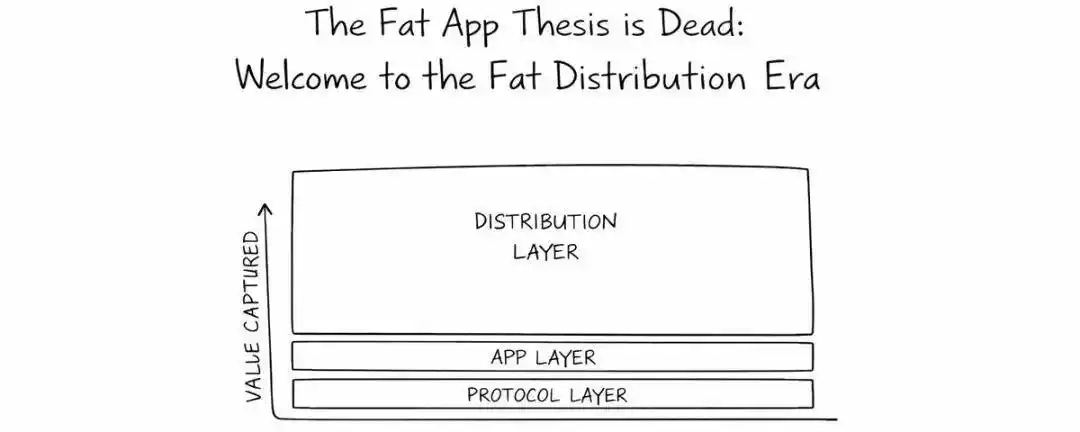
"Fat Apps" Are Dead, Welcome to the Era of "Fat Distribution"

The article "Fat Apps Are Dead, Welcome to the Era of Fat Distribution" argues that crypto applications are becoming commoditized infrastructure, shifting value from the applications themselves to the distribution channels and front-end interfaces that control user access. The author traces the evolution of value accumulation theories in crypto, from the 2016 "Fat Protocol" thesis (value accrues to base layers like Ethereum) to the 2022 "Fat App" thesis (value accrues to applications like Uniswap that built liquidity and user experience). By 2025, the thesis has shifted again. Excessive investment in infrastructure has led to diminishing returns; technical improvements (e.g., minor reductions in oracle costs or interest rate optimizations) are now imperceptible to end-users. Users prioritize familiar interfaces over marginally better backend performance. Consequently, applications like Aave and Morpho are increasingly focusing on B2B partnerships, embedding their services as backends within other platforms (e.g., traditional fintech apps like Robinhood). The author posits that convincing an existing platform to integrate a feature is far easier than onboarding millions of new users to complex, native crypto workflows. A case study illustrates this: Coinbase directs its users' borrowing activity to Morpho on Base, even though competitors offer better rates, because the seamless, integrated user experience within the Coinbase app is more valuable to customers than optimizing for cost. The article concludes that while some apps will remain B2C, the new competitive moat is no longer liquidity or crypto-native UX, but rather control over distribution. The platforms that own the front-end and user relationships will capture the majority of the value.

marsbitHace 4 min(s)

"Fat Apps" Are Dead, Welcome to the Era of "Fat Distribution"

marsbitHace 4 min(s)

The Catfish Effect? Stablecoins Are Truly the Enemy of Bank Deposits

The article challenges the prevailing narrative that stablecoins pose an existential threat to the traditional banking system by causing massive deposit outflows. Instead, it argues that stablecoins act as a competitive catalyst, forcing banks to improve efficiency and offer higher deposit rates, rather than replacing them. Key points include: - Research indicates no significant correlation between stablecoin growth and bank deposit outflows, highlighting the "sticky" nature of deposits due to the convenience of bundled banking services (e.g., mortgages, payroll). - Stablecoins introduce competition, compelling banks to enhance operational efficiency and customer benefits, ultimately expanding financial intermediation and consumer welfare. - Regulatory frameworks like the GENIUS法案 (likely referring to U.S. stablecoin legislation) mitigate risks by mandating full reserves (cash, short-term Treasuries) and enforceable redemption rights, addressing concerns about run and liquidity risks. - Stablecoins offer efficiency gains through atomic settlements, enabling instant, cross-border transactions without intermediary delays, which could modernize outdated financial infrastructure. - The U.S. is urged to lead in stablecoin innovation to preserve the dollar’s global dominance, transforming stablecoins from offshore novelties into transparent, regulated components of domestic financial systems. The conclusion emphasizes that banks should view stablecoins as an opportunity to evolve, similar to other industries disrupted by technology, rather than as a threat.

marsbitHace 10 min(s)

The Catfish Effect? Stablecoins Are Truly the Enemy of Bank Deposits

marsbitHace 10 min(s)

Central Banks and Bitcoin: Inside the Czech National Bank's Groundbreaking Custody Experiment

The Czech National Bank (CNB) has launched a pilot project to test the direct custody of Bitcoin, marking a significant shift from the typical skepticism of central banks toward cryptocurrency. The initiative involves a $1 million operational sandbox that includes Bitcoin, a dollar stablecoin, and tokenized bank deposits. According to Trezor analyst Lucien, the project is not about immediate adoption into national reserves but about building internal capabilities in areas like key management, compliance, accounting, and on-chain auditing. Lucien highlights Bitcoin’s role as a bearer asset—similar to gold—but with operational advantages such as greater transparency, faster settlement, and lower custody costs. He also emphasizes the unique position of the Czech Republic, which already has a mature Bitcoin ecosystem, including widespread public adoption, favorable tax policies, and a history of Bitcoin innovation. The project reflects a pragmatic, learning-by-doing approach to regulation and central banking, contrasting with the theoretical debates common in other jurisdictions. While the pilot remains small-scale, it represents a strategic move to explore Bitcoin’s potential as a non-sovereign reserve asset that offers diversification without counterparty risk. The experiment may serve as a model for other central banks considering similar steps in an evolving global monetary landscape.

marsbitHace 11 min(s)

Central Banks and Bitcoin: Inside the Czech National Bank's Groundbreaking Custody Experiment

marsbitHace 11 min(s)

Pantera Partner: The Return of Professionalism and Rationality in Crypto VC, Where Is the Next Investment Hotspot?

Pantera Capital partners Paul Veradittakit and Franklin Bi discuss the current state and future trends of crypto venture capital. Despite a record $34 billion in total funding this year, deal volume has halved compared to 2021-2022, signaling a market shift toward professional, institutional capital focused on later-stage projects with rigorous due diligence. They attribute the previous "metaverse" and "altcoin" speculation frenzy to low interest rates and excess liquidity, which funded many unsustainable projects. The market is now rationalizing. Key developments include a clearer exit path via IPOs (e.g., Circle) and the emergence of Digital Asset Treasuries (DATs), which are actively managed vehicles for yield generation. DAT competition will hinge on execution and asset growth. Future investment themes include: - **Tokenization**: A multi-decade trend enabling programmable assets and new financial products, with stablecoins as a killer app. - **ZK-TLS (Zero-Knowledge TLS)**: Crucial for verifying off-chain data authenticity without exposing raw data, enabling new applications. - **Consumer/Prediction Markets**: Platforms like Polymarket offer democratized information discovery and entertainment. In a "bull or bear" segment: - **Stocks**: Divergent views on Robinhood (bullish for integration) vs. Coinbase (bullish for global institutional expansion). - **Payment Chains**: Skepticism about user lock-in vs. potential for optimized chains. - **Privacy**: Debate on whether it's a feature (bearish) or a investable vertical (bullish for enterprise solutions). Additional insights: - Token lockups should align investors and founders to ensure long-term commitment. - The "L1 war" isn't over; value capture mechanisms and user activity will determine winners.

marsbitHace 20 min(s)

Pantera Partner: The Return of Professionalism and Rationality in Crypto VC, Where Is the Next Investment Hotspot?

marsbitHace 20 min(s)

Trading

Spot
Futures

Discussions

Welcome to the HTX Community. Here, you can stay informed about the latest platform developments and gain access to professional market insights. Users' opinions on the price of BTC (BTC) are presented below.

活动图片