By | Deng Ding Kexuan
On August 26, Bill Gates published a long-form article about AI on Gates Notes:
The turbulent AI era is here. The choices we make now are critical.(The Turbulent AI Era Has Arrived, The Choices We Make Now Are Critical)
Original article on Bill Gates' Gates Notes:
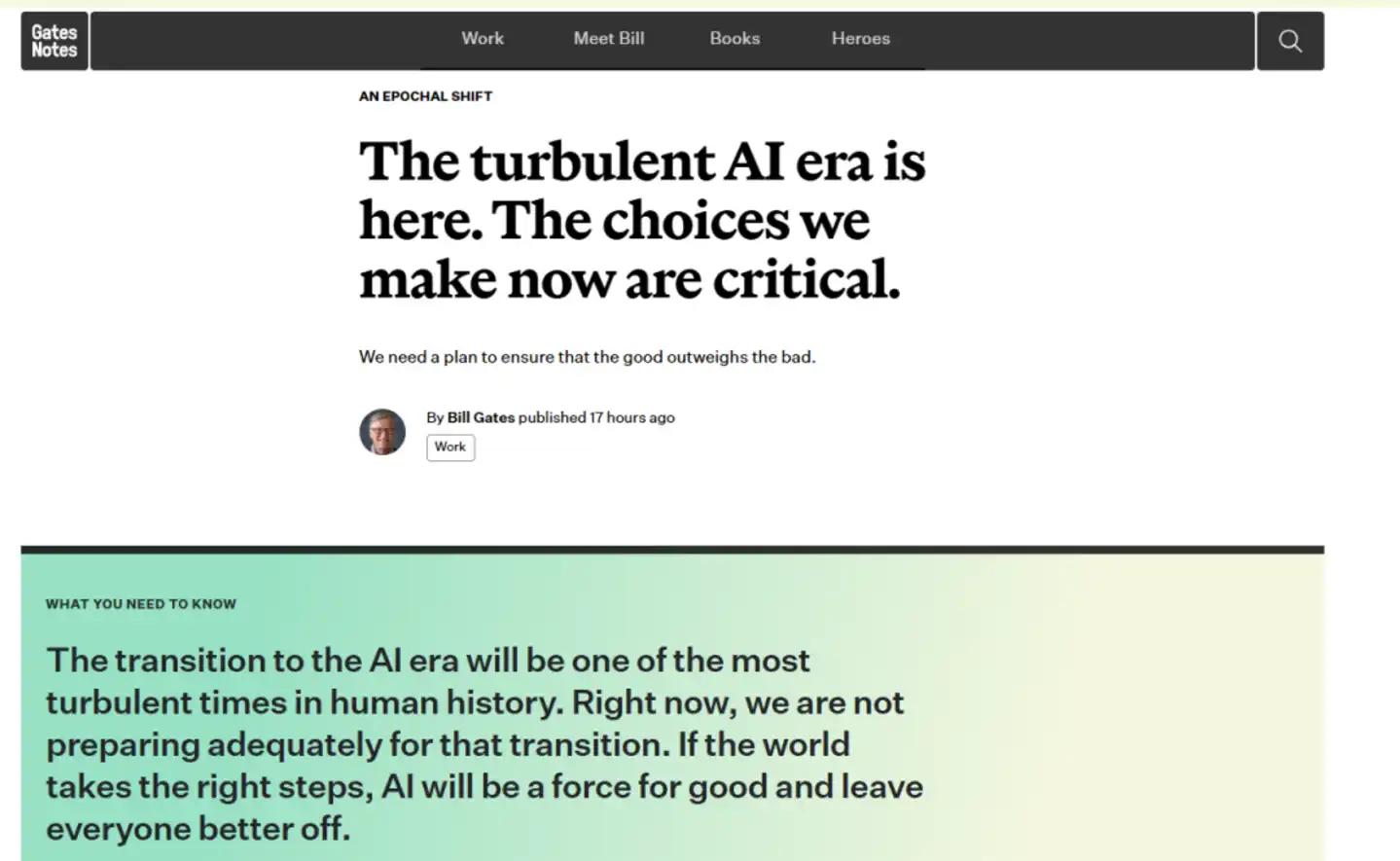
Core gist of the original article: AI could become the most powerful tool for equality, or a major source of inequality. Gates believes we need to start planning for this transition now.
This article is highly readable. Gates has not become an AI pessimist, nor does he deny AI's long-term value. He still believes AI will drive significant progress in fields like healthcare, education, agriculture, energy, and scientific research.
But his focus has changed.
In recent years, he talked more about what AI could ultimately create. This time, he spends considerable space discussing another question:
What will happen on the path from today to that future?
If the entire article were condensed into one sentence, it would probably be:
AI's long-term benefits could be enormous. But the 'transition period' between now and that future could become one of the most dramatic social transformations in human history. And we have barely established institutions for it.
Gates still believes in AI's long-term value. What worries him now is: how we get through the next decade or so in the middle.
He writes directly in the original text: "Unfortunately, we are not preparing for it now."
First Level: Gates believes this time cannot be simply compared to the Industrial Revolution
This is a point I consider very important and easily missed by news headlines.
Faced with the question 'Will AI take jobs?' in the past, a standard answer was: The steam engine eliminated some jobs but created new ones; the internet did the same, so AI will ultimately create new jobs too.
Gates now expresses clear skepticism about this analogy. Previous technologies primarily replaced physical labor or specific capabilities. New jobs ultimately still required human cognition.
The special thing about AI is: it is itself replacing cognitive labor.
The default cycle of the past two hundred years
Old jobs disappear → New jobs appear → Humans transition to them
Gates directly mentions law, customer service, healthcare, software, and manufacturing in the original text, later listing jobs like sales, software engineering, paralegal, loan approval, data analysis, and patient triage.
His assessment is: New jobs will still emerge, but without appropriate policies, the number of future positions may be far fewer than today's.
This assessment considers a deeper issue than the usual 'AI taking jobs'. For the past two hundred years, we assumed technological progress would ultimately create more, more complex jobs that also required human cognition.
But what if what's being scaled and made cheaper is 'cognitive capability' itself? The validity of this historical experience then becomes uncertain.
The biggest impact of AI on employment might not be a sudden wave of mass unemployment. A more likely change is that the same company, the same business, will need far fewer people in the future.
One person plus a few Agents can complete work that previously required a small team.
Jobs won't vanish overnight, but new job creation will slow, teams will thin out, and companies will become increasingly unwilling to pay the previous price for 'cognitive labor that can be done by AI'.
Second Level: The risk is no longer a post-AGI problem, it's happening now
Another important context for Gates's shift in stance this time.
He explained to MIT Technology Review why he is speaking out now specifically.
He believes several previously discussed 'danger thresholds' are actually starting to be crossed, including: biological capabilities, cyber attack capabilities, psychological and social influence, job market disruption, and AI controllability.
Especially Coding. Advances in Claude Code, long context, and Agentic Coding made him realize AI is crossing more than just a programming capability threshold.
An Agent capable of writing code at scale could also become a powerful tool for cyber attacks.
The stronger AI's capabilities, the better defenders become at finding vulnerabilities and patching systems. But the cost for attackers to find vulnerabilities and launch attacks using the same capabilities is also falling.
Gates also mentions this issue in the original text. The new capabilities attackers are gaining are rapidly increasing, while defenders cannot patch all weaknesses simultaneously.
Capabilities are crossing lines, governance remains stuck in the discussion stage.
Third Level: His biggest worry isn't just unemployment, but 'low-cost intelligent substitution'
There's one line from the MIT interview I find even more intriguing than the main text:
For well-defined jobs, AI will be cheaper and will do them better.
The examples he gives are very ordinary: telemarketing, customer service, finance departments, month-end closing, discount judgment, etc. A large number of white-collar jobs with clear processes, defined rules, and describable digitally will increasingly be easily done by low-cost AI.
The most crucial word here might not be 'substitution', but: cheaper.
The reality likely won't be a sudden switch where AI = 1, human = 0. It might be a department that previously needed 10 people now only needing 6.
The information processing required for entry-level positions is first handled mostly by Agents. A person's work hours used to dictate the speed of business expansion; now software can process vast numbers of tasks in parallel.
The core of the change is the marginal cost of labor and intelligence.
Following this line of thought further, Gates proposes an idea rarely heard from him: For some jobs, even if AI can do them, society may still want to leave them to people.
Fourth Level: A very interesting new concept – Human Reserved
Can be translated as: 'Human Reserved Domains.' Gates uses a vivid analogy: nature reserves.
Of course, roads and buildings could be built in nature reserves. We choose not to because the cost of losing them is too high. Human Reserved follows similar logic: even if AI can do it, we still decide to have humans do it.
This idea comes from his father's later years.
Gates's father had Alzheimer's disease. In his final years, a group of caregivers looked after him around the clock. Sometimes, his father could no longer express that he was hungry, but the caregivers could still understand him.
Gates writes there is something 'irreplaceably human' in this kind of care. Education and mental health might adopt a 'human + AI' approach, with humans bearing final responsibility and AI extending human capabilities.
Another example in healthcare: Technically, a robot could certainly tell a person 'You have an incurable disease.' Gates believes it should not.
The meaning of 'human work' in the future may no longer be determined solely by efficiency.
Fifth Level: Therefore, taxes and social security must be redesigned
If AI and robots continuously reduce labor demand, existing systems will encounter a very practical problem.
The current tax base
People work → Companies pay wages → Wages are taxed
If more and more work becomes: AI / robots work → Companies gain productivity benefits, the original tax base could be affected.
Therefore, Gates again raises the idea of a robot tax, and states it very directly:
"I believe we should tax AI tokens and robots."
"I believe we should tax AI tokens and robots."
When a company hires a person, it must pay payroll tax based on the salary. Purchasing a robot can often be immediately written off as a business expense.
Gates believes the current tax system actually incentivizes companies to replace humans with machines faster.
Taxation could, on one hand, slightly slow the pace at which companies move away from human labor, and on the other hand, raise funds for retraining and a stronger social safety net.
This touches on the flip side of the issue I previously considered when writing 'The Bill for AI Won't Just Be Paid by Tech Companies'.
If these investments ultimately do create huge productivity gains, who will the gains flow to?
Sixth Level: AI could simultaneously become 'the greatest equalizer' and 'the worst source of injustice'
This is the overarching thesis of the article.
"AI will either be the greatest equalizer ever invented, or the worst source of injustice."
AI will either be the greatest tool for equality ever invented by humanity, or the most severe source of injustice.
If the marginal cost of AI healthcare, AI education, AI agriculture, and AI research is low enough, capabilities previously available only to affluent regions have the opportunity to reach more ordinary people.
The same technology could also amplify existing disparities.
AI ownership is concentrated in a few companies.
Capital captures the main productivity gains.
The value of ordinary people's labor declines.
Affluent regions gain AI benefits first.
Low-income groups bear the brunt of job impacts first.
So the question is no longer just: 'Can AI create wealth?', but also: 'Who ultimately gets the wealth AI creates?'
Finally, the three categories of action he suggests
First, establish a new AI transition governance system.
Existing government agencies were not designed for a technology that spans employment, national security, education, healthcare, taxation, energy, finance, and cybersecurity.
Second, proactively manage job market impacts.
Including strengthening the social safety net, vocational retraining, adjusting tax systems, and unconventional solutions like Human Reserved.
Third, international coordination is needed; the US and China cannot be absent.
Cybersecurity, biological risks, and model proliferation all cross borders. Gates explicitly writes that a certain degree of cooperation between the US and China is needed.
The most hotly debated view in this article is his prediction about the future
Gates is discussing an AI transition period problem:
The endpoint of AI may be abundance, but there is no automatically smooth path between the 'abundant society' and the present.
An abundant society is at least a decade away. The entire transition process could last the next 10–20 years.
Sam Altman, Dario Amodei, and others often describe where AI can ultimately push productivity. Gates is discussing another period this time:
What exactly will happen between now and that abundant society?
This question is more realistic for ordinary people than 'When will AGI arrive?': Companies stop hiring so many new people. A department starts using Agents to do the work of several. Certain professional services become very cheap.
New productivity gains flow more to those who own the models, compute, and capital. But tax, education, social security, and employment systems still operate in the old way.
These changes don't need to wait for AGI to appear; some have already begun. The hardest part of AI may not just be making models powerful enough.
Once technology enters society, there is a slower, harder problem:
Do we have the capacity to make society adapt to it?
- References:Bill Gates / Gates Notes; MIT Technology Review Interview; Anthropic Claude Code materials.