Bernstein Interprets MRNA's 177% Surge: What's Fundamentals and What's Hype?

marsbitPublicado a 2026-08-21Actualizado a 2026-08-21

Resumen

Bernstein's analysis of Moderna's 177% stock surge following positive Phase 3 results for its individualized neoantigen therapy (INT) in melanoma distinguishes fundamental drivers from market speculation. The clinical breakthrough is real: the INTerpath-001 trial met its primary and key secondary endpoints, providing crucial validation for mRNA technology in oncology beyond infectious diseases. However, Bernstein argues the magnitude of the stock move cannot be justified by this single trial's fundamentals alone. The surge was amplified by three key factors: 1) A re-rating of Moderna's mRNA platform potential for expansion into other cancers, 2) A massive short squeeze, given ~15% of shares were sold short pre-announcement, and 3) The compelling "cancer vaccine" narrative that fueled broader investor enthusiasm. While the melanoma success is significant, Bernstein cautions that replication in lung, kidney, and bladder cancers—which have different immunogenicity—is not guaranteed. Furthermore, INT's commercial model faces challenges: it's a personalized treatment, not a mass-market vaccine, implying higher production costs and potential margin pressures despite a projected multi-billion dollar peak sales opportunity. The report also notes sector rotation, with some funds moving from crowded AI/semiconductor trades into defensive healthcare stocks, adding further momentum. In conclusion, Bernstein maintains a "Market-Perform" rating and a $45 price target, far below the po...

On August 19, Moderna and Merck announced the Phase 3 topline results for the personalized neoantigen therapy intismeran autogene (referred to as INT) in combination with Keytruda for the treatment of high-risk melanoma.

INTerpath-001 enrolled a total of 1,137 patients with stage IIB to IV cutaneous melanoma who had completed surgical resection and had not previously received systemic treatment. At the first interim analysis, the trial simultaneously met its primary endpoint of Recurrence-Free Survival (RFS) and the key secondary endpoint of Distant Metastasis-Free Survival (DMFS). Overall Survival (OS) data is not yet mature, and the trial will continue.

The company has so far only confirmed that the results are statistically significant and clinically meaningful, without disclosing specific hazard ratios, confidence intervals, patient subgroups, and full safety data. In other words, the market has confirmed the trial's success but does not yet know exactly how strong the efficacy is.

Following the announcement, Moderna's stock closed up about 177% to $174.38, with its market capitalization increasing by approximately $45 billion in a single day; Merck's stock rose about 13% to $152.20, with its market cap increasing by about $50 billion. The market debate quickly shifted from "Will the trial succeed?" to "Can such a scale of gains be justified by fundamentals?"

Clinical Breakthrough is Real, But Insufficient to Explain the 177% Surge

Bernstein believes that INTerpath-001 meeting both the RFS and DMFS endpoints at the first interim analysis suggests the efficacy is likely quite robust.

Interim analyses typically need to cross a higher statistical threshold. Based on this, the report speculates that the Phase 3 trial's RFS hazard ratio could be in the range of 0.50 to 0.65, and the DMFS hazard ratio might be close to 0.40, roughly consistent with previous Phase 2 data.

A hazard ratio below 1 means the relative risk of recurrence, distant metastasis, or death events is lower in the combination therapy group compared to the Keytruda monotherapy group. For example, a hazard ratio of 0.50 roughly represents an approximate 50% reduction in the relative risk of the relevant event, but does not equate to half of the patients being cured.

The above ranges are merely Bernstein's speculation based on statistical thresholds and past data, not the Phase 3 results announced by the companies. Specific efficacy, safety, and overall survival trends still await complete data.

However, the significance of this trial extends beyond melanoma. It is Moderna's first pivotal trial success outside of respiratory vaccines and the first personalized neoantigen regimen proven to further improve Keytruda's efficacy in a Phase 3 study.

This provides critical clinical evidence for expanding mRNA from infectious disease vaccines to cancer treatment and marks the starting point for the market's revaluation of Moderna's platform value.

The Market is Trading on Platform Revaluation and Short Covering

Clinical results can explain a stock price increase but are insufficient to explain its magnitude.

Bernstein believes that even with optimistic success expectations for all of INT's later-stage projects, it is difficult to justify Moderna's approximately 177% single-day surge. This rally is primarily driven by the convergence of three forces:

Clinical success reduces the residual risk for the melanoma project;

Investors begin pricing in the platform potential of mRNA expansion to more cancer types;

High short interest triggers short covering, amplifying short-term buying pressure.

Prior to the results announcement, approximately 14% to 15% of Moderna's float was sold short. After the clinical results exceeded pessimistic expectations, short sellers were forced to buy to cover their positions, and previously underweight investors also started chasing the rally. Moderna's trading volume that day approached 200 million shares, roughly equivalent to half of the company's total outstanding shares.
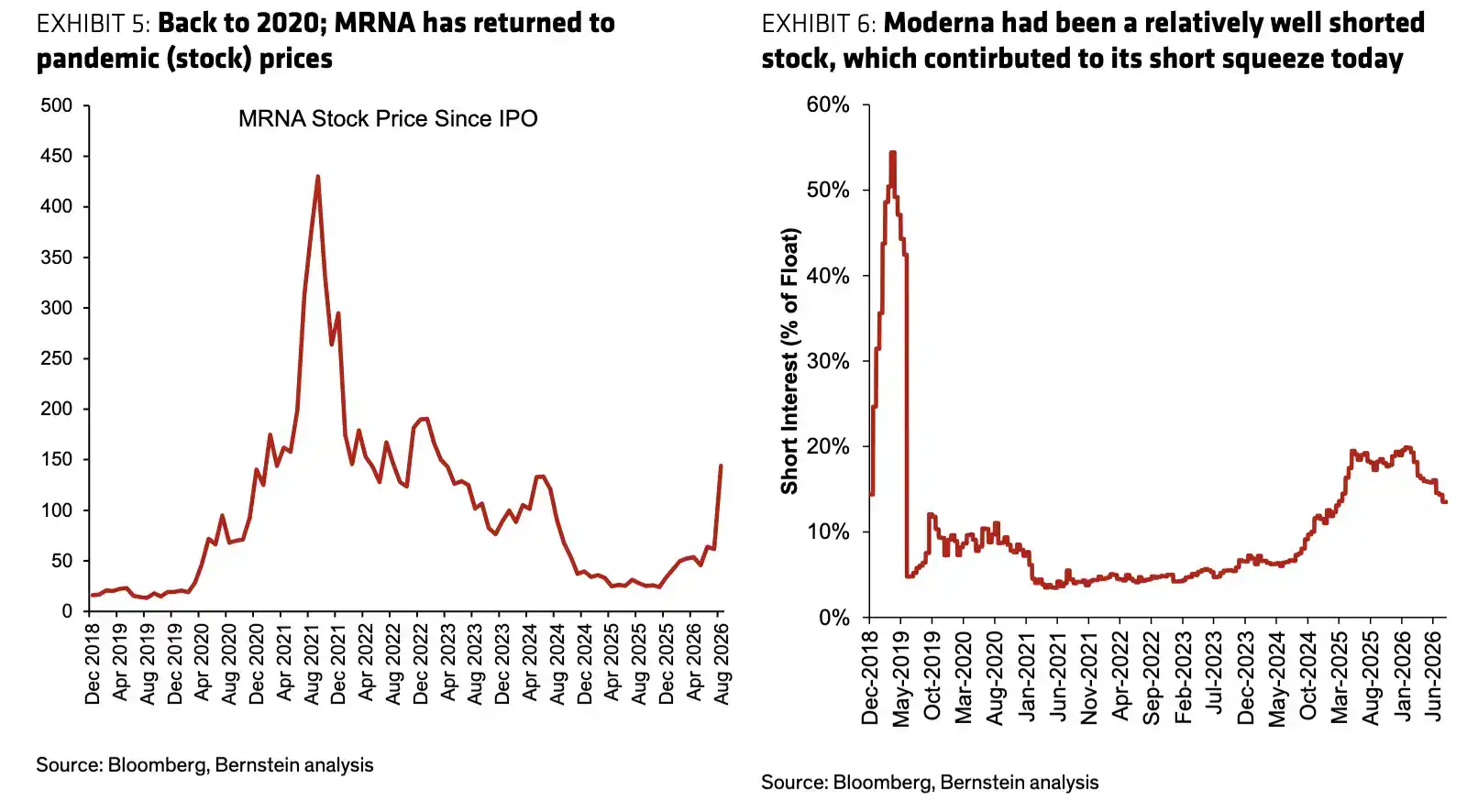
MRNA stock price chart (left) and short interest chart (right). MRNA's stock price surged on August 19, 2026, returning to pre-pandemic levels, while previously about 14-15% of its float was shorted, creating conditions for a short squeeze. Clinical data triggered the rise, but short covering further amplified the gains.

The news tag "cancer vaccine success" further amplified the spread effect. Compared to "personalized neoantigen therapy meets Phase 3 endpoints," this phrasing more easily leads the market to envision a large platform covering multiple cancer types.

Therefore, clinical data was the trigger for the rise, while platform narrative, short covering, and news effects amplified the gains. The amount of stock price increase does not mean the market has already confirmed that INT can generate equivalent levels of revenue and profit.

Melanoma is Just the Starting Point; Platform Replication Remains to Be Proven

Moderna and Merck currently have four Phase 3 studies and five Phase 2 studies around INT, covering melanoma, non-small cell lung cancer (NSCLC), renal cell carcinoma, and bladder cancer, and are beginning to enter unresectable or metastatic tumors.

Bernstein estimates that INTerpath-001 corresponds to a U.S. potential patient population of approximately 13,000 to 19,000 people, representing about 30% of the accessible patient population for the current Phase 3 and potential registration-enabling Phase 2 projects, and about 17% of all Phase 2 and Phase 3 projects.
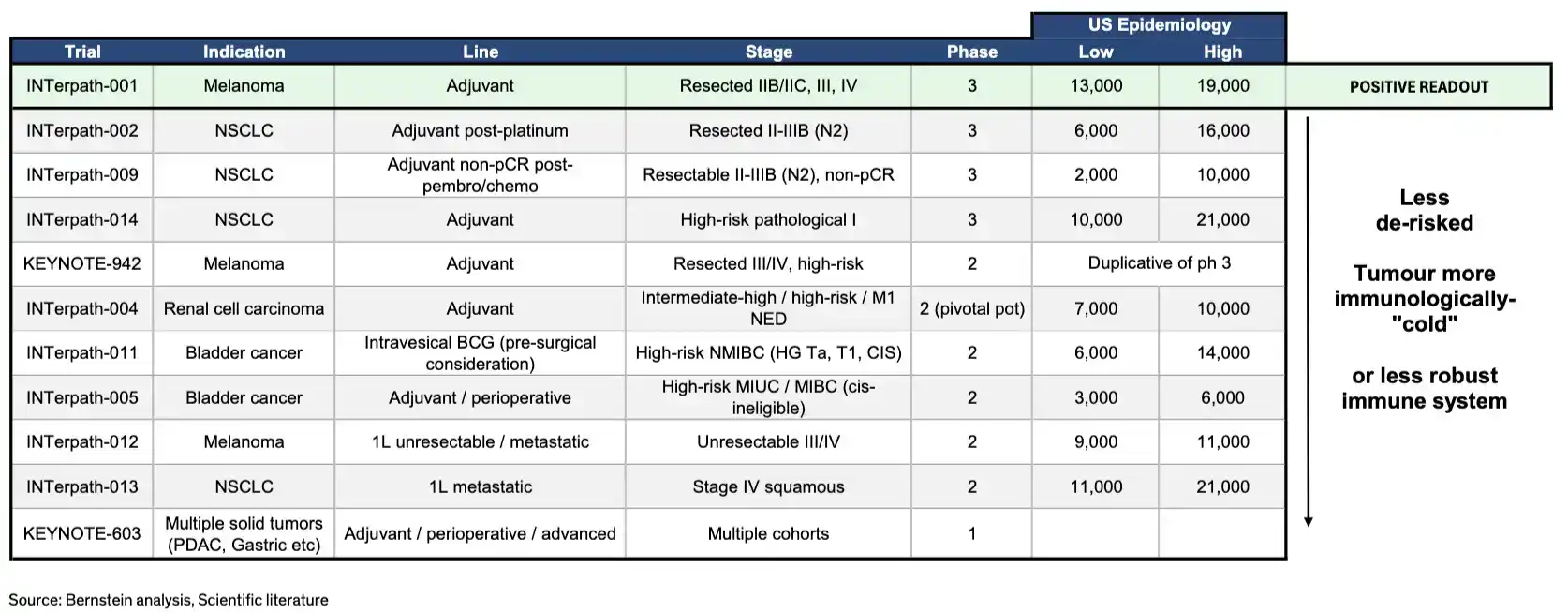
The U.S. accessible patient population for INTerpath-001 is approximately 13,000 to 19,000 people, representing only about 30% of the accessible patient total for current pivotal projects and about 17% of all Phase II and Phase III INT studies. Success in melanoma does not automatically guarantee the same results can be replicated in lung cancer, kidney cancer, and other cancer types.

If projects in lung cancer, kidney cancer, and bladder cancer can replicate the success in melanoma, INT's market potential will expand significantly. Bernstein currently gives an un-risk-adjusted sales forecast for early-stage melanoma and lung cancer of approximately $2.4 billion.

The report also uses Keytruda as an upside reference: its early-stage cancer indications generated about $7.9 billion in revenue in 2025, with an estimated $9.2 billion in 2028, and INT's future pricing could potentially be higher than Keytruda's.

But $2.4 billion is an un-risk-adjusted sales forecast, not profit, and certainly not realized performance. INT also has not yet covered several important Keytruda indications like triple-negative breast cancer, cervical cancer, and head and neck cancer.

More critically, melanoma typically has strong immunogenicity. Its success cannot be directly extrapolated to tumors with different immune microenvironments, such as lung cancer, kidney cancer, and bladder cancer.

INTerpath-001 proves the platform's *potential* for replication but does not prove replication *will* necessarily occur. The market has already started trading the endgame of success in other cancer types, but the relevant clinical data is still on the way.

Bernstein therefore maintains its "Market-Perform" rating and $45 price target for Moderna, far below the August 19 closing price of $174.38.

The "Cancer Vaccine" Label Blurs Commercial Realities

INT is not a preventive vaccine for healthy populations but a personalized treatment for cancer patients. At this stage, it is used as adjuvant therapy after patients have completed tumor resection, with the goal of reducing the risk of recurrence and distant metastasis caused by residual disease.

Tumor tissue and blood samples must be individually collected from each patient, followed by gene sequencing and algorithm analysis. The system selects up to 34 patient-specific neoantigens from the patient's tumor mutations, then produces the corresponding mRNA construct to induce a T-cell response against the tumor.
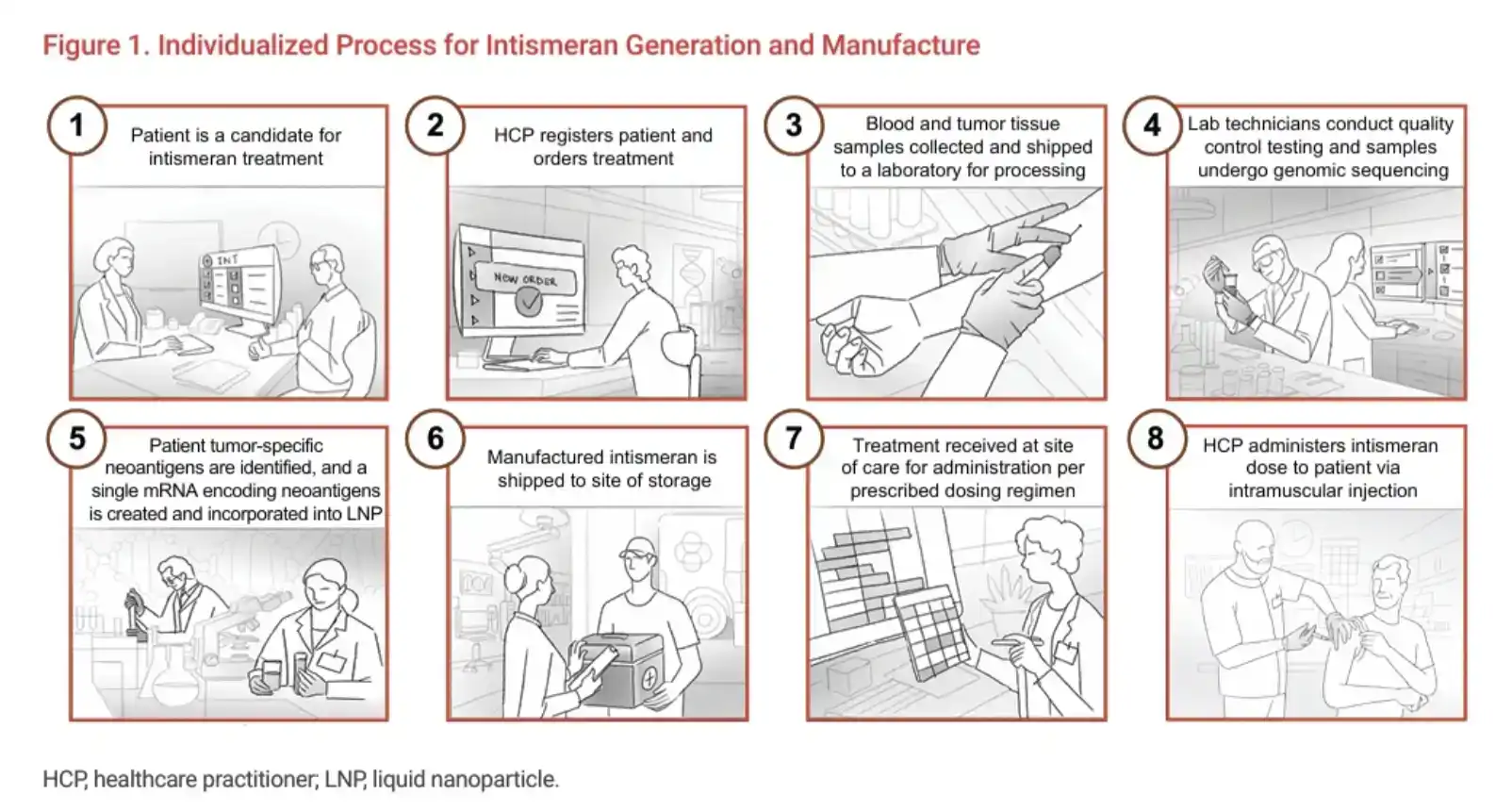
Therefore, while INT uses Moderna's mRNA platform, its business model is closer to that of a personalized oncology drug:

The target patient population is in the tens of thousands, not tens or hundreds of millions like traditional vaccines;

Each patient requires separate sequencing, design, and production;

Production costs are difficult to scale down rapidly like batch-produced vaccines;

Regulatory, pricing, and reimbursement will follow the oncology drug pathway.

"Cancer vaccine" is an easily communicable label, but it may amplify market imagination about patient scale while downplaying real-world constraints like personalized production costs and commercialization efficiency. The incremental impact of INT's success on traditional vaccine raw material suppliers is also relatively limited.

For Billions in Revenue, How Much Profit Ultimately Remains?

Compared to sales potential, Bernstein is more concerned about INT's profit margins.

Merck will be responsible for global commercialization. Moderna will participate in co-promotion in the U.S., while Merck will independently handle marketing and sales in markets outside the U.S. The two parties will share costs and profits per the agreement.

Bernstein uses the single melanoma indication as an example, assuming INT's peak sales reach $1.2 billion, with gross margins gradually improving from 35% at launch to 60%. After deducting approximately $250 million in SG&A expenses and profit sharing, the mature-stage contribution to Moderna's EPS would be about $0.60.

This is Bernstein's scenario calculation, not company guidance. It illustrates that even if INT becomes a billion-dollar product, personalized production costs and profit sharing will limit profit realization.

The market's current pricing, however, already implies multiple favorable conditions: success in other cancer types, smooth expansion of custom manufacturing, favorable pricing and reimbursement, and continuously improving gross margins. None of these conditions have yet been fully verified.

For Merck, INT's strategic value lies primarily in expanding Keytruda's usage. Most trials use an "INT + Keytruda" vs. "Keytruda monotherapy" design, so INT is first and foremost an add-on therapy, not a replacement for Keytruda.

If the combination regimen becomes the new standard of care, Bristol-Myers Squibb's Opdivo, Roche's Tecentriq, and AstraZeneca's Imfinzi could face market share pressure in some melanoma and NSCLC markets. However, the low initial gross margins and profit sharing could also weigh on INT's contribution to Merck's operating profit margin.

Therefore, Merck's approximately $50 billion market cap increase is similarly difficult to explain solely by the profits from the current melanoma project.

Pharma Sector Rally Also Influenced by AI Trading Rotation

Bernstein believes this rally is not entirely Moderna's individual stock story.

The report observes that the pharmaceutical and semiconductor sectors have recently shown a certain inverse trading characteristic. Against a backdrop of increasingly concentrated AI and semiconductor holdings, pharmaceuticals have started to be viewed by some investors as a relatively clean defensive option: demand is less affected by economic cycles, while potentially benefiting long-term from AI's application in drug discovery and clinical trials.
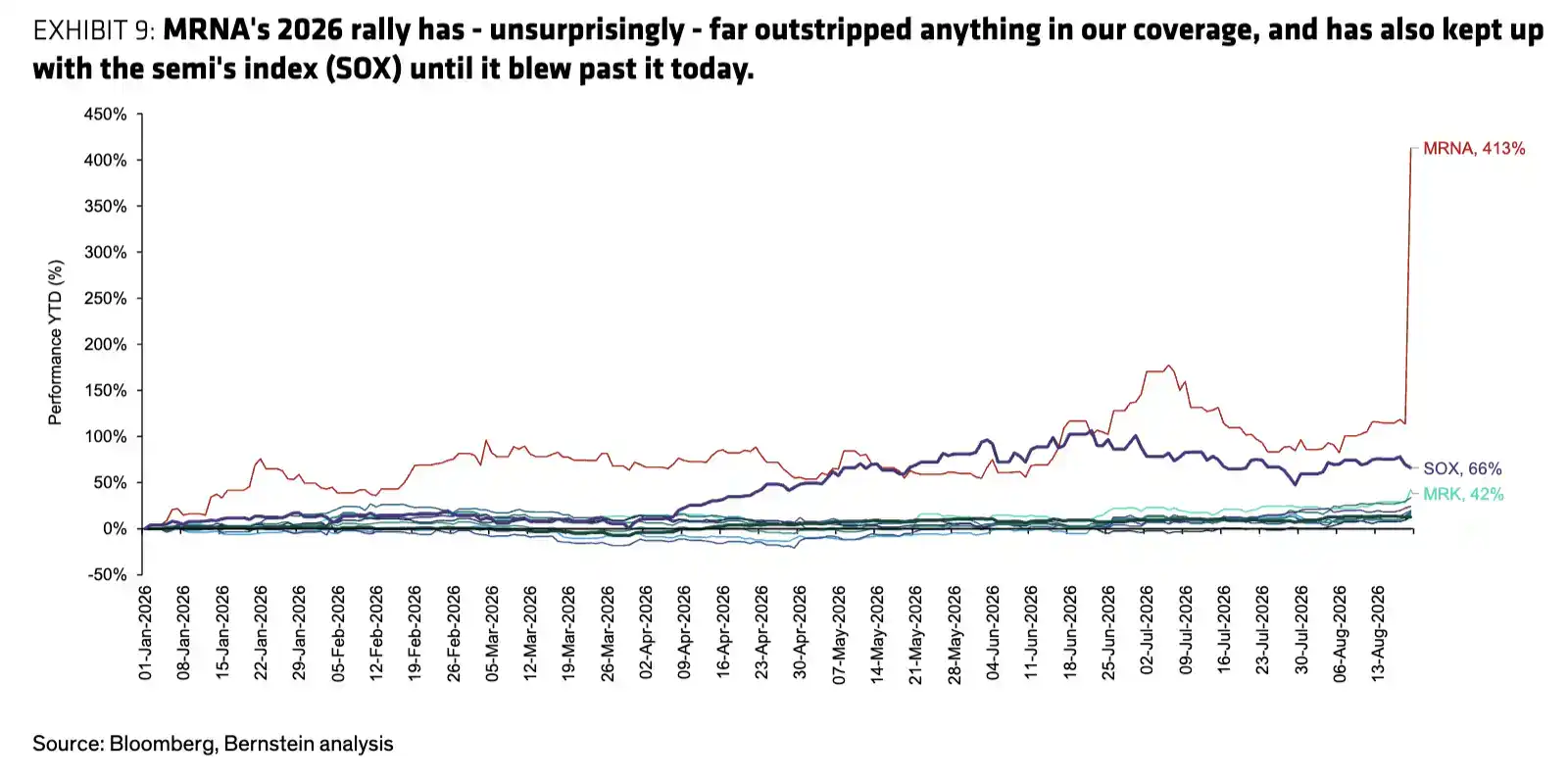
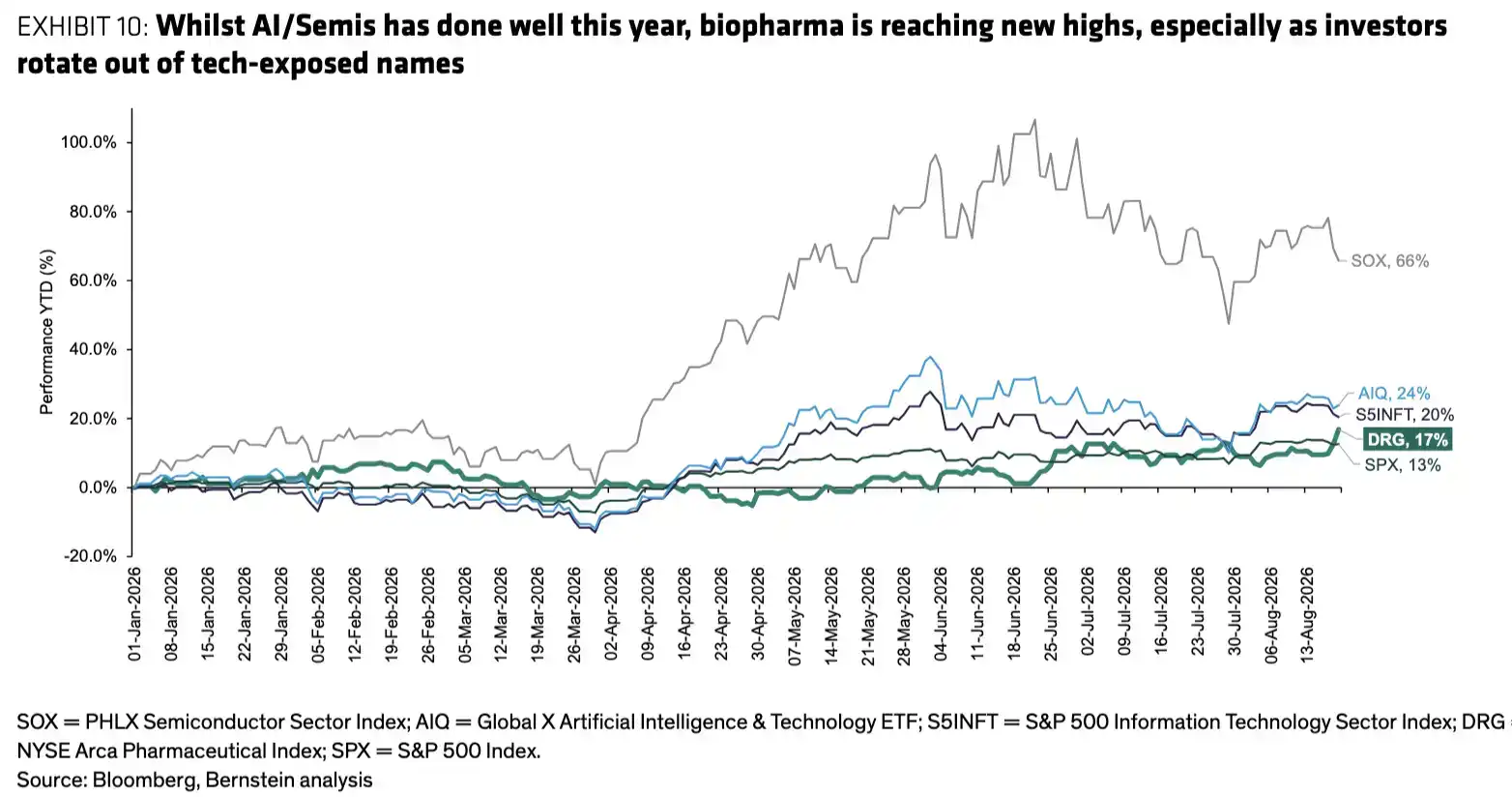
In 2026, the pharmaceutical sector (DRG) and the semiconductor index (SOX) show a clear inverse trading characteristic. When the AI theme experiences volatility and capital flows out of the tech sector, the pharmaceutical sector, as a defensive asset, sees capital inflows. Moderna's rise is not just an individual stock story but also a result of sector rotation.

This is merely Bernstein's interpretation of capital flows and does not imply a stable negative correlation between pharmaceuticals and semiconductors. However, when tech stock volatility rises, sector rotation can provide additional buying pressure for the pharma sector and amplify the market impact of INT's clinical results.

Thus, Moderna's rise contains three layers of trading: the foundation is the Phase 3 melanoma success, the middle layer is mRNA platform revaluation, and the outer layer consists of short covering and sector rotation. The further from the core, the greater the distance from quantifiable fundamentals.

From Clinical Breakthrough to Earnings Inflection Point: Three Validations Remain

INTerpath-001 has proven that mRNA personalized neoantigen therapy can succeed in a large Phase 3 trial. But to define it as Moderna's earnings inflection point, at least three more validations are needed:

First, complete Phase 3 data. The specific hazard ratios, safety profile, patient subgroups, and OS trends will determine INT's real advantage over Keytruda monotherapy.

Second, cross-cancer replication. Results from subsequent lung, kidney, and bladder cancer trials will determine whether melanoma is just a favorable indication or the starting point for a broader oncology platform.

Third, commercialization efficiency. Custom manufacturing cycles, capacity, pricing, reimbursement, and gross margins will determine whether sales can be converted into profits sufficient to support the valuation.

Bernstein does not deny the clinical value of INTerpath-001. Its real warning is: the market has rapidly jumped from a successful melanoma trial to endgame pricing based on a multi-cancer platform and long-term profit realization.

A clinical breakthrough has occurred, but an earnings inflection point is not yet confirmed. The current stock price is trading more on the imagination of platform success and short-term demand amplified by high short interest.


Criptos en tendencia

Preguntas relacionadas

QAccording to the article, what clinical trial results did Moderna and Merck announce that led to Moderna's stock surging by approximately 177%?

AModerna and Merck announced positive topline results from the Phase 3 INTerpath-001 trial. The trial evaluated the combination of intismeran autogene (INT), an individualized neoantigen therapy, with Keytruda (pembrolizumab) for the adjuvant treatment of high-risk melanoma (stage IIB to IV) after complete resection. At its first interim analysis, the trial met both its primary endpoint of Recurrence-Free Survival (RFS) and a key secondary endpoint of Distant Metastasis-Free Survival (DMFS), demonstrating statistical significance and clinical meaning.

QBesides the positive clinical data, what other three key factors does Bernstein cite as drivers of Moderna's extreme stock price increase?

ABernstein identifies three additional factors that amplified the stock price movement beyond the clinical results: 1) The clinical success triggered a market re-evaluation of Moderna's mRNA platform potential beyond infectious diseases into oncology. 2) A high short interest (14-15% of float) led to forced short covering, which intensified buying pressure. 3) The use of the compelling but potentially oversimplified 'cancer vaccine' news label enhanced market excitement and broad investor attention.

QWhat does Bernstein estimate as the potential US patient population for the INT therapy based solely on the successful melanoma trial (INTerpath-001), and what does this represent relative to the broader program?

ABernstein estimates that the US addressable patient population for the INT therapy based on the successful melanoma trial (INTerpath-001) is approximately 13,000 to 19,000 patients. This represents about 30% of the patient population in the late-stage (Phase 3 and potential registrational Phase 2) projects and only about 17% of the patient population across all ongoing Phase 2 and Phase 3 INT studies.

QAccording to Bernstein's analysis, what are the key commercial and logistical differences between INT and a traditional mass-market vaccine?

AINT operates more like a personalized cancer drug than a traditional vaccine. Key differences include: 1) Its target patient population is in the tens of thousands, not millions or billions. 2) Each treatment is customized for an individual patient based on sequencing their tumor and blood samples to identify up to 34 specific neoantigens. 3) Its production cannot achieve the same economies of scale as batch-produced vaccines, keeping manufacturing costs higher. 4) Its regulatory path, pricing, and reimbursement will follow the model for oncology drugs, not vaccines.

QWhat three future validations does Bernstein argue are necessary to confirm the clinical breakthrough as a true inflection point for Moderna's business?

ABernstein states that three key validations are still required: 1) The release of full Phase 3 data, including specific hazard ratios, safety profiles, patient subgroups, and overall survival trends, to define the true advantage over Keytruda monotherapy. 2) Successful replication of the results across other cancer types (e.g., non-small cell lung cancer, renal cell carcinoma, bladder cancer) to prove the platform's broad applicability. 3) Demonstration of commercial efficiency, encompassing the therapy's custom production cycle, capacity, pricing, reimbursement, and ultimately, its gross margins, to ensure sales can translate into profits that justify the valuation.

Lecturas Relacionadas

Uniswap Founder: When Stocks and Treasuries Are Fully On-Chain, How Will AMMs Restructure the Global Market?

Uniswap founder Hayden Adams argues that as traditional assets like stocks become tokenized, Automated Market Makers (AMMs) could fundamentally restructure global markets. The core insight is that AMMs are most efficient in "correlated pairs"—such as NVDA/SPY—where assets move together. In these pairs, passive liquidity providers (LPs) who are willing to hold the underlying assets face lower inventory risk and minimal hedging costs compared to traditional, delta-neutral market makers. This cost advantage allows AMMs to undercut professional firms. Tokenization enables assets to trade directly against each other on a shared settlement layer, rather than being siloed in dollar-based systems. Adams observes this pattern already emerging in DeFi, where assets naturally pair with correlated benchmarks (e.g., ETH for Ethereum assets). He believes this will extend to tokenized stocks, with liquidity concentrating in low-volatility correlated pairs, while a few high-volume "bridge pairs" (like SPY/USD) handle dollar conversions. The article highlights that early correlated markets for tokenized stocks already exist (e.g., on Robinhood's chain), and Uniswap v4 hooks like DualPool can further boost LP returns. Adams draws a parallel to the rise of passive index funds, suggesting passive AMM liquidity could similarly democratize market-making and capture significant market share from traditional finance. A response from crypto KOL Cody adds practical analysis, noting that while the correlated pair strategy reduces impermanent loss, current on-chain fees may not yet fully compensate for it. He shares his own LP strategy using valuation models, emphasizing that AMMs offer a novel, low-cost market-making avenue for those willing to hold inventory.

marsbitHace 2 min(s)

Uniswap Founder: When Stocks and Treasuries Are Fully On-Chain, How Will AMMs Restructure the Global Market?

marsbitHace 2 min(s)

Goldman Sachs Buys Volatility, Turns Bitcoin into a Yield Business

Goldman Sachs acquired NEOS Investments for up to $2.25 billion, gaining a suite of ETFs that generate income by selling options against crypto assets, particularly Bitcoin. This includes the BTCI fund, which sells call options against Bitcoin ETF holdings to capture high premiums from crypto’s volatility, offering investors stable cash flow—around 27% annualized in returns—while capping upside potential and fully exposing them to downside risk. The move highlights Wall Street’s broader push to package crypto-native yield—through staking, lending, and structured products—without taking directional bets on prices. Firms like Fidelity, JPMorgan, and Morgan Stanley now offer staking services or accept crypto as collateral for loans, collecting steady fees regardless of market direction. In contrast, native crypto firms like Bitwise remain vulnerable to market downturns, as their revenue depends entirely on assets under management. This reflects a strategic pivot: large institutions no longer need to “believe” in crypto to profit from it. They monetize volatility and investor activity through fee-based structures, leaving price risk to retail investors. As regulatory shifts like the proposed 401(k) rules unfold, yield-generating crypto products may gain even broader adoption in traditional portfolios, further cementing Wall Street’s role as a neutral intermediary capturing reliable revenue streams from the ecosystem.

marsbitHace 6 min(s)

Goldman Sachs Buys Volatility, Turns Bitcoin into a Yield Business

marsbitHace 6 min(s)

AI Launches a Fierce Assault on Cancer, Virtually Tests 4,000 Anti-Cancer Drugs, Google Gemma Downloads Exceed 1 Billion

Google's open-source Gemma AI model family has reached a new milestone, surpassing 10 billion cumulative downloads in two and a half years since its February 2024 launch. This growth has fueled a vast ecosystem, with over 100,000 developer-derived model variants powering diverse applications, from NASA satellites to over 100 million phones. A standout application involves cancer research. In collaboration with Google Research and Yale, a team developed a 27-billion-parameter model called Cell2Sentence-Scale 27B (C2S-Scale). This model innovatively converts complex single-cell sequencing data into a "sentence" of gene names ranked by activity, allowing it to analyze cellular behavior. It was used to conduct a "dual-context virtual screen" of over 4,000 drugs, aiming to find one that specifically boosts antigen presentation—a key process for immune system recognition—only in the presence of low interferon signals (a "cold tumor" context), not in neutral conditions. The model identified silmitasertib (CX-4945), a CK2 kinase inhibitor, as a top candidate. Subsequent live-cell experiments validated this AI-generated hypothesis, showing that the drug combined with low-dose interferon increased antigen presentation by about 50%, whereas neither element alone had a significant effect. This represents a novel, AI-proposed mechanistic pathway for potential cancer therapy. Beyond biomedicine, the Gemma ecosystem is expanding into unique domains. Models have been deployed in space on high-performance GPUs and are being used in projects like DolphinGemma to decipher dolphin communication patterns. The 10-billion-download milestone underscores a key trend: the disruptive potential of AI lies not just in raw model capability but in its widespread, silent integration into diverse hardware and real-world applications, as evidenced by the thriving "Gemmaverse" community.

marsbitHace 7 min(s)

AI Launches a Fierce Assault on Cancer, Virtually Tests 4,000 Anti-Cancer Drugs, Google Gemma Downloads Exceed 1 Billion

marsbitHace 7 min(s)

Shocking: OpenAI Fully Open-Sources Codex Harness

OpenAI has open-sourced the core framework of Codex, called "Harness," under an Apache-2.0 license. This move allows developers to deeply integrate AI agents into their own applications and workflows, moving beyond the limitations of generic chat interfaces. The Harness is the underlying execution system that manages an AI agent's complete lifecycle: understanding tasks, maintaining memory, using tools, handling failures, and requesting human approvals. OpenAI demonstrated that optimizations to the Harness alone can dramatically boost a model's performance, tripling scores on a benchmark while using significantly fewer tokens. The release includes three key components: a CLI tool (`codex exec`) for automated tasks, official SDKs (TypeScript/Python) for programmatic control, and the `app-server` for embedding agents directly into products. This enables features like persistent state, real-time event streaming, and human-in-the-loop controls. Early adopters showcase its versatility beyond coding. Examples include a tax preparation system that cut processing time by one-third, Cisco's platform for building apps with natural language, and a demo logistics dashboard where agents analyze data and propose actions within the existing interface. This paradigm shift grants developers full control over the user interface, context, tools, and security boundaries. AI becomes an invisible assistant within specialized software, rather than a separate chatbot. By open-sourcing the engine behind its powerful agents, OpenAI aims to spark a new wave of native, deeply integrated AI applications.

marsbitHace 12 min(s)

Shocking: OpenAI Fully Open-Sources Codex Harness

marsbitHace 12 min(s)

Trading

Spot

Artículos destacados

Qué es $S$

Entendiendo SPERO: Una Visión General Completa Introducción a SPERO A medida que el panorama de la innovación continúa evolucionando, la aparición de tecnologías web3 y proyectos de criptomonedas juega un papel fundamental en la configuración del futuro digital. Un proyecto que ha atraído la atención en este campo dinámico es SPERO, denotado como SPERO,$$s$. Este artículo tiene como objetivo reunir y presentar información detallada sobre SPERO, para ayudar a entusiastas e inversores a comprender sus fundamentos, objetivos e innovaciones dentro de los dominios web3 y cripto. ¿Qué es SPERO,$$s$? SPERO,$$s$ es un proyecto único dentro del espacio cripto que busca aprovechar los principios de descentralización y tecnología blockchain para crear un ecosistema que promueva la participación, la utilidad y la inclusión financiera. El proyecto está diseñado para facilitar interacciones de igual a igual de nuevas maneras, proporcionando a los usuarios soluciones y servicios financieros innovadores. En su esencia, SPERO,$$s$ tiene como objetivo empoderar a los individuos al proporcionar herramientas y plataformas que mejoren la experiencia del usuario en el espacio de las criptomonedas. Esto incluye habilitar métodos de transacción más flexibles, fomentar iniciativas impulsadas por la comunidad y crear caminos para oportunidades financieras a través de aplicaciones descentralizadas (dApps). La visión subyacente de SPERO,$$s$ gira en torno a la inclusividad, buscando cerrar brechas dentro de las finanzas tradicionales mientras aprovecha los beneficios de la tecnología blockchain. ¿Quién es el Creador de SPERO,$$s$? La identidad del creador de SPERO,$$s$ sigue siendo algo oscura, ya que hay recursos públicos limitados que proporcionan información de fondo detallada sobre su(s) fundador(es). Esta falta de transparencia puede derivarse del compromiso del proyecto con la descentralización, una ética que muchos proyectos web3 comparten, priorizando las contribuciones colectivas sobre el reconocimiento individual. Al centrar las discusiones en torno a la comunidad y sus objetivos colectivos, SPERO,$$s$ encarna la esencia del empoderamiento sin señalar a individuos específicos. Como tal, comprender la ética y la misión de SPERO sigue siendo más importante que identificar a un creador singular. ¿Quiénes son los Inversores de SPERO,$$s$? SPERO,$$s$ cuenta con el apoyo de una diversa gama de inversores que van desde capitalistas de riesgo hasta inversores ángeles dedicados a fomentar la innovación en el sector cripto. El enfoque de estos inversores generalmente se alinea con la misión de SPERO, priorizando proyectos que prometen avances tecnológicos sociales, inclusión financiera y gobernanza descentralizada. Estas fundaciones de inversores suelen estar interesadas en proyectos que no solo ofrecen productos innovadores, sino que también contribuyen positivamente a la comunidad blockchain y sus ecosistemas. El respaldo de estos inversores refuerza a SPERO,$$s$ como un contendiente notable en el dominio de proyectos cripto que evoluciona rápidamente. ¿Cómo Funciona SPERO,$$s$? SPERO,$$s$ emplea un marco multifacético que lo distingue de los proyectos de criptomonedas convencionales. Aquí hay algunas de las características clave que subrayan su singularidad e innovación: Gobernanza Descentralizada: SPERO,$$s$ integra modelos de gobernanza descentralizada, empoderando a los usuarios para participar activamente en los procesos de toma de decisiones sobre el futuro del proyecto. Este enfoque fomenta un sentido de propiedad y responsabilidad entre los miembros de la comunidad. Utilidad del Token: SPERO,$$s$ utiliza su propio token de criptomoneda, diseñado para servir diversas funciones dentro del ecosistema. Estos tokens permiten transacciones, recompensas y la facilitación de servicios ofrecidos en la plataforma, mejorando la participación y la utilidad general. Arquitectura en Capas: La arquitectura técnica de SPERO,$$s$ apoya la modularidad y escalabilidad, permitiendo la integración fluida de características y aplicaciones adicionales a medida que el proyecto evoluciona. Esta adaptabilidad es fundamental para mantener la relevancia en el cambiante paisaje cripto. Participación de la Comunidad: El proyecto enfatiza iniciativas impulsadas por la comunidad, empleando mecanismos que incentivan la colaboración y la retroalimentación. Al nutrir una comunidad sólida, SPERO,$$s$ puede abordar mejor las necesidades de los usuarios y adaptarse a las tendencias del mercado. Enfoque en la Inclusión: Al ofrecer tarifas de transacción bajas e interfaces amigables para el usuario, SPERO,$$s$ busca atraer a una base de usuarios diversa, incluyendo a individuos que anteriormente pueden no haber participado en el espacio cripto. Este compromiso con la inclusión se alinea con su misión general de empoderamiento a través de la accesibilidad. Cronología de SPERO,$$s$ Entender la historia de un proyecto proporciona información crucial sobre su trayectoria de desarrollo y hitos. A continuación se presenta una cronología sugerida que mapea eventos significativos en la evolución de SPERO,$$s$: Fase de Conceptualización e Ideación: Las ideas iniciales que forman la base de SPERO,$$s$ fueron concebidas, alineándose estrechamente con los principios de descentralización y enfoque comunitario dentro de la industria blockchain. Lanzamiento del Whitepaper del Proyecto: Tras la fase conceptual, se lanzó un whitepaper completo que detalla la visión, los objetivos y la infraestructura tecnológica de SPERO,$$s$ para generar interés y retroalimentación de la comunidad. Construcción de Comunidad y Primeras Interacciones: Se realizaron esfuerzos de divulgación activa para construir una comunidad de primeros adoptantes y posibles inversores, facilitando discusiones en torno a los objetivos del proyecto y obteniendo apoyo. Evento de Generación de Tokens: SPERO,$$s$ llevó a cabo un evento de generación de tokens (TGE) para distribuir sus tokens nativos a los primeros seguidores y establecer liquidez inicial dentro del ecosistema. Lanzamiento de la dApp Inicial: La primera aplicación descentralizada (dApp) asociada con SPERO,$$s$ se puso en marcha, permitiendo a los usuarios interactuar con las funcionalidades centrales de la plataforma. Desarrollo Continuo y Alianzas: Actualizaciones y mejoras continuas a las ofertas del proyecto, incluyendo alianzas estratégicas con otros actores en el espacio blockchain, han moldeado a SPERO,$$s$ en un jugador competitivo y en evolución en el mercado cripto. Conclusión SPERO,$$s$ se erige como un testimonio del potencial de web3 y las criptomonedas para revolucionar los sistemas financieros y empoderar a los individuos. Con un compromiso con la gobernanza descentralizada, la participación comunitaria y funcionalidades diseñadas de manera innovadora, allana el camino hacia un paisaje financiero más inclusivo. Como con cualquier inversión en el espacio cripto que evoluciona rápidamente, se anima a los posibles inversores y usuarios a investigar a fondo y participar de manera reflexiva con los desarrollos en curso dentro de SPERO,$$s$. El proyecto muestra el espíritu innovador de la industria cripto, invitando a una mayor exploración de sus innumerables posibilidades. Mientras el viaje de SPERO,$$s$ aún se desarrolla, sus principios fundamentales pueden, de hecho, influir en el futuro de cómo interactuamos con la tecnología, las finanzas y entre nosotros en ecosistemas digitales interconectados.

443 Vistas totalesPublicado en 2024.12.17Actualizado en 2024.12.17

Qué es $S$

Qué es AGENT S

Agent S: El Futuro de la Interacción Autónoma en Web3 Introducción En el paisaje en constante evolución de Web3 y las criptomonedas, las innovaciones están redefiniendo constantemente cómo los individuos interactúan con las plataformas digitales. Uno de estos proyectos pioneros, Agent S, promete revolucionar la interacción humano-computadora a través de su marco agente abierto. Al allanar el camino para interacciones autónomas, Agent S busca simplificar tareas complejas, ofreciendo aplicaciones transformadoras en inteligencia artificial (IA). Esta exploración detallada profundizará en las complejidades del proyecto, sus características únicas y las implicaciones para el dominio de las criptomonedas. ¿Qué es Agent S? Agent S se presenta como un marco agente abierto innovador, diseñado específicamente para abordar tres desafíos fundamentales en la automatización de tareas informáticas: Adquisición de Conocimiento Específico del Dominio: El marco aprende inteligentemente de diversas fuentes de conocimiento externas y experiencias internas. Este enfoque dual le permite construir un rico repositorio de conocimiento específico del dominio, mejorando su rendimiento en la ejecución de tareas. Planificación a Largo Plazo de Tareas: Agent S emplea planificación jerárquica aumentada por la experiencia, un enfoque estratégico que facilita la descomposición y ejecución eficiente de tareas complejas. Esta característica mejora significativamente su capacidad para gestionar múltiples subtareas de manera eficiente y efectiva. Manejo de Interfaces Dinámicas y No Uniformes: El proyecto introduce la Interfaz Agente-Computadora (ACI), una solución innovadora que mejora la interacción entre agentes y usuarios. Utilizando Modelos de Lenguaje Multimodal de Gran Escala (MLLMs), Agent S puede navegar y manipular diversas interfaces gráficas de usuario sin problemas. A través de estas características pioneras, Agent S proporciona un marco robusto que aborda las complejidades involucradas en la automatización de la interacción humana con las máquinas, preparando el terreno para una multitud de aplicaciones en IA y más allá. ¿Quién es el Creador de Agent S? Si bien el concepto de Agent S es fundamentalmente innovador, la información específica sobre su creador sigue siendo elusiva. El creador es actualmente desconocido, lo que resalta ya sea la etapa incipiente del proyecto o la elección estratégica de mantener a los miembros fundadores en el anonimato. Independientemente de la anonimidad, el enfoque sigue siendo en las capacidades y el potencial del marco. ¿Quiénes son los Inversores de Agent S? Dado que Agent S es relativamente nuevo en el ecosistema criptográfico, la información detallada sobre sus inversores y patrocinadores financieros no está documentada explícitamente. La falta de información disponible públicamente sobre las bases de inversión u organizaciones que apoyan el proyecto plantea preguntas sobre su estructura de financiamiento y hoja de ruta de desarrollo. Comprender el respaldo es crucial para evaluar la sostenibilidad del proyecto y su posible impacto en el mercado. ¿Cómo Funciona Agent S? En el núcleo de Agent S se encuentra una tecnología de vanguardia que le permite funcionar de manera efectiva en diversos entornos. Su modelo operativo se basa en varias características clave: Interacción Humano-Computadora Similar a la Humana: El marco ofrece planificación avanzada de IA, esforzándose por hacer que las interacciones con las computadoras sean más intuitivas. Al imitar el comportamiento humano en la ejecución de tareas, promete elevar las experiencias de los usuarios. Memoria Narrativa: Empleada para aprovechar experiencias de alto nivel, Agent S utiliza memoria narrativa para hacer un seguimiento de las historias de tareas, mejorando así sus procesos de toma de decisiones. Memoria Episódica: Esta característica proporciona a los usuarios una guía paso a paso, permitiendo que el marco ofrezca apoyo contextual a medida que se desarrollan las tareas. Soporte para OpenACI: Con la capacidad de ejecutarse localmente, Agent S permite a los usuarios mantener el control sobre sus interacciones y flujos de trabajo, alineándose con la ética descentralizada de Web3. Fácil Integración con APIs Externas: Su versatilidad y compatibilidad con varias plataformas de IA aseguran que Agent S pueda encajar sin problemas en ecosistemas tecnológicos existentes, convirtiéndolo en una opción atractiva para desarrolladores y organizaciones. Estas funcionalidades contribuyen colectivamente a la posición única de Agent S dentro del espacio cripto, ya que automatiza tareas complejas y de múltiples pasos con una intervención humana mínima. A medida que el proyecto evoluciona, sus posibles aplicaciones en Web3 podrían redefinir cómo se desarrollan las interacciones digitales. Cronología de Agent S El desarrollo y los hitos de Agent S pueden encapsularse en una cronología que resalta sus eventos significativos: 27 de septiembre de 2024: El concepto de Agent S fue lanzado en un documento de investigación integral titulado “Un Marco Agente Abierto que Usa Computadoras Como un Humano”, mostrando las bases del proyecto. 10 de octubre de 2024: El documento de investigación fue puesto a disposición del público en arXiv, ofreciendo una exploración profunda del marco y su evaluación de rendimiento basada en el benchmark OSWorld. 12 de octubre de 2024: Se lanzó una presentación en video, proporcionando una visión visual de las capacidades y características de Agent S, involucrando aún más a posibles usuarios e inversores. Estos marcadores en la cronología no solo ilustran el progreso de Agent S, sino que también indican su compromiso con la transparencia y la participación comunitaria. Puntos Clave Sobre Agent S A medida que el marco Agent S continúa evolucionando, varios atributos clave destacan, subrayando su naturaleza innovadora y potencial: Marco Innovador: Diseñado para proporcionar un uso intuitivo de las computadoras similar a la interacción humana, Agent S aporta un enfoque novedoso a la automatización de tareas. Interacción Autónoma: La capacidad de interactuar de manera autónoma con las computadoras a través de GUI significa un salto hacia soluciones informáticas más inteligentes y eficientes. Automatización de Tareas Complejas: Con su metodología robusta, puede automatizar tareas complejas y de múltiples pasos, haciendo que los procesos sean más rápidos y menos propensos a errores. Mejora Continua: Los mecanismos de aprendizaje permiten a Agent S mejorar a partir de experiencias pasadas, mejorando continuamente su rendimiento y eficacia. Versatilidad: Su adaptabilidad en diferentes entornos operativos como OSWorld y WindowsAgentArena asegura que pueda servir a una amplia gama de aplicaciones. A medida que Agent S se posiciona en el paisaje de Web3 y criptomonedas, su potencial para mejorar las capacidades de interacción y automatizar procesos significa un avance significativo en las tecnologías de IA. A través de su marco innovador, Agent S ejemplifica el futuro de las interacciones digitales, prometiendo una experiencia más fluida y eficiente para los usuarios en diversas industrias. Conclusión Agent S representa un audaz avance en la unión de la IA y Web3, con la capacidad de redefinir cómo interactuamos con la tecnología. Aunque aún se encuentra en sus primeras etapas, las posibilidades para su aplicación son vastas y atractivas. A través de su marco integral que aborda desafíos críticos, Agent S busca llevar las interacciones autónomas al primer plano de la experiencia digital. A medida que nos adentramos más en los reinos de las criptomonedas y la descentralización, proyectos como Agent S sin duda desempeñarán un papel crucial en la configuración del futuro de la tecnología y la colaboración humano-computadora.

829 Vistas totalesPublicado en 2025.01.14Actualizado en 2025.01.14

Qué es AGENT S

Cómo comprar S

¡Bienvenido a HTX.com! Hemos hecho que comprar Sonic (S) sea simple y conveniente. Sigue nuestra guía paso a paso para iniciar tu viaje de criptos.Paso 1: crea tu cuenta HTXUtiliza tu correo electrónico o número de teléfono para registrarte y obtener una cuenta gratuita en HTX. Experimenta un proceso de registro sin complicaciones y desbloquea todas las funciones.Obtener mi cuentaPaso 2: ve a Comprar cripto y elige tu método de pagoTarjeta de crédito/débito: usa tu Visa o Mastercard para comprar Sonic (S) al instante.Saldo: utiliza fondos del saldo de tu cuenta HTX para tradear sin problemas.Terceros: hemos agregado métodos de pago populares como Google Pay y Apple Pay para mejorar la comodidad.P2P: tradear directamente con otros usuarios en HTX.Over-the-Counter (OTC): ofrecemos servicios personalizados y tipos de cambio competitivos para los traders.Paso 3: guarda tu Sonic (S)Después de comprar tu Sonic (S), guárdalo en tu cuenta HTX. Alternativamente, puedes enviarlo a otro lugar mediante transferencia blockchain o utilizarlo para tradear otras criptomonedas.Paso 4: tradear Sonic (S)Tradear fácilmente con Sonic (S) en HTX's mercado spot. Simplemente accede a tu cuenta, selecciona tu par de trading, ejecuta tus trades y monitorea en tiempo real. Ofrecemos una experiencia fácil de usar tanto para principiantes como para traders experimentados.

1.6k Vistas totalesPublicado en 2025.01.15Actualizado en 2026.06.02

Cómo comprar S

Discusiones

Bienvenido a la comunidad de HTX. Aquí puedes mantenerte informado sobre los últimos desarrollos de la plataforma y acceder a análisis profesionales del mercado. A continuación se presentan las opiniones de los usuarios sobre el precio de S (S).

活动图片