Beneath the Surface Glamour: OpenAI's 'Four Major Dilemmas'

marsbitPublicado a 2026-02-24Actualizado a 2026-02-24

Resumen

Despite its massive user base and substantial funding, OpenAI faces four fundamental strategic challenges according to analysis by tech analyst Benedict Evans. The company lacks a durable technical moat, as multiple competitors now offer models with comparable performance, eliminating any sustained technological advantage. User engagement remains shallow, with only 5% of its 900 million weekly active users paying and 80% sending fewer than 1000 messages in 2025—equivalent to less than three prompts per day—indicating ChatGPT has not become a daily habit for most. Competitors like Google and Meta are closing the gap technologically and leveraging their distribution strengths to capture market share. Meanwhile, OpenAI’s platform strategy, which aims to build a full-stack AI ecosystem, may not create real network effects or lock-in, as users and developers can easily switch between underlying models. Additionally, the company’s product roadmap is heavily influenced by research breakthroughs rather than user-centric design, limiting strategic control. Evans concludes that without true differentiation, network effects, or ecosystem leverage, OpenAI’ position relies on execution rather than a defensible long-term strategy.

Author: Zhao Ying

Source: Wall Street News

Former a16z partner and renowned technology analyst Benedict Evans recently published an in-depth analysis, pointing directly to four fundamental strategic dilemmas faced by OpenAI beneath its apparent prosperity. He argues that despite OpenAI's massive user base and ample capital, it lacks a technological moat, suffers from insufficient user stickiness, faces rapid competition catching up, and has a product strategy constrained by lab R&D directions, all of which threaten its long-term competitiveness.

Evans points out that OpenAI's current business model does not possess a clear competitive advantage. The company has neither unique technology nor has it formed network effects. Only 5% of its 900 million weekly active users are paying, and 80% of users sent fewer than 1000 messages in 2025—equivalent to an average of less than three prompts per day. This "a mile wide, an inch deep" usage pattern indicates that ChatGPT has not yet become a daily habit for users.

Meanwhile, tech giants like Google and Meta have caught up with OpenAI technologically and are leveraging their distribution advantages to capture market share. Evans believes the real value in the AI field will come from new experiences and application scenarios that have yet to be invented, and OpenAI cannot create all these innovations alone. This forces the company to fight on multiple fronts simultaneously, laying out a comprehensive strategy from infrastructure to the application layer.

Evans's analysis reveals a core contradiction: OpenAI is attempting to build competitive barriers through massive capital investment and a full-stack platform strategy, but it remains questionable whether this approach can succeed in the absence of network effects and user lock-in mechanisms. For investors, this means a need to reassess OpenAI's long-term value proposition and its true position in the AI competitive landscape.

Vanishing Technical Advantage: Intensifying Model Homogenization

Evans notes in his analysis that currently about six institutions can launch competitive frontier models, with performance being largely equivalent. Companies leapfrog each other every few weeks, but none has established a technical lead that others cannot match. This stands in stark contrast to platforms like Windows, Google Search, or Instagram—which achieved self-reinforcing market share through network effects, making it difficult for competitors to break the monopoly regardless of investment.

This trend towards technical parity could change due to certain breakthroughs, most obviously the achievement of continuous learning capabilities, but Evans believes OpenAI currently cannot plan for this. Another potential differentiating factor is the scale effect of proprietary data, including user data or vertical industry data, but existing platform companies also have advantages in this regard.

Against the backdrop of converging model performance, competition is shifting towards brand and distribution channels. The rapid market share growth of Gemini and Meta AI confirms this trend—for the average user, these products look very similar, and Google and Meta have strong distribution capabilities. In contrast, Anthropic's Claude model often tops benchmark tests but has near-zero consumer awareness due to its lack of a consumer strategy and product.

Evans draws an analogy between ChatGPT and Netscape, which had an early advantage in the browser market but was ultimately defeated by Microsoft leveraging its distribution advantage. He believes chatbots face the same differentiation problem as browsers: they are essentially just an input box and an output box, with extremely limited room for product innovation.

Fragile User Base: Scale Masks Lack of Stickiness

Although OpenAI has a clear lead with 800 to 900 million weekly active users, Evans points out that this data masks a serious user engagement problem. The vast majority of users who already know about and know how to use ChatGPT have not cultivated it into a daily habit.

Data shows that only 5% of ChatGPT users pay. Even among American teenagers, the proportion using it a few times a week or less is much higher than those using it multiple times daily. OpenAI's "2025 Year in Review" event disclosed that 80% of users sent fewer than 1000 messages in 2025, which at face value equates to an average of less than three prompts per day, and even fewer actual conversations.

This shallow usage means most users do not see the differences in personality and focus between different models, nor do they benefit from stickiness-building features like "Memory." Evans emphasizes that the memory feature can only bring stickiness, not network effects. Meanwhile, usage data from a larger user base could be an advantage, but it's questionable how big this advantage is when 80% of users use it at most a few times a week.
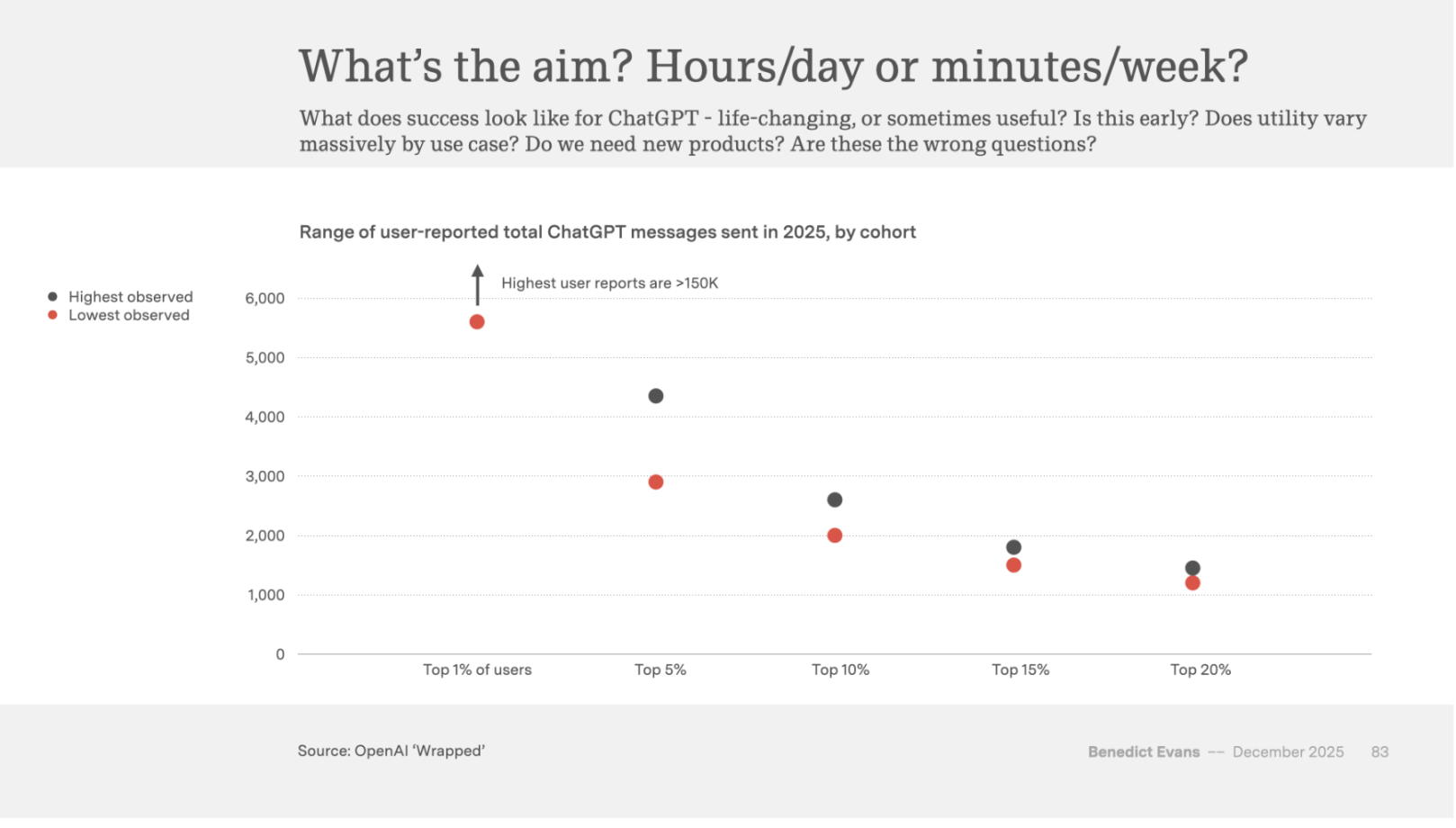
OpenAI itself has acknowledged the issue, proposing a "capability gap" between model capabilities and actual user usage. Evans sees this as sidestepping the fact that product-market fit is unclear. If users can't figure out what to use it for on an ordinary day, it means it hasn't changed their lives.

The company launched an advertising program partly to cover the service costs for the over 90% of non-paying users, but more strategically, this allows the company to offer these users the latest, most powerful (and most expensive) models, hoping to deepen user engagement. However, Evans questions whether giving users a better model will change the situation if they can't think of what to do with ChatGPT today or this week.

Platform Strategy in Question: Lack of a True Flywheel Effect

Last year, OpenAI CEO Sam Altman attempted to integrate the company's various initiatives into a coherent strategy, presenting a chart and quoting Bill Gates: "A platform is when the economic value of everybody that uses it exceeds the value of the company that creates it." Meanwhile, the CFO released another chart showcasing a "flywheel effect."
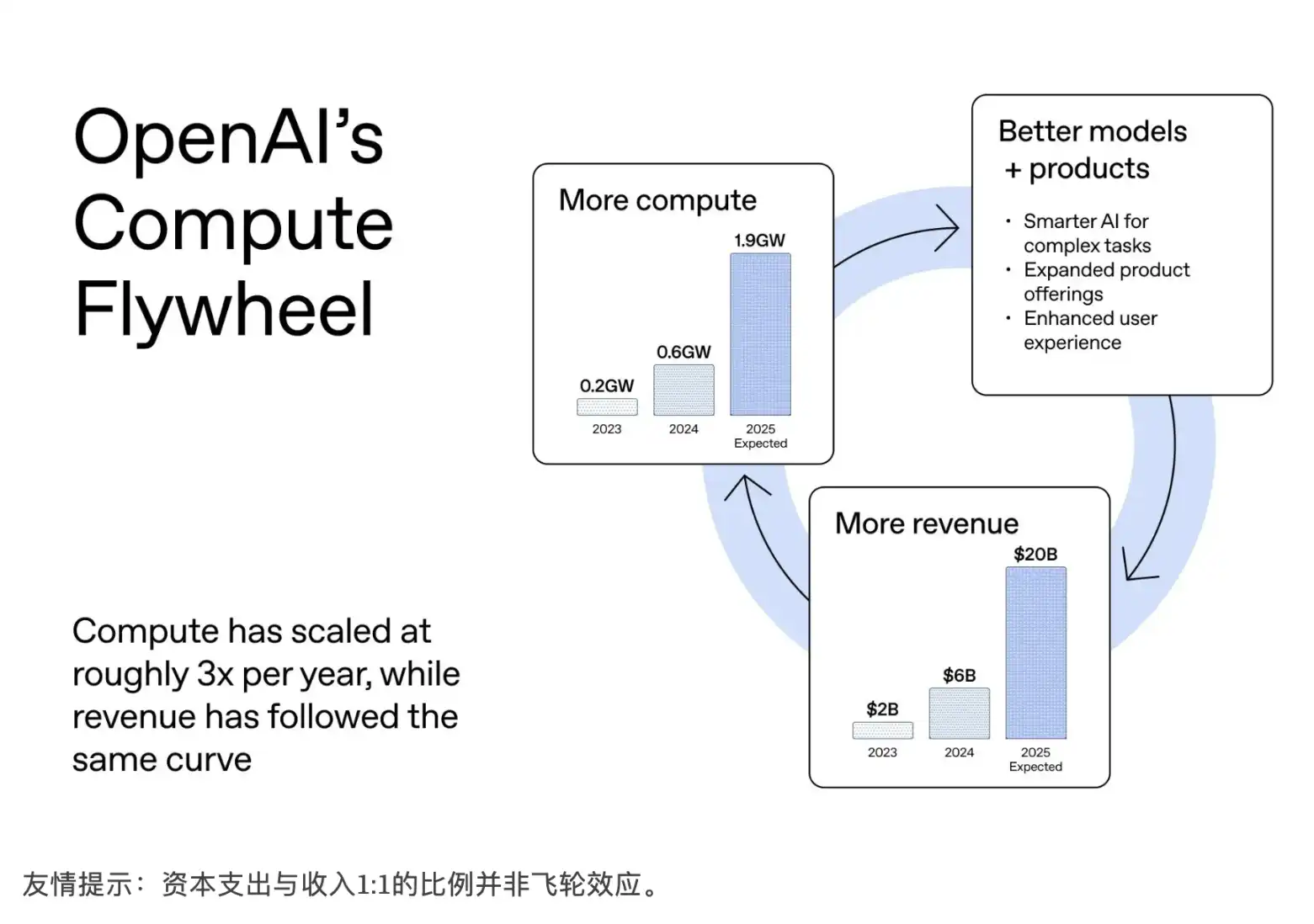
Evans considers the flywheel effect an elegant, coherent strategy: capital expenditure itself forms a virtuous cycle and becomes the foundation for building a full-stack platform company on top of it. Starting with chips and infrastructure, building up each layer of the tech stack; the higher you go, the more you help others use your tools to create their own products. Everyone uses your cloud, chips, and models, and then at higher layers, the layers of the tech stack reinforce each other, forming network effects and an ecosystem.

However, Evans bluntly states that he doesn't believe this is the right analogy, that OpenAI does not possess the platform and ecosystem dynamics that Microsoft or Apple once had, and that flywheel chart does not actually depict a true flywheel effect.

In terms of capital expenditure, the four major cloud computing firms invested about $400 billion in infrastructure last year and announced at least $650 billion for this year. OpenAI claimed a few months ago to have future commitments of $1.4 trillion and 30 gigawatts of computing power (with no clear timeline), while actual usage at the end of 2025 was 1.9 gigawatts. Lacking the large-scale cash flow from an existing business, the company achieves these goals through financing and using others' balance sheets (partly involving "recurring revenue").

Evans believes that massive capital investment might just buy a seat at the table, not a competitive advantage. He draws an analogy between AI infrastructure costs and aircraft manufacturing or the semiconductor industry: no network effects, but the process for each generation of products becomes more difficult and expensive, eventually leaving only a few companies able to sustain the investment required to stay at the frontier. However, while TSMC has a de facto monopoly in cutting-edge chips, this does not give it leverage or value capture ability further up the tech stack.

Evans points out that developers had to build apps for Windows because it had almost all the users, and users had to buy Windows PCs because it had almost all the developers—that's network effects. But if you invent a great new app or product using generative AI, you simply call the base model running in the cloud via an API, and the user doesn't know or care which model you used.

Lack of Product Leadership: Strategy Constrained by the Lab

Evans begins his article by quoting OpenAI product lead Fidji Simo from 2026: "Jakub and Mark set the long-term research direction. After months of work, amazing results emerge, and then the researchers contact me and say: 'I have something cool. How are you going to use it in chat? How for our enterprise products?'"

This stands in stark contrast to Steve Jobs' famous 1997 quote: "You've got to start with the customer experience and work backwards to the technology. You can't start with the technology and try to figure out where to sell it."

Evans argues that when you are the product lead at an AI lab, you cannot control your own roadmap; your ability to set product strategy is very limited. You open your email in the morning to find out what the lab research has produced, and your job is to turn it into a button. Strategy happens elsewhere, but where?

This issue highlights the fundamental challenge facing OpenAI: unlike Google in the 2000s or Apple in the 2010s, OpenAI's smart and ambitious employees do not have a truly effective product that others cannot replicate. Evans suggests that one interpretation of OpenAI's activities over the past 12 months is that Sam Altman is deeply aware of this and is trying to convert the company's valuation into a more lasting strategic position before the music stops.

For most of last year, OpenAI's answer seemed to be 'everything, all at once, immediately.' App platform, browser, social video app, collaboration with Jony Ive, medical research, advertising, etc. Evans believes some of this looks like "throwing everything at the wall," or simply the result of rapidly hiring lots of aggressive people. At times, it also gives the feeling that people are replicating the forms of previously successful platforms without fully understanding their purpose or dynamic mechanisms.

Evans repeatedly uses terms like platform, ecosystem, leverage, and network effects, but he acknowledges these terms are widely used in the tech industry with rather vague meanings. He quotes his university medieval history professor Roger Lovatt: "Power is the ability to make people do what they do not want to do." This, he suggests, is the real question: Does OpenAI have the ability to make consumers, developers, and enterprises use its system more, regardless of what the system actually does? Microsoft, Apple, and Facebook once had this power, as did Amazon.
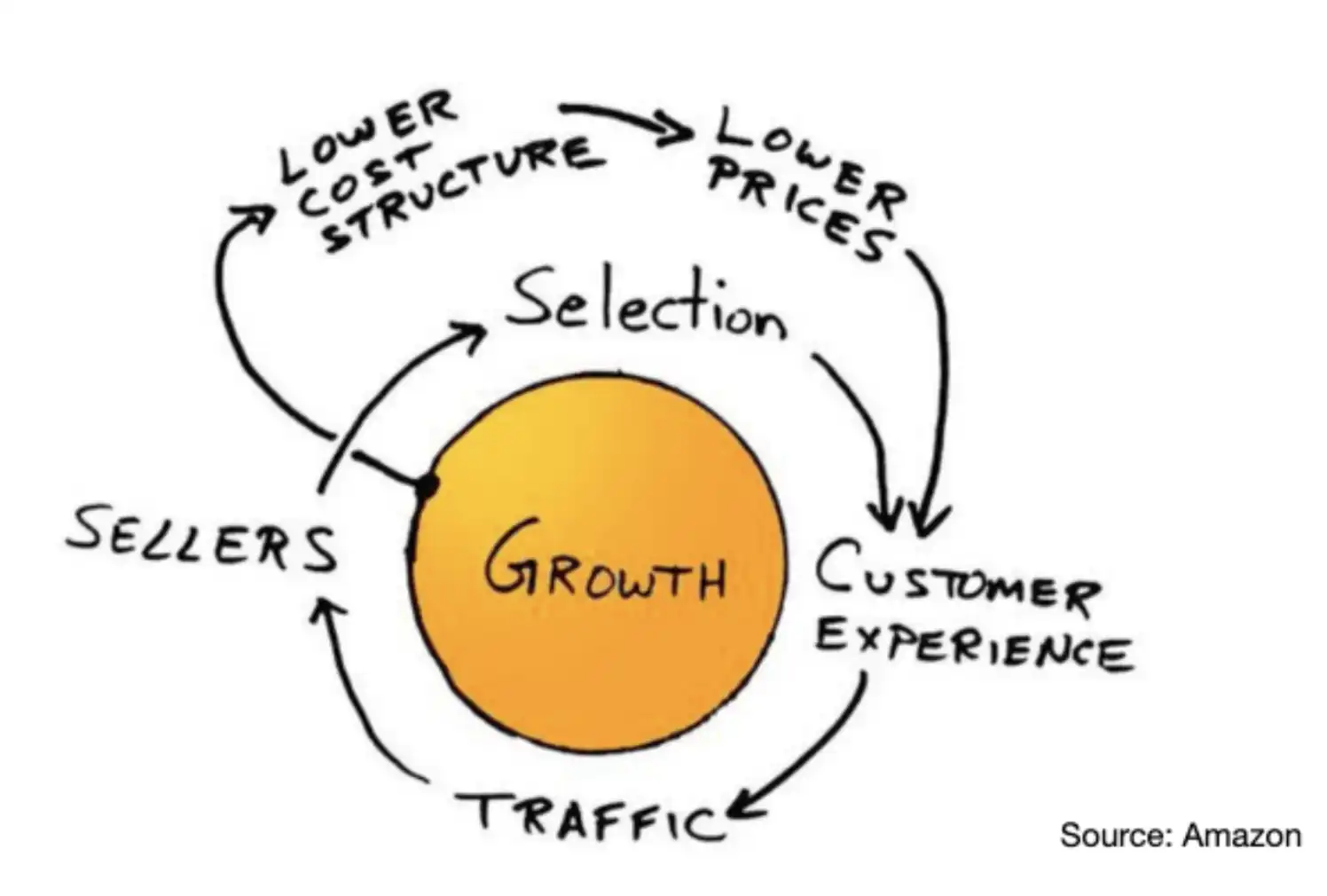
Evans believes a good way to interpret Bill Gates's quote is that what a platform truly achieves is leveraging the creativity of the entire tech industry, so you don't have to invent everything yourself; you can build much more, at scale, but all of it is done on your system, under your control. Foundation models are indeed multipliers; a lot of new things will be built with them. But do you have a reason why everyone must use your product, even if competitors have built the same thing? Is there a reason why your product will always be better than competitors', no matter how much money and effort they invest?

Evans concludes that without these advantages, then all you have is execution, day after day. Executing better than everyone else is certainly an aspiration, and some companies have done it for extended periods, even convincing themselves they've institutionalized it, but it is not a strategy.


Preguntas relacionadas

QWhat are the four fundamental strategic dilemmas facing OpenAI according to Benedict Evans' analysis?

AAccording to Benedict Evans, OpenAI faces four fundamental strategic dilemmas: 1) Lack of a technological moat, 2) Insufficient user stickiness, 3) Rapid competition catching up, and 4) Product strategy being constrained by the lab's research direction.

QWhy does Evans argue that OpenAI lacks a technological moat despite its large user base?

AEvans argues that OpenAI lacks a technological moat because about six institutions can now produce competitive frontier models with roughly equivalent performance. No company has established an unassailable technical lead, and there is an absence of network effects or user lock-in mechanisms that create self-reinforcing market share like those seen with Windows or Google Search.

QWhat user engagement data does Evans cite to demonstrate ChatGPT's 'shallow' usage pattern?

AEvans cites data showing that only 5% of ChatGPT users are paying subscribers. Furthermore, OpenAI's own '2025 Year in Review' disclosed that 80% of users sent fewer than 1,000 messages in 2025, which averages to less than three prompts per day, indicating it has not become a daily habit for the vast majority of its user base.

QHow does Evans critique OpenAI's 'flywheel' platform strategy and capital expenditure plans?

AEvans critiques the 'flywheel' strategy by arguing that massive capital expenditure (e.g., $1.4T in future compute commitments) may only buy a seat at the table rather than a competitive advantage. He states that OpenAI lacks the true platform dynamics and network effects of companies like Windows, where developers and users are locked into an ecosystem. He compares it to capital-intensive industries like semiconductor manufacturing, where high costs create barriers but do not inherently grant leverage over the rest of the tech stack.

QWhat core contradiction does Evans identify in OpenAI's product development process, as illustrated by a quote from its product head?

AEvans identifies a core contradiction where product strategy is dictated by the research lab, not customer needs. He contrasts a quote from OpenAI's product head—where researchers contact her to find a use for a new discovery—with Steve Jobs' philosophy of starting with the customer experience and working backward to the technology. This indicates that OpenAI's product team has limited control over its roadmap, and strategic direction happens elsewhere, leading to a reactive rather than a market-driven product strategy.

Lecturas Relacionadas

Must-Watch Events Next Week|CLARITY Act Could Face Senate Vote; SpaceX, Circle to Report Earnings (8.3-8.9)

**Summary: Key Events and Developments to Watch (August 3-9)** The upcoming week is marked by significant financial disclosures, key legislative deadlines, and notable product updates. **Major Financial Events:** Several companies are scheduled to release their Q2 2026 earnings. American Bitcoin (ABTC) will report on August 3, followed by SpaceX and Hut 8 Mining Corp. on August 4, and Circle on August 5. Notably, a significant portion of SpaceX shares (up to 12% of total shares) will be unlocked on August 6 following their earnings release. **Key Legislative Deadline:** The U.S. Senate faces an August 7 deadline to secure 60 votes for the CLARITY Act, a bipartisan bill aiming to establish a federal regulatory framework for cryptocurrencies. The Senate may hold a full vote on the bill during the week. **Economic Data:** The U.S. July Non-Farm Payrolls report will be released on August 7, providing crucial labor market data. **Technology & Product Updates:** * **Shutdowns:** DeFi portfolio tracker Zapper and wallet app Ctrl Wallet will cease operations on August 3. * **Upgrades:** LayerZero will deprecate its v1 relayers on August 3. XRP Ledger's new version 3.3.0, featuring five new functions, is expected next week. * **AI:** Elon Musk announced that the advanced Grok 4.6 AI model is set for release around August 7. * **Bitcoin:** The BIP-110 forced signaling for a potential Bitcoin network change is scheduled to begin around August 8. **Other Notable Events:** Chinese robotics firm Unitree Tech has set its preliminary price inquiry for its IPO for August 5. South Korean exchange Upbit will delist AQT and AERGO tokens on August 3.

marsbitHace 12 min(s)

Must-Watch Events Next Week|CLARITY Act Could Face Senate Vote; SpaceX, Circle to Report Earnings (8.3-8.9)

marsbitHace 12 min(s)

Stocks Are Plummeting More Sharply Than Cryptocurrencies. Where Has the Money Gone?

Stock Markets Plunge Deeper Than Cryptocurrencies: Where Did the Money Go? In late July, Seoul's Kospi index triggered circuit breakers for two consecutive days, plummeting over 40% from its June high. The collapse was led by heavyweight stocks like SK Hynix, whose record profits still disappointed investors, and devastating leveraged ETFs, with one major product losing over 83% of its value. This signaled a global, forced deleveraging targeting the most crowded trades. Interestingly, while stocks exhibited extreme volatility akin to crypto markets, Bitcoin rose nearly 15% in July after a prior steep drop. Analysis shows the money fleeing equities did not flow into Bitcoin. Instead, Bitcoin had already absorbed its sell-off in May-June, when U.S. spot Bitcoin ETFs saw historic outflows. The true safe-haven beneficiary was gold, whose price rose over 20% year-on-year, highlighting a decoupling between Bitcoin and gold as "digital gold." The sell-off was a targeted unwinding of leveraged positions in tech and semiconductors, accelerated by broker-dealer risk management and shifts in the AI narrative, including new competition from Chinese memory chipmakers. The retreat path was clear: from high-valuation tech stocks to cash and U.S. Treasuries, then to gold. For Bitcoin to attract sustained institutional inflows, conditions like eased global liquidity pressure, a "soft-landing" Fed rate cut, and U.S. regulatory clarity via legislation like the stalled CLARITY Act are needed. Currently, Bitcoin is not a safe haven but an already-cleared asset. Its low correlation with tech stocks, however, makes it a potential diversification play for institutional portfolios once the storm passes. The money isn't here yet, but the positioning is underway.

marsbitHace 12 min(s)

Stocks Are Plummeting More Sharply Than Cryptocurrencies. Where Has the Money Gone?

marsbitHace 12 min(s)

In Conversation with Ray Dalio: We Are Currently in an AI Bubble, with 1% of My Portfolio in Bitcoin

Ray Dalio, founder of Bridgewater Associates, warns in an interview that the current AI boom shows classic bubble characteristics, which could lead to significant economic downturns as seen in past cycles like 1929 or 2000. He explains that speculative enthusiasm, fueled by debt and overvaluation, often precedes a crash when rising rates or taxation force asset sales, causing widespread losses and recession. Dalio also outlines his "Big Cycle" theory, describing an approximate 80-year pattern where widening wealth gaps, massive government deficits, and shifting geopolitical power (like China's rise) create internal conflict and global instability. He emphasizes that we are in a late-cycle, transitional phase where traditional powers like the US and UK face decline. For personal wealth protection, Dalio advises diversification beyond cash into assets like stocks, bonds, real estate, and particularly gold, which he prefers over Bitcoin. While he holds about 1% of his portfolio in Bitcoin as a non-printable hard asset, he views gold as more secure from technological or governmental threats. Regarding AI's impact, Dalio believes it will disproportionately benefit capital owners, worsening inequality by replacing both physical and cognitive labor. He suggests that human intuition and emotional intelligence, combined with AI, will be key for future workers. On taxation, Dalio argues that wealth taxes are impractical and risk triggering asset sell-offs, reducing productive investment. He points to the UK as a cautionary example of debt, low productivity, and political strife. Geopolitically, Dalio foresees a more regionalized world, with the US showing weakness in prolonged conflicts like with Iran, akin to past imperial declines. The ideal outcome, he suggests, is coexisting powerful blocs (e.g., Americas, China-Asia Pacific) without major war.

marsbitHace 4 hora(s)

In Conversation with Ray Dalio: We Are Currently in an AI Bubble, with 1% of My Portfolio in Bitcoin

marsbitHace 4 hora(s)

Daily 7.2 Trillion KRW: Foreign Capital's Record Net Buying on Friday! Wall Street Says Headwinds for Korean Stock Fund Flows Have Subsided

South Korean stock market sees a dramatic shift in fund flows. On July 31, foreign investors made a record net purchase of approximately KRW 7.2 trillion in KOSPI stocks, marking a fundamental reversal from the persistent large-scale net outflows seen in previous months. This contributed to a significant narrowing of foreign net selling in July to KRW 9.8 trillion, down sharply from KRW 48.4 trillion in June and KRW 44.5 trillion in May. Simultaneously, domestic institutional pressure eased. South Korean pension funds and asset managers turned to a net buying position in July, purchasing KRW 1.0 trillion worth of KOSPI shares, contrasting with net sales in May and June. Market volatility is expected to be dampened by new financial regulations. Effective July 31, the Financial Services Commission tightened access for retail investors to single-stock leveraged ETFs by raising the minimum cash deposit requirement. Trading volumes for these products subsequently dropped to about 50% of their monthly average. Citigroup Research maintains its year-end KOSPI target of 10,000 points. The firm cites several supportive factors: the substantial easing of headwinds from capital outflows, a robust fundamental outlook for the semiconductor sector, historically low market valuations, strong economic fundamentals, and the potential for policy support from financial authorities if needed.

marsbitHace 4 hora(s)

Daily 7.2 Trillion KRW: Foreign Capital's Record Net Buying on Friday! Wall Street Says Headwinds for Korean Stock Fund Flows Have Subsided

marsbitHace 4 hora(s)

Trading

Spot
活动图片




