Behind the Coinbase Acquisition of USDH: Hyperliquid’s Interest-Driven Choice

Odaily星球日报Publicado a 2026-05-15Actualizado a 2026-05-15

Resumen

The article discusses the transition of the Hyperliquid ecosystem's native stablecoin, USDH, following its acquisition by Coinbase. Last September, USDH, issued by Native Markets, was a focal point in the ecosystem. Recently, Coinbase announced it will become the official USDC treasury deployer on Hyperliquid. Native Markets granted Coinbase the rights to purchase the USDH brand assets, leading to the gradual phase-out of USDH. Users can convert USDH to USDC or fiat without fees during this period. USDC is now Hyperliquid's official stablecoin. The move is framed as a three-way win: * **Coinbase & Circle:** Deepen ties with Hyperliquid's on-chain economy. Both companies are staking HYPE tokens. Circle had already invested in HYPE previously. * **Hyperliquid:** Becomes the primary beneficiary, set to receive the vast majority (estimated ~90%) of the reserve yield income from the ~$5.16 billion in USDC on its platform. This could translate to significant daily HYPE buybacks. The alliance with Coinbase may also offer regulatory advantages in the US. * **Native Markets:** While exiting the stablecoin business, the team reportedly received economic compensation from Coinbase for the USDH brand assets, framing it as a successful conclusion to USDH's role. However, the article notes criticism from some Hyperliquid community members. They view the shift as a step back for decentralization and argue that the original USDH issuer vote was driven by internal interests rather th...

Original|Odaily Planet Daily(@OdailyChina)

Author|Wenser(@wenser 2010)
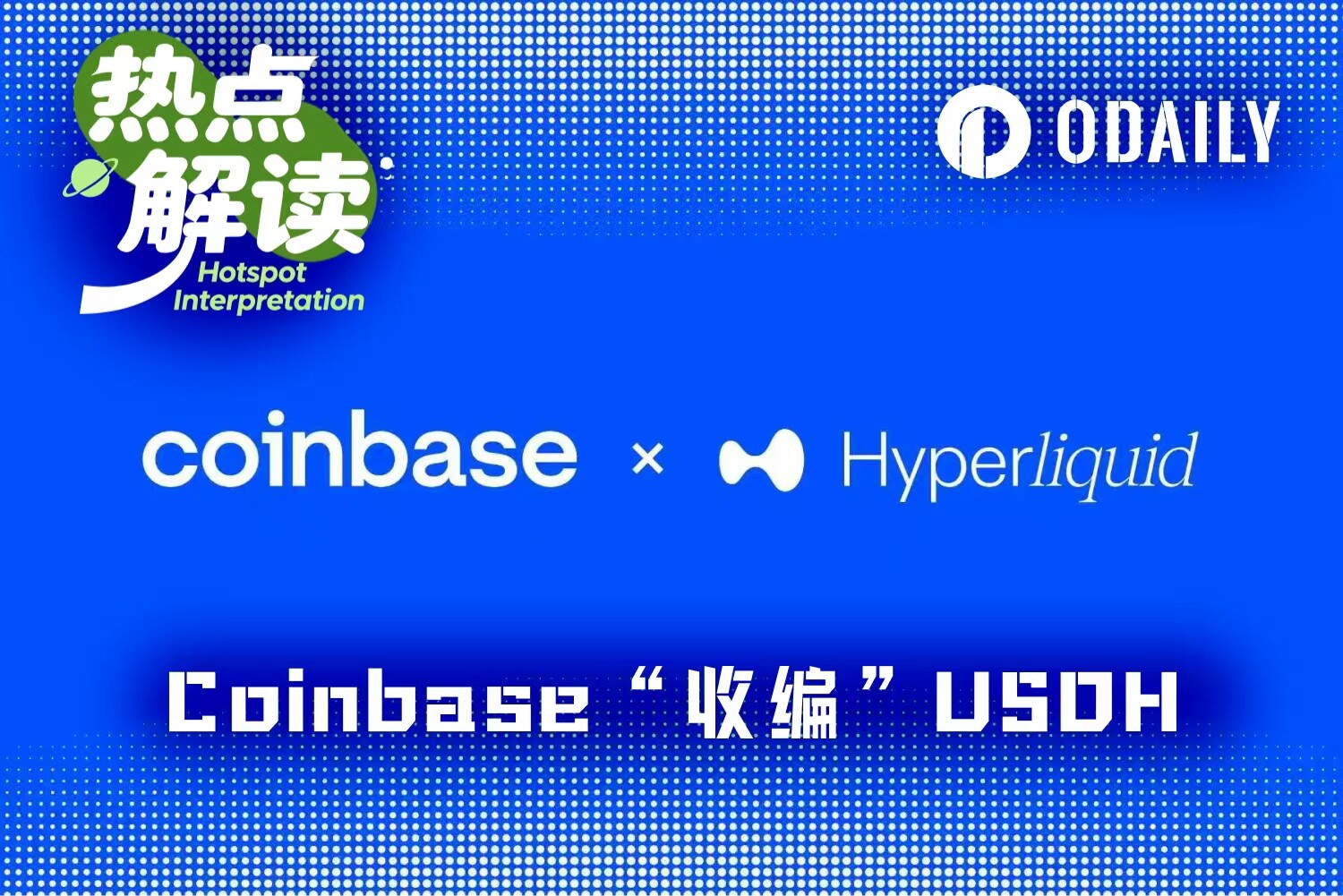
In September of last year, the battle over the Hyperliquid native stablecoin USDH once became a focal point in the industry; now, this once highly anticipated stablecoin has suddenly welcomed its own "exit moment."

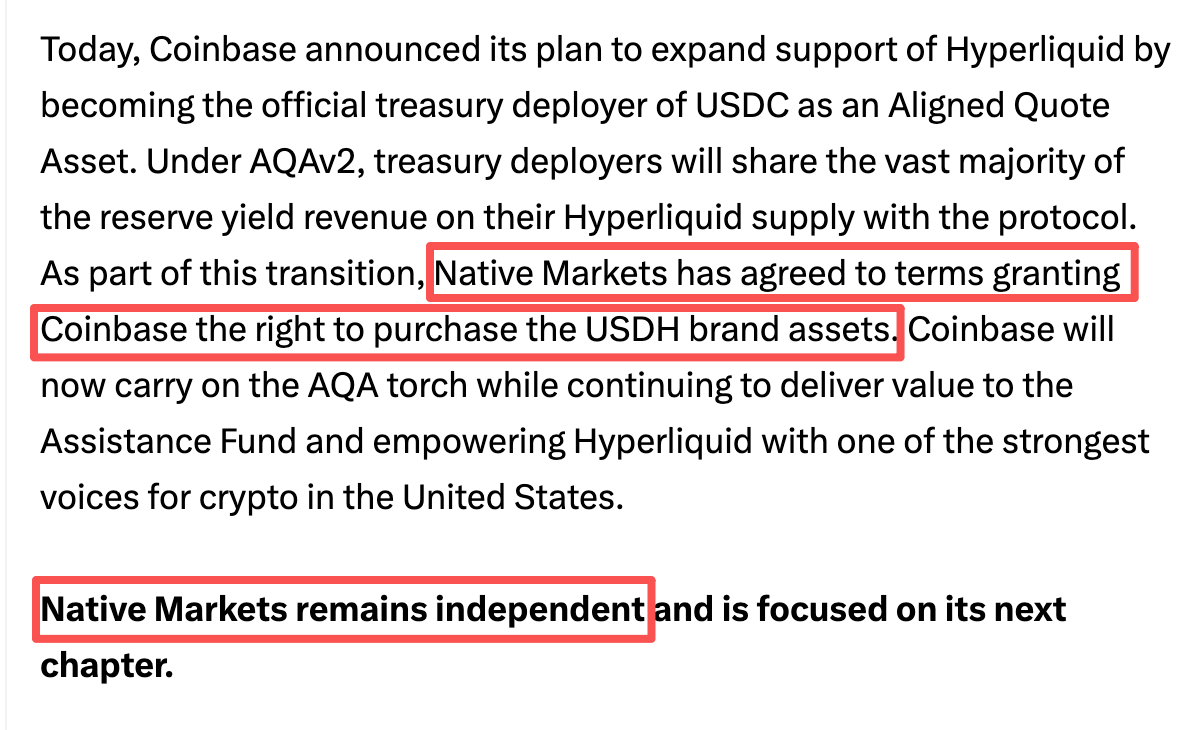
Last night, Coinbase announced it would become the official treasury deployer for USDC on Hyperliquid, while Native Markets, the issuer of the Hyperliquid native stablecoin USDH, granted Coinbase the right to purchase USDH brand assets. Subsequently, the USDH market will be gradually phased out, during which users can still convert USDH to USDC or fiat currency without transaction fees.

From this point on, the once-famous USDH has become an asset absorbed by Coinbase, while USDC is officially established as the official stablecoin and quote asset of Hyperliquid. Odaily Planet Daily will briefly analyze the details and subsequent impacts of this event in this article.

USDH Exits, USDC Rises: The Economic Calculations Behind $50 Billion

This grand play of the "Hyperliquid Ecosystem Stablecoin Battle" ultimately concluded with a win-win-win outcome for the three parties: Coinbase & Circle, Hyperliquid, and Native Markets, the USDH issuer.

Coinbase further deepened its integration with the Hyperliquid ecosystem through this move; Hyperliquid secured the majority of the revenue from USDC stablecoin reserves within its ecosystem; Native Markets, as the ultimate beneficiary of USDH, received its reward in the form of "selling the USDH brand assets."

Coinbase & Circle: Binding to Hyperliquid's On-Chain Economy, Continuously Increasing Investment in HYPE

Currently, the scale of USDC on Hyperliquid is approximately $5.164 billion, a year-on-year increase of 2 times.

As the official partner and revenue-sharing party for USDC, Coinbase's action undoubtedly aims to deeply integrate with the Hyperliquid ecosystem.

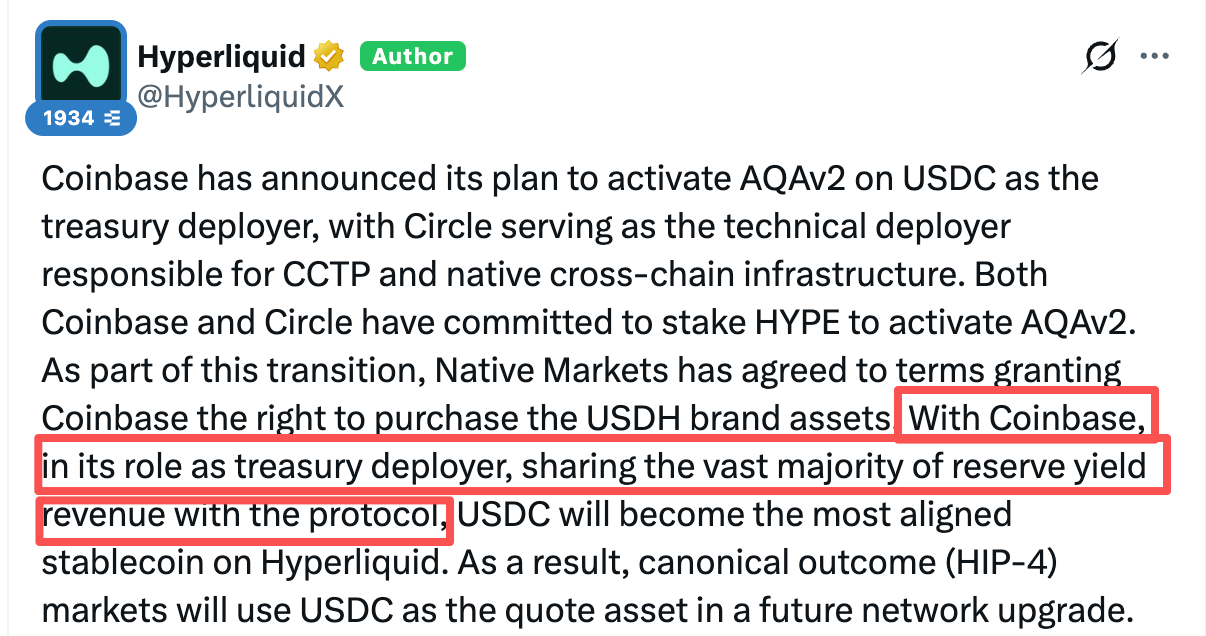
Additionally, according to official Hyperliquid announcement information, both Coinbase (funds deployer) and Circle (responsible for CCTP and native cross-chain infrastructure technical deployment) have committed to staking HYPE to activate AQAv2 (Aligned Quote Asset v2).

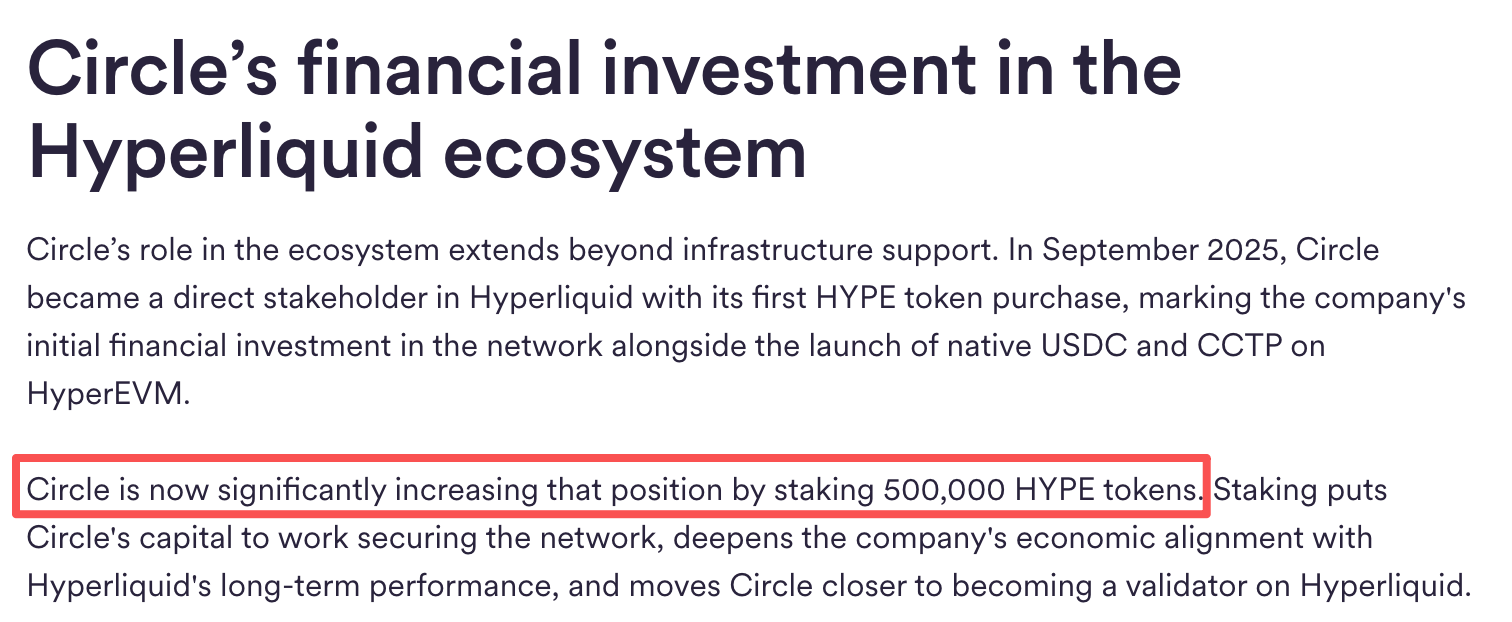
It is worth mentioning that in September last year, Circle had already purchased HYPE tokens, and its current HYPE token staking scale has increased to around 500,000.
Hyperliquid: Secures the Lion's Share of USDC Reserve Revenue, Enjoys the Convenience of Being a Coinbase Ally

As for the biggest winner of this cooperation, it is undoubtedly Hyperliquid as the foundational ecosystem.

According to the official announcement, Coinbase will subsequently share the majority (vast majority) of reserve revenue income with the Hyperliquid protocol. Although the specific split ratio has not been disclosed, if based on the previous USDH revenue-sharing mechanism, Hyperliquid will actually receive approximately 90% of the reserve revenue.

According to calculations by Hyperliquid community members, based on a scale of $4.7 billion and a 3.8% interest income rate, this revenue corresponds to approximately $160 million; in other words, it corresponds to a daily HYPE token buyback of about $440,000.

Furthermore, with the CLARITY Act passing the vote in the U.S. Senate Banking Committee, the deep integration between Hyperliquid and Coinbase also means that HYPE and Hyperliquid have gained a certain level of support in terms of U.S. regulation.
Native Markets: USDH's Historical Mission Accomplished

As the issuer of the Hyperliquid native stablecoin USDH, Native Markets might seem like the biggest loser in this "absorption event," but judging from its official statement, its ending can also be considered a "successful retirement."

On one hand, USDH provided a model and template for the revenue sharing of USDC between Coinbase and the Hyperliquid protocol; on the other hand, Coinbase likely directly acquired the USDH-related brand assets. The USDH stablecoin issued by the Native Markets team was essentially "acquired by Coinbase," thus providing the team with a certain economic return.

Subsequently, Native Markets also stated it would remain independent and seek developments in other areas.
After USDH's Exit, In a Win-Win-Win Situation, Only USDH Users Get Hurt

Of course, Native Markets' exit has not been met with universal "praise." Hyperliquid community users have also expressed disapproval of its so-called "sitting at the negotiation table" narrative.

Some believe that the exit of USDH signifies a complete regression of the decentralization era;

Others point out that during the original USDH stablecoin issuer vote, Paxos should have been chosen, as they at least considered users and stablecoin growth. Those who voted for Native Markets were merely aligning with factions and internal interests. Ultimately, users gained nothing. These remarks have garnered considerable agreement and support.

Thus, the drama from a year ago, filled with "dominant pursuit," "resistance against giants," has finally come to an end.

However, looking back now at the scene of Hyperliquid "shaking hands and making peace" with Coinbase and Circle is somewhat poignant and slightly ironic.

In the end, everything was merely about the distribution of interests, not the once-loudly proclaimed slogans of "for the community" or "for Hyperliquid."

Recommended Reading

Hyperliquid Stablecoin USDH Becomes the "Industry's Favorite," Giants Trigger Chaotic Battle for Distribution Rights

USDH Vote in Progress: "Prearranged Script," "Dominant Pursuit," "Stepping Down Bravely" Take Turns on Stage


Preguntas relacionadas

QWhat major announcement did Coinbase make regarding Hyperliquid, and what does it mean for USDH?

ACoinbase announced it will become the official USDC treasury deployer on Hyperliquid. Additionally, USDH issuer Native Markets granted Coinbase the right to purchase the USDH brand assets. This means the USDH market will gradually be shut down, and USDH will effectively be 'acquired' by Coinbase, while USDC is established as Hyperliquid's official stablecoin and quote asset.

QAccording to the article, why is Hyperliquid considered the biggest winner in this arrangement?

AHyperliquid is considered the biggest winner because it will receive the vast majority (estimated around 90%) of the revenue generated from the USDC reserves on its platform. This represents significant, ongoing income. Furthermore, the deep partnership with Coinbase provides regulatory support and convenience for the Hyperliquid ecosystem in the US market.

QWhat benefit does the article state that Coinbase and Circle gain from this partnership with Hyperliquid?

ACoinbase and Circle gain a deeper economic and strategic bond with the Hyperliquid ecosystem. Coinbase strengthens its role as a major stablecoin infrastructure provider. Both companies have also committed to staking HYPE tokens to support the platform's AQAv2 (Aligned Quote Asset) mechanism, with Circle having already increased its HYPE stake significantly.

QHow is the outcome for Native Markets, the issuer of USDH, described in the article?

AThe outcome for Native Markets is described as achieving a 'graceful exit' or 'mission accomplished.' While they are stepping away from USDH, they are reportedly receiving financial compensation from Coinbase for the sale of the USDH brand assets. The team will remain independent to pursue other ventures, having paved the way for the USDC revenue-sharing model.

QWhat is one of the main criticisms from the Hyperliquid community regarding the shutdown of USDH?

AOne major criticism from the community is that the shutdown of USDH represents a step back for decentralization. Some users also expressed disappointment, arguing that the initial vote for the USDH issuer was driven by internal interests and 'bandwagoning' rather than choosing an issuer (like Paxos) that would prioritize users and the stablecoin's growth, leaving end-users with nothing.

Lecturas Relacionadas

AI PC Battle: Bet on the Toll Booth, Not the Camp

**Title:** The AI PC Battle: Don't Bet on Sides, Bet on the Tollbooth **Summary:** The AI PC competition is moving beyond simple "x86 vs. Arm" narratives. The core investment thesis should focus on identifying which players can sustain margins, cash flow, and pricing power throughout the upgrade cycle, rather than backing a particular architecture. The opportunity is analyzed in three layers: 1. **The Advanced Foundry Tollbooth:** TSMC is positioned to collect "tolls" regardless of which chip designer wins, due to its dominant ~70% share in advanced semiconductor manufacturing, which is essential for high-end AI PC chips. 2. **Compute & Platform Spillover:** AMD represents an offensive in the x86 CPU+GPU space, while NVIDIA leverages its GPU and CUDA software stack dominance. Both benefit from the demand for increased local AI compute. 3. **Architecture Diffusion & Turnaround Plays:** ARM and Intel offer potential for significant upside (elasticity), but investments here require stricter discipline due to higher execution risks and competitive challenges. The industry is transitioning from concept to shipment validation. While short-term forecasts for AI PC adoption have been revised down slightly due to tariffs and procurement delays, the long-term trend towards AI becoming a standard PC feature remains intact. The key driver for upgrade cycles will be whether compelling enterprise applications (e.g., privacy-sensitive computing, low-latency inference) emerge beyond consumer-focused features like meeting summarization. Investment strategy should prioritize companies with platform-level advantages and recurring revenue streams. TSMC offers high certainty as the foundational tollbooth. AMD presents a strong offensive play within the established ecosystem. ARM and Intel are higher-risk, higher-potential-reward turnaround bets. The report cautions against chasing short-term hype and emphasizes a disciplined, long-term approach focused on buying ecosystem strength and cash-flow certainty after market enthusiasm subsides. **Key Risks:** Underwhelming AI PC applications slowing upgrade cycles; slow improvement in Windows on Arm compatibility; macro/tariff impacts on PC demand; potential advanced node supply-demand mismatches affecting TSMC; high overall AI sector valuations making stocks vulnerable to a risk-off shift in markets.

marsbitHace 7 min(s)

AI PC Battle: Bet on the Toll Booth, Not the Camp

marsbitHace 7 min(s)

Ten-Thousand-Word Analysis: From $10 to $290, MRVL Wins the Entire AI Era by 'Not Making GPUs'

Marvell Technology's stock price surged from under $10 in 2016 to a record $290 in June 2026, fueled not by making GPUs, but by dominating AI infrastructure connectivity. This analysis argues the market misvalues MRVL as merely a smaller Broadcom in custom AI chips, overlooking its true, unique position. Marvell's core strength lies in enabling high-speed data flow for AI clusters through three interconnected businesses. First, it holds a commanding ~70% market share in high-speed optical DSPs (essential for data center light modules), a deep-moat business with accelerating growth. Second, its custom AI chip design business serves hyperscalers like AWS, Microsoft, and Google, with a significant revenue pipeline despite lower margins. Third, stable cash flows come from Ethernet switch chips and enterprise storage controllers. Together, they form a full-stack "AI data movement" platform. CEO Matt Murphy's transformative leadership since 2016, involving strategic divestments, key acquisitions (like Inphi for optical DSPs), and securing long-term agreements with major cloud providers, repositioned the company. A pivotal $2 billion strategic investment from NVIDIA in 2026 underscored Marvell's critical role in the AI ecosystem, particularly through collaborations like NVLink Fusion. While Marvell faces risks—including client concentration (losing the Amazon Trainium3 design), lower-margin business mix, competitive threats, insider selling, and complex supply chains—its fundamentals remain strong. The optical interconnect moat is widening with the acquisition of Celestial AI (photonics fabric), and financial metrics show accelerating revenue growth and operating leverage. With a PEG ratio suggesting undervaluation relative to its growth, the thesis is that the market undervalues Marvell's monopolistic position in AI "plumbing" while overemphasizing its competitive custom chip segment. The story transcends investing, symbolizing how in any complex system—from the internet to AI—the value of "connection" ultimately surpasses that of individual "nodes."

marsbitHace 37 min(s)

Ten-Thousand-Word Analysis: From $10 to $290, MRVL Wins the Entire AI Era by 'Not Making GPUs'

marsbitHace 37 min(s)

AI Relay Stations Spark Heated Debate on Zhihu: Behind Cheap Tokens, What Are Users Really Worried About?

A discussion on Zhihu about "AI relay stations" shifted the niche developer topic of "cheap tokens" into broader user awareness. Users moved beyond simply questioning the legitimacy of these services to focus on practical concerns: Where do cheap tokens truly come from? Is the model being accessed the real one? Can relay stations see prompts, code, and API keys? For occasional users, are the risks worth it? The core debate centered less on price and more on trust. A primary worry is model authenticity—the risk of "model swapping," where users paying for a premium model might be routed to a cheaper one, creating an information asymmetry. Others argued that cost comparisons matter; while cheaper than official pay-as-you-go APIs, relay stations may not be the lowest-cost option versus subscriptions, domestic models, or free tiers, making user needs assessment crucial. Speculation about token sources ranged from legitimate bulk discounts to gray-area methods like account sharing or exploiting regional pricing. This opacity makes risk assessment difficult for users. Data security emerged as a critical concern, especially for enterprise use. When processing sensitive information like code, contracts, or client data, the inability to verify a relay station's data handling, retention, or access policies poses significant compliance and confidentiality risks. The evolving consensus suggests relay stations can be used cautiously for low-sensitivity, disposable tasks (e.g., summarizing public info, simple translation). However, they should not be the default for sensitive, professional, or production workflows involving proprietary data, Agents, or automated systems. Recommendations include avoiding large prepayments, not relying on a single service, using test prompts to monitor quality, anonymizing data where possible, and keeping official channels as backups. Ultimately, the discussion framed tokens not just as a billing unit but as a measure of real cost encompassing price, model integrity, data security, and service stability. The popularity of relay stations highlights user demand for affordable access, but the debate underscores a key trade-off: the savings from cheap tokens may come at the price of trust, transparency, and control over one's data and AI experience.

marsbitHace 1 hora(s)

AI Relay Stations Spark Heated Debate on Zhihu: Behind Cheap Tokens, What Are Users Really Worried About?

marsbitHace 1 hora(s)

In-Depth Research Report on TradFi: The Convergence Wave of Crypto and Traditional Finance

In 2026, the crypto industry is undergoing a profound infrastructure-level transformation—TradFi assets are migrating on-chain at an unprecedented pace. According to CoinGecko's Q1 2026 report, the total value locked (TVL) of tokenized real-world assets (RWA) has surpassed $31 billion, a nearly 4x increase from $7.8 billion at the beginning of 2025, with the sector’s aggregate market capitalization reaching $19.3 billion. Among these, the market cap of tokenized stocks surged from $2 million to $486 million, with Q1 spot trading volume reaching $15.1 billion—a single quarter already surpassing the entire second half of 2025. RWA perpetual contract Q1 trading volume reached a staggering $524.8 billion, far exceeding the $313 billion for all of 2025. Meanwhile, BlackRock's BUIDL fund has reached $2.3 billion in scale and has filed for two new tokenized funds, signaling that the world's largest asset manager's tokenization strategy is evolving from pilot to product suite expansion. HTX, as a core participant in the crypto exchange sector, officially launched TradFi perpetual futures products including NVDA, AAPL, MSFT, META, and SPY in 2026, enabling crypto users to gain 24/7 trading access to core U.S. equities. Boston Consulting Group predicts that global tokenized asset scale could reach $16 trillion by 2030, while McKinsey offers a conservative estimate of approximately $2 trillion. The on-chain migration of TradFi assets is no longer a "future narrative" but a structural transformation unfolding in real time, as crypto exchanges evolve from single crypto asset trading platforms toward "multi-asset-class trading infrastructure."

HTX LearnHace 1 hora(s)

In-Depth Research Report on TradFi: The Convergence Wave of Crypto and Traditional Finance

HTX LearnHace 1 hora(s)

Trading

Spot
Futuros
活动图片