Behind ANSEM's 300% Weekly Surge: The Recovery and Traps of Solana Meme Coins

Foresight NewsPublicado a 2026-07-08Actualizado a 2026-07-08

Resumen

The meme coin ANSEM surged nearly 299% in a week, driving a resurgence in Solana-based meme token activity. Data from DeFiLlama shows Pump.fun's weekly DEX volume reached $5.33 billion, with July 4th marking the platform's first $1 billion daily volume since April. This revival saw a spike in new token launches and heightened trading activity, with memes again accounting for over 20% of Solana's weekly transaction volume. However, industry reports highlight significant risks. The average meme coin holding time has plummeted to around 100 seconds, and sophisticated bots often front-run retail investors, acquiring large portions of supply at launch before dumping. Research analyzing thousands of projects indicates widespread market manipulation, with a majority of top-gaining tokens showing signs of wash trading and pool manipulation. While meme coins effectively attract new users and generate hype for the Solana ecosystem, the current rally raises the critical question of whether this cycle can break free from the established pattern where late-arriving retail traders become exit liquidity for early bots and coordinated groups. The market's future trajectory hinges on whether the momentum can be sustained or if it will fade, leading traders back to major assets like SOL.


Author: Gino Matos

Compiled by: Chopper, Foresight News


The Meme coin ANSEM has surged nearly 299% in seven days, driving a recovery in the Solana Meme coin market. According to DeFiLlama data, the weekly trading volume of Pump.fun on decentralized exchanges (DEX) reached $5.33 billion, with a 30-day trading volume of $18.22 billion.


July 4th marked the first time since April 8th that Pump.fun and PumpSwap's daily trading volume exceeded $1 billion, and the trading volume for the week of June 29th to July 5th was the first to surpass $5 billion since late March.


Driven by the ANSEM rally, on July 1st, the Solana Meme coin launch platform saw the number of newly launched tokens and graduating projects hit an 80-day high. Alongside ANSEM's explosive popularity, a large number of copycat tokens emerged simultaneously. The proliferation of copycats has historically been a typical signal of a Meme coin bull market revival. A Phemex research report on July 1st pointed out that within just two weeks, the issuance fees on the Pump.fun platform recovered to 62% of their previous peak, and trading volume rebounded to 55%.
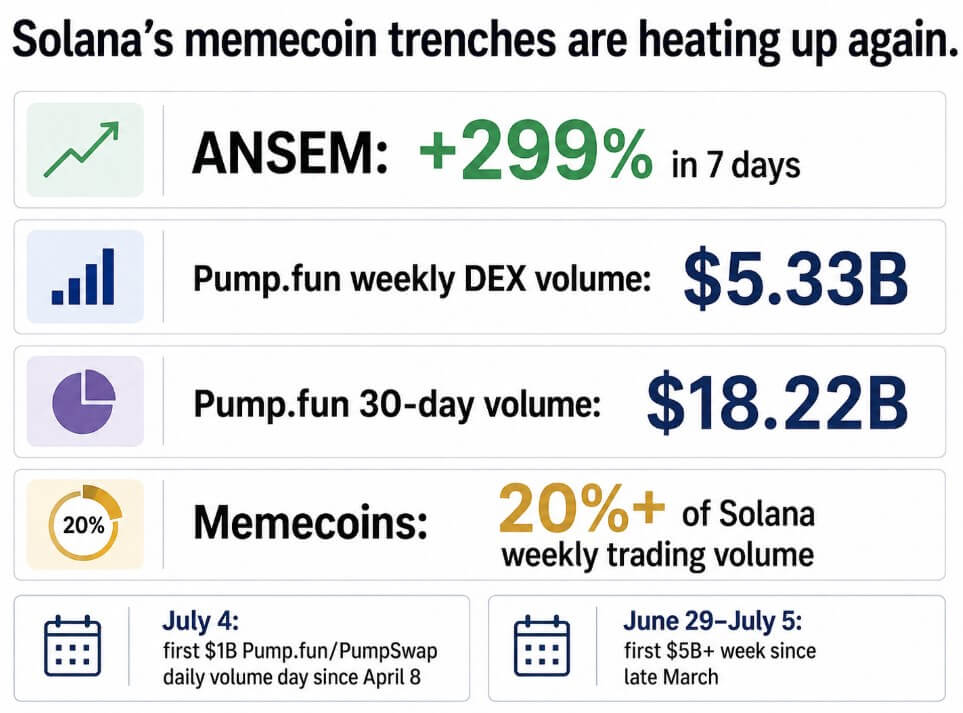

ANSEM rose 299% in a week, Pump.fun's weekly trading volume was $5.33 billion, and Meme coins accounted for over 20% of Solana's trading volume


This recovery trend is also reflected in the broader market. Data from Blockworks shows that Meme coins account for over 20% of Solana's weekly trading volume, the first time since mid-May.


A Galaxy research report from October 2025 noted that in Q4 2024, Meme coins once accounted for 50% of Solana's weekly trading volume. The current 20% share indicates only a modest market recovery, still far from its peak.


Galaxy also pointed out that compared to various formal DeFi products, Meme coins can more quickly attract ordinary retail investors to create wallets, use decentralized exchanges, and cross-chain bridges. These tokens have an extremely low barrier to entry and inherent social virality, directly converting traffic and hype into tradable assets.


However, the contradiction within the sector is also highlighted here. While Meme coins can attract new users, their ultra-fast-paced trading rules foster an extremely unequal playing field, where retail investors often end up as exit liquidity for bots and whales. The meteoric rise of ANSEM has brought this contradiction back into the spotlight.


Statistics from Galaxy show that the current average holding time for Meme coins is only 100 seconds, down from about 300 seconds in previous cycles, indicating a significant acceleration in trading pace. Sniping bots and batch wallets hoard large amounts of tokens the moment they launch, then sell off to cash out once retail investors FOMO in.


A paper presented at the 2026 ACM Conference on Computer and Communications Security, titled "Preventing Manipulative Bots in Meme Coin Copy Trading," fully dissects this harvesting logic: copy trading has become the mainstream entry method for retail, but bots react far faster than humans. The paper surveyed over 6,000 Meme projects, finding that the vast majority of tokens are swept up by bots within 1 to 5 blocks of launch.


The MemeTrans platform, tracking over 41,000 Solana Meme projects and 200 million on-chain transactions, found that various coordinated manipulation accounts hold an average of 36.5% of a project's circulating supply; while holdings appear dispersed, they are actually highly concentrated. In the survey, 84.13% of projects were flagged as high-risk. Another research report analyzed 34,988 Meme tokens, revealing that among the top gainers, 82.8% showed signs of artificial volume generation like wash trading and pool manipulation, with over 17,000 wallet addresses incurring cumulative losses exceeding $9.3 million.


These data clearly reflect a pattern: the Meme coins with the most exaggerated gains often have the most severe artificial manipulation.


So, has the Meme market recovered?


A bull market scenario is characterized by Pump's daily trading volume consistently exceeding $1 billion, with Solana's Meme coins accounting for close to 30% of weekly trading volume.


ANSEM drives the continuous emergence of explosive secondary Meme coins, with user growth, launch speed, and attention reinforcing each other. This situation more closely resembles the early rise of Meme coins.


In a bear market scenario, ANSEM's copycats distract investors, Pump's weekly trading volume falls back below $3 billion, and Meme coins' share of Solana's total trading volume drops to 15%-18%. In this case, ANSEM would be a flash in the pan, and traders would turn back to SOL, mainstream cryptocurrencies, and other more liquid altcoins.
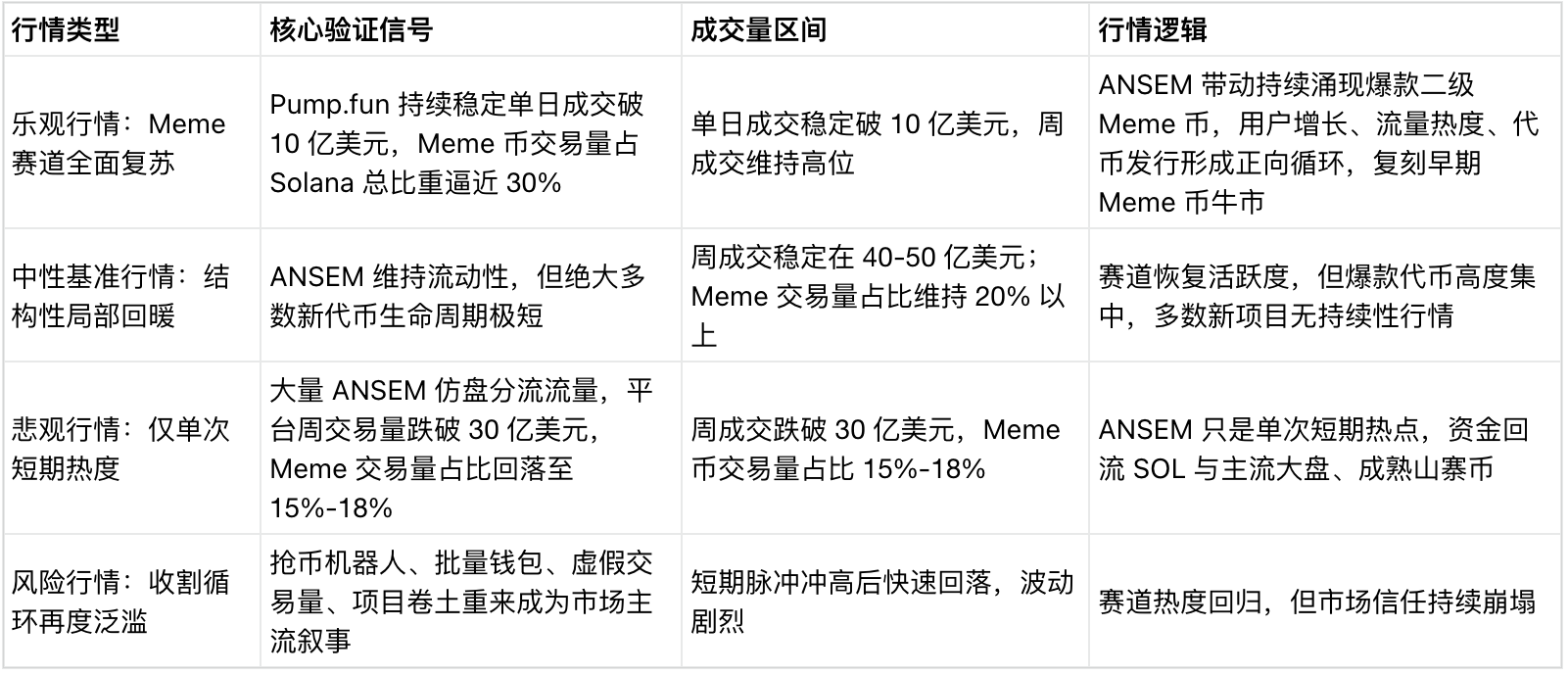

Four subsequent market scenarios


It is undeniable that the Solana Meme sector possesses strong traffic-driving capabilities, achieving levels of attention and hype that most formal blockchain products find hard to match. However, with this ANSEM-driven market recovery, the industry needs to consider: Can this wave of hype break free from the old cycle of bot sniping and whale manipulation, and stop making later-entering retail investors the exit liquidity for early funds?


Criptos en tendencia

Preguntas relacionadas

QAccording to the article, what is the key indicator of a true bull market for Solana meme coins?

AA true bull market for Solana meme coins is indicated by the daily trading volume on platforms like Pump.fun consistently exceeding $10 billion and meme coins accounting for close to 30% of Solana's total weekly trading volume.

QWhat significant risk for retail investors in the meme coin market is highlighted by the academic paper presented at the 2026 International Conference on Computer Communication and Networks?

AThe paper highlights the risk of 'sniping bots' and manipulation. It details that bots can execute trades within 1 to 5 blocks after a meme coin launches, accumulating large positions before most human investors can react, creating an uneven and potentially predatory trading environment.

QBased on the data from MemeTrans, what percentage of the analyzed Solana meme projects were flagged as high-risk?

AAccording to the MemeTrans platform's analysis of over 41,000 Solana meme projects, 84.13% of them were flagged as high-risk assets.

QWhat does the article suggest is the primary contradiction or paradox within the Solana meme coin ecosystem?

AThe primary contradiction is that while meme coins are excellent at attracting new users to the Solana ecosystem due to their low barrier to entry and viral nature, they also create a hyper-fast, unequal trading environment. This environment, dominated by bots and coordinated groups, often results in retail investors becoming exit liquidity for early, manipulative insiders.

QWhat scenario would likely lead ANSEM to be a fleeting phenomenon, causing traders to shift focus back to major assets like SOL?

AANSEM would become a fleeting phenomenon in a bearish market scenario. This is characterized by its numerous copycat versions diluting investor attention, weekly trading volume on Pump.fun falling back below $3 billion, and the meme coin share of Solana's total trading volume dropping to 15-18%.

Lecturas Relacionadas

Embodied Intelligence 'Gaokao' is Insanely Hard, Humans Score 100, Best Model Only 12.8

Embodied AI Faces a Daunting "Everest": New Benchmark Reveals Huge Gap Between Models and Humans A comprehensive new benchmark for robotic manipulation, RoboDojo, has been released, painting a stark picture of the current state of embodied AI. It serves as a unified evaluation platform covering both simulation and real-world robot tasks. The benchmark assesses five core capabilities: Generalization (adapting to new scenes/objects), Memory, Precision manipulation, Long-Horizon multi-step tasks, and Open semantic understanding. It includes 42 simulation tasks and 18 standardized real-world tasks across three dual-arm robot platforms. The results are sobering. In simulation, the best-performing generalist robot policy achieved an average success rate of only 8.80%. Performance in the real world was slightly higher but still low, with the top model succeeding 12.8% of the time on average. In stark contrast, human experts scored 76.03% in simulation and 100% in real-world tests. The benchmark highlights significant, uneven gaps in current models' abilities. While some excel in specific areas like visual recognition or simple actions, they struggle with reliability, especially in long-horizon tasks where errors accumulate and in open-ended semantic instructions. The low scores, particularly in real-world deployment with physical uncertainties like camera noise and contact dynamics, underscore that today's models are far from being robust, general-purpose operational robots. RoboDojo is more than just a ranking; it's an infrastructure designed for fair, reproducible comparison. Its companion system, XPolicyLab, standardizes the interface for different models to be evaluated. Maintained by an academic consortium without commercial ties, it aims to provide a community-wide "altitude meter" to track genuine progress toward reliable and generalizable robot manipulation.

marsbitHace 26 min(s)

Embodied Intelligence 'Gaokao' is Insanely Hard, Humans Score 100, Best Model Only 12.8

marsbitHace 26 min(s)

Weng Li's New Blog Proposes 'Self-Evolution Should Start from Harness', DeepSeek's Cui Tianyi Endorses with Repost

Lilian Weng, former OpenAI security VP and co-founder of Thinking Machines Lab, has published a new blog post titled "Harness Engineering for Self-Improvement," proposing a pragmatic path for AI self-evolution. She argues that Recursive Self-Improvement (RSI) may practically begin at the "Harness" layer—the external runtime system governing how models use tools, manage context, and execute tasks—rather than directly from the model rewriting its own weights. The blog outlines a progression from optimizing prompts (Context Engineering) to designing workflows, and ultimately to Self-Improving Harness systems. These systems can identify their own weaknesses, propose targeted, verifiable modifications to the harness code, and validate improvements. Works like Self-Harness and Darwin Gödel Machine (DGM) demonstrate significant performance gains on benchmarks like SWE-bench through such automated harness evolution, rivaling handcrafted agents. DeepSeek researcher Tianyi Cui endorsed the view, noting harness-based self-evolution is as promising as model-based approaches. Weng emphasizes this is complementary to model training, with both reinforcing each other. However, key challenges remain: weak evaluators for subjective tasks, reward hacking, diversity collapse, managing long-term system health versus short-term success, and defining the human oversight role. The consensus is growing: the harness is a critical variable, as the same model can exhibit vastly different capabilities within different harness systems.

marsbitHace 1 hora(s)

Weng Li's New Blog Proposes 'Self-Evolution Should Start from Harness', DeepSeek's Cui Tianyi Endorses with Repost

marsbitHace 1 hora(s)

Trading

Spot

Artículos destacados

Qué es MEME 2.0

Memecoin 2.0: El Ascenso de $MEME 2.0 en el Mundo de las Criptomonedas Introducción En el panorama siempre cambiante de las criptomonedas, ha surgido un nuevo contendiente. Memecoin 2.0, simbolizada como $MEME 2.0, lleva el concepto de las monedas meme a un emocionante nuevo nivel. Como un subproducto del Memecoin original, este proyecto ha capturado la atención de la comunidad cripto al cambiar el enfoque de los incentivos financieros típicos a una experiencia comprometida y entretenida. Operando en la blockchain de Ethereum, Memecoin 2.0 redefine audazmente la participación de la comunidad en la esfera cripto. ¿Qué es Memecoin 2.0, $MEME 2.0? En su núcleo, Memecoin 2.0 es un proyecto de criptomoneda que prioriza el espíritu comunitario y la diversión asociada con la cultura meme. A diferencia de las criptomonedas convencionales, que se concentran en casos de uso prácticos y beneficios tangibles, Memecoin 2.0 se distingue al abrazar el lado más liviano de la moneda digital. El proyecto existe sin promesas de utilidad, un mapa estructurado o retornos financieros, enfocándose en cambio en fomentar una comunidad vibrante centrada en memes y en el disfrute compartido. Al hacerlo, aprovecha la creciente tendencia de la cultura meme en el espacio en línea, convirtiéndose en un jugador único en el mundo de los activos digitales. Creador de Memecoin 2.0, $MEME 2.0 A pesar de la extensa investigación sobre los orígenes de Memecoin 2.0, la identidad explícita de su creador sigue siendo desconocida. Esta anonimidad no es inusual en la comunidad cripto, donde muchos proyectos son liderados por individuos o grupos que prefieren permanecer en las sombras. La falta de información disponible públicamente sobre el creador podría verse como un movimiento estratégico, poniendo el foco en la participación comunitaria en lugar de la notoriedad individual dentro del espacio. Inversores de Memecoin 2.0, $MEME 2.0 La información sobre los inversores o el respaldo financiero de Memecoin 2.0 es escasa. Esta ausencia de detalles puede sugerir que el proyecto es autofinanciado o que su enfoque en la comunidad en lugar de las estructuras de inversión tradicionales ha atraído a un tipo diferente de apoyo. Dado que el mundo de las monedas meme generalmente involucra una participación más de base en lugar de inversión institucional, este enfoque está alineado con la ética de los proyectos impulsados por la comunidad. ¿Cómo Funciona Memecoin 2.0, $MEME 2.0? Memecoin 2.0 opera completamente en la blockchain de Ethereum, capitalizando sus robustas características de seguridad y escalabilidad. Al aprovechar las fortalezas de Ethereum, Memecoin 2.0 puede ofrecer un entorno seguro para las interacciones de los usuarios, asegurando que las transacciones sean tanto eficientes como rentables. Uno de los atributos únicos de Memecoin 2.0 radica en su estructura impulsada por la comunidad. El valor y la popularidad del token $MEME 2.0 derivan de la participación activa de sus usuarios, en vez de de una utilidad inherente. Este diseño refuerza el enfoque del proyecto en el aspecto de entretenimiento de las criptomonedas, lo que implica que la risa y la participación comunitaria son las verdaderas monedas que impulsan su éxito. Además, el proyecto encaja dentro del ecosistema más amplio de las monedas meme, donde el valor de cada moneda meme oscila basado en la cultura, tendencias y la participación de la comunidad, en lugar de principios económicos tradicionales. Cronología de Memecoin 2.0, $MEME 2.0 Para entender mejor la evolución y los hitos de Memecoin 2.0, aquí hay una cronología que destaca eventos significativos en su historia: 2024: Se reconoce la creación de Memecoin 2.0 como una ramificación del Memecoin original, estableciéndose dentro del contexto próspero de las monedas meme mientras opera en la blockchain de Ethereum. 13 de julio de 2024: Memecoin 2.0 se posiciona oficialmente como una moneda meme centrada en la comunidad en la red de Ethereum, enfatizando su enfoque centrado en el entretenimiento que invita a los usuarios a participar y crecer. Puntos Clave Sobre Memecoin 2.0, $MEME 2.0 Varios rasgos críticos definen a Memecoin 2.0: Enfoque Centrado en la Comunidad: La misión principal de Memecoin 2.0 es crear una experiencia comunitaria divertida y atractiva, capitalizando en el disfrute colectivo derivado de la cultura memética. Construido sobre Ethereum: Operar en la blockchain de Ethereum proporciona al proyecto una infraestructura esencial que garantiza seguridad y escalabilidad. Falta de Utilidad o Hoja de Ruta: En un notable desvío de las criptomonedas tradicionales, Memecoin 2.0 no promete características utilitarias ni retornos financieros, reafirmando su compromiso con la participación comunitaria y el compromiso social. Enfoque en la Cultura Memética: Al abrazar los aspectos humorísticos y culturales del fenómeno meme, Memecoin 2.0 proporciona una plataforma para que los usuarios interactúen con cripto tanto fuera de línea como en línea. Contexto Adicional: La Importancia de las Monedas Meme Las monedas meme han surgido como una clase distinta de criptomonedas, a menudo impulsadas por el humor y un enfoque desenfadado para el comercio. Estas monedas generalmente carecen de una utilidad significativa o hojas de ruta de desarrollo, atrayendo a los usuarios con la promesa de diversión, interacción comunitaria y relevancia cultural. En el panorama del ecosistema cripto más amplio, las monedas meme reviven la importancia de la participación comunitaria, revirtiendo enfoques únicamente motivados por el lucro. Proyectos como Memecoin 2.0 inauguran una era donde el entretenimiento puede armonizar con las aspiraciones financieras, convirtiendo la blockchain en un parque de diversiones para la creatividad y la interacción social. Conclusión Memecoin 2.0, o $MEME 2.0, encarna una nueva ola de criptomonedas que prioriza la participación comunitaria sobre estructuras financieras rígidas. Con un enfoque en el humor y la interacción social, capitaliza sobre la fascinación que rodea la cultura meme. Al operar en la blockchain de Ethereum, Memecoin 2.0 aprovecha las capacidades de la tecnología mientras se mantiene firme en su compromiso con el valor de entretenimiento de la moneda digital. A medida que el espacio alrededor de las criptomonedas continúa evolucionando, Memecoin 2.0 sirve como un testimonio de la noción de que el futuro de los activos digitales podría depender, en gran medida, de experiencias compartidas, risas y sólidas conexiones comunitarias. En el mundo impredecible de las criptomonedas, quizás la alegría pueda ser tan valiosa como la ganancia financiera tradicional.

119 Vistas totalesPublicado en 2024.04.04Actualizado en 2024.12.03

Qué es MEME 2.0

Cómo comprar MEME

¡Bienvenido a HTX.com! Hemos hecho que comprar Memeland (MEME) sea simple y conveniente. Sigue nuestra guía paso a paso para iniciar tu viaje de criptos.Paso 1: crea tu cuenta HTXUtiliza tu correo electrónico o número de teléfono para registrarte y obtener una cuenta gratuita en HTX. Experimenta un proceso de registro sin complicaciones y desbloquea todas las funciones.Obtener mi cuentaPaso 2: ve a Comprar cripto y elige tu método de pagoTarjeta de crédito/débito: usa tu Visa o Mastercard para comprar Memeland (MEME) al instante.Saldo: utiliza fondos del saldo de tu cuenta HTX para tradear sin problemas.Terceros: hemos agregado métodos de pago populares como Google Pay y Apple Pay para mejorar la comodidad.P2P: tradear directamente con otros usuarios en HTX.Over-the-Counter (OTC): ofrecemos servicios personalizados y tipos de cambio competitivos para los traders.Paso 3: guarda tu Memeland (MEME)Después de comprar tu Memeland (MEME), guárdalo en tu cuenta HTX. Alternativamente, puedes enviarlo a otro lugar mediante transferencia blockchain o utilizarlo para tradear otras criptomonedas.Paso 4: tradear Memeland (MEME)Tradear fácilmente con Memeland (MEME) en HTX's mercado spot. Simplemente accede a tu cuenta, selecciona tu par de trading, ejecuta tus trades y monitorea en tiempo real. Ofrecemos una experiencia fácil de usar tanto para principiantes como para traders experimentados.

245 Vistas totalesPublicado en 2024.12.12Actualizado en 2026.06.02

Cómo comprar MEME

Discusiones

Bienvenido a la comunidad de HTX. Aquí puedes mantenerte informado sobre los últimos desarrollos de la plataforma y acceder a análisis profesionales del mercado. A continuación se presentan las opiniones de los usuarios sobre el precio de MEME (MEME).

活动图片