Beginner Hacker's Guide: How to Ace Your First Hackathon

marsbitPublicado a 2026-01-13Actualizado a 2026-01-13

Resumen

A Beginner Hacker's Guide: How to Ace Your First Hackathon This guide provides essential tips for first-time hackathon participants to maximize their learning and success, regardless of winning. Key advice includes: * **Choosing the Right Event:** Start with well-organized hackathons from major companies (e.g., Google, AWS) or on established platforms like DoraHacks for clear rules and valuable feedback. * **Understanding the Rules:** Thoroughly read and adhere to all submission guidelines and judging criteria to avoid disqualification. * **Focus on Quality, Not Just Prizes:** Avoid reusing old projects. Instead, focus on creating something new that genuinely aligns with the hackathon's theme. * **Communicate Early and Often:** Engage with organizers, mentors, and the community on platforms like Discord for clarifications and help instead of working in isolation. * **Learn from Others:** Study past winning submissions on platforms like DoraHacks to understand what makes a project stand out. Network with other participants during the event. * **Perfect Your Demo:** Create a clear, concise 1-3 minute demo video and compelling documentation. Your presentation is as important as the project itself. * **Manage Time Wisely:** Plan your time effectively, delegate tasks in a team, and leave ample time to prepare your final submission. * **Keep Building:** View the hackathon as a starting point. Whether you win or not, continue to develop your project, learn from...

Ready to sign up for your first hackathon? Maybe you're a college student looking to build something cool over the weekend, or an indie developer exploring new tech and meeting like-minded people. Whatever the case, welcome! You're about to experience one of the best ways for developers to learn, create, and grow.

But most beginners don't realize this: the people who get the most out of a hackathon aren't necessarily the ones who win prizes. Prizes are great, but the skills, portfolio projects, and connections you gain have a much longer shelf life.

This guide will help you avoid common beginner pitfalls so you can walk away with a full load of gains, whether you win or not.

1. How to Choose Your First Hackathon and Platform

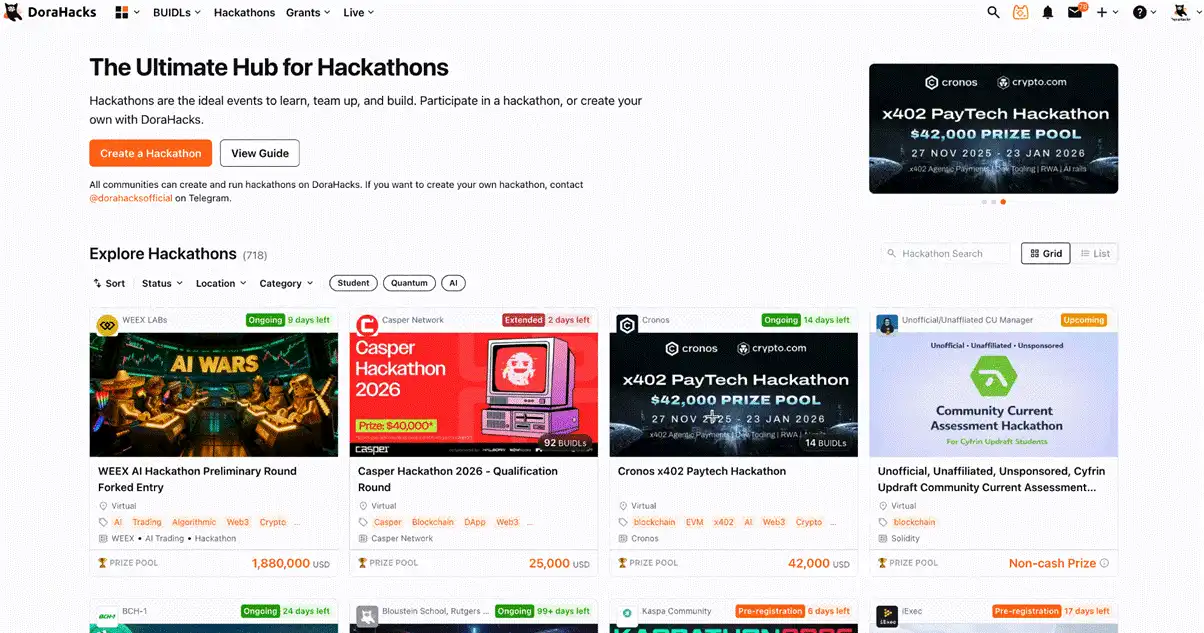
Not all hackathons are created equal. As a beginner, it's recommended to start with events hosted by large companies, such as Google or AWS's AI-themed hackathons, or events from major crypto tech companies like Circle or Binance. These hackathons have clear rules, responsive organizers, and judges who provide valuable feedback (and yes, the rewards are usually quite generous).

A reliable platform can help filter out the noise. DoraHacks is one of the world's primary hackathon platforms. Thanks to the trust of hackers and the industry, DoraHacks consistently collaborates with leading enterprises and communities to host hackathons in various tech fields like AI and blockchain. The platform's reputation means both organizers and participants have a basic quality guarantee. Furthermore, the platform archives hundreds of thousands of past projects; you can research before competing and learn from previous winners (more on that later).

Be cautious of smaller platforms or hackathons with vague information—your time is precious, so spend it on competitions that respect that.
2. Treat the Rules as Your Lifeline (This is Crucial for Your Submission)

This might sound obvious, but you'd be surprised how many excellent projects get disqualified for not following the rules. Before writing your first line of code or description, thoroughly read the rules. Understand exactly what details to submit and in what format.

Pay attention to eligibility requirements; check submission materials like demo videos, GitHub repositories, or any documentation; note any restrictions; and understand the judging criteria.
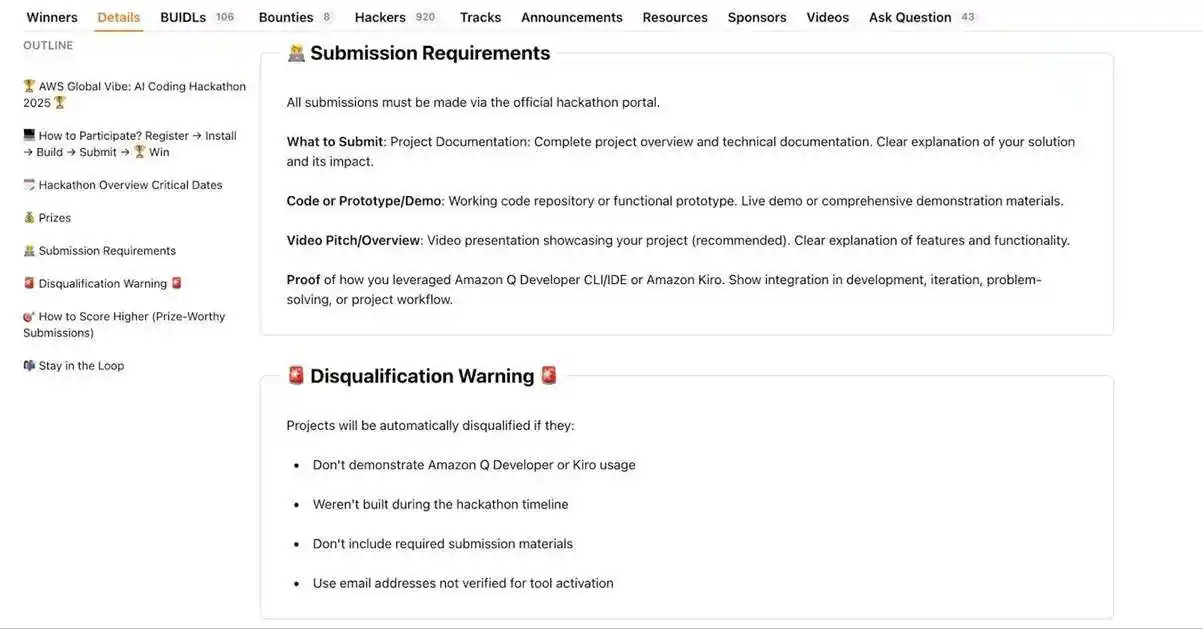
Rules for the 2025 AWS AI Vibe Coding Hackathon

The rules aren't red tape; they're a contract between you and the organizers. Following them not only shows professionalism but also ensures your efforts are judged fairly.

3. Don't Be a "Bounty Hunter"

Tempted to submit the same project to every hackathon hoping to get lucky? Stop. Organizers and judges can easily spot recycled, off-topic projects, and these submissions usually don't fare well.

Most hackathons have themes for a reason. Even if there's an "open track," judges will still evaluate how well your project aligns with the hackathon's goals. Submitting an unrelated dating app at a blockchain hackathon won't be a good fit, no matter how polished it is.

Instead of spreading yourself thin across ten unrelated competitions, focus on a few that genuinely match your interests and skills. You'll produce better work and make a stronger impression on judges and sponsors who actually care about these issues.

4. Communicate Early and Often

Many beginners treat hackathons like an exam—heads down, no talking, figure it all out alone. This is a big mistake. Good hackathons have organizers, mentors, and community channels specifically to help you succeed. Use them!

If the rules are unclear, ask for clarification before going down the wrong path. If you hit a technical snag, reach out to a mentor or post in the community Discord. If you're unsure if your idea fits the theme, check with the organizers early; don't wait until judging to find out. For example, on DoraHacks, you can message the organizers directly.

Don't struggle alone when help is readily available.
5. Learn from Other Hackers

One of the most underrated benefits of hackathons is the opportunity to learn from other participants. You're surrounded by people solving similar problems with different approaches, skill levels, and perspectives.

Studying past projects is one of the fastest ways to improve. On DoraHacks, you can browse a vast archive of past projects (like this one), filter by category, and see exactly what winning teams submitted. Watch their demo videos, read their project pages, and observe how they present their ideas. Notice what makes top projects stand out: a clear problem statement, a polished demo, strong alignment with the theme. Equally important: observe what weaker projects lack so you can avoid the same pitfalls.

During the competition, interact with other participants too. Share your progress, ask what others are working on, and don't be afraid to give or receive feedback. The hacker community is generally very supportive; today's competitor could be your collaborator or co-founder tomorrow.
6. Submit a Great Demo

A great project with a poor presentation often loses to a decent project with an amazing demo. Judges have limited time and dozens of submissions to review. Make it easy for them.

Your written description is crucial: use clear language, logical flow, and don't assume judges have background information you haven't provided. Screenshots, diagrams, and links to a working demo all make your submission stronger.

Keep your demo video concise and clear: explain the problem you're solving, show how your solution works, highlight what's unique—aim for 1 to 3 minutes total, unless the rules specify otherwise.
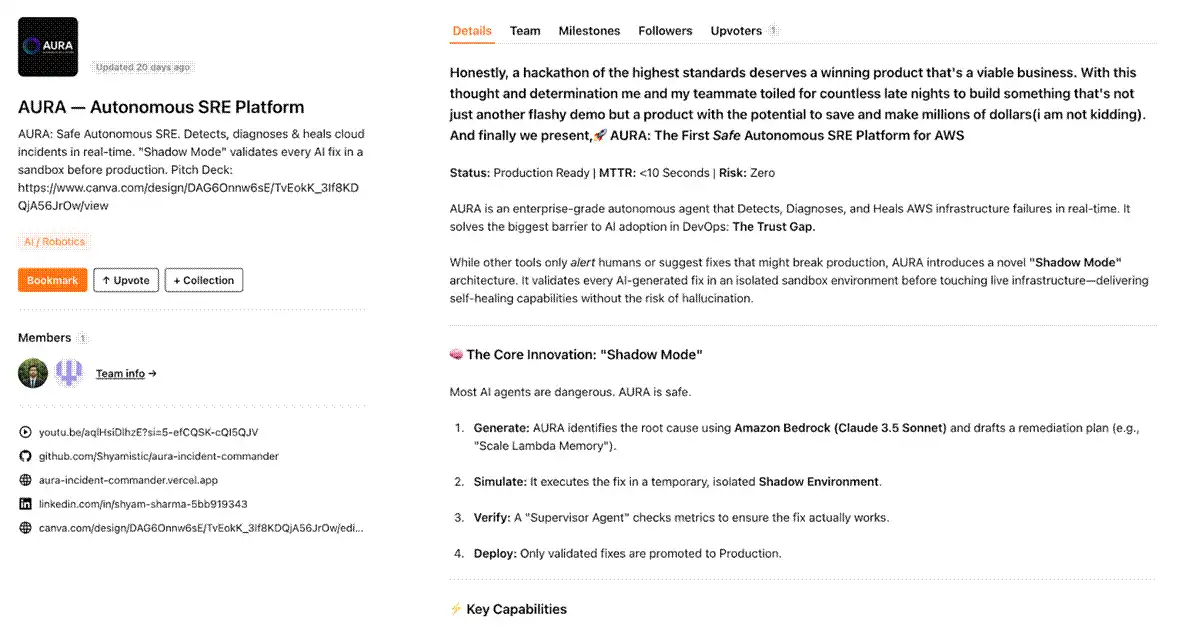
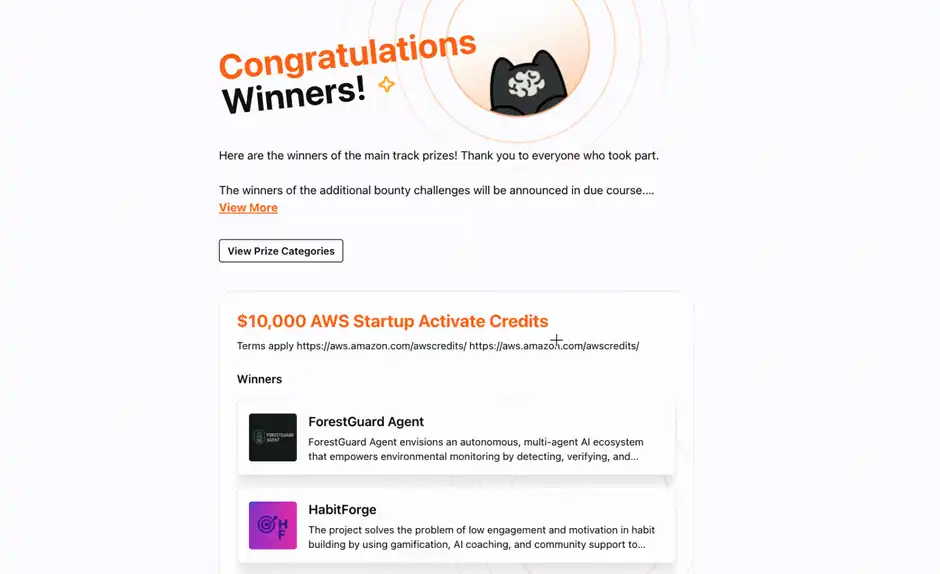
An example of a winning project on DoraHacks

Treat your submission like a pitch. You're not just showing what you built; you're convincing the judges why it matters.

7. Manage Your Time Wisely

Hackathons have deadlines, and they arrive faster than you think. Poor time management is the most common reason potentially great projects end up with incomplete submissions.

Always reserve time for submitting your materials. Recording the demo video, writing documentation, packaging everything up—these take longer than you think. Don't wait until the last minute.

If you're on a team, define roles clearly. Working in parallel is efficient only if everyone knows their responsibilities.

8. Accept the Outcome and Keep Building

Hackathons are competitions, and competitions have winners and losers. You might give it your all and walk away empty-handed. It stings, but it's completely normal.

The difference between a successful hacker and a frustrated one is how they respond. If you don't win, ask yourself what you learned. If the idea is solid and you keep iterating seriously, opportunities will find you. Many successful projects didn't win their first hackathon either but found their moment through continuous improvement.

The hackathon ends, but your work doesn't have to. If the project has potential, keep developing it. Hackathon projects are excellent portfolio pieces, and continued progress shows potential employers or investors that you're serious.

Countless amazing projects are born at hackathons and then disappear forever. The excitement fades, life gets busy, and that brilliant idea never gets another commit. Don't let that happen to you.

Celebrate the wins, learn from the losses, and then keep competing. In the long run, persistence matters more than luck.

Conclusion: Play the Long Game

Your first hackathon is just the beginning. You'll make mistakes, learn lessons, and probably wish you'd done some things sooner. That's okay; everyone starts from zero.

The people who get the most out of hackathons treat each one as a step in a longer journey. They accumulate skills, expand their network, and build a track record of consistent participation and delivery. Over time, victories come not from luck but from becoming stronger.

So, find a hackathon on DoraHacks that excites you, read the rules, chat with the organizers, learn from others, and keep creating. Leave the rest to time.

Happy hacking!

About DoraHacks

DoraHacks is a leading global hackathon community and open-source developer incentive platform. DoraHacks provides a toolkit for all parties to empower them to organize hackathons and fund early-stage ecosystem startups.

DoraHacks is committed to driving a global hacker movement in Web3, AI, quantum computing, and space technology. To date, over 30,000 startup teams have received more than $300 million in total funding through the DoraHacks community. Numerous open-source communities, enterprises, and technology ecosystems are actively utilizing DoraHacks and its BUIDL AI capabilities to organize hackathons and provide financial support for open-source initiatives.

Website | Twitter | Discord | Telegram | Binance Live | Youtube

Preguntas relacionadas

QWhat is the most important thing to do before writing any code for a hackathon?

ARead the rules thoroughly to understand submission requirements, format, eligibility, and judging criteria.

QWhy should new hackers avoid being 'prize miners'?

ASubmitting the same project to multiple unrelated hackathons is easily spotted by judges and usually results in poor outcomes due to lack of relevance to the theme.

QWhat is a key benefit of studying past projects on platforms like DoraHacks?

AIt is one of the fastest ways to learn what makes winning projects successful, such as clear problem statements, polished demos, and strong theme alignment.

QWhat is a crucial element for a successful project submission that many beginners overlook?

AA good demo, including a clear and concise 1-3 minute video that explains the problem, shows the solution working, and highlights its unique value.

QWhat should a hacker do if their project doesn't win a hackathon?

ALearn from the experience, ask what was gained, and continue building and iterating on the project, as persistence is more important than luck in the long run.

Lecturas Relacionadas

After Three Consecutive Quarters of Decline, Can the Crypto Market Find a Window for Stabilization in Q3?

The cryptocurrency market has just concluded its worst-performing quarter since 2022, with total capitalization dropping 12.6% to $2.1 trillion. All core metrics indicate capital is leaving the sector, not just rotating within it. Bitcoin fell 14.2% and Ethereum dropped 25.4% in Q2, breaking their previous correlation with US tech stocks. A key driver is the reversal in US spot Bitcoin ETF flows, which saw a net outflow of approximately $4.67 billion in Q2, including a record monthly outflow near $4.5 billion in June. While recent data suggests long-term holders are accumulating again, sustained ETF outflows mean continued selling pressure. Market focus is now singularly on the Federal Reserve. The upcoming July FOMC meeting is seen as the most critical event for Q3. A dovish signal could support Bitcoin reclaiming a $68,000-$84,000 range, while a hawkish stance might establish a new trading band around $50,000-$56,000. Additionally, regulatory uncertainty persists, with the progress of the crucial *CLARITY Act* stalling in the Senate, reducing its perceived 2026 passage probability to 40-45%. Despite the broad downturn, a few sectors showed growth. Prediction markets saw nominal volume surge 48.7% year-over-year to $113.8 billion, and tokenized collectibles transaction volume rose 143% quarterly to $1.4 billion. The Real-World Asset (RWA) tokenization sector also continued steady growth, now representing ~$28.1 billion in on-chain value. The market's foundation for an extreme crash appears limited, with Bitcoin price hovering near its 200-week moving average. However, the trading paradigm has shifted from narrative-driven speculation to decisions based on price action, policy developments, and interest rate expectations, making a broad sentiment-driven rally unlikely in the near term.

marsbitHace 1 hora(s)

After Three Consecutive Quarters of Decline, Can the Crypto Market Find a Window for Stabilization in Q3?

marsbitHace 1 hora(s)

BIT Trading Moment: BTC Still Suppressed by Weekly 200 EMA, Rejection May Restart Decline; Storage and Semiconductors that Surged Last Night Begin Falling in Evening Trading

**Crypto & Stock Market Wrap: Bitcoin Tests Resistance, Stocks Retreat After AI Surge** Bitcoin consolidates around $66,000, facing key resistance near $68,000—an area seen as a major psychological and technical hurdle where previous rallies have failed. Analysts note the cryptocurrency is caught between its 200-week moving average (~$63,333) and 200-week EMA (~$68,328). A clear break above $68k is needed to signal a stronger bullish trend, while a rejection could lead to a retest of $63k support. Market sentiment remains cautious, with low futures open interest pointing to a low-liquidity rebound rather than a full bull market. Bitcoin spot ETFs saw another $203 million inflow. US stock futures pointed lower after a strong Tuesday session led by a massive rebound in semiconductors and memory stocks. The rally was fueled by renewed optimism about AI-driven hardware demand, with Micron, SanDisk, and SK Hynix surging. However, those gains reversed in pre-market trading. Super Micro Computer (SMCI) soared over 20% after hours on strong guidance and a record backlog. Other standouts included Rocket Lab and nuclear energy plays Oklo and X-Energy. Rising oil prices (Brent above $91) and climbing Treasury yields (10-year near 4.64%), however, are reigniting inflation concerns and acting as a headwind for equities. In Asia, markets were mixed. South Korea's KOSPI pared early gains to close slightly higher as semiconductor stocks like SK Hynix gave back initial surges. Japan's Nikkei edged lower as the yen hit a fresh 38-year low against the dollar, raising fears of potential market intervention. Key events to watch include the Samsung Galaxy launch, AMD's AI event, and a slew of major tech earnings from Alphabet, Tesla, and IBM after the close on Wednesday, followed by the ECB meeting and Intel's earnings on Thursday.

marsbitHace 1 hora(s)

BIT Trading Moment: BTC Still Suppressed by Weekly 200 EMA, Rejection May Restart Decline; Storage and Semiconductors that Surged Last Night Begin Falling in Evening Trading

marsbitHace 1 hora(s)

Former CFTC Chairman, Circle President Tarbert: Preaching Long-Termism While Cashing Out $30 Million Himself

Former CFTC Chairman and Circle President Heath Tarbert has consistently advocated for a long-term vision in public, urging patience from investors as Circle’s stock price has fallen significantly from its peak. However, it has been revealed that since Circle’s IPO, Tarbert has continuously sold his CRCL shares through pre-arranged trading plans, cashing out approximately $30 million, without making any public market purchases. This contrast between his public messaging and personal actions has drawn criticism. Tarbert joined Circle in July 2023 as Chief Legal Officer, leveraging his regulatory experience to help guide the company through its IPO and expansion. Despite promoting stablecoins as long-term infrastructure, he established a 10b5-1 trading plan just before Circle went public, leading to substantial stock sales over the following year. In March 2026, he initiated another plan to sell more shares. His career trajectory highlights a pattern of moving between high-level regulatory roles and influential positions in the financial sector. After resigning as CFTC Chairman in early 2021, he joined Citadel Securities as Chief Legal Officer just 27 days later, during a period of intense regulatory scrutiny for the firm. He later joined Circle, aiding its efforts to navigate regulatory challenges for its public listing. While Tarbert's expertise in policy and compliance is valuable to companies like Circle, his actions—advocating long-term confidence while personally divesting—raise questions about the alignment between his public statements and his private financial decisions, leaving investors who followed his advice to bear the market risks.

marsbitHace 1 hora(s)

Former CFTC Chairman, Circle President Tarbert: Preaching Long-Termism While Cashing Out $30 Million Himself

marsbitHace 1 hora(s)

Gate Research Institute: The 'Wall Street-ization' Wave of Crypto Financial Products – Competition or Integration?

The article titled "Gate Research Institute: Are Crypto Financial Products Sparking a 'Wall Street' Wave—Competition or Convergence?" explores the evolving relationship between the crypto ecosystem and traditional finance (TradFi). The piece begins by reflecting on Bitcoin's original 2009 vision of decentralization, disintermediation, and moving away from banks. It then contrasts this with the 2024 landscape, where key crypto assets like Bitcoin are increasingly held through Wall Street products like ETFs issued by giants like BlackRock. The article questions whether this signifies that TradFi is systematically taking over the rights to issue, price, custody, and distribute crypto financial assets. The core argument is that this is not a zero-sum takeover but rather a bidirectional convergence where each side addresses the other's weaknesses. Crypto offers 24/7 global markets, programmable settlement, and open access but lacks compliant channels, institutional-grade custody, deep fiat liquidity, and mainstream distribution. TradFi possesses these but is constrained by legacy systems, limited operating hours, and slow settlement. Two primary convergence paths are highlighted: * **Path A (CEX to TradFi):** Exemplified by Gate, which has progressed from offering tokenized stocks and CFDs to providing direct, real stock trading (US, Hong Kong, South Korea) within its platform, using USDT. * **Path B (TradFi to Crypto):** Exemplified by Robinhood, which has integrated crypto trading, acquired exchanges like Bitstamp, and is moving traditional assets like stocks onto the blockchain via tokenization and its own Layer 2. Both paths are ultimately competing to become the next-generation, unified financial account—a "super account" where users can seamlessly trade cryptocurrencies, stocks, ETFs, RWA (Real World Assets), and tokenized treasury products in one interface. The growth of RWA and tokenized treasuries (e.g., BlackRock's BUIDL) is presented as the asset-layer fusion, providing stable, yield-bearing assets on-chain and acting as a bridge between the two worlds. In conclusion, the "Wall Street-ization" of crypto is framed as a mutual transformation. Decentralized ideals persist in the protocol layer, while at the application layer, a more efficient, global, and accessible unified capital market is emerging from this convergence. The future competition lies not between crypto exchanges and stockbrokers, but between platforms vying to offer the most comprehensive asset coverage, liquidity, and user experience within a single account.

marsbitHace 2 hora(s)

Gate Research Institute: The 'Wall Street-ization' Wave of Crypto Financial Products – Competition or Integration?

marsbitHace 2 hora(s)

Trading

Spot
活动图片





