Bearish Alert for Stellar: Will the Bears Drag XLM Into Deeper Fiery Red?

TheNewsCryptoPublished on 2025-12-11Last updated on 2025-12-11

Abstract

Stellar (XLM) has declined by 4.04% in the past 24 hours, trading at $0.2405 amid a fearful market sentiment. Despite the drop, the TD Sequential indicator is signaling a potential buy opportunity in the same zone that previously triggered a 95% rally. However, technical indicators suggest bearish pressure may persist. The MACD shows weakening bullish momentum, while the CMF at -0.14 indicates capital outflows. The RSI at 41.46 reflects neutral-to-bearish sentiment, and the Bull Bear Power remains slightly negative. Key support lies at $0.2397, with resistance near $0.2413. A breakdown could lead to further declines, while a rebound might initiate upward movement above $0.2421.

The crypto market’s volatile nature has resulted in displaying both bear and bull signals alternative day. This back and forth flip makes it hard to predict the price action. With the Fear and Greed Index value holding at 29, fear sentiment is lingering across the assets, including Bitcoin (BTC) and Ethereum (ETH), trading on the downside.

Meanwhile, Stellar (XLM) has registered a 4.04% drop in value over the last 24 hours. In the morning hours, the asset traded at a high range of $0.2594. The bearish pressure in the XLM market triggered the price to plunge to a bottom level of $0.2397. Currently, Stellar traded at $0.2405, with the daily trading volume reaching $191.66 million.

Furthermore, an analyst chart shows that the TD Sequential indicator is flashing another buy signal for Stellar at the same price zone where it previously triggered one. The last time this signal appeared in this area, XLM rallied nearly 95%, suggesting that this setup might hint at a similar potential rebound, if market conditions align.

Is a Breakout Ahead, or Is More Bearish Pressure Coming for Stellar?

The current trading pattern of Stellar reveals the bearish pressure, and the price could move down to the key support at around $0.2397. With the downside correction strengthening, the asset might trigger the death cross to take place. Eventually, the bears drive down the price below $0.2389.

Upon a bullish reversal, the XLM price may immediately rise and find the resistance at the $0.2413 range. Assuming the correction on the upside continues, the asset could push for the emergence of the death cross. The bulls would initiate a steady price movement on the upside, above the $0.2421 mark.

Stellar’s Moving Average Convergence Divergence (MACD) line is found below the signal line, which indicates weakening bullish momentum. The buyers are losing strength, and the sellers may gain control. Also, this bearish signal may hint at continued downward movement.

Additionally, the Chaikin Money Flow (CMF) indicator of XLM is at -0.14, suggesting mild bearish pressure in the market. This negative value infers that the capital is flowing out of the asset. The current momentum is not extremely bearish, but it has weak demand and reduced accumulation.

Stellar’s daily Relative Strength Index (RSI) settled at 41.46, implying its neutral-to-slightly bearish sentiment, weakened momentum. The asset is not oversold, but the selling pressure is stronger than buying interest. Moreover, the Bull Bear Power (BBP) reading of XLM at -0.0025 is slightly negative, with the bears in control. As the value is near zero, the asset has a mild bearish sentiment in the market.

Top Updated Crypto News

OFFICIAL TRUMP (TRUMP) Takes a Hit: Can It Hold Its Ground or Test Lower Lows?

TagsAltcoinCryptocurrencyStellarXLM

Related Reads

From Airdrop Myth to King of Derivatives: A Look Back at Hyperliquid's 2025 Conquest

Reviewing crypto's growth in 2025, Hyperliquid stands out. It began the year with an epic airdrop and strong price performance, capturing attention. By year's end, it transformed into a top-four revenue-generating platform in crypto, earning over $650M and at one point capturing 70% of all perp trading volume. Its success was no accident. In Q1, it solidified its reputation by being first to list new assets like the TRUMP perp and launched HyperEVM, a smart contract layer. Q2 saw explosive growth: HYPE token surged 4x from April lows, and HyperEVM's TVL grew from $350M to $1.8B. The platform gained mainstream media coverage. In Q3, major wallets like Phantom and MetaMask integrated via Hyperliquid's builder codes, routing $158B in volume and earning partners nearly $50M. A high-profile stablecoin bid war was won by Native Markets, aligning with Hyperliquid's bootstrapped ethos. However, new competitors like Aster and Lighter emerged with aggressive airdrops. Q4 brought permissionless listings via HIP-3, enabling new markets like stock perps and yield-bearing collateral. Yet, HYPE fell nearly 50% from its September peak due to market conditions, a rare ADL event during a crash, and the start of team token unlocks. As perps go mainstream in 2026, Hyperliquid's true test begins. Its success came from building a superior product and ecosystem without shortcuts. Maintaining leadership will require doing it all over again in a crowded field.

marsbitHace 12 min(s)

From Airdrop Myth to King of Derivatives: A Look Back at Hyperliquid's 2025 Conquest

marsbitHace 12 min(s)

ETC Olympia Development Part 1: Implementing ECIP-1111 and ECIP-1112

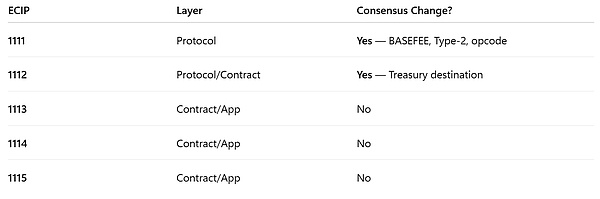
ETC Olympia Development Series Part 1: Implementing ECIP-1111 and ECIP-1112 This article introduces the first part of the Ethereum Classic Olympia development series, focusing on the implementation of ECIP-1111 and ECIP-1112. These two proposals are the only components within the broader Olympia framework that modify consensus behavior. ECIP-1111 modernizes the fee market by introducing an EIP-1559-style mechanism with a base fee and optional priority tip (miner tip). A key difference from Ethereum is that the base fee is not burned but is instead redirected to a treasury address defined by ECIP-1112. It also adds support for Type-2 transactions and the BASEFEE opcode (0x48), ensuring compatibility with modern EVM tooling and wallets. Crucially, it does not change miner rewards, monetary policy, or existing transaction types. ECIP-1112 defines an immutable, deterministic treasury smart contract that will receive the redirected base fees. This vault is designed to be receive-only upon activation, meaning it can accumulate value but cannot distribute funds until a separate, subsequent governance layer (defined in other ECIPs) is deployed and activated on the contract layer. The article emphasizes the modular architecture of Olympia. While the suite includes five ECIPs (1111-1115), only these two affect consensus. This separation ensures that the core protocol remains minimal and auditable, while future governance and funding mechanisms can evolve independently at the contract level without requiring further hard forks. The implementation is currently in the draft stage per the ECIP-1000 process. Any decision to move forward with mainnet activation will require extensive testing on the Mordor testnet and full community review.

金色财经Hace 16 min(s)

ETC Olympia Development Part 1: Implementing ECIP-1111 and ECIP-1112

金色财经Hace 16 min(s)

Market Divergence: SOL Becomes Institutional Darling, Terra Ecosystem Completely Collapses, ZEC Shorts Forced to 'Hold the Bag' by Whales?

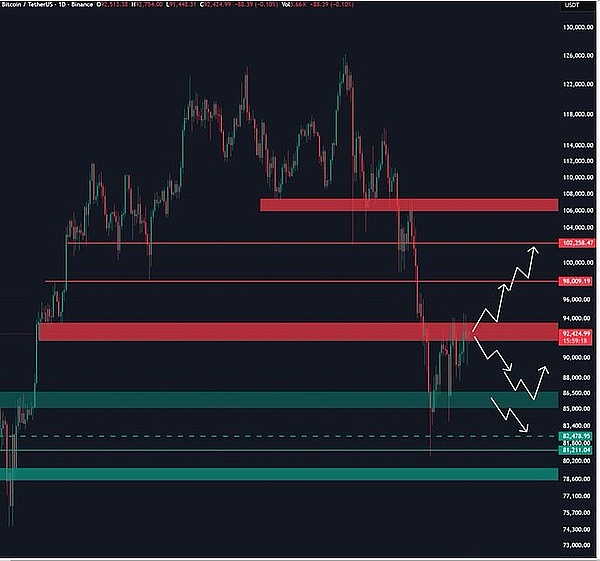
The cryptocurrency market is currently experiencing significant divergence, with some assets surging while others face severe downturns. Bitcoin (BTC) is testing a critical resistance zone between $92,000 and $94,000. A successful breakout could propel it toward $100,000, while failure may lead to a pullback below $90,000. Similarly, Ethereum (ETH) is approaching its key level at $3,400. Holding above this could push it to $3,700-$3,800, otherwise a retest of $3,000 support is likely. Solana (SOL) has emerged as a major institutional favorite. Despite market volatility, SOL ETFs continue seeing consistent inflows. Support from major platforms like Coinbase, which integrated Solana DEX functionality, and growing adoption by traditional finance giants like JPMorgan and Nasdaq, highlight strong fundamental strength. Accumulating SOL gradually is recommended. In contrast, the Terra ecosystem (LUNA, LUNC, USTC) has effectively collapsed. Founder Do Kwon received a 15-year prison sentence, and the project's $40 billion collapse triggered a broader market crisis. These assets are considered uninvestable. Zcash (ZEC) presents a cautionary tale for short sellers. Many are trapped in losing positions as large holders (whales) maintain price range, collecting funding rates systematically. This strategy allows whales to profit from perpetual funding while gradually squeezing shorts. The lesson: take profits quickly when shorting ZEC and avoid greed. Overall strategy: Wait for BTC/ETH to break key levels before acting, accumulate SOL steadily, avoid Terra assets entirely, and short ZEC with extreme caution.

金色财经Hace 17 min(s)

Market Divergence: SOL Becomes Institutional Darling, Terra Ecosystem Completely Collapses, ZEC Shorts Forced to 'Hold the Bag' by Whales?

金色财经Hace 17 min(s)

Trading

Spot
Futures
活动图片