Base MCP, The Next Step for x402

marsbitPublicado a 2026-05-28Actualizado a 2026-05-28

Resumen

Base has officially launched Base MCP, allowing users to connect their Base Account to AI Agents to perform actions like swaps, transfers, portfolio tracking, and transaction history queries through conversational commands. This move aligns with Base's strategic focus on AI, driven by the broader competition in the emerging Agent-to-Agent payment sector. The evolution of Agent payments has accelerated. In late 2024, the primary method involved insecure browser automation. By 2025, solutions like Coinbase's x402 (providing crypto wallets for Agents), Google's AP2, and Visa's token-based system emerged. x402 has since processed 176 million transactions totaling over $70 million, with a median value between $0.01 and $0.10. Stablecoins, particularly USDC, dominate these settlements due to their negligible transaction costs compared to traditional payment fees, which are prohibitive for micro-payments. Coinbase faces competition from Stripe, which has built a comparable infrastructure for Agent payments with its Tempo blockchain, Privy wallets, Bridge routing (acquired for $1.1B), and the recently launched MPP protocol. Both companies are now competing at the application layer. The core reason AI is central to Base's strategy is to expand the scenarios for Agent payments, ensuring more transactions occur on its network. By securing a dominant position and scale advantage in this nascent field, Coinbase aims to capture the future commercial potential of Agent-driven payments. T...

Yesterday, Base officially launched Base MCP. By connecting Base Account to AI Agent through Base MCP, you can use colloquial language, like chatting, to have the Agent perform operations such as Swap, transfers, position tracking, and transaction history queries.

Players familiar with Base know that the main focus on the Base chain right now is AI, so such an update from Base doesn't come as a surprise. Some players even anticipate new gameplay on the Base chain, similar to the AI meme coin $SHIT on Ethereum before, where they could directly use Base MCP to let an Agent participate in chain-based token launches through chat.

But if we step back from the perspective of a chain degen and look at the competition in Agent-to-Agent payments, we might find a new answer as to why AI has become the main focus for Base.

Rapidly Developing Agent Payments

Let's rewind to September 2024. Back then, if you wanted an AI Agent to complete a payment for something, humans basically had only one choice: use browser automation tools (like headless browsers such as Playwright, Selenium) to let the AI Agent simulate human actions and complete the checkout process on a webpage.

Since this required providing payment credentials (like full credit/debit card numbers, CVV, expiration dates, etc.) to the AI Agent, this sole option was not secure.

By May 2025, Coinbase launched x402, providing an AI Agent with a crypto wallet and solving this problem in a crypto-native way. But Coinbase wasn't the only one to recognize this as a potential market, and the solutions weren't limited to just crypto-native ones. In 2025, Google launched AP2, allowing users to authorize spending permissions to an Agent. Visa expanded its existing card payment channels, launching Visa Intelligent Commerce, which doesn't give the Agent sensitive information like credit card numbers or CVV, but instead provides the Agent with specific, limited tokens to complete payments.

Today, x402 has processed 176 million transactions from AI Agents, with a total transaction volume exceeding $70 million. This amount might not seem huge, but neither Coinbase nor the traditional giants are taking this emerging payment competition lightly:

- On January 22, 2026, Capital One, the sixth-largest bank in the US with $470 billion in assets, $330 billion in deposits, and the third-largest credit card issuer in the nation, announced the acquisition of Brex for $5.15 billion to enhance AI payment capabilities.

- In March 2026, Mastercard acquired the stablecoin infrastructure company BVNK for $1.8 billion.

- In February 2025, Stripe acquired the stablecoin payment platform Bridge for $1.1 billion.

While they haven't explicitly stated it, acquiring stablecoin-related companies is likely a move to prepare for the upcoming era of Agent payments. Stablecoins are indeed crucial for Agent payments.

Why Are Stablecoins Important for Agent Payments?

According to data statistics from Keyrock, the median transaction amount for Agent transactions processed on x402 so far is between $0.01 and $0.10, with 76% of transactions being under $0.30.
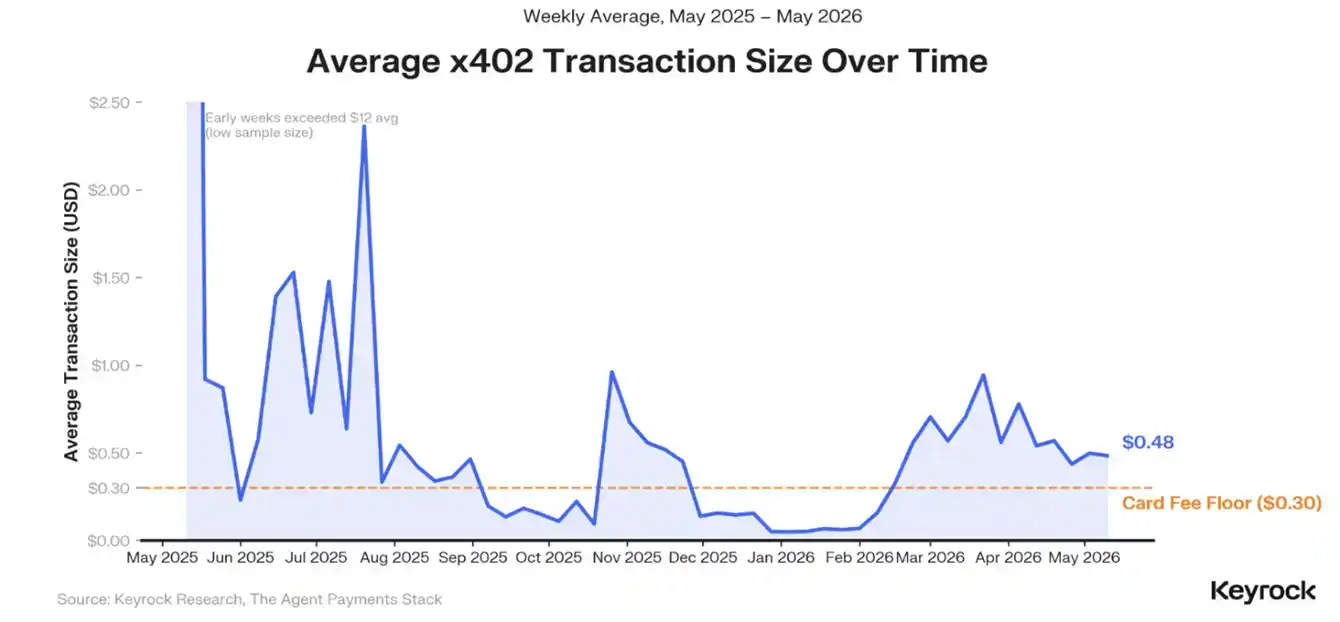
$0.30 is the most common flat fee per transaction in the US and many major markets. This fee is like a wall, making micropayments under $1 very uneconomical. For example, for a 3-cent API call, a $0.30 fee is 10 times the call cost; if an Agent pays with a credit card, the cumulative cost would be prohibitively high.

Blockchain solves this problem well. On Base, the transaction settlement cost is $0.0001. With this immense advantage, stablecoins have almost naturally won the competition against traditional payment giants in the realm of Agent payments.

Of the 176 million Agent transactions processed by x402, 98.6% were settled in USDC. Given the close relationship between Coinbase and Circle, it's fair to say Coinbase is also a big winner at the settlement layer.

But the settlement layer is just one layer in Agent payments. In the track of solving Agent payments via crypto-native means, Coinbase has a competitor—Stripe.

The Challenge from Stripe

This March, Stripe launched the Agent Payment Protocol MPP, which has brought Stripe's architecture map for Agent payments almost on par with Coinbase's.

- From the settlement layer: Coinbase has Base, Stripe has Tempo.

- From the wallet layer: Coinbase has Agent Wallet, Stripe has Privy.

- From the routing layer: Coinbase has built-in routing facilities, Stripe has Bridge, acquired for $1.1 billion.

- From the payment protocol: Coinbase has x402, Stripe has MPP.

Now let's return to the Base MCP mentioned at the beginning of the article. Since both competing sides now have these four layers of supporting infrastructure, the next battlefront is naturally the application layer.

This is the core reason why AI can become Base's main focus—Base needs to ensure that AI (at least in the cryptocurrency space) happens on Base. This is not actually about providing a perspective for degens on the Base chain, but about broadening the scenarios for Agent payments, enabling more Agents to conduct more transactions for more applications, thereby securing its leading position in the Agent payment track.

Once a dominant scale advantage is established, when Agent payments enter the commercial domain in the future, Coinbase stands to win even bigger.

Looking at the launch of Base MCP from this angle, one can sense that this is just a small step in Coinbase's grand ambition.


Preguntas relacionadas

QWhat is Base MCP and what key functionality does it enable for AI Agents?

ABase MCP is a protocol recently launched by Base. It allows users to connect their Base Account to an AI Agent. Once connected, users can use natural, conversational language to instruct the Agent to perform actions such as executing token swaps, making transfers, tracking portfolio positions, and querying transaction history.

QAccording to the article, why are stablecoins considered crucial for Agent payments?

AStablecoins are crucial for Agent payments because they enable micro-transactions economically. Traditional payment methods often have fixed fees around $0.30 per transaction, which makes small payments (e.g., a few cents for an API call) prohibitively expensive. In contrast, settlement costs on Base are around $0.0001, allowing stablecoins like USDC to facilitate vast numbers of small-value transactions efficiently, as evidenced by 98.6% of x402 transactions being settled in USDC.

QHow does the article contrast Coinbase's and Stripe's approaches to the Agent payment infrastructure?

AThe article contrasts their approaches by outlining the similar four-layer infrastructure both companies have built: Settlement Layer (Coinbase has Base, Stripe has Tempo), Wallet Layer (Coinbase has Agent Wallet, Stripe has Privy), Routing Layer (Coinbase has internal routing, Stripe acquired Bridge), and Payment Protocol Layer (Coinbase has x402, Stripe has MPP). This positions them as direct competitors in the Agent payment space.

QWhat strategic reason does the article suggest is behind Base making AI its main narrative?

AThe article suggests that Base's strategic focus on AI is not primarily for on-chain 'degen' activities but to expand the scenarios for Agent payments. By ensuring more AI activity (at least in the crypto space) happens on Base, Coinbase aims to generate more Agent-driven transactions across more applications. This builds a dominant scale advantage, securing Coinbase's leading position in the emerging Agent payment competition for future commercial applications.

QWhat does the median transaction amount on x402 indicate about the nature of Agent payments?

AThe median transaction amount on x402 falls between $0.01 and $0.10, with 76% of transactions being under $0.30. This data indicates that Agent payments are predominantly micro-transactions, involving very small sums of money per transaction.

Lecturas Relacionadas

Fei-Fei Li's Team Clarifies the Concept of 'World Models', Sora Merely a Renderer

"World Models" has become a widely used yet confusing term in AI. To address this, a team led by Fei-Fei Li and World Labs proposed a functional taxonomy based on the Partially Observable Markov Decision Process framework. This taxonomy categorizes systems called "world models" into three distinct projections: Renderers, Simulators, and Planners. Renderers, like OpenAI's Sora and other video generation models, focus on producing photorealistic visual outputs for human perception. They prioritize visual fidelity over physical accuracy. Simulators, such as NVIDIA Omniverse, aim to compute precise future environmental states for computational tasks like engineering analysis or digital twins. Planners, like Vision-Language-Action models, take in observations and goals to output executable actions for robots or agents. The article clarifies that most current "world models," including Sora, are primarily Renderers. They generate convincing visuals but lack the core ability to simulate state transitions based on actions, a key requirement for a true world model in classic reinforcement learning definitions. This conceptual confusion has practical implications, leading to potential misalignment in technology selection, investment, and public understanding of AI capabilities. Clear categorization is crucial. It helps enterprises avoid costly mistakes (e.g., using a renderer for robot training), allows investors to accurately assess markets, and enables researchers to build comparable benchmarks. While future systems may integrate these functions, recognizing current boundaries is essential for honest assessment and progress.

marsbitHace 1 hora(s)

Fei-Fei Li's Team Clarifies the Concept of 'World Models', Sora Merely a Renderer

marsbitHace 1 hora(s)

Bloomberg Uncovered: How Do China's Wealthy Circumvent the Annual $50,000 Limit to Transfer Assets?

**Summary: How Wealthy Chinese Circumvent $50,000 Annual Foreign Exchange Limits** Despite China's strict capital controls, including an annual $50,000 per person foreign exchange quota, an estimated $150 billion in funds still leaves the country annually via various gray and underground channels. This report outlines the evolution of China's "capital wall" and the methods used to bypass it. **The Evolving Capital Controls:** * **Foundation (1994):** The system of "current account convertibility with strict capital account controls" was established. * **Quota Set (2007):** The $50,000 individual annual forex purchase limit was formalized. * **Crackdown Begins (2015-2017):** Following market volatility, enforcement tightened. Banks were required to scrutinize transactions, and channels like using UnionPay cards for Hong Kong insurance premiums or buying overseas property were blocked. * **Digital & Legal Upgrades (2024-2026):** Enhanced algorithms now flag suspicious patterns (e.g., "smurfing"). The Common Reporting Standard (CRS) provides Chinese tax authorities with data on citizens' offshore accounts. Unlicensed cross-border brokers have been targeted. **Five Primary Methods for Moving Capital:** 1. **Underground Banking / "Hawala" (Duiqiao):** The largest-scale method. No money crosses borders. Clients pay RMB to a domestic account; an overseas associate deposits equivalent foreign currency into the client's offshore account. Risks include high fees, account freezes, and legal penalties. 2. **"Smurfing" or "Ant Moving":** Using multiple individuals' $50,000 quotas to pool funds for one offshore recipient. Increasingly detected by anti-money laundering algorithms. 3. **Trade Invoice Manipulation:** Businesses over-invoice imports or under-invoice exports via offshore shell companies, creating a pretext to transfer excess funds abroad under the guise of trade. 4. **Channel Migration:** After a crackdown on internet brokers, funds flow toward more compliant but costly channels like major banks' cross-border wealth management services or Qualified Domestic Institutional Investor (QDII) quotas. 5. **Structural Arrangements:** High-net-worth individuals use complex, high-cost legal structures involving offshore trusts, insurance, and investment migration programs to transfer asset ownership. **Regulatory Response: Focusing on People, Not Just Money** The current strategy extends oversight from enterprises to **individual residents**. Tools like CRS allow retroactive visibility into offshore assets. Cryptocurrencies, once seen as a potential loophole, are now actively monitored and prosecuted as an illegal channel. The underlying driver remains: with significant wealth concentrated among millions of affluent households seeking diversification amid domestic economic shifts, the incentive to move assets offshore persists despite regulatory barriers.

marsbitHace 1 hora(s)

Bloomberg Uncovered: How Do China's Wealthy Circumvent the Annual $50,000 Limit to Transfer Assets?

marsbitHace 1 hora(s)

Trading

Spot
Futuros
活动图片




