Banks Prepare To Spend $100 Million+ To Stop Crypto Bills, Expert Warns

bitcoinistPublicado a 2026-03-11Actualizado a 2026-03-11

Resumen

The fight over US crypto legislation is intensifying into a direct clash between the digital asset industry and the established banking sector. According to Dennis Porter, CEO of the Satoshi Action Fund, the banking industry is preparing a massive lobbying push, potentially exceeding $100 million, to counteract efforts to advance crypto market structure and stablecoin legislation. Porter warns that this creates a significant counterbalance to crypto lobbying groups and could lead lawmakers to withdraw support. He states that crypto industry faces political challenges, including low public trust and ethical concerns linked to Trump family involvement. Furthermore, market structure legislation is politically difficult as it covers a wide range of complex issues. The banking industry holds an advantage due to its entrenched local influence, including physical branches and jobs in lawmakers' districts. Porter cautions that if the dispute escalates into an open lobbying war, it could jeopardize the already tight Senate vote. He also notes that the legislative window is narrowing as midterm elections approach, with electoral incentives increasingly shaping the calendar.

The fight over US crypto legislation is turning into a direct clash between digital-asset firms and one of Washington’s oldest power centers. In an interview with Pete Rizzo, Satoshi Action Fund founder and CEO Dennis Porter said the banking industry is preparing a nine-figure lobbying push that could complicate efforts to advance both market structure legislation and stablecoin rules.

Crypto’s D.C. Outlook Just Got Darker

Porter said the core dispute is no longer just about whether Congress wants to regulate crypto, but on whose terms. President Donald Trump has publicly backed keeping the GENIUS Act intact, Porter noted, which he described as a positive sign for crypto firms. But he argued that support from the White House does not resolve the deeper standoff with banks, especially around stablecoins and the issue of rewards programs that banks view as a threat to deposits.

“The bank lobby has come out and said that they do plan to spend to counteract the crypto industry,” Porter said. “They said they’re raising nine figures, which is right up there with the Fairshake number. So that does create that counterbalance where they can essentially assert themselves into the ecosystem and start to peel some of these lawmakers off.”

That matters because, in Porter’s telling, crypto is entering the fight without a clean political backdrop. He said Democrats have grown more cautious around digital-asset legislation as Trump family involvement in the sector has raised ethics concerns among both lawmakers and voters.

At the same time, he described market structure as a far more expansive and politically difficult package than stablecoin legislation, since it touches not only securities-versus-commodities questions but also DeFi, illicit finance, ethics provisions and the makeup of the CFTC.

Porter argued that this leaves the legislation exposed to a wider set of objections and delays. He said there is still a path forward if key Democrats become comfortable with revisions, but added that the bill currently lacks a decisive forcing mechanism and has been pushed aside while lawmakers focus on a housing package.

The bank-crypto standoff, he suggested, could become especially dangerous if it turns into an open lobbying war. “If we end up in a situation where they’re directly lobbying against each other, you could see a lot of not just Democrats peel off this bill, but even possibly Republicans peel off this bill as well,” Porter said. “The vote is already tight in the Senate, very tight.”

His reasoning was straightforward: banks bring not just money, but entrenched local influence. Unlike much of crypto, Porter said, banks can point to branches, jobs and long-standing relationships in lawmakers’ districts. That advantage becomes even more important at a time when, by his own account, the industry is struggling politically.

“And also, crypto really is not popular right now,” Porter said. “Public trust in the crypto space is at an all-time low. Something that we’re deeply concerned about at Satoshi Action. Something that definitely needs some work.”

Porter framed that weakness as both a political problem and a policy argument. In his view, one purpose of market structure legislation is precisely to clean out the “crap” and scams that have damaged the sector’s reputation. But until lawmakers see a clearer consumer and political upside, he suggested, crypto firms may have trouble overcoming resistance from incumbents that view stablecoins as an existential threat to their business model.

He was notably cautious on timing. While some analysts have argued the window effectively closes by summer, Porter said the odds decline as the midterms approach but do not disappear entirely. His broader point was that the legislative calendar is being shaped as much by electoral incentives as by the text of the bills themselves.

At press time, the total crypto market cap stood at $2.34 trillion.
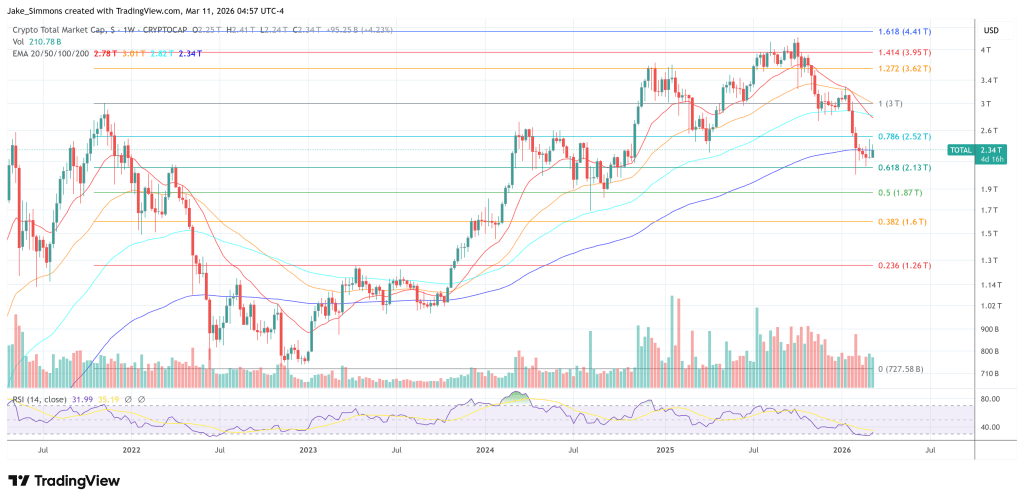
Total crypto market cap, 1-week chart | Source: TOTAL on TradingView.com

Preguntas relacionadas

QAccording to Dennis Porter, how much money is the banking industry preparing to spend to counteract crypto legislation efforts?

AThe banking industry is preparing to spend a nine-figure sum, which is over $100 million, to lobby against crypto bills.

QWhat are the two main types of US crypto legislation mentioned that are being complicated by this banking push?

AThe two main types of US crypto legislation mentioned are market structure legislation and stablecoin rules.

QWhat reason does Porter give for why banks have a significant advantage in a lobbying war against crypto?

APorter states that banks have an advantage because they bring not just money, but entrenched local influence, including physical branches, jobs, and long-standing relationships in lawmakers' districts.

QWhat does Dennis Porter cite as a major political weakness for the crypto industry in this fight?

AHe cites that 'crypto is not popular right now' and that 'public trust in the crypto space is at an all-time low.'

QBeyond the bank opposition, what other reason is given for why the market structure bill is politically difficult to pass?

AThe market structure bill is described as politically difficult because it is a far more expansive package that touches on securities-vs-commodities questions, DeFi, illicit finance, ethics provisions, and the makeup of the CFTC, leaving it exposed to a wider set of objections.

Lecturas Relacionadas

Annual Salary of Millions Competing for Electricians, Meta Rushes to Open Its Own Technical School

The AI boom is facing an unexpected bottleneck: a severe shortage of skilled construction workers and electricians. As tech giants like Meta, OpenAI, and Alphabet race to build massive data centers—such as OpenAI's $16 billion "Stargate" project—they are hitting a critical labor wall. The U.S. needs an estimated 130,000 more electricians, 240,000 construction workers, and 150,000 supervisors by 2030 for AI infrastructure alone, but tens of thousands of electrician jobs go unfilled each year. While AI companies offer high premiums, with electricians earning up to $280,000 annually, worker scarcity still causes massive losses—delays on a single project can cost $14.2 million per month. The complexity of building AI data centers, which require immense power (equivalent to powering hundreds of thousands of homes), sophisticated electrical systems, and advanced liquid cooling solutions, demands highly skilled technicians who are in short supply. To combat this, companies are investing heavily in training. Meta has committed $115 million to a free training school offering tuition, housing, and stipends, targeting 5,000 new workers. OpenAI is partnering with unions to secure skilled labor. These efforts are paying off, with a significant rise in Gen Z interest in trade schools over college. However, the power demands are staggering. AI data centers are driving a rapid surge in electricity consumption, projected to account for up to 12% of U.S. power use by 2028 and raising costs for consumers. Furthermore, the construction boom is project-based, leading to a potential future glut of trained workers once building peaks, which could depress wages industry-wide. The race for AI supremacy now depends as much on skilled hands as on advanced chips.

marsbitHace 8 min(s)

Annual Salary of Millions Competing for Electricians, Meta Rushes to Open Its Own Technical School

marsbitHace 8 min(s)

OpenAI No Longer Sells Its Most Expensive Model for Profit

OpenAI is shifting its business strategy away from promoting its most expensive, flagship models for every task. Recent price cuts—80% for GPT-5.6 Luna and 20% for Terra—signal a deeper change: the company now actively advises users that many tasks don't require the most powerful model. Instead, OpenAI recommends a tiered approach: use the high-end GPT-5.6 Sol for complex planning and analysis, then delegate execution to cheaper models like Luna. This mirrors moves by Anthropic, which recently launched Claude Opus 5 at half the price of its top model, Fable 5. Both companies are de-emphasizing flagship models as primary revenue drivers, using them instead for brand prestige and technological showcases. The industry is entering a "mass-market" phase, similar to automotive, where high-volume, cost-effective models handle daily operations and drive scale. OpenAI's price reductions are partly enabled by AI models themselves optimizing underlying code and infrastructure, creating a self-reinforcing cycle of efficiency gains and cost reduction. Competition is shifting from "who is smartest" to "who offers the best value." The goal is no longer selling individual models but fostering widespread API adoption and ecosystem lock-in. By making AI calls cheap and ubiquitous, companies like OpenAI aim to become the indispensable, utility-like infrastructure powering automated workflows—the "water and electricity" of software, quietly embedded everywhere.

marsbitHace 8 min(s)

OpenAI No Longer Sells Its Most Expensive Model for Profit

marsbitHace 8 min(s)

Will the Fed Definitely Raise Interest Rates in September? How Will Crypto and U.S. Stocks Withstand the Pressure?

The market's expectation for a September Fed rate hike surged dramatically in early August, jumping from under 50% to over 80% within a week. This shift followed a contentious July FOMC meeting, where a 9-3 vote to hold rates revealed growing dissent from hawkish members advocating for an immediate hike to combat persistent inflation. The primary catalyst for this repricing is rising oil prices, driven by renewed geopolitical tensions around the Strait of Hormuz, which threaten global supply. Energy costs directly influence inflation metrics, making the upcoming July CPI report (due August 12th) a critical data point. If it shows inflation reaccelerating, the probability of a September hike will solidify. For Bitcoin and crypto assets, this is typically bearish news. Bitcoin continues to behave as a high-beta, liquidity-sensitive risk asset. A rate hike raises the opportunity cost of holding non-yielding assets and could drive capital toward money markets, pressuring crypto prices in the short term. However, historical patterns suggest that if a hike is perceived as the end of a tightening cycle rather than the start, any negative price impact may be brief. U.S. stocks, particularly crypto-linked equities like Coinbase and growth-oriented tech stocks, are also vulnerable. Higher rates increase discount rates in valuation models, putting pressure on high-multiple companies. This coincides with a pivotal tech earnings season where investor focus has shifted from massive AI capital expenditure to tangible revenue and cash flow generation. Companies with negative cash flow and weak growth narratives could face heightened volatility if borrowing costs rise in September. In summary, a September Fed hike has evolved into a mainstream market scenario. Key factors to watch are oil prices, the July CPI report, and Fed communications, which will determine the final decision and its impact on volatile crypto and equity markets.

marsbitHace 18 min(s)

Will the Fed Definitely Raise Interest Rates in September? How Will Crypto and U.S. Stocks Withstand the Pressure?

marsbitHace 18 min(s)

Trading

Spot
活动图片





