Banks Need CLARITY Act More Than Crypto – Former CFTC Chair Explains Why

bitcoinistPublicado a 2026-03-10Actualizado a 2026-03-10

Resumen

Former CFTC Chairman Chris Giancarlo argues that US banks need the regulatory clarity provided by the CLARITY Act more than the crypto industry does. He states that without clear rules, banks' general counsels are preventing large investments in new technology, risking that US institutions fall behind global counterparts. In contrast, the crypto industry, composed of risk-takers, will continue to build and innovate in other jurisdictions if necessary. Giancarlo believes the odds of the stalled bill passing are 60-40, noting it has become a political issue pitting Republicans against Democrats and TradFi against DeFi. He warns that if the legislation fails, agencies like the SEC and CFTC will likely establish temporary rules, but this won't provide the long-term certainty that banks require to modernize.

US banks may need regulatory clarity more than the crypto industry, a former Commodity Futures Trading Commission (CFTC) chief said, arguing they risk falling behind the rest of the world.

Regulatory Uncertainty Could Leave US Banks Behind

On Sunday, Chris Giancarlo, former chairman of the CFTC, discussed the significant policy reversal under the Trump administration that has been driving crypto innovation in the US, including the highly anticipated market structure bill.

In an interview for Scott Melker’s The Wolf Of All Streets podcast, the ex-CFTC chief affirmed that landmark stablecoin legislation enacted last July, the GENIUS Act, was “the appetizer” for crypto regulation, while the market structure bill, also known as the CLARITY Act, represents the main dish but has become the “hard part.”

For context, the CLARITY Act has been stalled for nearly two months after the Senate Banking Committee published its bill draft in mid-January. Multiple policies, including key restrictions for stablecoin issuers, were criticized by crypto leaders, leading to a prolonged fight between banks and the digital assets industry.

Giancarlo affirmed that banks need regulatory clarity more than the crypto industry, arguing that they will be hesitant to invest in new technology without clear rules, and their systems will be superseded.

The banks, however, can’t afford regulatory uncertainty. Their general counselors are telling their boards, you can’t invest billions of dollars in this (...) unless you’ve got regulatory certainty. (...) The banks need this clarity because they need to build this. They need to be in the forefront, not in the rear guard of this innovation.

On the contrary, the crypto industry will continue to build and innovate in other jurisdictions. “They are risk-takers. They’re going to build it here, or they’re going to build it abroad,” the former CFTC chairman asserted.

If the CLARITY Act isn’t passed, Giancarlo believes the leaders of financial regulatory agencies, such as the Securities and Exchange Commission (SEC) and CFTC, will likely establish the necessary rules to oversee the sector.

“They won’t have the support of legislation that makes it work forever or at least into the next presidential cycle, but it’ll make it work for now. Now, does that give the industry the certainty they want? No. And who needs that certainty more than the banks? Crypto doesn’t need it. They were building even under the whip hand of Gary Gensler,” he added.

Are The Odds In Crypto Regulation’s Favor?

Giancarlo emphasized that the digital assets legislation has become a political issue, with Republicans opposing Democrats, and traditional finance (TradFi) opposing decentralized finance (DeFi) and new technologies.

The ex-CFTC chief also noted that the challenges of the regulatory timing, asserting that “If we could not be in a worse time, we’re in an election year.” During this period, politicians’ focus is on the upcoming mid-term elections, he detailed, and “everything that takes place in Washington (...) is all about swaying the voters for the elections.”

Last month, Treasury Secretary Scott Bessent urged lawmakers to pass the stalled bill this spring. He acknowledged the efforts of a bipartisan working group to advance the legislation, emphasizing that Democrats are open to collaborating with Republicans.

He also warned that the chances of reaching a deal could crumble if Democrats gain control of the House of Representatives in November, given the Biden administration’s stringent regulations on the industry.

Despite the delay, Giancarlo believes the odds are 60-40 in favor of passing the legislation, arguing that there’s “a lot of good in the bill for all sides” and its importance is recognized by all parties.

“I think there’s a recognition that this is the new architecture of finance and America, our financial institutions are the world’s dominant financial institutions. We need to modernize that. We need to adopt this technology,” he concluded.
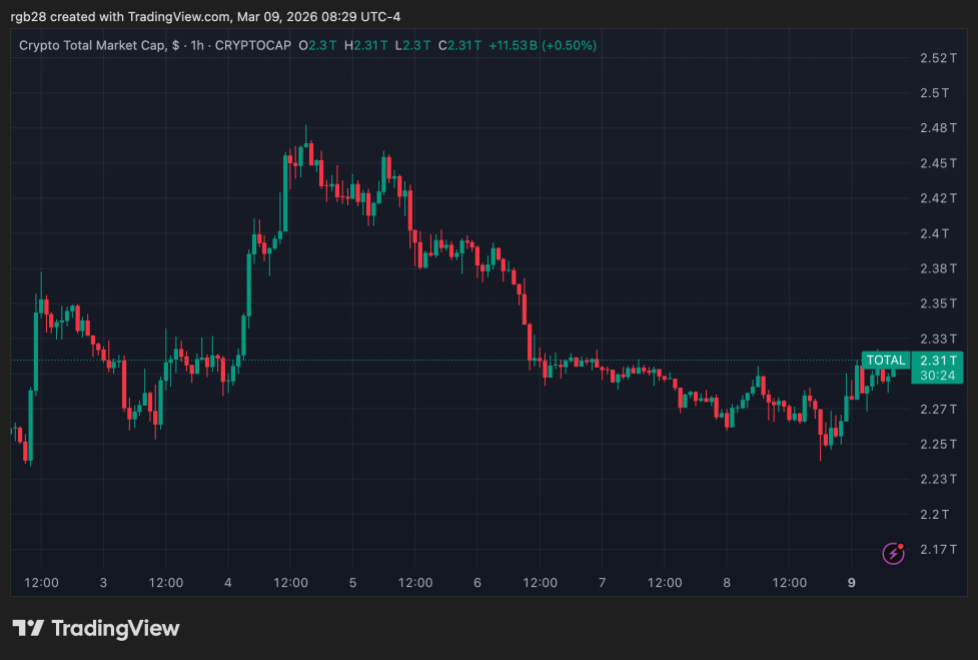
The total crypto market capitalization is at $2.31 trillion in the one-week chart. Source: TOTAL on TradingView


Preguntas relacionadas

QAccording to the former CFTC chair, why do US banks need regulatory clarity more than the crypto industry?

ABecause their general counsels advise that they cannot invest billions of dollars in new technology without regulatory certainty, and they risk having their systems superseded and falling behind the rest of the world.

QWhat are the two key pieces of legislation mentioned, and how does the former CFTC chairman describe their relationship?

AThe two key pieces are the GENIUS Act and the CLARITY Act. He describes the GENIUS Act as 'the appetizer' for crypto regulation, while the CLARITY Act (market structure bill) represents 'the main dish' but is the 'hard part.'

QWhat does Chris Giancarlo believe will happen if the CLARITY Act is not passed by Congress?

AHe believes that financial regulatory agencies like the SEC and CFTC will likely establish the necessary rules to oversee the sector, but this will not provide the long-term certainty that the industry, particularly banks, desires.

QWhy is the current timing particularly challenging period for passing crypto regulation, according to the article?

ABecause it is an election year, where politicians' focus is on swaying voters for the upcoming mid-term elections, making it a difficult time to pass significant legislation.

QWhat odds does Giancarlo give for the CLARITY Act eventually being passed, and what is his reasoning?

AHe gives 60-40 odds in favor of passing the legislation, reasoning that there is 'a lot of good in the bill for all sides' and a recognition that modernizing financial architecture with this technology is necessary for the US to maintain its dominant position.

Lecturas Relacionadas

OpenAI's Largest Internal Wealth Creation: 600 People Cash Out a Total of $6.6 Billion, 75 Take Home the Maximum $30 Million Each

A Wall Street Journal report reveals OpenAI's unprecedented pre-IPO wealth creation. In a single employee stock sale last October, over 600 current and former employees sold shares, collectively cashing out approximately $6.6 billion. Due to high investor demand, the company tripled the individual sale cap to $30 million, with about 75 employees selling the maximum amount. This event represents the largest such transaction in tech industry history for a private company. OpenAI's valuation was $500 billion for this tender offer. Employees with over two years of tenure were eligible, allowing many post-ChatGPT hires their first liquidity event. The company's stock has reportedly grown over 100-fold in seven years. Following a restructuring, employees collectively hold about 26% of OpenAI. The scale of executive wealth is also staggering. In court testimony related to Elon Musk's lawsuit, President and co-founder Greg Brockman confirmed his OpenAI stake is worth around $30 billion. Analysis indicates about 165 current and former employees hold a combined ~$164.9 billion in equity, averaging nearly $1 billion per person in paper wealth. OpenAI's per-employee stock-based compensation is estimated to be 34 times the average of major tech firms before their IPOs. OpenAI continues its rapid ascent, closing a $122 billion funding round at an $852 billion valuation in March. With monthly revenue hitting $2 billion, over 900 million weekly ChatGPT users, and plans for a potential trillion-dollar IPO in late 2026, this wealth-creation engine shows no signs of stopping.

链捕手Hace 22 min(s)

OpenAI's Largest Internal Wealth Creation: 600 People Cash Out a Total of $6.6 Billion, 75 Take Home the Maximum $30 Million Each

链捕手Hace 22 min(s)

Understanding CPO (Co-Packaged Optics) in One Article: Why Nvidia Is Willing to Spend $3.2 Billion on a Fiber?

NVIDIA and Corning announced a multi-year strategic partnership on May 6, 2026, with NVIDIA committing up to $3.2 billion to support Corning's U.S. expansion. This investment will triple Corning's manufacturing plants and significantly boost its optical fiber and communications production capacity. The core driver behind this massive investment is the fundamental shift from copper to optical interconnect technology within AI data centers. As GPU clusters scale, copper wires face critical limitations: severe signal attenuation over distance, high energy consumption for signal integrity, and excessive heat generation. Optical fiber, transmitting light instead of electrical signals, solves these issues with minimal loss, near-light speed, and lower power needs. The article outlines a three-stage evolution of data center interconnect: 1. **Traditional Copper Interconnects:** The mainstream solution of the 2010s, now being phased out due to scaling bottlenecks. 2. **Pluggable Optical Modules:** The current mainstream, where modules convert electrical signals to light externally. This process still introduces energy loss and latency. 3. **CPO (Co-Packaged Optics):** The next-generation technology where the optical engine is integrated directly with the GPU chip package. This drastically reduces the electrical signal travel distance to mere millimeters, slashing power consumption and latency while boosting data density. NVIDIA CEO Jensen Huang has identified CPO as an essential core technology for AI infrastructure. NVIDIA's investment signifies a strategic shift from being a buyer to actively controlling its supply chain for critical components. With demand for specialized optical fiber far outstripping supply—evidenced by soaring prices—securing long-term manufacturing capacity has become a competitive necessity. While Corning's expansion may pressure some suppliers, a projected global fiber supply gap of 5-15% over the next few years creates a significant opportunity window, particularly for Chinese manufacturers competitive in optical preforms, chips, and modules. Ultimately, NVIDIA's move is not about chasing a trend but an engineering imperative. The transition to light-based interconnects like CPO is driven by the physical limits of copper, marking a definitive step in the ongoing AI computing revolution.

marsbitHace 47 min(s)

Understanding CPO (Co-Packaged Optics) in One Article: Why Nvidia Is Willing to Spend $3.2 Billion on a Fiber?

marsbitHace 47 min(s)

KOL's Perspective: Why Is SOL Set to Rise from This Point?

**Summary: Why SOL is Positioned for Growth at This Level** The article argues that SOL is poised for an upward move from its current price point, citing several key factors. Primarily, SOL has just broken out of a 4-month consolidation phase. This breakout signals a return of risk appetite to the broader crypto market, as SOL is seen as a key indicator of overall crypto health. The token's ownership has reportedly shifted from short-term traders and tourists to long-term accumulators, leading to low volume. Any meaningful increase in trading activity could thus trigger significant upward momentum. Fundamental strengths include strong institutional adoption, integration with DeFi and RWAs (Real-World Assets), and the potential benefits from the Clarity Act. Despite its high volatility—having dropped 70% from its all-time high but still up 12x from its bear market low—SOL is highlighted as one of the few tokens from the last cycle to reach new highs. It boasts a robust ecosystem of applications, users, and protocols. Future catalysts include the expected influx of AI developers following the Miami Accelerate conference, which focused on AI on Solana. Furthermore, Solana is positioned as the premier chain for memecoin activity, a trend expected to continue and drive network usage and fees. The article concludes that recent price action reflects a healthy transfer to long-term holders, setting the stage for growth.

marsbitHace 1 hora(s)

KOL's Perspective: Why Is SOL Set to Rise from This Point?

marsbitHace 1 hora(s)

Trading

Spot
Futuros
活动图片




