Bankless Co-founder: Why I Sold All My ETH

链捕手Publicado a 2026-05-27Actualizado a 2026-05-27

Resumen

Author David Hoffman, founder of Bankless, explains his decision to sell all his ETH, despite being a prominent figure in the Ethereum ecosystem. He clarifies that his move is not a bearish take on Ethereum itself, which he remains highly optimistic about as a network. His core argument is that the "ETH is money" thesis, which he helped popularize, has largely played out. Hoffman argues that ETH has achieved the market valuation it deserves based on Ethereum's current success and competitive position. He details several reasons for this view. First, the path for ETH to become global money required nearly flawless execution and sustained dominance across Ethereum's entire technical and social stack—a coordination challenge he now believes had a narrower window for success than anticipated. Second, market data shows a strong correlation between L1 chain activity/fees and the price of its native asset; Ethereum's fee dominance has been challenged by competitors like Solana. Third, the "strong version" of crypto (decentralized, native crypto economies) that ETH's monetary thesis relied upon has struggled to maintain a positive mainstream narrative and stable adoption beyond a brief period. Finally, Ethereum's architecture as a "giver"—providing secure block space and tokenization capabilities at cost to L2s and applications—means it doesn't capture premium value directly. Its rollup-centric roadmap further directs most profits to L2s and applications ("fat app theory"). In conc...

Author:David Hoffman

Translation:Jiahuan, ChainCatcher

If you missed the news last week, I sold my ETH.

For someone who has built a career, community, identity, and business around Ethereum, making this decision was not easy.

The reason behind the sale requires a more thorough explanation than fragmented tweets on Twitter.

The 'ETH is Money' thesis did not fail... it has simply been realized. Ethereum has earned the ETH price it deserves, and I believe ETH as an asset will not be revalued, either upwards or downwards.
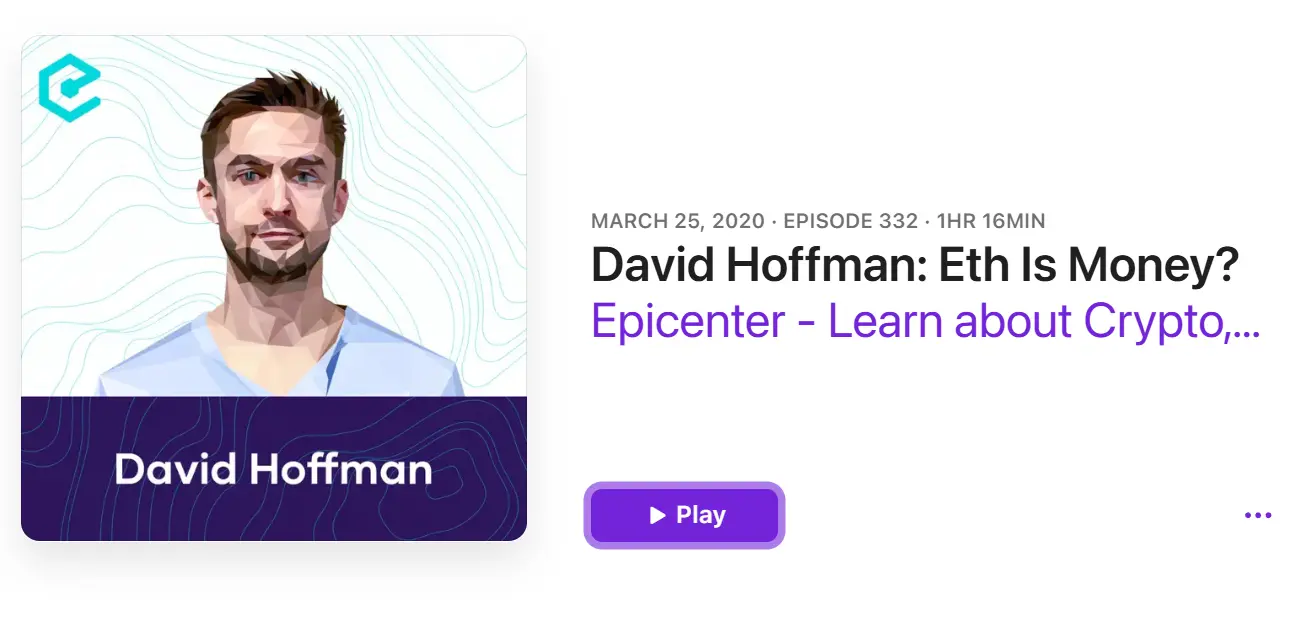
'ETH is Money' is the core narrative proposed by author David Hoffman in 2019 and long promoted through Bankless, advocating that ETH should become a global store of value. It was once one of Ethereum's most mainstream bullish logics.

Note: I am extremely bullish on Ethereum. I expect the Ethereum network to perform exceptionally well from here on out. However, I believe that only a tiny fraction of this success will be reflected in ETH.

The article text is as follows:

'ETH is Money' Has Always Been an Aspiration

Money is a coordination game, and coordination is very difficult.

The Ethereum project itself is a series of coordination challenges stacked upon multiple levels, and the 'ETH is Money' thesis demands that all these levels succeed, and succeed unequivocally.

ETH can only become money if and only if every layer of Ethereum's techno-social stack performs better than its competitors.

Given the ambition of the Ethereum project, achieving its most successful version was always a monumental challenge. Despite shortcomings, the Ethereum project has performed admirably, fully deserving its current market capitalization.

Nevertheless, the window of opportunity for $ETH to be 'revalued' by the market seems to be closing.

In a sense, ETH is money. But it is not the most successful version we collectively aspired to.

Ethereum is a Coordination Game

A Turing-complete blockchain is such a powerful idea that Ethereum's maximum potential is the entire crypto world. Everything.

The only obstacle to Ethereum achieving 100% absolute domination over everything is coordination.

Ethereum's leadership needs to be sufficiently decentralized; governance needs 'rough consensus' to create credible neutrality, maximizing Ethereum's adoption at the highest level.

Ethereum's leadership needs to respond quickly to market dynamics, operating like a startup facing an existential threat of marginalization.

Ethereum L2s need to be able to operate and make their own market choices independently from the base layer, but they also need to be economically bound and constrained by the broader Ethereum economy and brand.

Ethereum's roadmap needs to be executed in a specific order to maximize and maintain Ethereum's momentum and market dominance, thereby fully subduing competition and maximizing confidence in Ethereum and ETH.

Key technology R&D and engineering implementation need to be fast enough so that Ethereum can both prove its utility to the outside world and stay ahead of competitors.

The 'ETH is Money' thesis is about creating an extremely revolutionary and powerful financial asset that, by virtue of its unique properties as the premier global store of value, attracts individuals who would otherwise be indifferent.

Ethereum's brand and ETH's strength need to be so powerful that traditional large capital not only feels safe but actively includes ETH as a significant position in retirement portfolios due to the dominance of the Ethereum project.

For 'ETH is Money' to happen, everything upstream of ETH needs to function in an extremely perfect manner.

Ethereum is not Bitcoin; it chose the hard path. Bitcoin chose to strip everything from its blockchain to elevate BTC.

Ethereum chose to add everything to its blockchain to maximize the utility of its block space. Only by doing this in the best possible way before competitors can ETH attain its status as global money.

We've come a long way, and Ethereum has already achieved the maximum potential market share it deserves.

I fear the window to play this game has closed.

The Macro Environment May Never Allow It to Happen

Looking back over the past few years, I see that Ethereum needed to overcome numerous macro-environmental challenges.

1. L1 Asset Valuation is Inextricably Linked to Revenue

Say what you will about how hard it is to value smart contract chains based on fees and revenue, but fees and revenue are clearly how smart contract L1 assets increase their pricing power.

By 2026, we have ample data showing that all these factors are closely correlated: L1 activity, L1 fees, and the price appreciation of the L1 native asset.

In 2021, when ETH had the highest L1 revenue market share, it dominated.

In 2024, when SOL's L1 revenue market share surged across the industry, it dominated.

In 2026, NEAR is experiencing price revaluation alongside fundamental growth in its L1 revenue and NEAR burn.

You can also look at assets like BNB and TRX, perhaps the highest cumulative revenue projects ever. Their price charts look the way I once expected ETH's should—provided ETH could maintain its L1 fee dominance for longer than just that stretch in 2022.

2. The Strong Version of Crypto Didn't Work

@0xMakesy put it well:

Ethereum represents the strong version of crypto, crypto for crypto's sake, self-sustaining and self-perpetuating. DeFi, NFTs, DAOs—we were rebels, building an alternative financial system of, by, and for the people, plugging imagination into the money system.

Simultaneously, there exists the weak version: efficient ledger infrastructure for financial institutions' backends. The weak version would fuel the strong version, converting demand for internet ledgers into inward-flowing capital streams toward crypto, toward Ethereum, ultimately converging on ETH.

Perhaps if Ethereum executed better, faster, stronger, and if crypto hadn't attracted such a massive cohort of speculative charlatans and value extractors, the industry could have won the influence and respect I always thought it deserved.

But the only period where crypto maintained a positive brand image with the general public was from late 2020 to early 2022. Outside this narrow window, crypto's reputation has been one of fraud, scams, get-rich-quick schemes, and uselessness to the average person.
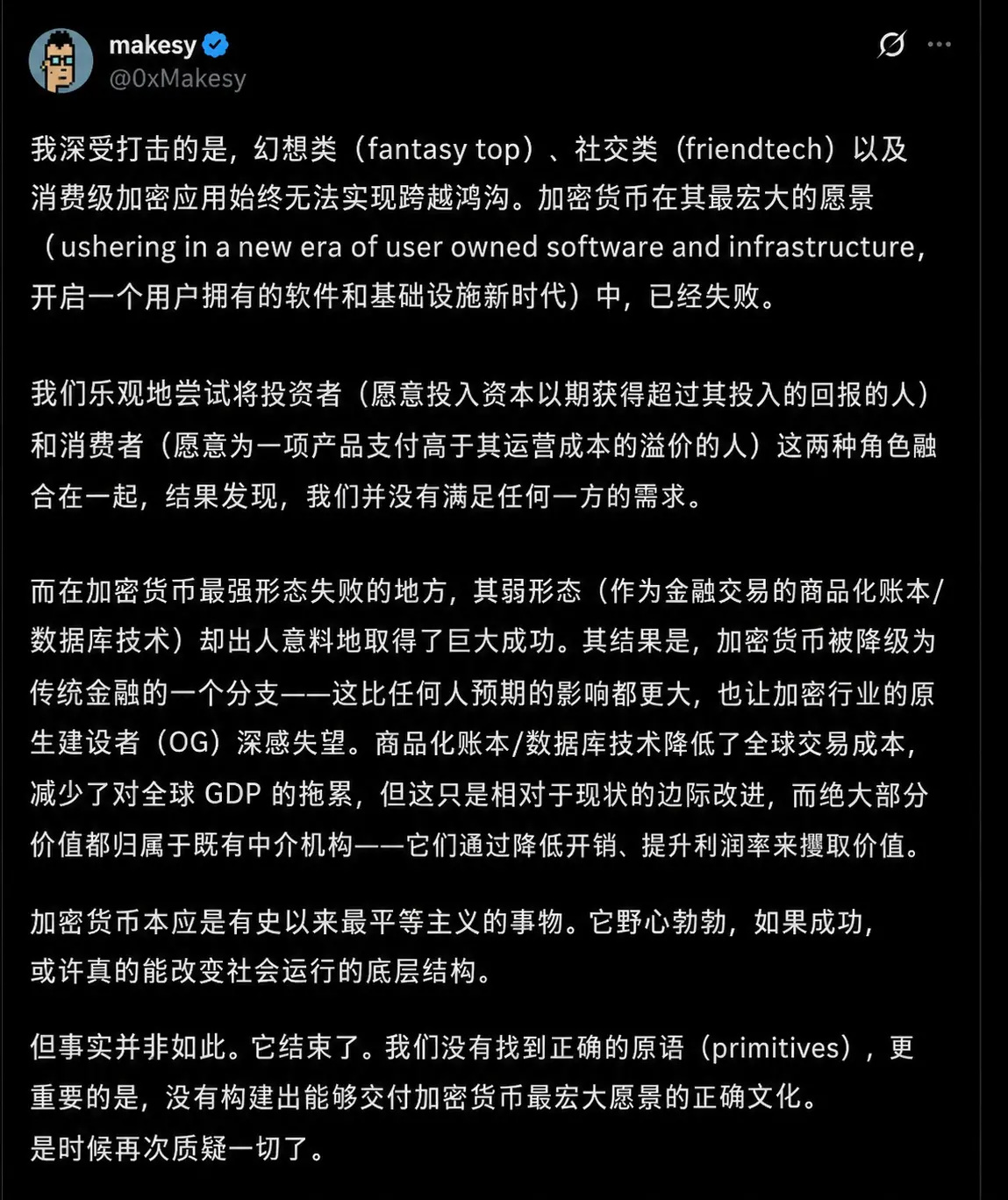
'ETH is Money' Relies on 'Strong Crypto'

Right at the moment when everyone was forced online, ETH emerged as the internet's money. The world discovered crypto for the first time, and for that brief window, it was very cool.

Money is a coordination game, and a currency's Schelling Point (consensus focal point) is held together by belief. In 2021, the broader public believed in ETH: it was cool, disruptive, and populist. Bitcoin possessed the same properties and has retained them better than ETH post-2021.

This raises a disquieting possibility: the strong version of crypto may never have been a stable equilibrium point. COVID was an extremely distorted time for money, and perhaps 'ETH as Money' was only propped up by that distortion.

If that's the case, ETH becoming money always depended on the strong version of crypto working better than it has in reality.

3. Ethereum's Utility Also Benefits Other Monies

Is Bitcoin money? Is the Dollar money? Is Gold money? It doesn't matter—whatever is money will be tokenized on Ethereum.

In 2020, Nic Carter posited on Bankless that stablecoins would likely be parasitic to ETH as Ethereum's native unit. Back then, Ethereum had $3B in stablecoins. Today, that number is $163B, a 54x increase.

The utility Ethereum provides is helping to expand the monetary network of any asset that truly is money, which is why the US is so bullish on crypto for stablecoin adoption. Ethereum is helping the US maintain dollar hegemony, and leveraging this fact is explicit government policy.

Clearly, the positive spillover effects garnered by $ETH as money are far less potent than those seen by the US government in Ethereum's stablecoin ecosystem.

Ethereum is a Giver, Not a Taker

At its core, Ethereum is a giver, not a taker.

It provides the world's most secure block space to L2s at cost.

It tokenizes the world's assets at cost.

It secures billions in DeFi at cost.

Ethereum takes no markup on anything it does.

This is the nature of open-source software and the power of Ethereum. Ethereum provides its full suite of immensely valuable goods to the world at cost.

Ethereum is noble. Ethereum is good.

Ethereum is the world's most successful non-profit organization.

Naturally, incredible mass adoption will occur on Ethereum. It has been and will continue to be one of the most impactful open-source software projects ever built by humanity, and being a 'non-profit protocol' is one of its core features.

This is why ETH's path to becoming money depended on maintaining sustained and extremely high market dominance.

Ultimately, as block space becomes commoditized, fees will trend towards zero. So long as it's Ethereum that gets commoditized and not its competitors, Ethereum can maintain its margins and dominance.

Ultimately, the fat protocol theory (referring to the idea that the majority of economic value will be captured and monopolized by the foundational protocol (like Ethereum), not by the application layer built on top, as in traditional internet models) will give way to the fat application theory, and applications will swallow the remaining profits.

So long as they are Ethereum's applications and not a competitor's, that's fine for ETH.

It's hard to square 'ETH is Money' with 'Ethereum is a giver, not a taker.' Ethereum's architecture is intentionally designed to give everything back to its ecosystem and only take the minimum required to keep the network running.

Architecturally, ETH is not prioritized within Ethereum; this is a feature, not a bug. ETH could only become money if Ethereum won a battle it was architecturally refusing to fight.

This could have worked if Ethereum could have maintained incredible market dominance.

This Thesis Asks Too Much of Ethereum

'ETH is Money' requires everything about Ethereum to go right. The margin for error is much smaller than I originally thought. Ethereum's momentum in 2021 and 2022 made 'ETH is Money' seem like the default path.

In hindsight, Solana's rise in 2021 alongside rising anti-Ethereum sentiment was the first major sign that Ethereum and ETH's coordination game wasn't going as planned.

The Ethereum Foundation needed to decentralize and allow alternative power structures to emerge. But it also needed to respond to market forces with the urgency and drive of a startup facing an existential elimination threat.

L2 teams needed the freedom for self-determination, but also needed to operate under the larger protective brand of Ethereum and ETH. The technical synchronicity integration between Ethereum and its L2s needed to be executed much faster.

Smart contract chains are valued via fees; to break out of this mold, Ethereum needed to rewrite the rules with overwhelming success.

My Reason for Selling

It just didn't reach its maximum potential either.

Ethereum did a noble thing, choosing for itself the hardest, most ambitious, most ideologically pure path for its future.

It secured some incredible wins and failed to win others.

Ethereum has earned the market cap it deserves.

I am very bullish on the Ethereum network and its ecosystem—Ethereum is architected to maximize the success of its apps, L2s, and ecosystem. The fat application theory means Ethereum's apps take all the fees, and the rollup-centric roadmap means L2s take 97% of the profits.

As for ETH the asset, I have a hard time seeing it being structurally revalued, either up or down.

Therefore, my reason for selling ETH is not bearishness on ETH; it's that I believe the 'ETH is Money' thesis has been realized, and I wish to allocate capital to other opportunities in the market that I'm bullish on.


Preguntas relacionadas

QAccording to David Hoffman, what is the core reason he sold his ETH, and why doesn't he see significant revaluation potential for it?

AHe believes the 'ETH is money' thesis has played out and has been fully priced into ETH's current market capitalization. He sold not because he is bearish on ETH, but because he sees little potential for the asset to be significantly revalued (either upward or downward) from its current level, as its success as a global store of value depended on a perfect execution by the Ethereum project that he now considers improbable. He wants to reallocate funds to other opportunities.

QWhat key characteristics of Ethereum's architecture make it a 'giver, not a taker,' and why does Hoffman argue this works against ETH becoming money?

AEthereum provides critical value—like secure block space for L2s, tokenization of global assets, and security for DeFi—'at cost,' without charging a premium. Its open-source, non-profit nature is its strength but means it is architected to give back nearly all value to its ecosystem. For ETH to become money, Ethereum would need to maintain extreme market dominance and 'win a battle it is architeturally architected to not participate in'—namely, capturing and monetizing value for the native asset itself.

QHoffman mentions the relationship between L1 assets and their revenue/fees. How does this observed pattern conflict with the 'ETH is money' thesis?

AThe data shows a strong correlation between L1 activity/fees/revenue and the price appreciation of that L1's native asset (e.g., ETH in 2021, SOL in 2024, NEAR in 2026). The 'ETH is money' thesis aimed to transcend this fee-based valuation model, positioning ETH as a global store of value regardless of network fees. However, the market continues to value smart contract L1s based on their revenue capture, and ETH has not maintained the overwhelming fee dominance needed to break this pattern and validate the 'money' narrative.

QWhat does Hoffman mean by 'strong version' versus 'weak version' of cryptocurrency, and why is the former's failure problematic for ETH?

AThe 'strong version' is cryptocurrency for its own sake—a self-sustaining, alternative financial system (DeFi, NFTs, DAOs). The 'weak version' is cryptocurrency as efficient ledger infrastructure for traditional finance. The 'ETH is money' thesis relied on the success and mainstream appeal of the 'strong version' to create a powerful social consensus. However, crypto's public brand has largely been associated with scams and speculation, not positive utility. This failure of the 'strong version' to achieve a stable, respected position undermines the social coordination needed for ETH to become widely accepted as money.

QHow does the concept of 'coordination' present a fundamental challenge for Ethereum and the 'ETH is money' narrative?

AMoney is a coordination game, and for ETH to become the dominant global money, Ethereum needed to win a series of complex, stacked coordination challenges perfectly. This included: decentralized yet decisive leadership, perfectly synchronized L2s, flawless technical execution to stay ahead of competitors, and creating a brand powerful enough to attract major traditional capital. Hoffman argues that the window for Ethereum to achieve this level of flawless coordination and market dominance, which was necessary for ETH to break free from being valued as a fee-generating L1, has likely closed.

Lecturas Relacionadas

From Issuer to Infrastructure Owner: Circle's Arc Strategy and the Fatal Gap in the GENIUS Act

Circle raised $222 million for its proprietary Layer-1 blockchain, Arc, positioning itself not just as a stablecoin issuer but as the owner of the settlement infrastructure USDC relies on. This move, backed by investors like BlackRock and Apollo, highlights a significant structural conflict unaddressed by the GENIUS Act of 2025. While the act focuses on stablecoin reserves and issuer oversight, it remains silent on the market structure implications of an issuer controlling the underlying network—a scenario akin to a currency issuer also owning the payment rails. Traditionally, financial regulations separate issuers from settlement infrastructure to ensure neutrality. With Arc, Circle gains control over transaction ordering, fees, and network rules, potentially favoring USDC over competitors. The article argues that this creates a permanent structural temptation, even if no abuse occurs. The solution lies in applying established market infrastructure principles: mandating neutral transaction ordering, transparent fee schedules, and governance separated from Circle’s commercial interests. The current pre-mainnet phase offers a critical window for regulators to establish these rules before Arc becomes entrenched. Once operational, enforcing changes would be costly and disruptive. The core question remains: should a regulated stablecoin issuer be allowed to own the settlement network its competitors must use? The GENIUS Act doesn’t answer this, but Circle’s Arc strategy makes it urgent.

marsbitHace 1 hora(s)

From Issuer to Infrastructure Owner: Circle's Arc Strategy and the Fatal Gap in the GENIUS Act

marsbitHace 1 hora(s)

What Are the Key Variables Determining the AI Bull Market?

Title: What Determines the AI Bull Market? Key Variables Revealed Despite rising oil prices above $100/barrel, persistent inflation, and fragile Fed rate cut expectations—a traditionally hostile environment for high-valuation tech stocks—the AI sector continues to drive the market to new highs. According to analysts, the current AI boom is in a phase of "rational fervor": while bubbles exist, they are not yet out of control. The crucial shift is the emergence of Agentic AI, which is evolving from an assisting tool (Copilot) to an autonomous execution tool (Autopilot), creating a clearer commercial path from investment to revenue. This shift accelerates Token consumption and inference computing demand while boosting revenue forecasts for leading firms. The market is now rewarding capital expenditure as it transforms from a burden into a competitive moat, supporting hardware chains like GPUs, optical modules, and storage. However, valuations have already priced in growth expectations for 2027-2028. The forward P/E ratio for the "Magnificent Seven" tech giants is about 35x, compared to 25x for the rest of the S&P 500. This premium implies AI adoption must occur 5 to 8 times faster than past technological revolutions—a scenario with little room for error. The sustainability of the AI bull market hinges on three key variables: 1. **Short-term liquidity shocks**: Risks include sustained high oil prices, resurgent inflation, rising interest rates, and potential unwinding of the yen carry trade. The critical question is whether the upward revision speed of Annual Recurring Revenue (ARR) can outpace the rise in interest rates. 2. **Mid-term industry realization**: Can the actual pace of AI adoption and commercialization match the current lofty valuations? Historically, general-purpose technology revolutions follow a non-linear path with periods of acceleration and deceleration. 3. **Long-term structural constraints**: These include energy and power grid limitations, employment displacement and consumer purchasing power, social acceptance and potential backlash, and potential hardware technology breakthroughs that could disrupt current supply chains. While the long-term prospects for AI remain optimistic with potential for significant productivity gains, the stock market's pricing depends not just on the vision but on the actual speed of realization amid these growing constraints. The direction is clear, but the pace of execution will determine whether the bubble remains controlled or spirals out of control.

marsbitHace 1 hora(s)

What Are the Key Variables Determining the AI Bull Market?

marsbitHace 1 hora(s)

The AI Industrial Revolution: Where Are We Now?

This article explores the current stage of the AI industrial revolution, arguing we are still merely attaching new tools to old workflows rather than fundamentally redesigning production. The author compares this to the early Industrial Revolution, where factories simply replaced waterwheels with steam engines without changing their core structure. Similarly, today we embed AI chat windows into existing software but leave organizational processes unchanged. While massive investment floods into AI infrastructure (data centers, chips), akin to railway manias of the past, the real transformation lies in "dismantling the old workshop"—reorganizing companies around AI. Examples include Notion's use of hundreds of AI Agents and Y Combinator's experiments with self-improving AI systems that operate autonomously. The author notes a critical gap: while China has vast AI user growth, few companies have rebuilt core workflows. AI is beginning to impact entry-level jobs, and early adopters are gaining a compounding advantage. The conclusion is that the pivotal moment will not be the invention of better models, but when organizations decide to tear down old structures and rebuild around AI, shifting the bottleneck from human coordination to computing power. The future workplace and job titles are yet to be defined, but the imperative is to move away from legacy processes and position oneself where the new "railway" is being built.

marsbitHace 1 hora(s)

The AI Industrial Revolution: Where Are We Now?

marsbitHace 1 hora(s)

Trading

Spot
Futuros

Artículos destacados

Qué es ETH 2.0

ETH 2.0: Una Nueva Era para Ethereum Introducción ETH 2.0, conocido ampliamente como Ethereum 2.0, marca una actualización monumental para la blockchain de Ethereum. Esta transición no es solo una mejora superficial; busca mejorar fundamentalmente la escalabilidad, seguridad y sostenibilidad de la red. Con un cambio del mecanismo de consenso intensivo en energía Prueba de Trabajo (PoW) a una Prueba de Participación (PoS) más eficiente, ETH 2.0 promete un enfoque transformador para el ecosistema blockchain. ¿Qué es ETH 2.0? ETH 2.0 es un conjunto de actualizaciones interconectadas y distintivas centradas en optimizar las capacidades y el rendimiento de Ethereum. La reestructuración está diseñada para abordar desafíos críticos que el mecanismo actual de Ethereum ha enfrentado, particularmente en lo que respecta a la velocidad de transacción y la congestión de la red. Objetivos de ETH 2.0 Los objetivos principales de ETH 2.0 giran en torno a mejorar tres aspectos clave: Escalabilidad: Con el objetivo de aumentar significativamente el número de transacciones que la red puede manejar por segundo, ETH 2.0 busca superar la limitación actual de aproximadamente 15 transacciones por segundo, potencialmente alcanzando miles. Seguridad: Las medidas de seguridad mejoradas son fundamentales para ETH 2.0, particularmente a través de una mejor resistencia contra ciberataques y la preservación del ethos descentralizado de Ethereum. Sostenibilidad: El nuevo mecanismo PoS está diseñado no solo para mejorar la eficiencia, sino también para reducir drásticamente el consumo de energía, alineando el marco operativo de Ethereum con consideraciones ambientales. ¿Quién es el Creador de ETH 2.0? La creación de ETH 2.0 se puede atribuir a la Fundación Ethereum. Esta organización sin fines de lucro, que desempeña un papel crucial en el apoyo al desarrollo de Ethereum, es liderada por el notable cofundador Vitalik Buterin. Su visión de un Ethereum más escalable y sostenible ha sido la fuerza motriz detrás de esta actualización, involucrando contribuciones de una comunidad global de desarrolladores y entusiastas dedicados a mejorar el protocolo. ¿Quiénes son los Inversores de ETH 2.0? Si bien los detalles sobre los inversores de ETH 2.0 no se han hecho públicos, se sabe que la Fundación Ethereum recibe apoyo de varias organizaciones e individuos en el ámbito de blockchain y tecnología. Estos socios incluyen firmas de capital de riesgo, compañías tecnológicas y organizaciones filantrópicas que comparten un interés mutuo en apoyar el desarrollo de tecnologías descentralizadas e infraestructura blockchain. ¿Cómo Funciona ETH 2.0? ETH 2.0 se distingue por introducir una serie de características clave que lo diferencian de su predecesor. Prueba de Participación (PoS) La transición a un mecanismo de consenso PoS es uno de los cambios más destacados de ETH 2.0. A diferencia de PoW, que se basa en la minería intensiva en energía para la verificación de transacciones, PoS permite a los usuarios validar transacciones y crear nuevos bloques de acuerdo con la cantidad de ETH que apuestan en la red. Esto conduce a una mayor eficiencia energética, reduciendo el consumo en aproximadamente un 99.95%, convirtiendo a Ethereum 2.0 en una alternativa considerablemente más verde. Cadenas Shard Las cadenas shard son otra innovación crítica de ETH 2.0. Estas cadenas más pequeñas operan en paralelo con la cadena principal de Ethereum, lo que permite que múltiples transacciones sean procesadas simultáneamente. Este enfoque mejora la capacidad general de la red, abordando las preocupaciones de escalabilidad que han afectado a Ethereum. Cadena Beacon En el núcleo de ETH 2.0 se encuentra la Cadena Beacon, que coordina la red y gestiona el protocolo PoS. Funciona como un organizador de cierta manera: supervisa a los validadores, asegura que los shards permanezcan conectados a la red y monitorea la salud general del ecosistema blockchain. Cronología de ETH 2.0 El viaje de ETH 2.0 ha estado marcado por varios hitos clave que trazan la evolución de esta importante actualización: Diciembre 2020: El lanzamiento de la Cadena Beacon marcó la introducción de PoS, preparándose para la migración hacia ETH 2.0. Septiembre 2022: La finalización de “La Fusión” representa un momento crucial en el que la red Ethereum se trasladó exitosamente de un marco PoW a uno PoS, anunciando una nueva era para Ethereum. 2023: El lanzamiento esperado de cadenas shard tiene como objetivo mejorar aún más la escalabilidad de la red Ethereum, consolidando a ETH 2.0 como una plataforma robusta para aplicaciones y servicios descentralizados. Características Clave y Beneficios Escalabilidad Mejorada Una de las ventajas más significativas de ETH 2.0 es su escalabilidad mejorada. La combinación de PoS y cadenas shard permite que la red expanda su capacidad, permitiendo acomodar un volumen mucho mayor de transacciones en comparación con el sistema heredado. Eficiencia Energética La implementación de PoS representa un gran paso hacia la eficiencia energética en la tecnología blockchain. Al reducir drásticamente el consumo de energía, ETH 2.0 no solo disminuye los costos operativos, sino que también se alinea más estrechamente con los objetivos de sostenibilidad global. Seguridad Mejorada Los mecanismos actualizados de ETH 2.0 contribuyen a mejorar la seguridad en toda la red. El despliegue de PoS, junto con las medidas de control innovadoras establecidas a través de cadenas shard y la Cadena Beacon, asegura un mayor grado de protección contra posibles amenazas. Costos Más Bajos para los Usuarios A medida que la escalabilidad mejora, los efectos sobre los costos de transacción también serán evidentes. Se espera que una mayor capacidad y una menor congestión se traduzcan en tarifas más bajas para los usuarios, haciendo que Ethereum sea más accesible para transacciones cotidianas. Conclusión ETH 2.0 marca una evolución significativa en el ecosistema blockchain de Ethereum. A medida que aborda problemas fundamentales como la escalabilidad, el consumo de energía, la eficiencia en las transacciones y la seguridad general, la importancia de esta actualización no puede ser subestimada. La transición a la Prueba de Participación, la introducción de cadenas shard y el trabajo fundamental de la Cadena Beacon son indicativos de un futuro donde Ethereum puede satisfacer las crecientes demandas del mercado descentralizado. En una industria impulsada por la innovación y el progreso, ETH 2.0 se erige como un testimonio de las capacidades de la tecnología blockchain para allanar el camino hacia una economía digital más sostenible y eficiente.

166 Vistas totalesPublicado en 2024.04.04Actualizado en 2024.12.03

Qué es ETH 2.0

Qué es ETH 3.0

ETH3.0 y $eth 3.0: Un Examen Profundo del Futuro de Ethereum Introducción En el paisaje en rápida evolución de las criptomonedas y la tecnología blockchain, ETH3.0, a menudo denotado como $eth 3.0, ha surgido como un tema de considerable interés y especulación. El término abarca dos conceptos principales que merecen aclaración: Ethereum 3.0: Esto representa una posible actualización futura destinada a aumentar las capacidades de la blockchain existente de Ethereum, enfocándose particularmente en mejorar la escalabilidad y el rendimiento. ETH3.0 Meme Token: Este proyecto de criptomoneda distinto busca aprovechar la blockchain de Ethereum para crear un ecosistema centrado en memes, promoviendo la participación dentro de la comunidad de criptomonedas. Comprender estos aspectos de ETH3.0 es esencial no solo para los entusiastas de las criptomonedas, sino también para aquellos que observan tendencias tecnológicas más amplias en el espacio digital. ¿Qué es ETH3.0? Ethereum 3.0 Ethereum 3.0 se presenta como una actualización propuesta para la red de Ethereum ya establecida, que ha sido la columna vertebral de muchas aplicaciones descentralizadas (dApps) y contratos inteligentes desde su inicio. Las mejoras previstas se concentran principalmente en la escalabilidad, integrando tecnologías avanzadas como sharding y pruebas de conocimiento cero (zk-proofs). Estas innovaciones tecnológicas tienen como objetivo facilitar un número sin precedentes de transacciones por segundo (TPS), potencialmente alcanzando millones, abordando así una de las limitaciones más significativas que enfrenta la tecnología blockchain actual. La mejora no es meramente técnica, sino también estratégica; está destinada a preparar la red de Ethereum para su adopción generalizada y utilidad en un futuro marcado por una mayor demanda de soluciones descentralizadas. ETH3.0 Meme Token En contraste con Ethereum 3.0, el ETH3.0 Meme Token se aventura en un ámbito más ligero y juguetón al combinar la cultura de memes de internet con la dinámica de las criptomonedas. Este proyecto permite a los usuarios comprar, vender e intercambiar memes en la blockchain de Ethereum, proporcionando una plataforma que fomenta la participación comunitaria a través de la creatividad y los intereses compartidos. El ETH3.0 Meme Token tiene como objetivo demostrar cómo la tecnología blockchain puede intersectarse con la cultura digital, creando casos de uso que son tanto entretenidos como financieramente viables. ¿Quién es el Creador de ETH3.0? Ethereum 3.0 La iniciativa hacia Ethereum 3.0 es impulsada principalmente por un consorcio de desarrolladores e investigadores dentro de la comunidad de Ethereum, incluyendo notablemente a Justin Drake. Conocido por sus ideas y contribuciones a la evolución de Ethereum, Drake ha sido una figura prominente en las discusiones sobre la transición de Ethereum a una nueva capa de consenso, denominada “Beam Chain.” Este enfoque colaborativo para el desarrollo significa que Ethereum 3.0 no es el producto de un creador singular, sino más bien una manifestación de ingenio colectivo centrado en avanzar la tecnología blockchain. ETH3.0 Meme Token Los detalles sobre el creador del ETH3.0 Meme Token son actualmente inidentificables. La naturaleza de los tokens de memes a menudo conduce a una estructura más descentralizada y dirigida por la comunidad, lo que podría explicar la falta de atribución específica. Esto se alinea con la ética de la comunidad cripto más amplia, donde la innovación a menudo surge de esfuerzos colaborativos en lugar de individuales. ¿Quiénes son los Inversores de ETH3.0? Ethereum 3.0 El apoyo a Ethereum 3.0 proviene principalmente de la Fundación Ethereum junto con una entusiasta comunidad de desarrolladores e inversores. Esta asociación fundamental proporciona un grado significativo de legitimidad y mejora la perspectiva de una implementación exitosa, ya que aprovecha la confianza y credibilidad construidas a lo largo de años de operaciones en la red. En el clima cambiando rápidamente de las criptomonedas, el apoyo de la comunidad juega un papel crucial en impulsar el desarrollo y la adopción, posicionando a Ethereum 3.0 como un contendiente serio para futuros avances en blockchain. ETH3.0 Meme Token Si bien las fuentes actualmente disponibles no proporcionan información explícita sobre las fundaciones o organizaciones de inversión que respaldan el ETH3.0 Meme Token, es indicativo del modelo de financiamiento típico para tokens de memes, que a menudo depende del apoyo de base y la participación comunitaria. Los inversores en tales proyectos suelen consistir en individuos motivados por el potencial de innovación impulsada por la comunidad y el espíritu de cooperación que se encuentra dentro de la comunidad cripto. ¿Cómo Funciona ETH3.0? Ethereum 3.0 Las características distintivas de Ethereum 3.0 radican en su implementación propuesta de sharding y tecnología zk-proof. Sharding es un método de particionamiento de la blockchain en piezas más pequeñas y manejables o “shards,” que pueden procesar transacciones de manera concurrente en lugar de secuencial. Esta descentralización del procesamiento ayuda a prevenir la congestión y asegura que la red permanezca receptiva incluso bajo una carga pesada. La tecnología de prueba de conocimiento cero (zk-proof) contribuye con otra capa de sofisticación al permitir la validación de transacciones sin revelar los datos subyacentes involucrados. Este aspecto no solo mejora la privacidad, sino que también aumenta la eficiencia general de la red. También se habla de incorporar una Máquina Virtual de Ethereum de conocimiento cero (zkEVM) en esta actualización, amplificando aún más las capacidades y utilidad de la red. ETH3.0 Meme Token El ETH3.0 Meme Token se distingue al capitalizar la popularidad de la cultura de memes. Establece un mercado para que los usuarios participen en el comercio de memes, no solo por entretenimiento sino también por el posible beneficio económico. Al integrar características como staking, provisión de liquidez y mecanismos de gobernanza, el proyecto fomenta un entorno que incentiva la interacción y participación de la comunidad. Al ofrecer una mezcla única de entretenimiento y oportunidad económica, el ETH3.0 Meme Token tiene como objetivo atraer a una audiencia diversa, que abarca desde entusiastas de las criptomonedas hasta conocedores casuales de memes. Línea de Tiempo de ETH3.0 Ethereum 3.0 11 de noviembre de 2024: Justin Drake insinúa la próxima actualización de ETH 3.0, centrada en mejoras de escalabilidad. Este anuncio significa el comienzo de las discusiones formales sobre la futura arquitectura de Ethereum. 12 de noviembre de 2024: Se espera que la propuesta anticipada para Ethereum 3.0 se desvele en Devcon en Bangkok, preparando el escenario para una mayor retroalimentación de la comunidad y posibles próximos pasos en el desarrollo. ETH3.0 Meme Token 21 de marzo de 2024: El ETH3.0 Meme Token se lista oficialmente en CoinMarketCap, marcando su incursión en el dominio público de las criptomonedas y mejorando la visibilidad de su ecosistema basado en memes. Puntos Clave En conclusión, Ethereum 3.0 representa una evolución significativa dentro de la red de Ethereum, enfocándose en superar las limitaciones en términos de escalabilidad y rendimiento a través de tecnologías avanzadas. Sus actualizaciones propuestas reflejan un enfoque proactivo hacia las demandas y la usabilidad futura. Por otro lado, el ETH3.0 Meme Token encapsula la esencia de la cultura impulsada por la comunidad en el espacio de las criptomonedas, aprovechando la cultura de memes para crear plataformas atractivas que fomentan la creatividad y participación del usuario. Comprender los distintos propósitos y funcionalidades de ETH3.0 y $eth 3.0 es fundamental para cualquiera interesado en los desarrollos en curso dentro del espacio cripto. Con ambas iniciativas abriendo caminos únicos, subrayan colectivamente la naturaleza dinámica y multifacética de la innovación en blockchain.

178 Vistas totalesPublicado en 2024.04.04Actualizado en 2024.12.03

Qué es ETH 3.0

Cómo comprar ETH

¡Bienvenido a HTX.com! Hemos hecho que comprar Ethereum (ETH) sea simple y conveniente. Sigue nuestra guía paso a paso para iniciar tu viaje de criptos.Paso 1: crea tu cuenta HTXUtiliza tu correo electrónico o número de teléfono para registrarte y obtener una cuenta gratuita en HTX. Experimenta un proceso de registro sin complicaciones y desbloquea todas las funciones.Obtener mi cuentaPaso 2: ve a Comprar cripto y elige tu método de pagoTarjeta de crédito/débito: usa tu Visa o Mastercard para comprar Ethereum (ETH) al instante.Saldo: utiliza fondos del saldo de tu cuenta HTX para tradear sin problemas.Terceros: hemos agregado métodos de pago populares como Google Pay y Apple Pay para mejorar la comodidad.P2P: tradear directamente con otros usuarios en HTX.Over-the-Counter (OTC): ofrecemos servicios personalizados y tipos de cambio competitivos para los traders.Paso 3: guarda tu Ethereum (ETH)Después de comprar tu Ethereum (ETH), guárdalo en tu cuenta HTX. Alternativamente, puedes enviarlo a otro lugar mediante transferencia blockchain o utilizarlo para tradear otras criptomonedas.Paso 4: tradear Ethereum (ETH)Tradear fácilmente con Ethereum (ETH) en HTX's mercado spot. Simplemente accede a tu cuenta, selecciona tu par de trading, ejecuta tus trades y monitorea en tiempo real. Ofrecemos una experiencia fácil de usar tanto para principiantes como para traders experimentados.

4.1k Vistas totalesPublicado en 2024.12.10Actualizado en 2025.03.21

Cómo comprar ETH

Discusiones

Bienvenido a la comunidad de HTX. Aquí puedes mantenerte informado sobre los últimos desarrollos de la plataforma y acceder a análisis profesionales del mercado. A continuación se presentan las opiniones de los usuarios sobre el precio de ETH (ETH).

活动图片