Bank of England Engages Polygon for Second Phase of Digital Pound Trials

cryptonews.ruPublicado a 2026-08-12Actualizado a 2026-08-12

Resumen

The Bank of England (BoE) has selected a consortium comprising Polygon Labs, NOBO Finance, and Dun & Bradstreet for the next phase of its Digital Pound Lab program. The trials aim to explore how a central bank digital currency (CBDC) and private stablecoins could streamline complex, multi-party cross-border trade settlements, a process currently slow and costly for small and medium-sized enterprises (SMEs). The consortium is working on two interconnected projects. The first focuses on creating a reusable, 'bankable profile' for SMEs to simplify credit applications by consolidating transaction data, open financial market data, and Dun & Bradstreet's commercial records, with smart contracts managed by Polygon. The second project tests using shipping documents as collateral on the blockchain to allow SMEs to receive early invoice payments, with Polygon developing the stablecoin infrastructure. The BoE clarified this is a research sandbox with no real customers or money, and participation does not guarantee a future digital pound launch. Polygon's platform handles the stablecoin payments and conversions. Results from this phase will inform the BoE and UK Treasury's assessment ahead of potential next steps by late 2026.

The Bank of England has selected Polygon Labs, NOBO Finance, and business data provider Dun & Bradstreet to conduct the next phase of its Digital Pound Lab program.

These companies are testing how a central bank digital pound and private stablecoins can be used to settle different parts of the same cross-border trade transaction.

What Problem is the Bank of England Trying to Solve?

For small businesses involved in exporting and importing goods, trade finance remains a slow and costly process due to verification by multiple parties and settlements that can take days. Large companies can afford this delay through treasury operations, but small firms face a cash gap between shipping goods and receiving payment.

The Bank of England is trying to solve this problem by using various forms of digital money working together.

The consortium , which includes the selected Polygon Labs, NOBO Finance, and Dun & Bradstreet, is implementing two interconnected projects as part of the central bank's experimental program.

The first method creates a profile that small and medium-sized enterprises (SMEs) can use when approaching different lenders, instead of repeatedly submitting the same documents each time — a so-called 'Bank-Grade SME Profile'.

Dun & Bradstreet handles risk data processing for this project, while Polygon Labs provides 'smart' contract tracing services.

Polygon is also developing stablecoins for the second project, which examines the possibility of companies receiving early payment on invoices using shipping documents as collateral.

The potential borrower profile for SMEs is created by combining three data sources: signals from e-wallet transactions, open financial market data, and Dun & Bradstreet's commercial records.

Has the Digital Pound Launched?

The Bank of England has made it clear that the lab does not involve real customers or real money. Participation in the testing also does not imply a decision has been made to issue a digital pound.

UK fintech firm NOBO has moved to the second phase after successfully completing the first phase, which implemented conditional B2B payments via escrow accounts. The new phase uses Dun & Bradstreet business data and the Polygon blockchain for enhanced security and efficiency.

Polygon processes stablecoin payments through its Open Money Stack platform, which manages the conversion of fiat to stablecoins, wallets, and settlements.

The Polygon network processed 743 million transactions in Q2 2026, a 160% increase compared to the same period last year. As Cryptopolitan reports, this was primarily driven by stablecoin transfers. To date, Polygon has settled over $2.6 trillion in stablecoin transaction volume and works with companies such as Revolut and Stripe.

The results of the second phase will form the basis for the Bank of England and the UK Treasury's assessment of the digital pound before taking further steps at the end of 2026.


Criptos en tendencia

Preguntas relacionadas

QWhich companies were selected by the Bank of England for the next phase of its Digital Pound Lab program?

AThe Bank of England selected Polygon Labs, NOBO Finance, and business data provider Dun & Bradstreet.

QWhat specific problem is the Bank of England trying to solve with this initiative?

AThe Bank of England is trying to solve the slow and costly trade financing process for small and medium-sized enterprises (SMEs) involved in exporting and importing goods. This is due to multi-party verification and settlement delays that create cash flow gaps for smaller firms.

QWhat is the 'Banking-Grade SME Profile' mentioned in the article?

AThe 'Banking-Grade SME Profile' is a credit profile that SMEs can use when applying to different lenders, eliminating the need to repeatedly submit the same documents. It is created by combining electronic wallet transaction signals, open financial market data, and commercial records from Dun & Bradstreet.

QIs the digital pound already launched, according to the article?

ANo, the digital pound is not launched. The Bank of England has made it clear that the lab trials do not involve real customers or real money. Participation in testing does not imply a decision to issue a digital pound has been made.

QWhat will the results of this second phase be used for?

AThe results of the second phase will inform the assessment of the digital pound by the Bank of England and the UK Treasury before deciding on any further steps by the end of 2026.

Lecturas Relacionadas

Zcash's ETF Gilding: How a Privacy Coin Was Packaged by Wall Street into a Compliant Asset

The article traces the decade-long path of Zcash (ZEC), a privacy-focused cryptocurrency, to its potential launch as the first privacy coin spot ETF, with Grayscale's ZCSH filing in August 2026. It argues ZEC's suitability stemmed not from regulatory acceptance of its privacy technology, but from its centralized, institutional structure from inception—a commercial company (ECC) with venture capital backing and a Founder's Reward—making it easier to package than decentralized alternatives. Three key institutions, intertwined in a network, drove the process: Grayscale (owned by DCG, an early ZEC investor), which had held ZEC in a trust since 2017; Coinbase, providing custody, prime brokerage, derivatives, and venture investment; and ZODL, a new for-profit entity formed in 2026 when ECC's core development team split from the non-profit foundation. The major regulatory hurdle was SEC scrutiny (2023-2026) over ZEC's historical structure, which resembled an unregistered investment contract due to automatic block rewards to ECC and the Foundation. This was resolved through governance changes (NU6 upgrade in 2024) that ended direct funding and shifted control to community voting, coinciding with a broader shift in SEC enforcement policy. Notably, the law firm Davis Polk represented both the Zcash Foundation in its SEC defense and Grayscale in the ETF filing. The push is also driven by DCG's dire financial needs amid Genesis bankruptcy lawsuits, seeking high-fee products (the ZEC ETF charges 2.5%). Concurrently, major mining operations by entities like Cypherpunk Technologies (backed by Winklevoss Capital) and DCG's Fortitude Mining expanded, motivated by profitability and aiming to influence the network. The article concludes with irony: to become a compliant ETF asset, ZEC must shed its core privacy feature for the fund's holdings, which will be held in transparent, auditable addresses. Wall Street is not adopting privacy technology but packaging the *concept* of privacy into a tradable, fee-generating financial product. The transformation was not a single master plan but the result of a network of aligned interests capitalizing on regulatory, governance, and market shifts over ten years.

marsbitHace 5 min(s)

Zcash's ETF Gilding: How a Privacy Coin Was Packaged by Wall Street into a Compliant Asset

marsbitHace 5 min(s)

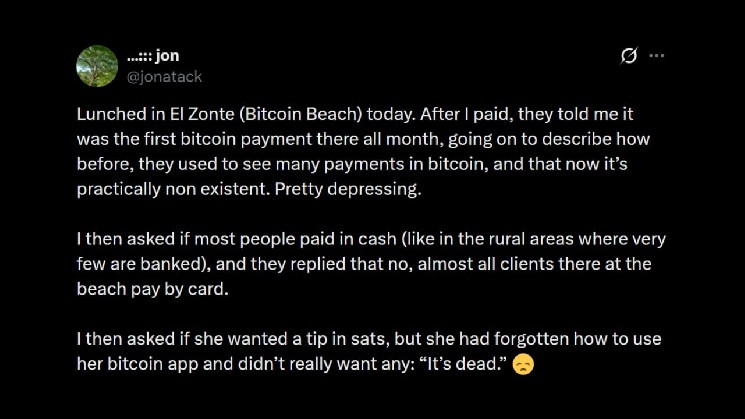
Bitcoin Core Developer Warns That Bitcoin Payments Are Disappearing at 'Bitcoin Beach'

A Bitcoin Core developer, John Atack, who has lived in El Salvador since 2022, shared a concerning anecdote about Bitcoin adoption in the country. While dining at El Zonte, a region known as "Bitcoin Beach," he paid with Bitcoin and was told it was the first such payment the establishment had received in a month. Staff explained Bitcoin payments, once common, have now virtually disappeared, with nearly all customers using cards. An employee even declined a Bitcoin tip, stating she had forgotten how to use her wallet and declaring "It's already dead." Atack emphasized this was a single observation but noted the employee had witnessed the payment evolution over three years. His comments sparked mixed reactions. Some disputed his experience, with one user confirming successful Bitcoin payments in the same area. However, Bitcoin reporter Juan Galt acknowledged an underlying "economic problem," arguing that expecting price appreciation makes using Bitcoin for everyday transactions counterintuitive to economic incentives needed for a circular crypto economy. Despite the concerning report, Atack also reflected that El Salvador remains a global leader in cryptocurrency adoption and progressive legislation, sometimes causing locals to take these advancements for granted. The story highlights the ongoing challenges of mainstream Bitcoin adoption for daily commerce, even in pioneering nations.

cryptonews.ruHace 8 min(s)

Bitcoin Core Developer Warns That Bitcoin Payments Are Disappearing at 'Bitcoin Beach'

cryptonews.ruHace 8 min(s)

A Huge 'Sleeping' Wave of New Bitcoin Buyers Has Not Even Bought Bitcoin Yet

A recent study by the Federal Reserve Bank of Cleveland, titled "Do You Even Crypto, Bro? Cryptocurrencies in Household Finance," reveals that Bitcoin and other crypto assets are less understood than other financial assets in US households. The primary reasons for not owning crypto are a lack of knowledge and the perception that it is a poor investment. Even among owners, the main motivations are profit-seeking and portfolio diversification rather than an understanding of the underlying technology's benefits, such as independence from banks. The research found that showing respondents Bitcoin's past 12-month performance increased their desired portfolio allocation by about 47%, indicating investment decisions are driven more by recent returns than fundamental comprehension. Crypto gains are often treated like lottery winnings, leading to one-off luxury purchases rather than sustained increases in spending. While non-owners largely view crypto as high-risk, owners are somewhat less likely to do so, though they exhibit greater uncertainty about future returns compared to traditional assets like stocks or gold. This ambiguity about Bitcoin's nature and valuation contributes directly to its price volatility. The study concludes that this volatility will persist, but education efforts combined with price appreciation could convert today's uninformed non-owners into future Bitcoin holders.

cryptonews.ruHace 10 min(s)

A Huge 'Sleeping' Wave of New Bitcoin Buyers Has Not Even Bought Bitcoin Yet

cryptonews.ruHace 10 min(s)

Grain Prices Haven't Taken Off Yet, So Why Have Fertilizer Prices Risen First?

Fertilizer prices are rising ahead of a potential global food price surge, driven primarily by supply-side constraints rather than current agricultural demand. While a strong El Niño is forecast for late 2026, its impact is expected to be initially limited to specific crops like palm oil and rubber, not leading to immediate, broad-based grain shortages. The fertilizer market is currently propelled by its own dynamics: **Urea** faces domestic oversupply in China, with its price reliant on the potential to export to higher-priced international markets. **Phosphate fertilizers** are experiencing a rare "supply-led" cycle due to global sulfur shortages, shipping disruptions, and production cuts overseas, placing Chinese producers with integrated resources and export channels in a key position. **Potash** supply is tightening due to planned maintenance and production cuts at major global producers, underpinning its long-term resource scarcity narrative. Looking ahead to 2027, a prolonged El Niño could shift the market into a second phase of "demand-supply resonance." If extreme weather significantly impacts crop yields and global grain inventories, rising food prices and farmer income would boost fertilizer application demand. This potential demand surge, layered onto the existing supply constraints, could amplify the price cycle. The overarching theme is that **food security is redefining the strategic value of fertilizers**, particularly for resource-constrained phosphate and potash. Policy priorities balancing domestic supply guarantees with export opportunities, coupled with resource ownership and global supply chain access, are becoming critical determinants of profitability beyond short-term weather cycles.

marsbitHace 13 min(s)

Grain Prices Haven't Taken Off Yet, So Why Have Fertilizer Prices Risen First?

marsbitHace 13 min(s)

Trading

Spot

Artículos destacados

Qué es $BANK

Banco AI: Un Paso Revolucionario en el Futuro de la Banca Introducción En una era marcada por avances rápidos en tecnología, Banco AI se sitúa en la intersección de la inteligencia artificial (IA) y los servicios bancarios. Este proyecto innovador busca redefinir el panorama financiero, mejorando la eficiencia operativa, las medidas de seguridad y las experiencias del cliente a través del poder de la IA. Al embarcarnos en esta exploración de Banco AI, profundizaremos en lo que implica el proyecto, sus dinámicas operativas, su contexto histórico y hitos significativos. ¿Qué es Banco AI? En su esencia, Banco AI representa una iniciativa transformadora destinada a integrar la inteligencia artificial en varias operaciones bancarias. Este proyecto aprovecha las capacidades de la IA para automatizar procesos, mejorar los protocolos de gestión de riesgos y mejorar la interacción con los clientes a través de servicios personalizados. Los objetivos principales de Banco AI incluyen: Automatización de Funciones Bancarias: Al aprovechar las tecnologías de IA, Banco AI tiene como objetivo automatizar tareas rutinarias, reduciendo la carga sobre los recursos humanos y mejorando la eficiencia. Mejora en la Gestión de Riesgos: El proyecto utiliza algoritmos de IA para predecir e identificar riesgos, fortaleciendo así las medidas de seguridad contra fraudes y otras amenazas. Personalización de Servicios Bancarios: Banco AI se centra en ofrecer productos y servicios financieros a medida al analizar datos y comportamientos de los clientes. Mejoramiento de la Experiencia del Cliente: La implementación de soluciones impulsadas por IA, como chatbots y asistentes virtuales, tiene como objetivo proporcionar a los usuarios interacciones más humanas, revolucionando la forma en que los clientes se relacionan con los bancos. Con estos objetivos, Banco AI se posiciona como un jugador crucial para hacer que la banca sea más eficiente, segura y centrada en el usuario. ¿Quién es el Creador de Banco AI? Los detalles sobre el creador de Banco AI siguen siendo desconocidos. Como tal, no se ha identificado a ninguna persona u organización específica en la información disponible. El anonimato que rodea el inicio del proyecto plantea preguntas, pero no resta valor a su ambiciosa visión y objetivos. ¿Quiénes Son los Inversores de Banco AI? Al igual que con el creador del proyecto, no se ha divulgado información específica sobre los inversores u organizaciones que apoyan a Banco AI. Sin esta información, es un desafío delinear el respaldo financiero y el apoyo institucional que podrían estar impulsando el proyecto hacia adelante. No obstante, la importancia de contar con una sólida base de inversión es fundamental para sostener el desarrollo en un campo tan innovador. ¿Cómo Funciona Banco AI? Banco AI opera en múltiples frentes innovadores, centrándose en factores únicos que lo diferencian de los marcos bancarios tradicionales. A continuación, se presentan las características operativas clave: Automatización: Al aplicar algoritmos de aprendizaje automático, Banco AI automatiza varios procesos manuales dentro de los bancos. Esto resulta en la reducción de costos operativos y permite que los trabajadores humanos redirijan sus esfuerzos hacia actividades más estratégicas. Gestión Avanzada de Riesgos: La integración de la IA en las prácticas de gestión de riesgos equipa a los bancos con herramientas para predecir con precisión amenazas potenciales como el fraude, garantizando que la información y los activos de los clientes permanezcan seguros. Recomendaciones Financieras Personalizadas: A través del aprendizaje continuo a partir de las interacciones con los clientes, los sistemas de IA desarrollan una comprensión matizada de las necesidades del usuario, lo que les permite ofrecer consejos adaptados sobre decisiones financieras. Interacciones Mejoradas con los Clientes: Al utilizar chatbots y asistentes virtuales impulsados por IA, Banco AI permite una experiencia más atractiva para el cliente, permitiendo a los usuarios resolver sus consultas rápidamente, reduciendo así los tiempos de espera y mejorando los niveles de satisfacción. En conjunto, estas características operativas posicionan a Banco AI como un pionero en el sector bancario, estableciendo nuevos parámetros para la entrega de servicios y la excelencia operativa. Línea de Tiempo de Banco AI Entender la trayectoria de Banco AI requiere mirar su contexto histórico. A continuación, se presenta una línea de tiempo que destaca hitos y desarrollos importantes: Inicios de 2010: La conceptualización de la integración de la IA en los servicios bancarios comenzó a ganar atención a medida que las instituciones bancarias reconocieron los posibles beneficios. 2018: Se produjo un aumento notable en la implementación de tecnologías de IA cuando los bancos comenzaron a utilizar herramientas de IA como chatbots para el servicio al cliente básico y sistemas de gestión de riesgos para mejorar la seguridad. 2023: La sofisticación de la IA continuó avanzando, con la introducción de IA generativa para tareas más complejas como el procesamiento de documentos y análisis de inversiones en tiempo real. Este año marcó un salto significativo en las capacidades que la tecnología de IA otorgó a los bancos. 2024-Estatus Actual: A partir de este año, Banco AI se encuentra en una trayectoria ascendente, con investigaciones y desarrollos en curso que pronto mejorarán las capacidades en las operaciones bancarias. La continua exploración de las aplicaciones de IA sugiere emocionantes desarrollos aún por venir. Puntos Clave Sobre Banco AI Integración de la IA en la Banca: Banco AI se centra en adoptar inteligencia artificial para optimizar los procesos bancarios y mejorar la experiencia del usuario. Enfoque en Automatización y Gestión de Riesgos: El proyecto enfatiza fuertemente estas áreas, con el objetivo de desplazar la carga de tareas rutinarias mientras mejora los marcos de seguridad a través de análisis predictivos. Soluciones Bancarias Personalizadas: Al aprovechar los datos de los clientes, Banco AI permite servicios bancarios adaptados a las necesidades individuales de los usuarios. Compromiso con el Desarrollo: Banco AI se mantiene comprometido con esfuerzos de investigación y desarrollo continuos, asegurando su adaptabilidad y relevancia continua a medida que la tecnología sigue evolucionando. Conclusión En resumen, Banco AI ejemplifica un paso crucial hacia adelante en la industria bancaria, aprovechando la inteligencia artificial para redefinir los paradigmas operativos, mejorar la seguridad y promover la satisfacción del cliente. A pesar de las lagunas en la información sobre el creador y los inversores, los objetivos claros y los mecanismos funcionales de Banco AI proporcionan una sólida base para su evolución continua. A medida que la tecnología de IA sigue avanzando y fusionándose con el sector bancario, Banco AI está bien posicionado para impactar significativamente el futuro de los servicios financieros, mejorando la forma en que entendemos e interactuamos con la banca.

318 Vistas totalesPublicado en 2024.04.06Actualizado en 2024.12.03

Qué es $BANK

Cómo comprar BANK

¡Bienvenido a HTX.com! Hemos hecho que comprar Lorenzo Protocol (BANK) sea simple y conveniente. Sigue nuestra guía paso a paso para iniciar tu viaje de criptos.Paso 1: crea tu cuenta HTXUtiliza tu correo electrónico o número de teléfono para registrarte y obtener una cuenta gratuita en HTX. Experimenta un proceso de registro sin complicaciones y desbloquea todas las funciones.Obtener mi cuentaPaso 2: ve a Comprar cripto y elige tu método de pagoTarjeta de crédito/débito: usa tu Visa o Mastercard para comprar Lorenzo Protocol (BANK) al instante.Saldo: utiliza fondos del saldo de tu cuenta HTX para tradear sin problemas.Terceros: hemos agregado métodos de pago populares como Google Pay y Apple Pay para mejorar la comodidad.P2P: tradear directamente con otros usuarios en HTX.Over-the-Counter (OTC): ofrecemos servicios personalizados y tipos de cambio competitivos para los traders.Paso 3: guarda tu Lorenzo Protocol (BANK)Después de comprar tu Lorenzo Protocol (BANK), guárdalo en tu cuenta HTX. Alternativamente, puedes enviarlo a otro lugar mediante transferencia blockchain o utilizarlo para tradear otras criptomonedas.Paso 4: tradear Lorenzo Protocol (BANK)Tradear fácilmente con Lorenzo Protocol (BANK) en HTX's mercado spot. Simplemente accede a tu cuenta, selecciona tu par de trading, ejecuta tus trades y monitorea en tiempo real. Ofrecemos una experiencia fácil de usar tanto para principiantes como para traders experimentados.

1.0k Vistas totalesPublicado en 2025.05.09Actualizado en 2026.06.02

Cómo comprar BANK

Discusiones

Bienvenido a la comunidad de HTX. Aquí puedes mantenerte informado sobre los últimos desarrollos de la plataforma y acceder a análisis profesionales del mercado. A continuación se presentan las opiniones de los usuarios sobre el precio de BANK (BANK).

活动图片