Balaji Says ‘Zcash Or Communism’ As He Warns AI Supercharges Surveillance

bitcoinistPublicado a 2026-02-20Actualizado a 2026-02-20

Resumen

Balaji Srinivasan argues that the rise of AI-powered surveillance creates an urgent need for financial privacy, framing the choice as “Zcash or communism.” He warns that AI enables any state or individual to compile extensive personal dossiers from online data, surpassing historical surveillance capabilities. Encryption, particularly through Zcash, is presented as a critical defense, making individuals “sovereign” and invisible to targeting. Srinivasan also positions Zcash as a scalable, privacy-focused blockchain with Solana-like throughput, using zero-knowledge proofs for private transactions. He suggests Zcash can coexist with transparent chains like Bitcoin, serving different needs while addressing the growing threat of AI-driven wealth seizure and control.

Balaji Srinivasan is once again making the most provocative version of a privacy argument and he’s pinning it to a specific chain: Zcash. In a Feb. 18 video shared on X, Srinivasan framed the stakes in stark terms: “The choice is clear. It’s Zcash or communism,” tying the rise of AI-enabled surveillance to what he described as a renewed appetite for wealth seizure.

In a follow-up post, he argued that AI has shifted surveillance from a state-scale project to something closer to an on-demand service. “Any scrap of information online can now be integrated, digested, and synthesized...by any state or stalker capable of running an AI model...to form a dossier more complete than anything the Soviets could ever dream of,” he wrote.

Srinivasan’s prescription was blunt: “There will be no single silver bullet. But anything you haven’t encrypted can and will be used against you.”

Srinivasan anchored his “communism requires surveillance” claim in an historical example meant to make a modern point about data exhaust. “In 1918, in the midst of the Bolshevik Revolution, Lenin gave an order to murder 100 nearby ‘kulaks,’” he said, emphasizing that such an order “required a list”: names, locations, and a population that couldn’t easily move.

His argument is that the internet reverses that asymmetry if encryption becomes the default. “Today, neo-communism is rising once again. But the Internet could change the game,” he said. “No full list, if we encrypt it. No fixed location, either. They can’t hit what they can’t see.”

Those themes carried into a longer discussion on the Never Say Podcast, where Srinivasan connected privacy to basic operational freedom. “If you’re under surveillance, you’re not sovereign,” he said. “If every move is being tracked...you don’t have the advantage of surprise. You can never launch something. You can never have private deliberations.”

Arjun Khemani, a 19-year-old Zcash researcher on the episode, echoed the AI angle from the user side: “Especially with AI, being able to recognize where you are exactly...you can’t have freedom without privacy,” he said, arguing that broadcasting every transaction and context signal is “not... the world that I want to live in.”

Zcash As A Scaling Bet, Not Just A Privacy Stance

Srinivasan’s pitch wasn’t limited to privacy-by-principle. He positioned Zcash as a technical response to where he thinks the market has landed on scalability: on-chain throughput wins, and routing complexity loses.

Asked why “Zcash must scale” is a “moral imperative,” Srinivasan contrasted Bitcoin’s scaling reality: exchanges, custodians, and database entries with the decentralization promise many users think they’re buying. “Lightning...they’ve been saying, ‘Lightning is going to be there any day now’ for 10 years,” he said, arguing that real-world deployments tend toward “a hub and spoke topology” resembling traditional finance rails. “Within a bank, it’s fast...between banks, they do settlement,” he added, describing a dynamic he sees mirrored in major Lightning implementations.

From there, he argued crypto has effectively segmented into layers: Bitcoin for immutability and brand, Ethereum for programmability, and Solana for straightforward on-chain execution at scale. The opening he sees for Zcash is combining “Solana-like scalability” with private transactions, leaning on zero-knowledge proofs as “compression technology” as much as secrecy. “It’s what a lot of people wanted Bitcoin to be,” he said.

Srinivasan also stressed that privacy doesn’t necessarily replace transparency, it complements it. He argued that Bitcoin’s public ledger can be a feature for proof-of-reserves narratives, while Zcash’s private-by-default design targets a different threat model. His bottom line is coexistence, not conquest: “It’s possible that Bitcoin... and Zcash coexist because Bitcoin is transparent and Zcash is private,” he said, while suggesting “this could be Zcash’s moment.”

At press time, ZEC traded at $259.18.
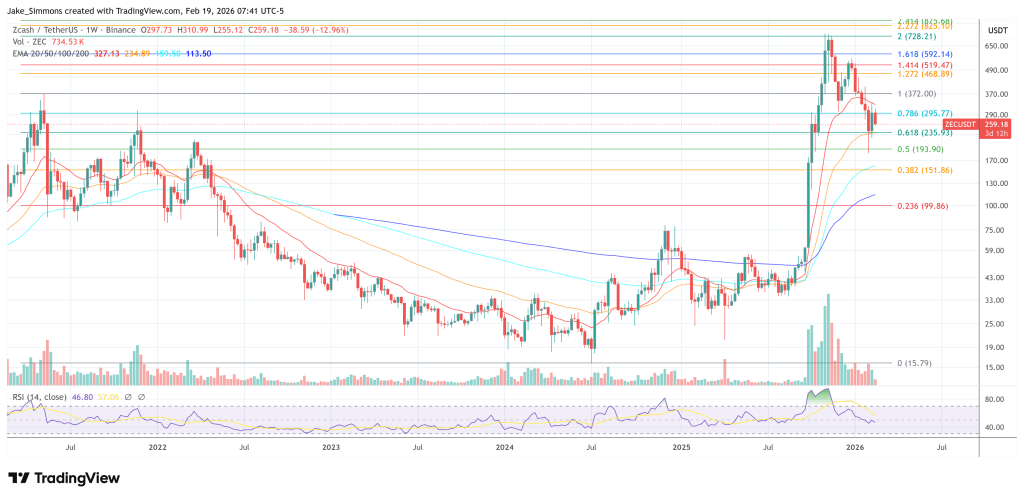
ZEC price remains below the 0.786 Fib, 1-week chart | Source: ZECUSDT on TradingView.com

Preguntas relacionadas

QWhat is the main argument Balaji Srinivasan makes about the relationship between privacy, Zcash, and communism?

ABalaji Srinivasan argues that the rise of AI-enabled surveillance creates a stark choice: 'Zcash or communism.' He claims that communism requires extensive surveillance for wealth seizure and control, and that encryption, specifically through privacy-focused cryptocurrencies like Zcash, is the technological solution to prevent this by making individuals sovereign and their information private.

QHow does Srinivasan claim AI has changed the nature of surveillance?

ASrinivasan states that AI has shifted surveillance from a large-scale state project to an on-demand service. He argues that any state or individual with an AI model can now integrate, digest, and synthesize any scrap of online information to create a more comprehensive dossier than was ever possible before, surpassing even the capabilities of historical surveillance states like the Soviet Union.

QBesides privacy, what other technical advantage does Srinivasan attribute to Zcash?

ABeyond its core privacy feature, Srinivasan positions Zcash as a scaling bet. He argues it combines 'Solana-like scalability' with private transactions by using zero-knowledge proofs as a form of 'compression technology.' This addresses what he sees as the market's preference for on-chain throughput over complex routing solutions like the Lightning Network.

QWhat historical example does Srinivasan use to support his claim that 'communism requires surveillance'?

ASrinivasan uses the historical example of Lenin during the 1918 Bolshevik Revolution ordering the murder of 100 'kulaks.' He emphasizes that such an order 'required a list'—names, locations, and a population that couldn't easily move—to illustrate how surveillance is foundational to state control and seizure of assets.

QHow does Srinivasan view the potential coexistence of Bitcoin and Zcash?

ASrinivasan believes Bitcoin and Zcash can coexist because they serve different purposes. He states that Bitcoin's transparent ledger is a feature for narratives like proof-of-reserves, while Zcash's private-by-default design addresses a different threat model. His view is one of complementary coexistence, not conquest, suggesting 'this could be Zcash's moment.'

Lecturas Relacionadas

Stuck Polymarket: The Real Test After Riding the Traffic Boom Has Arrived

Polymarket, a leading prediction market platform, is facing significant technical challenges as its growth outpaces its current infrastructure on Polygon. Users are experiencing laggy transactions, unresponsive orders, and delayed confirmations, severely impacting the trading experience. In response, DeFi Engineering VP Josh Stevens outlined a comprehensive engineering overhaul. The plan includes reducing on-chain data delays, fixing order cancellation issues, rebuilding the central limit order book (CLOB), improving website performance, and developing a unified SDK and API. A major revelation was the ongoing "chain migration," indicating a potential move away from Polygon. The core issue is that Polymarket has evolved from a simple prediction market into a high-frequency trading platform, making Polygon's limitations—such as block space, gas fees, and block time—a ceiling for further growth. The migration is not just a simple chain switch but a fundamental rebuild of its trading system to support more complex products like perpetual contracts (Perps). This announcement has sparked competition among chains like Solana, Sui, and Algorand, all vying to host Polymarket. For Polygon, losing this key application, which contributes significantly to its gas fee revenue, would be a major setback. The real test for Polymarket is no longer attracting users but proving it can provide a stable, reliable trading environment that retains them.

Odaily星球日报Hace 14 min(s)

Stuck Polymarket: The Real Test After Riding the Traffic Boom Has Arrived

Odaily星球日报Hace 14 min(s)

Lowering Expectations for BTC's Next Bull Market

The author, Alex Xu, explains his decision to significantly reduce his Bitcoin holdings (from full to ~30% of his portfolio) during the current bull cycle, citing a lowered long-term outlook for BTC's price appreciation in the next cycle. He outlines six key reasons for this reduced expectation: 1. **Diminished Growth Drivers:** The narrative of exponential user adoption has largely played out with institutional ETF adoption. The next major growth phase—adoption by sovereign national reserves or central banks—seems unlikely in the near future. 2. **Personal Opportunity Cost:** More attractive investment opportunities have emerged in other assets, such as undervalued companies. 3. **Industry-Wide Contraction:** The broader crypto industry is struggling, with most Web3 business models (SocialFi, GameFi, DePIN) failing. This overall萧条 (depression) reduces the fundamental demand and consensus for Bitcoin. 4. **Strain on Major Buyer:** MicroStrategy, a major corporate buyer of BTC, faces rising financing expenses for its debt, which could slow its purchasing rate and create significant marginal pressure on the market. 5. **Increased Competition from Gold:** The emergence of "tokenized gold" has closed the functional gap (portability, divisibility) between physical gold and Bitcoin, offering a strong competitor in the non-sovereign store-of-value space. 6. **Security Budget Concerns:** The block reward halving continues to exacerbate the long-standing issue of funding Bitcoin's network security, with new fee source explorations like Ordinals and L2s largely failing. The author's decision to hold a significant (though reduced) position reflects a cautious, not bearish, outlook. He remains open to increasing his exposure if the fundamental reasons for his skepticism change or if new positive catalysts emerge.

marsbitHace 52 min(s)

Lowering Expectations for BTC's Next Bull Market

marsbitHace 52 min(s)

Can Iran 'Control' the Strait of Hormuz?

Iran has announced a comprehensive plan to assert control over the strategic Strait of Hormuz, a critical global oil shipping chokepoint. The proposed measures include requiring all vessels to obtain Iranian permission for passage, imposing fees for security, environmental protection, and navigation management—preferably paid in Iranian rials—and absolutely banning Israeli ships. Vessels from countries deemed hostile by Iran’s top security bodies may also be barred. Analysts suggest Iran’s motives are multifaceted: increasing pressure on the U.S. and Israel by leveraging control over oil transit to influence global prices and inflation; creating a new revenue stream, potentially exceeding $7.7 billion annually, to counter Western sanctions and support postwar reconstruction; and using transit permissions as bargaining chips in future negotiations, notably with the U.S. However, the plan faces significant practical and diplomatic challenges. Enforcing comprehensive interception and fee collection in the busy waterway, patrolled by international military forces, would be difficult. The U.S. has already countering with a blockade of Iranian ports and threats to intercept any ship paying fees, potentially strangling Iran’s oil exports and fee revenue. Broad international opposition, led by European and Gulf states, and legal controversies further complicate implementation. The proposal may ultimately serve more as a negotiating tactic than a feasible policy, with its execution remaining highly uncertain.

marsbitHace 2 hora(s)

Can Iran 'Control' the Strait of Hormuz?

marsbitHace 2 hora(s)

Trading

Spot
Futuros
活动图片





