Avalanche lands $200B real estate deal, yet ONE barrier blocks AVAX bulls

ambcryptoPublicado a 2026-03-10Actualizado a 2026-03-10

Resumen

Avalanche (AVAX) has secured a $200 billion real estate tokenization deal in Bergen County, New Jersey, marking one of the largest real-world asset integrations on its blockchain. This five-year agreement involves migrating property records and related opportunities onto the Avalanche network, strengthening its position in traditional finance. The development has positively influenced market sentiment, with on-chain data showing increased whale accumulation and buyer dominance in both spot and futures markets. Technically, AVAX is approaching the 50-day EMA, a key resistance level. A break above it could confirm bullish momentum, potentially driving prices toward liquidity zones above the current range.

Over $200 billion worth of real estate is set to be tokenized on the Avalanche network in Bergen County, New Jersey.

According to AVAX’s announcement on their recent tweet, the initiative follows a five-year agreement that will migrate property records and related opportunities onto blockchain infrastructure.

This move marks one of the largest real-world asset integrations on the Avalanche ecosystem. It also cemented AVAX as the leading network for blockchain adoption in traditional finance sectors.

The development has begun to influence market sentiment.

Institutional adoption strengthens

Large-scale tokenization projects often attract institutional attention. In this case, the scale of the real estate integration could significantly expand Avalanche’s real-world asset ecosystem across more counties if not states.

Such adoption strengthens the long-term value proposition of the network. It also introduces new demand channels beyond speculative trading.

As the news spreads, traders appear to be positioning for a potential move.

AVAX whales are on strategic moves

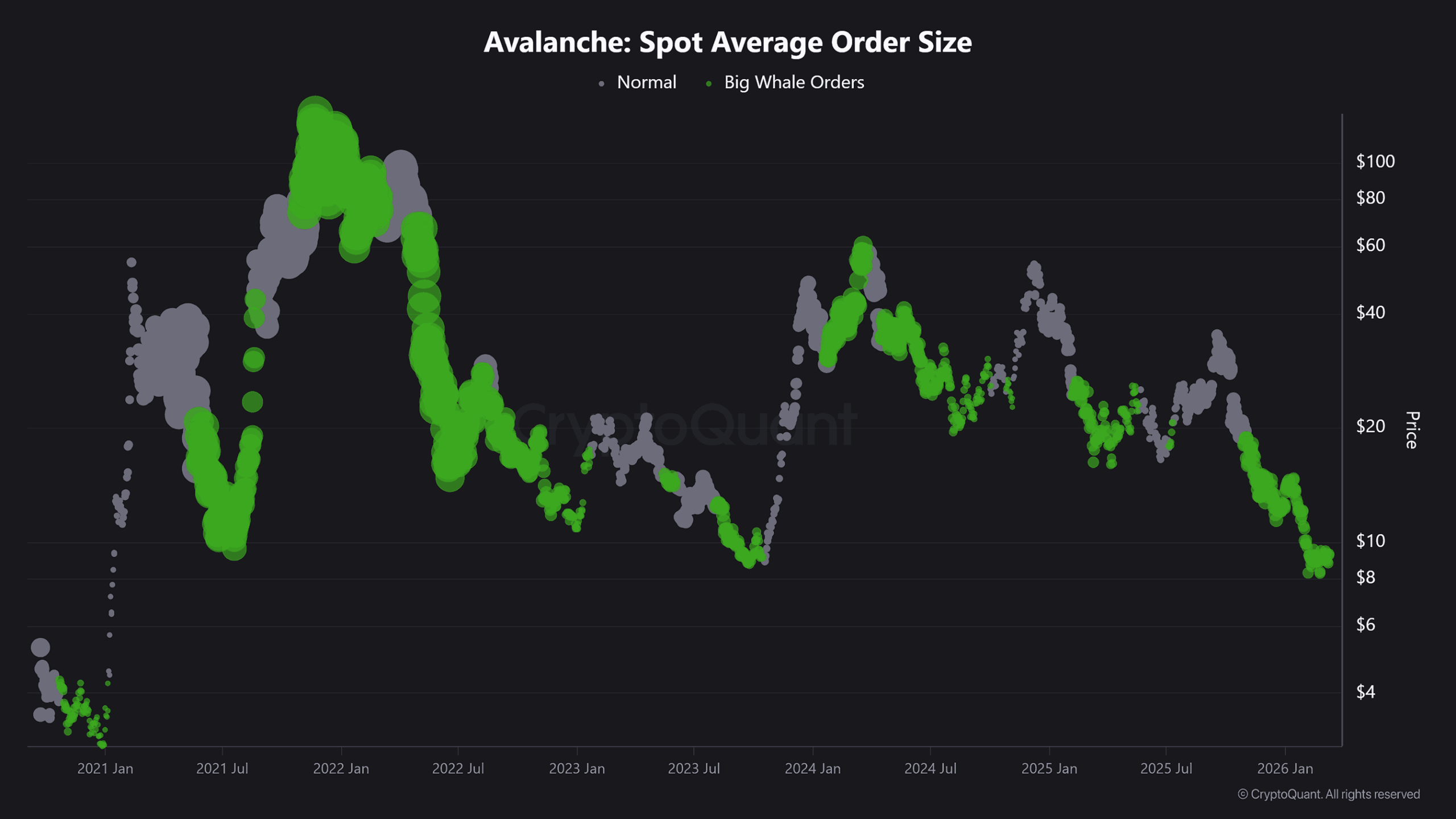
AMBCrypto analysis of the latest on-chain data indicates that Avalanche [AVAX] whale orders are rising significantly at the current price level.

Large investors are accumulating positions across both spot and futures markets as they anticipate for a long-term market structure shift in the near future.

Moreso, given the positive developments in store on AVAX ecosystem.
Source: CryptoQuant

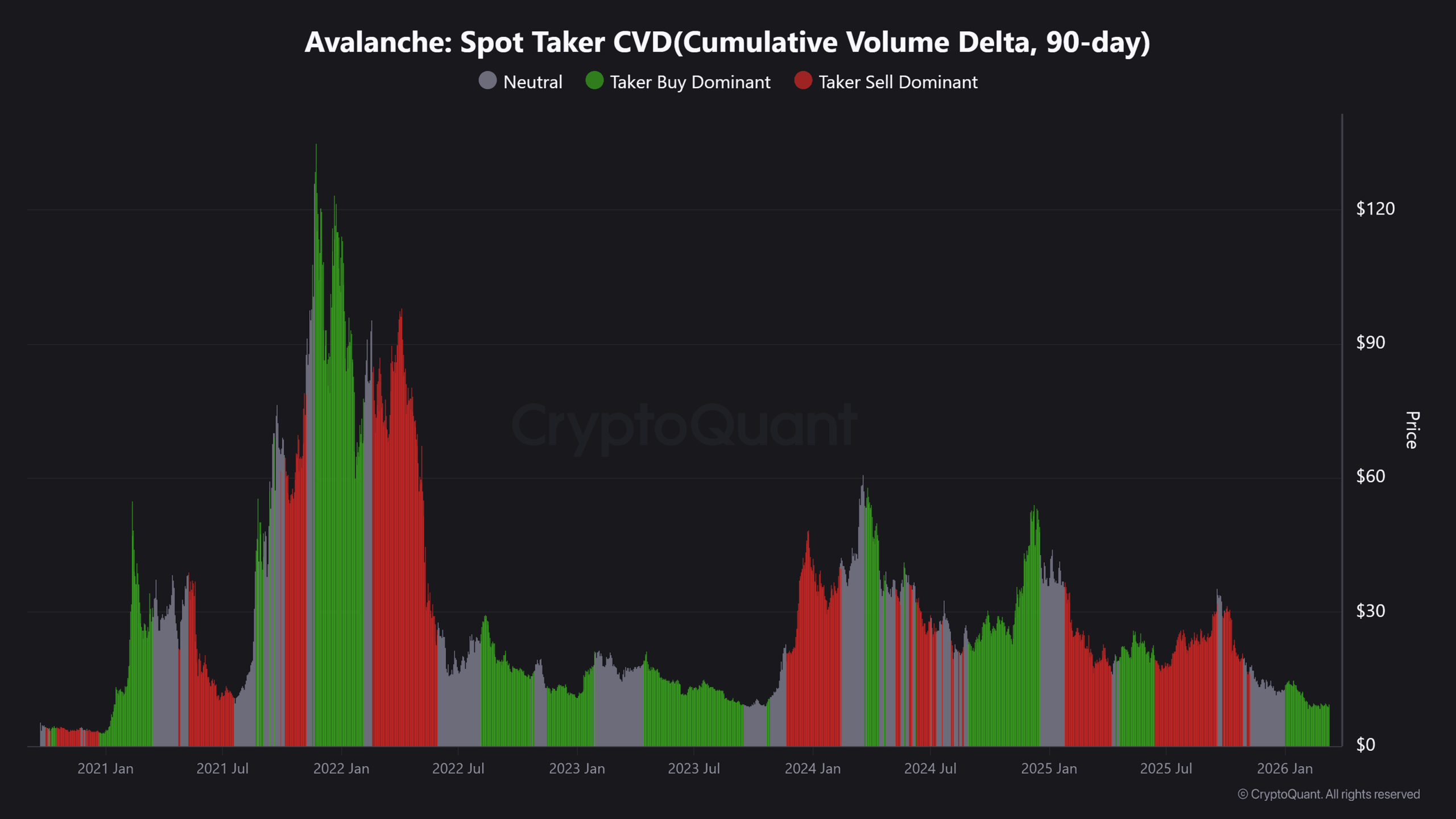
At the same time, buyers have begun dominating derivatives activity.

Usually, when whale accumulation aligns with buyer dominance, bullish momentum often gains additional support.

Avalanche seems to be replicating a similar scenario as the network’s buyers dominated both the spot and futures markets at press time.
Source: CryptoQuant

Liquidity structure add a bullish bias

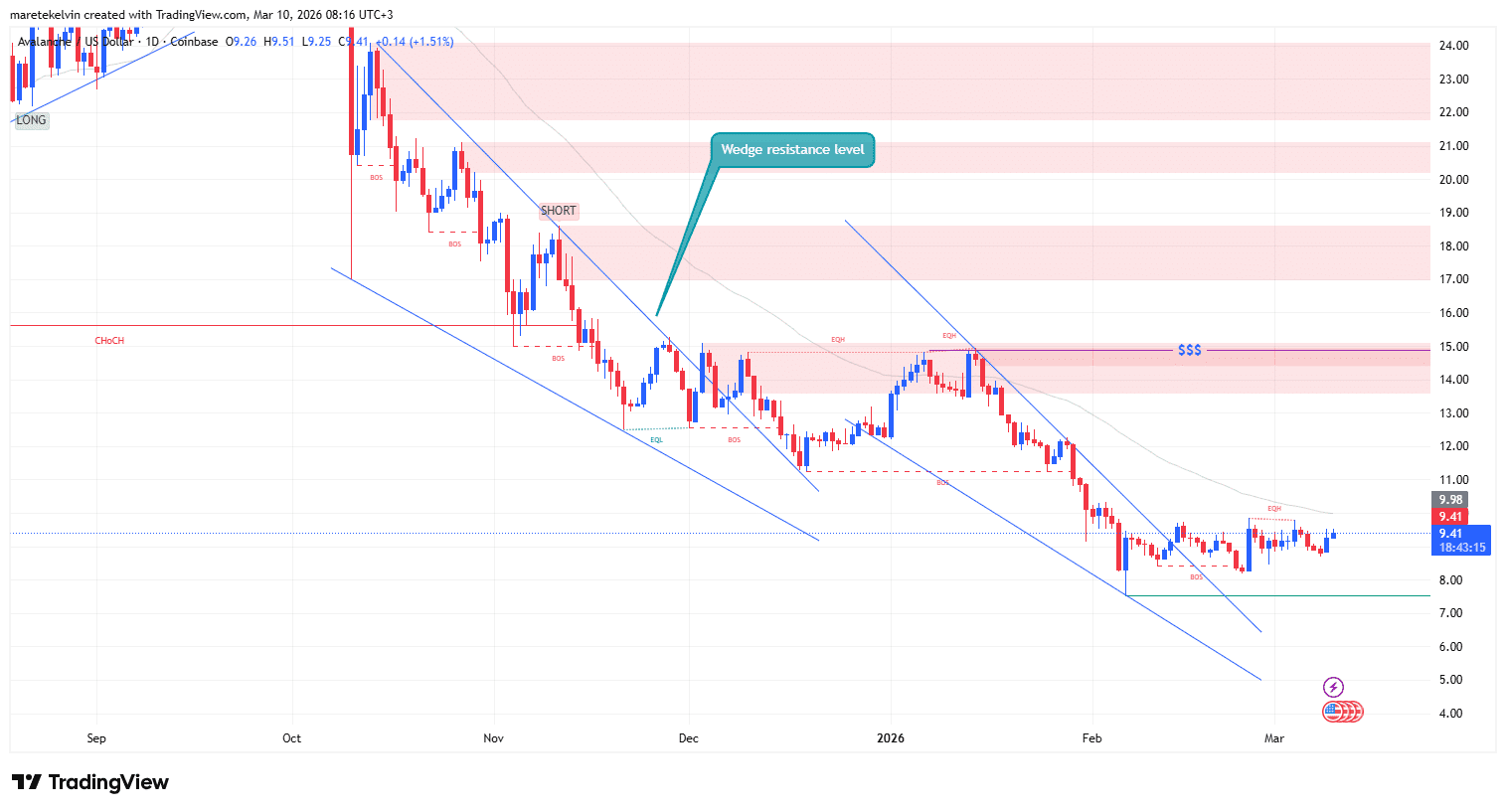
From a technical perspective, the daily market structure is also beginning to lean bullish. The presence of equal highs liquidity above the current price level affirms the market’s bullish bias.

From previous similar observations, these zones often acted as price magnets. In most cases, the zones contain clusters of stop orders and pending liquidity.

If bullish momentum continues, the market could attempt to sweep that liquidity.
Source: TradingView

50-day EMA becomes the next hurdle

Despite the improving sentiment, Avalanche [AVAX] still faces a key technical barrier.

The token is approaching the 50-day exponential moving average (EMA), which currently acts as resistance. A decisive break above this level could confirm a stronger bullish continuation. Failure to reclaim it, however, may keep prices trapped within consolidation.

For now, the market appears to be building momentum. Rising whale accumulation, buyer dominance and a major real-world asset development are aligning in Avalanche’s favour.

If these factors hold, the next move could target the liquidity resting above the current price range.


Final Summary

  • AVAX secures a $200B real estate tokenization deal in Bergen County, strengthening the networks real-world asset adoptions.
  • Rising whale accumulation and buyer dominance could drive AVAX toward a breakout above the 50-day EMA.


Next: Bitcoin: Bhutan sells amid MSTR’s $1.28B BTC buy – Strategic move?
Share
  • Share
  • Tweet

Criptos en tendencia

Preguntas relacionadas

QWhat is the significance of the $200 billion real estate deal for the Avalanche network?

AThe $200 billion real estate tokenization deal in Bergen County, New Jersey, is one of the largest real-world asset adoptions on the Avalanche network, strengthening its position in traditional finance and expanding its ecosystem.

QHow are AVAX whales responding to this development according to on-chain data?

AAVAX whale orders are rising significantly, with large investors accumulating positions in both spot and futures markets in anticipation of a long-term market structure shift.

QWhat technical barrier is Avalanche (AVAX) currently facing?

AAVAX is approaching the 50-day exponential moving average (EMA), which acts as a key resistance level. A break above it could confirm bullish continuation, while failure may lead to consolidation.

QWhat does buyer dominance in derivatives activity indicate for AVAX?

ABuyer dominance in derivatives activity, combined with whale accumulation, often supports bullish momentum and suggests a potential upward price movement.

QHow might the liquidity structure above the current price level influence AVAX's price action?

AThe presence of equal highs liquidity above the current price acts as a price magnet, potentially driving the market to sweep that liquidity if bullish momentum continues.

Lecturas Relacionadas

Vitalik's Algorithmic Stablecoin Vision: Interpreting the Mechanism and Challenges from an Options Perspective

Vitalik Buterin's recent algorithmic stablecoin proposal envisions using an option-like mechanism to create a stablecoin without the liquidation risks inherent in traditional collateralized debt position (CDP) models. The design splits one unit of ETH into two components: a 'stable' leg (P) that maintains value up to a certain strike price, and an 'upside' leg (N) that captures any appreciation above that price. Together, they always sum to one ETH, eliminating the need for debt or liquidation mechanisms. From an options perspective, the stable leg essentially functions as a synthetic, covered call position. However, significant challenges exist. For the stable asset to maintain its peg, it must continuously roll deep in-the-money call options, leading to potential rollover slippage, predictable trading paths vulnerable to front-running, and liquidity issues. Crucially, the system's scalability depends on a constant demand for the upside leg—a form of leveraged ETH long position without funding rates or liquidation risk. It's unclear if such persistent, specific demand will materialize from speculators or market makers who have simpler alternatives like perpetual swaps. The author, drawing from experience with Rysk, argues that DeFi options have struggled as standalone trading products due to complexity and fragmented liquidity. Their potential lies instead as foundational infrastructure underpinning more complex financial primitives like stablecoins, structured yields, or index products—transforming from a direct product into a core pricing and risk distribution engine for the next generation of on-chain finance.

marsbitHace 17 min(s)

Vitalik's Algorithmic Stablecoin Vision: Interpreting the Mechanism and Challenges from an Options Perspective

marsbitHace 17 min(s)

GPT-5.6 Countdown: Abandon the Illusion of a Single API, Computational Iteration Can't Outpace a Single Page of Compliance

In mid-June, three seemingly independent industry events—the compliance-driven throttling of Fable 5, the open-sourcing of GLM-5.2, and the leaked release timeline for GPT-5.6—are pushing the global AI industry toward a watershed moment. These shifts signal a fundamental restructuring of the industry's underlying logic. First, **"usability" has substantially overtaken "advanced capabilities"** as the primary weight, pushing the global large language model (LLM) supply chain into a "dual-track" phase of controlled closed-source and local open-source coexistence. Second, **the competitive moats of closed-source giants are shifting**. Their technical focus is moving from "language intelligence" toward "spatial intelligence (world models)"—a domain heavily reliant on computing power. Third, faced with常态化 transnational compliance risks, **a "model-agnostic" decoupled design has become a survival necessity for application-layer developers to maintain business continuity.** The article details how Anthropic's Fable 5, despite its advanced engineering feats, was restricted for non-U.S. citizens within 72 hours of launch, highlighting how geopolitical compliance can instantly limit even the most advanced models. In response, the open-source camp, exemplified by Zhipu AI's MIT-licensed GLM-5.2, is gaining market share by offering stable performance improvements and significant cost advantages (up to 70% savings for enterprises), while achieving full adaptation with domestic semiconductor platforms. Meanwhile, closed-source leaders like OpenAI are pivoting. The anticipated GPT-5.6 reportedly shifts focus from language to spatial intelligence and world models, aiming to rebuild a generational gap in areas like 3D understanding, simulation, and industrial design that demand immense compute. The core conclusion is that the LLM supply chain's logic has changed. Enterprises must now evaluate infrastructure based on a composite of technical performance and policy compliance. For developers, complete reliance on a single closed-source API poses unacceptable risk. Implementing a truly model-agnostic architecture—enabling swift switches to compliant, locally deployable open-source alternatives—is no longer just good practice but a fundamental baseline for business continuity.

marsbitHace 3 hora(s)

GPT-5.6 Countdown: Abandon the Illusion of a Single API, Computational Iteration Can't Outpace a Single Page of Compliance

marsbitHace 3 hora(s)

Is the 'Token Subsidy War' Among AI Giants Almost Over?

The article discusses the ongoing "token subsidy war" among AI giants like OpenAI and Anthropic, questioning whether it's nearing its end. It reveals that current AI subscription prices are heavily subsidized, with some plans offering tokens at up to 70 times the actual cost to attract and retain heavy users, especially developers and enterprises. This strategy mirrors past internet-era subsidy battles, but with a key difference: AI tokens lack "lock-in" effects. Unlike ride-hailing or food delivery apps, users can easily switch between AI providers as APIs become standardized, making it difficult for companies to raise prices post-subsidy. The piece highlights a structural asymmetry in the competition. Giants like Google, with massive advertising revenue, can afford to subsidize tokens indefinitely, akin to using "tokens as a weapon." In contrast, venture-backed companies like OpenAI and Anthropic face pressure to become profitable, especially as they approach IPO. The article cites Google Ventures founder Bill Maris, who suggests Google could slash token prices by 80%, putting immense pressure on competitors. Two potential endgames are presented: the "internet service" model (subsidize, monopolize, then raise prices) and the "utility" model (tokens become a standardized, low-margin commodity like electricity). Given the low switching costs, the latter seems more likely. The competition may not have a single winner but could instead accelerate AI's evolution into a foundational, infrastructure-level technology, akin to a public utility. For now, users continue to benefit from heavily subsidized token costs.

marsbitHace 3 hora(s)

Is the 'Token Subsidy War' Among AI Giants Almost Over?

marsbitHace 3 hora(s)

Trading

Spot
Futuros

Artículos destacados

Cómo comprar ONE

¡Bienvenido a HTX.com! Hemos hecho que comprar Harmony (ONE) sea simple y conveniente. Sigue nuestra guía paso a paso para iniciar tu viaje de criptos.Paso 1: crea tu cuenta HTXUtiliza tu correo electrónico o número de teléfono para registrarte y obtener una cuenta gratuita en HTX. Experimenta un proceso de registro sin complicaciones y desbloquea todas las funciones.Obtener mi cuentaPaso 2: ve a Comprar cripto y elige tu método de pagoTarjeta de crédito/débito: usa tu Visa o Mastercard para comprar Harmony (ONE) al instante.Saldo: utiliza fondos del saldo de tu cuenta HTX para tradear sin problemas.Terceros: hemos agregado métodos de pago populares como Google Pay y Apple Pay para mejorar la comodidad.P2P: tradear directamente con otros usuarios en HTX.Over-the-Counter (OTC): ofrecemos servicios personalizados y tipos de cambio competitivos para los traders.Paso 3: guarda tu Harmony (ONE)Después de comprar tu Harmony (ONE), guárdalo en tu cuenta HTX. Alternativamente, puedes enviarlo a otro lugar mediante transferencia blockchain o utilizarlo para tradear otras criptomonedas.Paso 4: tradear Harmony (ONE)Tradear fácilmente con Harmony (ONE) en HTX's mercado spot. Simplemente accede a tu cuenta, selecciona tu par de trading, ejecuta tus trades y monitorea en tiempo real. Ofrecemos una experiencia fácil de usar tanto para principiantes como para traders experimentados.

301 Vistas totalesPublicado en 2024.12.12Actualizado en 2026.06.02

Cómo comprar ONE

Discusiones

Bienvenido a la comunidad de HTX. Aquí puedes mantenerte informado sobre los últimos desarrollos de la plataforma y acceder a análisis profesionales del mercado. A continuación se presentan las opiniones de los usuarios sobre el precio de ONE (ONE).

活动图片