Aster Launches Shield Mode: A High-Performance Trading Protection Mode for On-Chain Traders

深潮Publicado a 2025-12-15Actualizado a 2025-12-15

Resumen

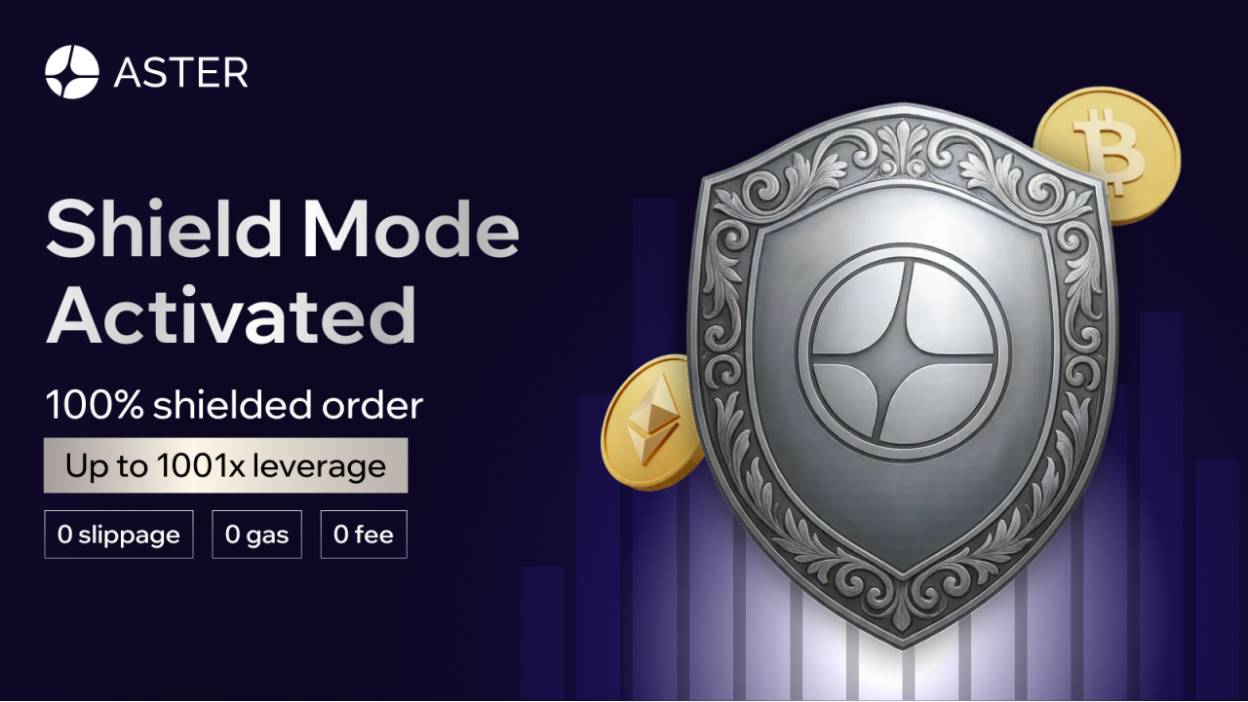
Aster, a high-performance on-chain trading platform supported by YZi Labs, has launched Shield Mode, a new protected trading feature integrated directly into Aster Perpetual. This mode is designed for advanced traders, offering up to 1001x leverage, zero slippage, no opening fees, and fully on-chain settlement. It enhances privacy by allowing users to open and manage positions without interacting directly with the public order book, protecting trading strategies from exposure. Shield Mode also eliminates gas costs, accelerates execution, and will soon support flexible fee models: a commission-based structure or a profit-and-loss based fee. All Shield Mode trades are fee-free until the end of the year. This release marks a key step in Aster's vision to become a next-generation platform for professional on-chain trading.

Aster, a high-performance, privacy-focused on-chain trading platform supported by YZi Labs, today announced the official launch of Shield Mode. This trading feature, as a new protection mode, is directly integrated into Aster Perpetual, aiming to incorporate the complete 1001x leverage trading experience into a faster, more secure, and flexible on-chain trading environment.

Shield Mode is a significant milestone in Aster's vision to advance the next generation of on-chain trading platforms. This mode is designed for advanced traders while providing solutions to the core challenges exchanges face in fully transparent on-chain markets.

Regarding the official launch of Shield Mode, Aster CEO Leonard stated:

Shield Mode is our understanding and interpretation of the future of on-chain trading. The future of on-chain trading is not just about leverage and speed, but also about the emphasis on control, privacy, and protection mechanisms. We are building a platform where traders can perform at their highest level without being forced to expose their trading strategies to the entire market.

Evolution of On-Chain Trading: From 1001x Leverage to Shield Mode

Aster's 1001x leverage product is renowned for pushing the boundaries of on-chain perpetual trading, offering up to 1001x leverage, zero slippage, zero opening fees, and fully on-chain settlement. As on-chain trading infrastructure matures, traders are increasingly aware of the dual nature of fully transparent trading, particularly the risks associated with exposing strategies and intentions in on-chain markets.

In mid-2025, Aster introduced the Hidden Orders feature on its perpetual contract platform, allowing traders to hide order prices and quantities from the public order book while maintaining deep liquidity. This was a crucial step in giving traders greater operational privacy and freedom on-chain.

Shield Mode builds on this foundation with further upgrades, combining high-performance leveraged trading with enhanced trade intent protection to create a smoother and more controllable trading experience.

Shield Mode: The Next-Generation Trading Mode on Aster

Shield Mode is a new trading mode built directly on Aster Perpetual, integrating the 1001x leverage trading experience into a single interface and account system. In this mode, traders can more easily open and manage long or short positions without directly interacting with the public order book, while seamlessly accessing high-leverage trading without cross-chain switches, fragmented operations, or frequent on-chain signatures.

The advantages of Aster's 1001x trading model continue in Shield Mode, including up to 1001x leverage for BTC and ETH, zero slippage, and zero opening fees. Shield Mode further eliminates closing fees, completely removes Gas costs, and accelerates trade execution.

These improvements collectively set a new benchmark for on-chain perpetual contract trading: a high-level on-chain trading experience that combines cost efficiency with extreme performance.

Flexible Fee Structure to Adapt to Diverse Trading Strategies

Shield Mode is designed to support a flexible fee model, allowing traders to choose their payment method based on strategic preferences. In subsequent updates, traders will be able to choose between two modes:

  • Commission Mode: Charges a fixed percentage fee based on trading volume, suitable for high-frequency, stable trading.
  • PnL Mode: Charges fees only on profitable trades, suitable for performance-oriented strategies.

To celebrate the launch of Shield Mode, all trades in this mode will be fee-free from now until the end of the year. This flexibility gives traders greater autonomy over cost control, allowing users with different risk preferences and trading behaviors to find a suitable fee structure.

Laying the Foundation for Aster's Next Phase of Development

Shield Mode embodies Aster's macro vision beyond a single trading function. By introducing a protected trading mode for on-chain markets, Aster provides traders with greater decision-making autonomy and strategic protection capabilities.

Simultaneously, fully integrating the 1001x experience into Aster Perpetual lays the groundwork for unifying Aster's core products under a seamless system in the future, simplifying the path for traders to access high leverage and manage positions.

Combined with zero Gas costs and zero fee characteristics, this mode redefines the efficiency and performance standards of on-chain perpetual trading. This release marks Aster's evolution not only as a decentralized exchange but also as a platform specifically designed for professional and high-performance trading in the next generation of on-chain finance.

About Aster

As an on-chain trading platform, Aster supports high-performance perpetual contracts and spot trading, featuring MEV-aware trading mechanisms, advanced order types like Hidden Orders, and the protected trading mode Shield Mode across multiple blockchains.

Beyond trading features, Aster enhances capital efficiency through Trade & Earn and connects real traders with early liquidity opportunities via Rocket Launch to drive ecosystem growth.

Supported by YZi Labs, Aster is building its own Aster Chain and launching multi-phase airdrop and incentive programs for the global community.

To learn more, visit the Aster Official Website or the Official X Account.


Criptos en tendencia

Preguntas relacionadas

QWhat is Aster Shield Mode and what are its main benefits for on-chain traders?

AAster Shield Mode is a new trading protection mode integrated into Aster Perpetual, designed to provide a high-performance trading environment with enhanced privacy and control. Its main benefits include combining 1001x leverage trading with protection of trading intent, eliminating gas costs and closing fees, accelerating trade execution, and offering a flexible fee structure.

QHow does Shield Mode address the challenges of fully transparent on-chain markets?

AShield Mode addresses the challenges of on-chain market transparency by allowing traders to open and manage positions without directly interacting with the public order book. This protects their trading strategies and intentions from being exposed to the entire market, providing greater operational privacy and freedom.

QWhat trading advantages does Shield Mode inherit from Aster's 1001x leverage model?

AShield Mode inherits key advantages from Aster's 1001x leverage model, including up to 1001x leverage on BTC and ETH, zero slippage, zero opening fees, and fully on-chain settlement. It further enhances this by removing closing fees and gas costs entirely.

QWhat flexible fee structures will be available in Shield Mode for different trading strategies?

AShield Mode will offer two flexible fee structures: Commission Mode, which charges a fixed percentage fee based on trading volume (suitable for high-frequency, stable trading), and PnL Mode, which only charges fees on profitable trades (suitable for performance-oriented strategies).

QHow does the launch of Shield Mode contribute to Aster's broader vision for on-chain trading?

AThe launch of Shield Mode is a key milestone in Aster's vision for next-generation on-chain trading platforms. It provides traders with greater decision-making autonomy and strategy protection, integrates the 1001x experience into a seamless system, and sets new standards for cost efficiency and performance in on-chain perpetual trading.

Lecturas Relacionadas

Blackrock Lowers Bitcoin-to-IBIT Conversion Minimum in In-Kind Program from $25 Million to $1 Million

Blackrock has lowered the minimum threshold for converting bitcoin into shares of its iShares Bitcoin Trust (IBIT) from $25 million to $1 million. The move, announced by Robbie Mitchnick, Head of Digital Assets at Blackrock, expands access to the fund's "in-kind" creation mechanism. This process allows authorized participants, such as large banks, to exchange physical bitcoin for ETF shares directly, rather than using cash. Previously, the high $25 million minimum effectively restricted the option to major market makers and large institutional traders. Reducing the threshold enables a broader range of mid-sized institutional investors and authorized participants to engage in this arbitrage mechanism. This is expected to strengthen the price correlation between IBIT shares and the spot price of bitcoin, improve secondary market liquidity, tighten bid-ask spreads, and benefit shareholders. A key advantage is the tax efficiency for institutions already holding bitcoin, as they can convert holdings without triggering a taxable cash sale. The change occurs as IBIT continues to dominate spot bitcoin ETF inflows, attracting significant capital even amid market volatility. It contrasts with the outflows seen from competitors like Grayscale's GBTC. Blackrock intends to further lower the threshold, aiming eventually to make in-kind conversions available for transactions of any size. Analysts view the growth of in-kind creations as a sign of a maturing and more efficient ETF market structure.

cryptonews.ruHace 16 min(s)

Blackrock Lowers Bitcoin-to-IBIT Conversion Minimum in In-Kind Program from $25 Million to $1 Million

cryptonews.ruHace 16 min(s)

Luke Dashjr Removed from BIP Editor Duties

Luke Dashjr, a Bitcoin developer, has been removed from his role as editor of Bitcoin Improvement Proposals (BIPs) following a dispute over his involvement with BIP 110. The move was initiated by another Bitcoin developer, Mark Erhardt, who submitted a pull request after proposing Dashjr's removal on the Bitcoin developers mailing list. Erhardt accused Dashjr of having "actively participated" in the creation and implementation of BIP 110, alleging that as an editor, Dashjr unfairly promoted the proposal by attempting to assign it a BIP number before community discussion and pushing for its rapid acceptance. After discussion on the mailing list, Bitcoin developer John Atack confirmed that Dashjr no longer had editor or administrator privileges in the BIP repository. Atack then merged the pull request, formally removing Dashjr from the list of BIP editors. Dashjr denounced the action, calling it "a simple abuse of power by Core" and stating that "they have no authority to do this." BIP 110 proposed temporarily limiting the amount of arbitrary data that could be embedded in Bitcoin transactions. The proposal led to a minority-supported fork where nodes with the update rejected blocks from miners not signaling support. However, this fork quickly stalled due to a lack of hash rate support. A related article titled "Sailor Cranks Up the Heat: '110 Reasons' Why BIP-110 is a Bad Idea" is referenced as further commentary on the controversial proposal.

cryptonews.ruHace 20 min(s)

Luke Dashjr Removed from BIP Editor Duties

cryptonews.ruHace 20 min(s)

Tokenized US Treasuries Lose Momentum, Equity Tokenization Becomes New Frontier in RWA

Tokenized U.S. Treasuries, once a major driver in the RWA market, have plateaued around $15 billion. Meanwhile, the tokenized stock market is rapidly expanding, growing 6.5x to approximately $1.9 billion since early 2025, attracting diverse players. The SEC's recent classification framework identifies four key tokenized security structures, applicable to stocks: 1. **Issuer-Sponsored:** Companies tokenize their own shares directly, preserving full shareholder rights but with stricter compliance (e.g., Securitize). 2. **Custodial:** A third party tokenizes securities held by a custodian like DTCC, also inheriting rights but reliant on traditional infrastructure (e.g., DTCC's pilot, Ondo's recent IVV tokenization). 3. **Linked Security:** A third party issues tokenized debt securities backed by the underlying stock, offering high on-chain flexibility but no voting rights (e.g., Ondo, xStocks, Robinhood's new Stock Tokens). 4. **Security-Based Swap:** Tokenized derivatives contracts providing synthetic exposure (e.g., Robinhood's earlier Classic Stock Tokens). Major players are pursuing different strategies. **Securitize** uses the issuer-sponsored model for full compliance. **Ondo** and **xStocks** leverage the linked security structure for wider accessibility and DeFi integration, though it fragments liquidity and excludes U.S. investors. **Robinhood** has shifted to a linked security model, aiming to leverage its user base and new blockchain. Traditional infrastructure giants like **DTCC**, the **NYSE**, and **Nasdaq** are piloting tokenization to enhance efficiency. **Coinbase** has announced plans for tokenized stocks accessible on-chain but not to U.S. customers, suggesting a potential linked security approach. The convergence of crypto-native platforms, fintech firms, and traditional financial infrastructure on tokenized stocks highlights its potential as the next major catalyst for the RWA sector. Key developments to watch include evolving regulatory frameworks and their impact on the competitive landscape.

marsbitHace 22 min(s)

Tokenized US Treasuries Lose Momentum, Equity Tokenization Becomes New Frontier in RWA

marsbitHace 22 min(s)

Trading

Spot

Artículos destacados

Cómo comprar XLE

¡Bienvenido a HTX.com! Hemos hecho que comprar State Street Energy Select Sector SPDR ETF (XLE) sea simple y conveniente. Sigue nuestra guía paso a paso para iniciar tu viaje de criptos.Paso 1: crea tu cuenta HTXUtiliza tu correo electrónico o número de teléfono para registrarte y obtener una cuenta gratuita en HTX. Experimenta un proceso de registro sin complicaciones y desbloquea todas las funciones.Obtener mi cuentaPaso 2: ve a Comprar cripto y elige tu método de pagoTarjeta de crédito/débito: usa tu Visa o Mastercard para comprar State Street Energy Select Sector SPDR ETF (XLE) al instante.Saldo: utiliza fondos del saldo de tu cuenta HTX para tradear sin problemas.Terceros: hemos agregado métodos de pago populares como Google Pay y Apple Pay para mejorar la comodidad.P2P: tradear directamente con otros usuarios en HTX.Over-the-Counter (OTC): ofrecemos servicios personalizados y tipos de cambio competitivos para los traders.Paso 3: guarda tu State Street Energy Select Sector SPDR ETF (XLE)Después de comprar tu State Street Energy Select Sector SPDR ETF (XLE), guárdalo en tu cuenta HTX. Alternativamente, puedes enviarlo a otro lugar mediante transferencia blockchain o utilizarlo para tradear otras criptomonedas.Paso 4: tradear State Street Energy Select Sector SPDR ETF (XLE)Tradear fácilmente con State Street Energy Select Sector SPDR ETF (XLE) en HTX's mercado spot. Simplemente accede a tu cuenta, selecciona tu par de trading, ejecuta tus trades y monitorea en tiempo real. Ofrecemos una experiencia fácil de usar tanto para principiantes como para traders experimentados.

100 Vistas totalesPublicado en 2026.08.08Actualizado en 2026.08.08

Cómo comprar XLE

Qué es AVGO

El contrato perpetuo AVGOUSDT sigue el precio de las acciones comunes de Broadcom Inc. (Nasdaq: AVGO). Broadcom Inc. es un líder en tecnología que diseña, desarrolla y suministra semiconductores y software de infraestructura para las necesidades complejas y críticas de misión de organizaciones globales.

84 Vistas totalesPublicado en 2026.08.08Actualizado en 2026.08.08

Qué es AVGO

Cómo comprar AVGO

¡Bienvenido a HTX.com! Hemos hecho que comprar Broadcom (AVGO) sea simple y conveniente. Sigue nuestra guía paso a paso para iniciar tu viaje de criptos.Paso 1: crea tu cuenta HTXUtiliza tu correo electrónico o número de teléfono para registrarte y obtener una cuenta gratuita en HTX. Experimenta un proceso de registro sin complicaciones y desbloquea todas las funciones.Obtener mi cuentaPaso 2: ve a Comprar cripto y elige tu método de pagoTarjeta de crédito/débito: usa tu Visa o Mastercard para comprar Broadcom (AVGO) al instante.Saldo: utiliza fondos del saldo de tu cuenta HTX para tradear sin problemas.Terceros: hemos agregado métodos de pago populares como Google Pay y Apple Pay para mejorar la comodidad.P2P: tradear directamente con otros usuarios en HTX.Over-the-Counter (OTC): ofrecemos servicios personalizados y tipos de cambio competitivos para los traders.Paso 3: guarda tu Broadcom (AVGO)Después de comprar tu Broadcom (AVGO), guárdalo en tu cuenta HTX. Alternativamente, puedes enviarlo a otro lugar mediante transferencia blockchain o utilizarlo para tradear otras criptomonedas.Paso 4: tradear Broadcom (AVGO)Tradear fácilmente con Broadcom (AVGO) en HTX's mercado spot. Simplemente accede a tu cuenta, selecciona tu par de trading, ejecuta tus trades y monitorea en tiempo real. Ofrecemos una experiencia fácil de usar tanto para principiantes como para traders experimentados.

104 Vistas totalesPublicado en 2026.08.08Actualizado en 2026.08.08

Cómo comprar AVGO

Discusiones

Bienvenido a la comunidad de HTX. Aquí puedes mantenerte informado sobre los últimos desarrollos de la plataforma y acceder a análisis profesionales del mercado. A continuación se presentan las opiniones de los usuarios sobre el precio de A (A).

活动图片