Aster Chain mainnet debuts: Can it slow the DEX’s falling market share?

ambcryptoPublicado a 2026-03-18Actualizado a 2026-03-18

Resumen

Aster Chain, a perpetual DEX backed by YZi Labs, has launched its mainnet. The new Layer 1 blockchain incorporates zero-knowledge proofs and stealth addresses to prevent "position hunting" and improve privacy for high-frequency traders, while maintaining a CEX-like user experience. Despite a strong initial debut in late 2025, Aster's trading volume and market share have significantly declined. Weekly volume dropped from a peak of $74 billion to under $10 billion, and its market share fell from 40% to 20%. Competitor Hyperliquid, which initially lost dominance to Aster, has since regained much of its market share. The native token, ASTER, fell 86% from its high but recovered 80% during a broader market bounce. The mainnet announcement caused a brief 10% price surge, but gains were not sustained. The token remains range-bound between $0.70 and $0.80, with a potential move to $0.95 if key resistance is broken. Future demand may depend on the success of planned staking features.

YZi Labs-backed perpetual DEX platform Aster has finally unveiled its Aster Chain mainnet. The new chain will adopt zero-knowledge proofs and stealth addresses in a bid to curb ‘position hunting,’ common on transparent public chains and platforms like Hyperliquid.

Initially, the DEX debuted on BNB Chain via a bridge and later extended to Ethereum [ETH], Solana [SOL], and Arbitrum [ARB] as a multi-chain dApp. While it will still support trading across these chains, it will transition into a sovereign Layer 1 ecosystem.

The move is aimed at achieving the privacy and other optimal features for high-frequency traders while maintaining a CEX-like user experience.

Aster’s market share falls

Although the DEX became an instant hit after its launch last September, the traction has waned significantly in 2026.

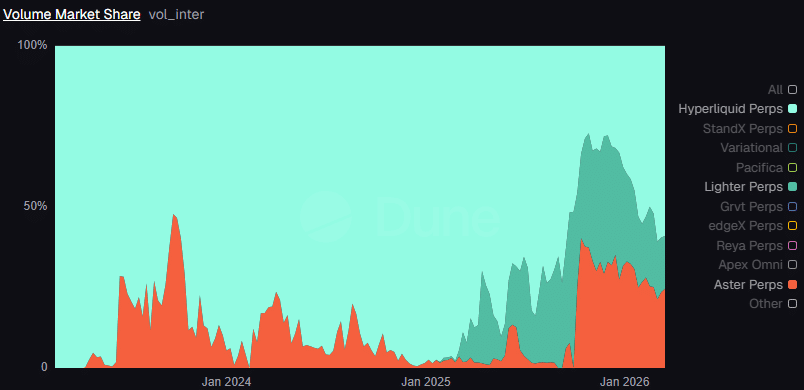
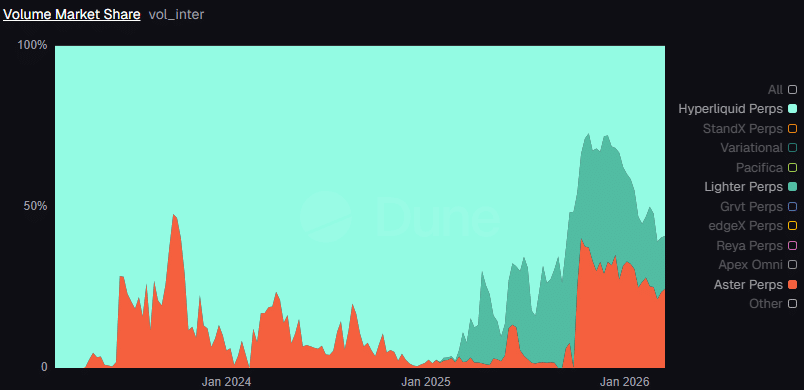
During its peak activity in October 2025, it handled nearly $74 billion in weekly trading volume. But its trading activity shrank to less than $10 billion as of mid-March 2026, following the broader crypto rout in the past few months.

Its overall market share in perps trading volume declined by half, from 40% to 20%, over the same period.
Source: Dune

Interestingly, Aster’s wild FOMO after launch clawed down Hyperliquid’s [HYPE] market share. Hyperliquid had over 60% dominance before Aster went live. Afterward, its dominance fell to 27% but began reclaiming it only after unveiling trading support for oil, gold, silver, and other commodities via HIP-3.

As of writing, Hyperliquid has regained most of its trading volume, while Aster’s steep decline has not abated.

ASTER price reaction

Likewise, its native token ASTER slumped 86% after a free fall from $3 to a low of $0.4. However, the broader market relief bounce from early February has boosted the altcoin’s recovery by 80%.

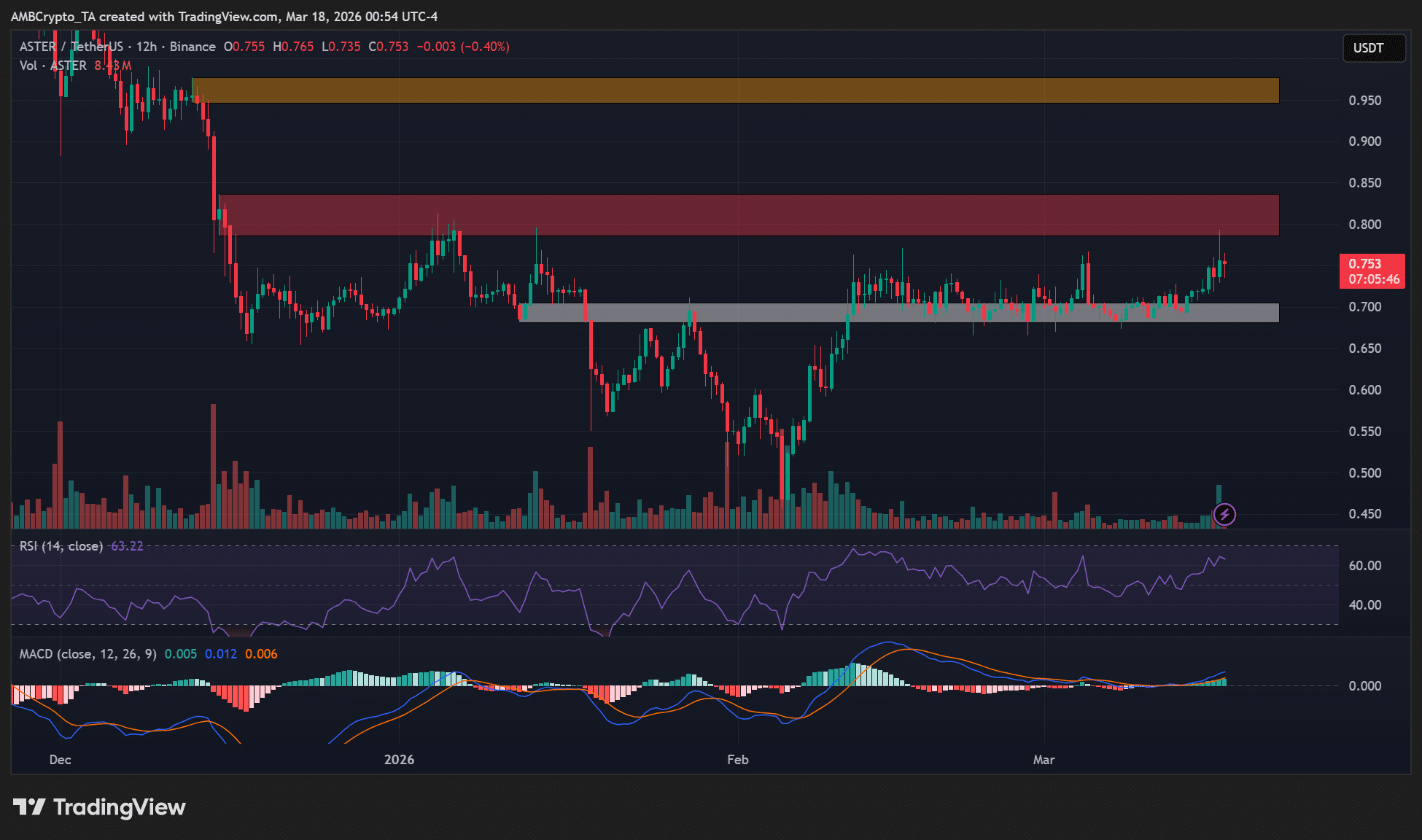
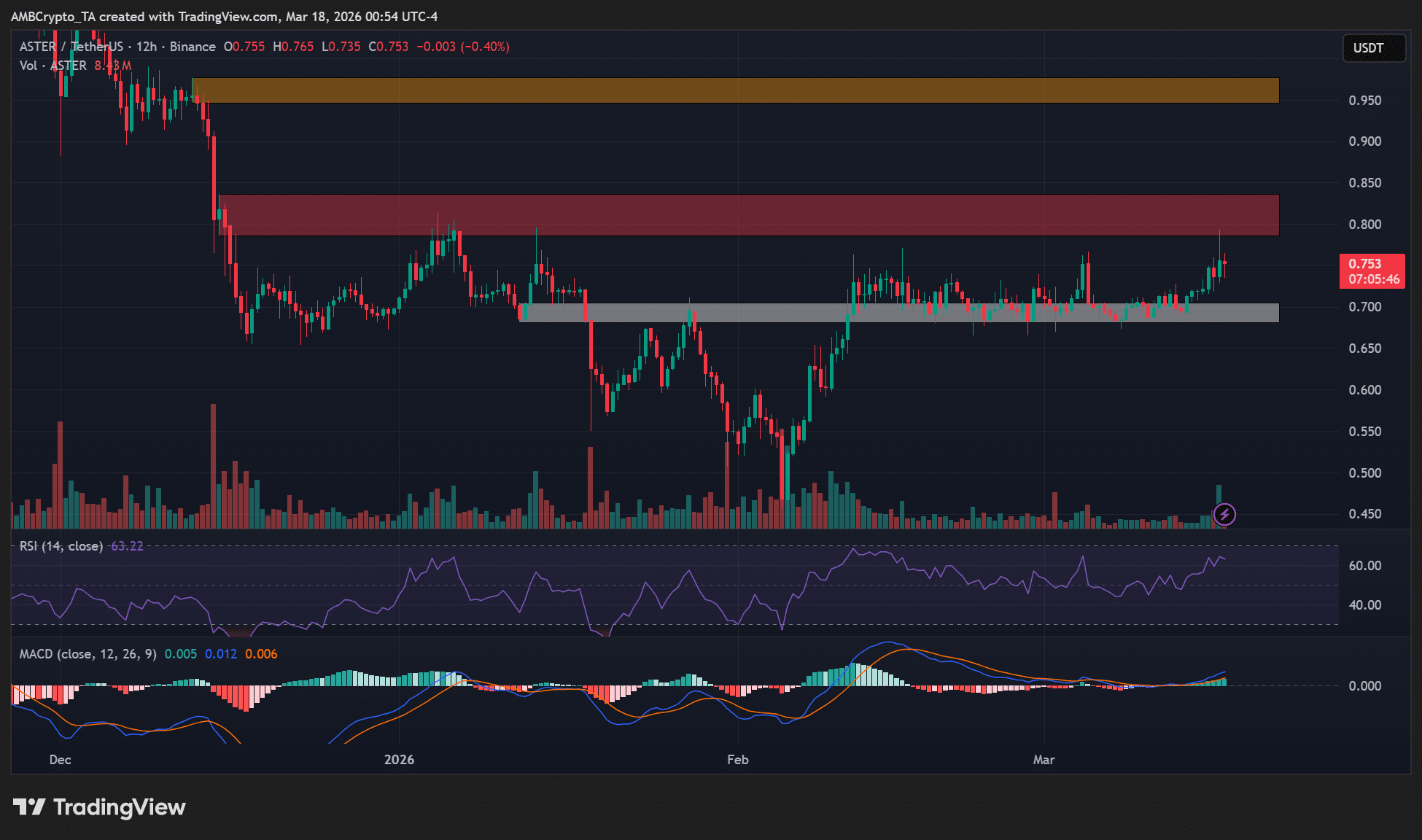
But the mainnet debut didn’t help bulls that much. After the update, ASTER swiftly rallied by nearly 10%, hitting $0.790, but had erased most of the gains at the time of writing.

When zoomed out, the altcoin was still stuck at its February tight price range of $0.70 and $0.80. The sideways structure may extend if there is no meaningful catalyst for a broader market extended recovery.

However, should the $0.80 price level be flipped to support, then retesting $0.950 could be feasible. It’s unclear whether the planned staking feature will induce demand for ASTER.
Source: ASTER/USDT, TradingView

Final Summary

  • Aster has unveiled its Aster Chain mainnet to double down on privacy and trading efficiency.
  • Still, the DEX’s traction remains in a downtrend while the ASTER price has been stuck in a tight range.

Preguntas relacionadas

QWhat is the main purpose of the newly launched Aster Chain mainnet?

AThe Aster Chain mainnet aims to provide enhanced privacy and optimal features for high-frequency traders by adopting zero-knowledge proofs and stealth addresses to curb position hunting, while maintaining a CEX-like user experience.

QHow did Aster's market share in perpetual trading volume change from its peak to mid-March 2026?

AAster's market share in perpetual trading volume declined by half, from 40% at its peak to 20% by mid-March 2026.

QWhat was the impact of Aster's launch on Hyperliquid's market dominance?

AAster's launch reduced Hyperliquid's market dominance from over 60% to 27%, though Hyperliquid later regained most of its trading volume after introducing support for commodities like oil, gold, and silver via HIP-3.

QHow did the ASTER token price react to the mainnet debut?

AThe ASTER token initially rallied nearly 10% to $0.790 after the mainnet debut but erased most of those gains shortly after, remaining stuck in the $0.70 to $0.80 range.

QWhat chains did Aster initially support before transitioning to a sovereign Layer 1 ecosystem?

AAster initially debuted on BNB Chain via a bridge and later extended to Ethereum, Solana, and Arbitrum as a multi-chain dApp before transitioning to a sovereign Layer 1 ecosystem.

Lecturas Relacionadas

Google and Amazon Simultaneously Invest Heavily in a Competitor: The Most Absurd Business Logic of the AI Era Is Becoming Reality

In a span of four days, Amazon announced an additional $25 billion investment, and Google pledged up to $40 billion—both direct competitors pouring over $65 billion into the same AI startup, Anthropic. Rather than a typical venture capital move, this signals the latest escalation in the cloud wars. The core of the deal is not equity but compute pre-orders: Anthropic must spend the majority of these funds on AWS and Google Cloud services and chips, effectively locking in massive future compute consumption. This reflects a shift in cloud market dynamics—enterprises now choose cloud providers based on which hosts the best AI models, not just price or stability. With OpenAI deeply tied to Microsoft, Anthropic’s Claude has become the only viable strategic asset for Google and Amazon to remain competitive. Anthropic’s annualized revenue has surged to $30 billion, and it is expanding into verticals like biotech, positioning itself as a cross-industry AI infrastructure layer. However, this funding comes with constraints: Anthropic’s independence is challenged as it balances two rival investors, its safety-first narrative faces pressure from regulatory scrutiny, and its path to IPO introduces new financial pressures. Globally, this accelerates a "tri-polar" closed-loop structure in AI infrastructure, with Microsoft-OpenAI, Google-Anthropic, and Amazon-Anthropic forming exclusive model-cloud alliances. In contrast, China’s landscape differs—investments like Alibaba and Tencent backing open-source model firm DeepSeek reflect a more decoupled approach, though closed-source models from major cloud providers still dominate. The $65 billion bet is ultimately about securing a seat at the table in an AI-defined future—where missing the model layer means losing the cloud war.

marsbitHace 4 hora(s)

Google and Amazon Simultaneously Invest Heavily in a Competitor: The Most Absurd Business Logic of the AI Era Is Becoming Reality

marsbitHace 4 hora(s)

Computing Power Constrained, Why Did DeepSeek-V4 Open Source?

DeepSeek-V4 has been released as a preview open-source model, featuring 1 million tokens of context length as a baseline capability—previously a premium feature locked behind enterprise paywalls by major overseas AI firms. The official announcement, however, openly acknowledges computational constraints, particularly limited service throughput for the high-end DeepSeek-V4-Pro version due to restricted high-end computing power. Rather than competing on pure scale, DeepSeek adopts a pragmatic approach that balances algorithmic innovation with hardware realities in China’s AI ecosystem. The V4-Pro model uses a highly sparse architecture with 1.6T total parameters but only activates 49B during inference. It performs strongly in agentic coding, knowledge-intensive tasks, and STEM reasoning, competing closely with top-tier closed models like Gemini Pro 3.1 and Claude Opus 4.6 in certain scenarios. A key strategic product is the Flash edition, with 284B total parameters but only 13B activated—making it cost-effective and accessible for mid- and low-tier hardware, including domestic AI chips from Huawei (Ascend), Cambricon, and Hygon. This design supports broader adoption across developers and SMEs while stimulating China's domestic semiconductor ecosystem. Despite facing talent outflow and intense competition in user traffic—with rivals like Doubao and Qianwen leading in monthly active users—DeepSeek has maintained technical momentum. The release also comes amid reports of a new funding round targeting a valuation exceeding $10 billion, potentially setting a new record in China’s LLM sector. Ultimately, DeepSeek-V4 represents a shift toward open yet realistic infrastructure development in the constrained compute landscape of Chinese AI, emphasizing engineering efficiency and domestic hardware compatibility over pure model scale.

marsbitHace 4 hora(s)

Computing Power Constrained, Why Did DeepSeek-V4 Open Source?

marsbitHace 4 hora(s)

Trading

Spot
Futuros

Artículos destacados

Cómo comprar ASTER

¡Bienvenido a HTX.com! Hemos hecho que comprar Aster (ASTER) sea simple y conveniente. Sigue nuestra guía paso a paso para iniciar tu viaje de criptos.Paso 1: crea tu cuenta HTXUtiliza tu correo electrónico o número de teléfono para registrarte y obtener una cuenta gratuita en HTX. Experimenta un proceso de registro sin complicaciones y desbloquea todas las funciones.Obtener mi cuentaPaso 2: ve a Comprar cripto y elige tu método de pagoTarjeta de crédito/débito: usa tu Visa o Mastercard para comprar Aster (ASTER) al instante.Saldo: utiliza fondos del saldo de tu cuenta HTX para tradear sin problemas.Terceros: hemos agregado métodos de pago populares como Google Pay y Apple Pay para mejorar la comodidad.P2P: tradear directamente con otros usuarios en HTX.Over-the-Counter (OTC): ofrecemos servicios personalizados y tipos de cambio competitivos para los traders.Paso 3: guarda tu Aster (ASTER)Después de comprar tu Aster (ASTER), guárdalo en tu cuenta HTX. Alternativamente, puedes enviarlo a otro lugar mediante transferencia blockchain o utilizarlo para tradear otras criptomonedas.Paso 4: tradear Aster (ASTER)Tradear fácilmente con Aster (ASTER) en HTX's mercado spot. Simplemente accede a tu cuenta, selecciona tu par de trading, ejecuta tus trades y monitorea en tiempo real. Ofrecemos una experiencia fácil de usar tanto para principiantes como para traders experimentados.

771 Vistas totalesPublicado en 2025.09.25Actualizado en 2025.09.25

Cómo comprar ASTER

Discusiones

Bienvenido a la comunidad de HTX. Aquí puedes mantenerte informado sobre los últimos desarrollos de la plataforma y acceder a análisis profesionales del mercado. A continuación se presentan las opiniones de los usuarios sobre el precio de ASTER (ASTER).

活动图片