As Circle, the First Stablecoin Stock, Resolves to Shed Its Label

链捕手Publicado a 2026-05-12Actualizado a 2026-05-12

Resumen

Circle, the "stablecoin stock," reported its Q1 2026 results, showing a 20% YoY revenue increase to $694M despite a 15% drop in net profit due to post-IPO stock-based compensation and operational investments. The company's USDC stablecoin hit a record $770B in circulation with on-chain transaction volume soaring 263% YoY. However, market share slightly declined amid competition. The key market catalyst was the announcement of a $222M pre-sale for the ARC token of Circle's new institutional-focused Layer 1 blockchain, Arc, valuing the network at $30B. Led by a16z, the round included major investors like BlackRock and Apollo. CEO Jeremy Allaire positioned this as a strategic pivot from a stablecoin issuer to a broader internet platform and "financial OS" company. Circle also launched "Agent Stack" products for AI agent payments using USDC. While reaffirming its full-year 2026 guidance, the company noted the financial impact of Arc is not yet included, leaving room for future upside. Following the report, CRCL's stock surged nearly 16%. Wall Street analysts remain largely bullish on the long-term narrative, though some caution about near-term execution risks and the current immaterial contribution of new initiatives like Arc. The focus is now on Arc's mainnet launch, ARC token adoption, and evolving U.S. crypto regulation.

Author: Chloe, ChainCatcher

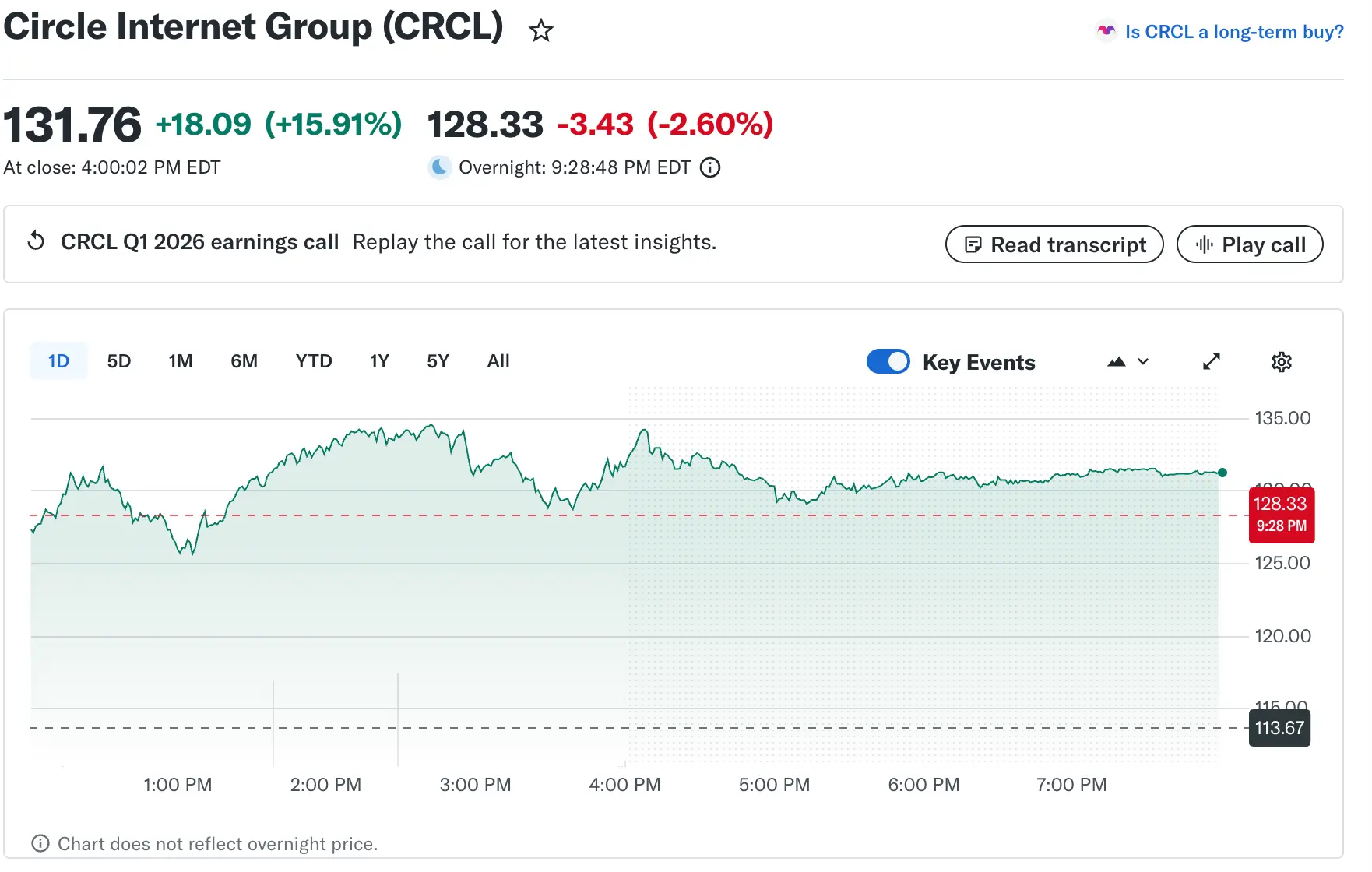
Circle released its first-quarter earnings for 2026 before the market opened yesterday, posting double-digit year-over-year revenue growth and simultaneously disclosing that its new public chain Arc's native token completed a pre-sale of $222 million at a $3 billion valuation. Although net profit declined 15% year-over-year due to increased stock-based compensation and operational investments, market focus remained centered on the long-term narrative of Arc and AI agent payments. CRCL's stock price surged nearly 16% that day, closing at $131.76, hitting a new high since mid-March.
USDC Scale Hits New Record, On-chain Transaction Volume Up 263% YoY

Circle's first-quarter total revenue and reserve income reached $694 million, a 20% increase year-over-year. Breakdown:

  • Reserve Income: $653 million, up 17% YoY, primarily benefiting from a 39% YoY increase in average USDC circulation, partially offset by a 66 basis point decrease in reserve yield (down to 3.5%).

  • Other Revenue: $42 million, roughly doubling YoY, reflecting strong growth in subscription, service, and transaction revenues.

  • Net Income from Continuing Operations: $55 million, down 15% YoY, mainly due to stock-based compensation and related payroll taxes post-IPO, as well as increased investment in products, distribution, and operational infrastructure.

  • Adjusted EBITDA: $151 million, up 24% YoY; Adjusted EBITDA margin was 53%.

Notably, both revenue and net income fell short of Wall Street analysts' expectations prior to the earnings release. According to Bloomberg, sell-side analysts had forecast revenue around $720.8 million and a reserve yield of 3.56%, neither of which were met. However, the adjusted EBITDA of $151 million exceeded the market expectation of $137.9 million, providing some support. This also indicates that the interest rate environment will be one of the most critical external variables for Circle moving forward.

On the operational front, USDC circulation reached $77 billion, up 28% YoY. First-quarter USDC on-chain transaction volume reached $21.5 trillion, a 263% YoY increase, reflecting a significant rise in stablecoin usage density as a payment and settlement medium.

According to Visa Onchain Analytics data, USDC accounted for 63% of stablecoin transaction volume in Q1. Meanwhile, Circle's USYC has become the world's largest tokenized money market fund as of May 7. Other key operational metrics include a USDC "platform retention" balance of $13.7 billion at quarter-end, up 254% YoY; 7.2 million "active wallets" holding over $10 in USDC, up 47% YoY; and a stablecoin market share of 28%, down 62 basis points YoY, directly reflecting competitive pressure from Tether and other rivals.

Public Chain Arc Completes $222 Million Token Financing with Star-Studded Investor Lineup

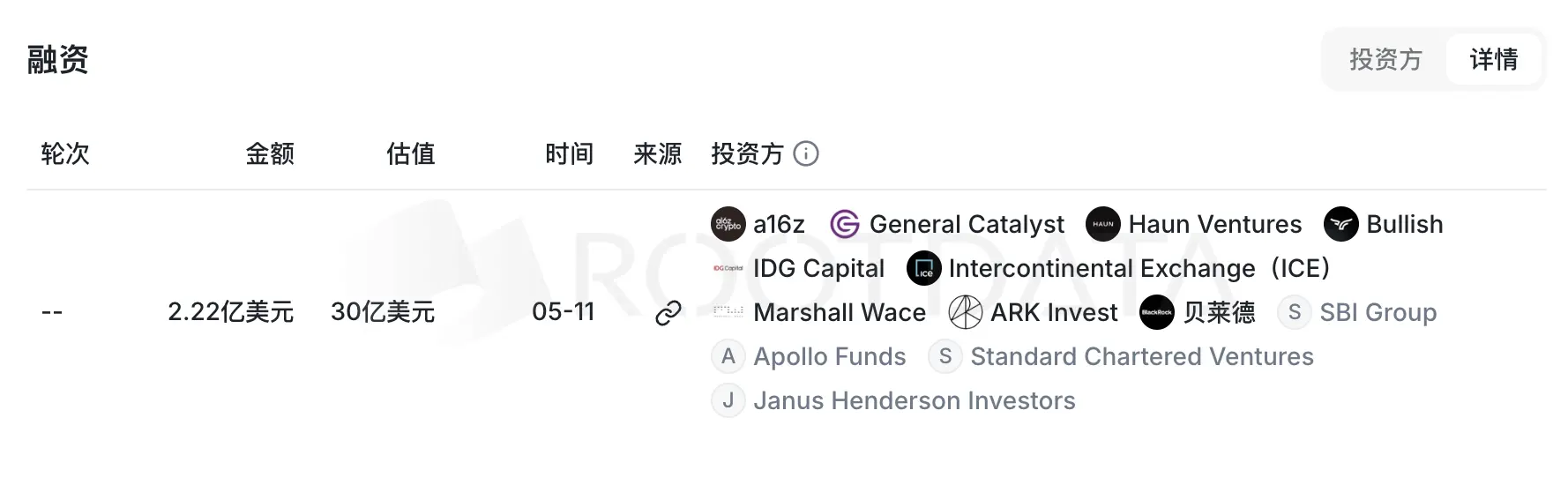
Circle also announced that the native token ARC for Arc, its institutionally-focused Layer 1 public chain, has completed a $222 million pre-sale, with a fully diluted network valuation of $3 billion. According to crypto asset data platform RootData, the financing was led by a16z with a $75 million investment. Other participating investors include BlackRock, Apollo Funds, Intercontinental Exchange (ICE), Standard Chartered Ventures, ARK Invest, Bullish, and over ten other institutions.
Circle CEO Jeremy Allaire stated that the company is transitioning from a stablecoin issuer to a broader internet platform company, entering the operating system and application business. Regarding token distribution, Circle holds 25% of the initial 10 billion token supply, 60% is allocated to network builders and participants, and 15% is reserved as long-term reserves.

Notably, Circle stated that this financial forecast does not incorporate the financial impact of the ARC token pre-sale, Arc incentive programs, or future Arc-related revenues.

Reaffirms Previously Announced Full-Year Guidance, No Adjustments

Additionally, Circle simultaneously launched a series of "Agent Stack" products, including Circle CLI (Command Line Tool), Agent Wallets, and Agent Marketplace, enabling developers and merchants to create, fund, and monetize AI agent-driven activities using USDC across multiple public chains and payment protocols.

The earnings report also revealed that, in terms of payment business, the Circle Payments Network (CPN) processed an annualized transaction volume of $8.3 billion as of March 31, based on the past 30 days of activity. Managed Payments, launched in April, allows financial institutions to offer stablecoin payment services without managing digital assets themselves.

New enterprise use cases for USDC include: Kyriba embedding USDC into its corporate treasury system, and Polymarket expanding its use of USDC as a core collateral and settlement asset.

Finally, regarding the outlook for the full year 2026, Circle chose to reiterate its previously announced performance guidance without any upward or downward revisions. Specifically, USDC circulation is still expected to maintain a 40% compound annual growth rate (CAGR) over multi-year cycles. FY2026 other revenue is projected between $150 million and $170 million; RLDC margin is expected between 38% and 40%; and adjusted operating expenses are forecast at $570 million to $585 million.

Similarly, this set of guidance does not incorporate the financial impact of the ARC token pre-sale, Arc incentive programs, or future Arc-related revenues, meaning there is room for upward revision once the Arc ecosystem successfully launches.

Majority of Wall Street Analysts Issue Bullish Ratings

Following the earnings release, CRCL surged approximately 16% that day, closing at $131.76, reaching its highest level since March 18. The stock has gained 66% year-to-date, with market capitalization rebounding to around $35 billion.

Wall Street analysts are generally optimistic about Circle's stock price performance over the next 12 months and beyond. According to TipRanks statistics, the consensus target price is $138.50. Among them, Peter Christiansen of Citi gave a 12-month target of $243, while Gautam Chhugani of Bernstein set a target of $190. Along with ten other analysts, all issued "Buy" ratings.

However, analysts still retain some reservations about short-term execution risks. Clear Street analyst Owen Lau pointed out that while the narratives of Arc and Agent Stack are eye-catching, they are "not yet a material business." John Todaro of Needham & Co. noted that recent DeFi protocol hacks could indirectly affect USDC use cases: "If capital leaves DeFi, how does that impact Circle's business?" Andrew Jeffrey of William Blair believes that CRCL stock price volatility will remain high in the short term, but Circle holds a significant advantage in "stablecoin commerce" with multiple catalysts progressing simultaneously.

It can be seen that Circle's earnings report presents a dual structure: the stablecoin business is still scaling rapidly, but unit economics are being compressed by interest rates and distribution costs. The market's willingness to award a 16% single-day gain is more of a bet that the Arc public chain, ARC tokenomics, and AI agent payments can reposition Circle from a stablecoin issuer to a "network financial operating system" in the medium to long term, opening up second and third growth curves beyond the existing USDC spread model.

Perhaps the market's focus going forward will be on the Arc mainnet launch timeline, market acceptance of the ARC token after public circulation, and the impact of subsequent U.S. GENIUS Act and Clarity Act implementations on the overall stablecoin competitive landscape.


Preguntas relacionadas

QWhat was Circle's stock price performance after the release of its Q1 2026 earnings report?

AFollowing the release of its Q1 2026 earnings report, Circle's stock (CRCL) rose nearly 16% on the day, closing at $131.76, which was a new high since mid-March.

QWhat major development did Circle announce alongside its earnings?

AAlongside its earnings, Circle announced that the native token ARC of its new institutional finance-focused Layer 1 blockchain, Arc, completed a pre-sale of $222 million at a fully diluted network valuation of $30 billion.

QWhat were the key financial results for Circle in Q1 2026?

AIn Q1 2026, Circle's total revenue and reserve income was $694 million, a 20% year-over-year increase. However, net income from continuing operations was $55 million, down 15% YoY. Adjusted EBITDA was $151 million, a 24% YoY increase.

QWho led the funding round for the ARC token?

AThe funding round for the ARC token was led by the venture capital firm Andreessen Horowitz (a16z), which invested $75 million.

QAccording to the article, what is the main transformation that Circle's CEO Jeremy Allaire described for the company?

ACircle's CEO Jeremy Allaire stated that the company is transforming from a stablecoin issuer into a broader internet platform company, entering the operating system and application businesses.

Lecturas Relacionadas

As Consensus Accelerates, What Are Young Investors Betting On?

Title: As Consensus Forms Faster, What Are Young Investors Betting On? In the rapid evolution of tech investment, a new generation of young investors is navigating a landscape where AI, robotics, commercial aerospace, and quantum computing are advancing simultaneously. Traditional investment logic based on financial models is giving way to a need for deep technical understanding and the ability to act before industry consensus forms. An analysis of trends from the "WAIC FUTURE TECH" list of young investment leaders reveals key shifts in focus. The first major trend is the movement of AI from the digital screen into the physical world. Investment is shifting from large language models and chatbots towards embodied AI, robotics, AI hardware, and edge computing. While demonstrations generate excitement, the real challenge lies in achieving scalable, reliable, and cost-effective delivery in complex real-world environments like factories and logistics. Success depends not just on algorithms but on the integration of sensors, actuators, and control systems. Second, the competitive focus for large models is moving beyond raw capability toward building an "intelligence flywheel." The goal is to create self-reinforcing systems where user interaction generates data, improving the model, which in turn enhances the user experience and attracts more engagement. Companies that successfully embed AI into workflows to create these closed-loop systems can build lasting value that isn't easily erased by the next model upgrade. Third, facing a potential bottleneck in high-quality human-generated data, investors are looking at new underlying technologies. Reinforcement learning and self-play, as demonstrated by AlphaGo Zero, offer paths for AI to generate its own experience. Scientific foundation models, which aim to build general AI capabilities for fields like life sciences and materials discovery, represent a non-consensus direction that could unlock new frontiers of knowledge and data. Finally, in deep-tech areas like quantum computing, commercial aerospace, and space-based infrastructure, patient capital is essential. These fields have long, uncertain development and validation cycles involving complex engineering, supply chains, and regulations. Investment here requires a long-term view, focusing on foundational team capabilities and the eventual emergence of market demand, even if commercial returns are distant. Collectively, these trends illustrate how young investors are adapting to a new era. They are learning to make earlier, technically-informed judgments, balance hype with real-world viability, and provide the patient capital needed to build the deep-tech foundations of the future.

marsbitHace 4 min(s)

As Consensus Accelerates, What Are Young Investors Betting On?

marsbitHace 4 min(s)

Can Japan Buy Growth with AI? Will the Bond Market Believe It?

Japan's cabinet has introduced the 2026 Basic Policy on Economic and Fiscal Management and Reform, shifting its primary fiscal target. The new framework moves away from the traditional annual primary balance goal and instead prioritizes a stable reduction of the debt-to-GDP ratio. This change is tied to a strategy of increased "responsible proactive fiscal" spending, aiming to boost long-term growth through investments in strategic sectors like AI, semiconductors, energy, and robotics. The government estimates total public and private investment in 62 key technologies could exceed 370 trillion yen by 2040. The market reaction has been mixed and cautious. While equity markets may respond to policy signals, bond markets are focused on fiscal credibility. Concerns center on whether the weakening of the clear primary balance anchor could lead to looser fiscal discipline. If investors doubt that these strategic investments will generate sufficient productivity gains, tax revenue, and nominal growth to outpace rising interest costs, they may demand higher yields on Japanese Government Bonds (JGBs). Recent volatility in the yen and JGB yields, with the 10-year yield briefly reaching 2.9%, reflects this skepticism. The success of this new framework hinges on two factors: whether Japan can achieve a nominal growth rate consistently higher than its long-term interest rates, and whether future budgets demonstrate disciplined control over bond issuance. The government's narrative is that strategic investment is essential to break Japan's cycle of low growth, aging, and labor shortages. However, the bond market will continuously assess the credibility of this plan, pricing the risk that it may represent fiscal expansion rather than a viable growth strategy.

marsbitHace 41 min(s)

Can Japan Buy Growth with AI? Will the Bond Market Believe It?

marsbitHace 41 min(s)

Misjudged A-Shares: Resilience, Expectations, and Confidence

China's A-share market recently faced selling pressure, especially in tech sectors, initially triggered by a global tech sell-off that began in South Korea. However, the article argues this is a case of "mistaken injury" and highlights the market's underlying resilience. This resilience stems from three main pillars: **1) Tech Sector Fundamentals:** Unlike Korea's market dominated by a few memory chip stocks, China's tech sector is diversified across computing, communications, electronics, and semiconductors, supported by dual narratives of global AI supply chains and domestic substitution. Core areas like optical modules and fiber optics continue to show strong earnings growth. **2) "National Team" Support:** State-backed institutions and large corporations have made significant market purchases and announced buybacks, providing liquidity and signaling confidence. This is seen as a stabilizing policy signal, often associated with market bottoms. **3) Broader Market Pillars:** Other major sectors are showing endogenous recovery momentum. Consumer stocks benefit from stabilizing CPI and signs of sector recovery (e.g., liquor price hikes). Cyclical sectors like aluminum have high earnings, potential price increases due to tight supply, and low valuations. The financial sector offers stable dividends and low valuations. The conclusion is that the sell-off was driven by external contagion, not a collapse in fundamentals. With strong policy support and recovering momentum across key sectors, the A-share market possesses the toughness to regain stability.

marsbitHace 1 hora(s)

Misjudged A-Shares: Resilience, Expectations, and Confidence

marsbitHace 1 hora(s)

Trading

Spot
活动图片




