As Channel Dividends Fade, What Can DeFi Protocols Rely On to Resist Giant Harvesting?

marsbitPublicado a 2026-06-22Actualizado a 2026-06-22

Resumen

The article discusses how major tech companies like Coinbase, Stripe, and Kraken are increasingly acquiring or building their own underlying infrastructure to capture profits, moving away from relying on external DeFi protocols. It uses the example of Coinbase's Base blockchain, which generates sequencing fees for Coinbase from protocols like Morpho that deploy on it. Similarly, Stripe acquired Bridge to capture stablecoin yield instead of paying it to Circle, and Kraken bought NinjaTrader for its derivatives licenses. The core argument is that when channel-based advantages (like user traffic) fade, control over the profit-generating infrastructure becomes critical. While this could lead to a future dominated by a few integrated giants, the article suggests a more balanced outcome is possible. Protocols that have already achieved deep, multi-chain integration and embedded themselves into corporate backends create high switching costs, making them difficult to replace. Examples include Morpho (despite reliance on Base, it's widely deployed) and Uniswap. The piece concludes that the race between institutional expansion and open-source protocol proliferation will ultimately shape the industry's structure.

Author: Thejaswini M A

Compiler: Saoirse, Foresight News

In Goodfellas, Ray Liotta has a line: "Forget about it. Pay me." This line shatters the romantic filter of mafia morality glorified in works like The Godfather, starkly revealing the cold, parasitic, and profit-driven essence of organized crime. Following this similar logic, let's discuss large tech companies.

You control value by controlling profits. To achieve this, you don't even need to build a public blockchain protocol or a project. This is a profit war with no rules. However, we cannot blame companies like Coinbase, Stripe, or Kraken for making such choices.

From the most fundamental business logic, their operations resemble a shrewd real estate play: securing traffic distribution channels first. Now holding the power of these channels, they look down and ask, "Who really holds the pricing power?"

Coinbase built its own blockchain; Stripe spent $11 billion acquiring infrastructure it could have leased; Kraken spent $15 billion acquiring a derivatives trading platform; Apple built the App Store. The logic of this playbook is: let others explore the market and bear the early-stage risks, then acquire the underlying infrastructure once the profitability of the sector becomes sufficiently attractive. The core question this article explores: when traffic distribution channels no longer hold core value, where will the industry head?

Coinbase has 110 million verified users. For years, its lending products offered to users were built on the open-source protocol Morpho, with all protocol fees going to Morpho. Later, Coinbase launched its own Layer 2 blockchain, Base. Morpho chose to deploy on Base solely because Coinbase's massive user base could bring transaction volume. Now, every transaction on Base generates sequencing fees that flow entirely into Coinbase's pockets, not Morpho's.

Base generated $76 million in net sequencing fee revenue in 2024, and $74 million in 2025. Before February 2026, according to a licensing agreement, Coinbase needed to share a portion of revenue with Optimism. But eventually, Coinbase severed the partnership, switched to self-developed underlying architecture, and now keeps the entire $64 million revenue stream. Meanwhile, Morpho remains firmly rooted on Base, developing well with a Total Value Locked (TVL) of $2.5 billion. However, every business processed by Morpho now shares a portion with Coinbase.
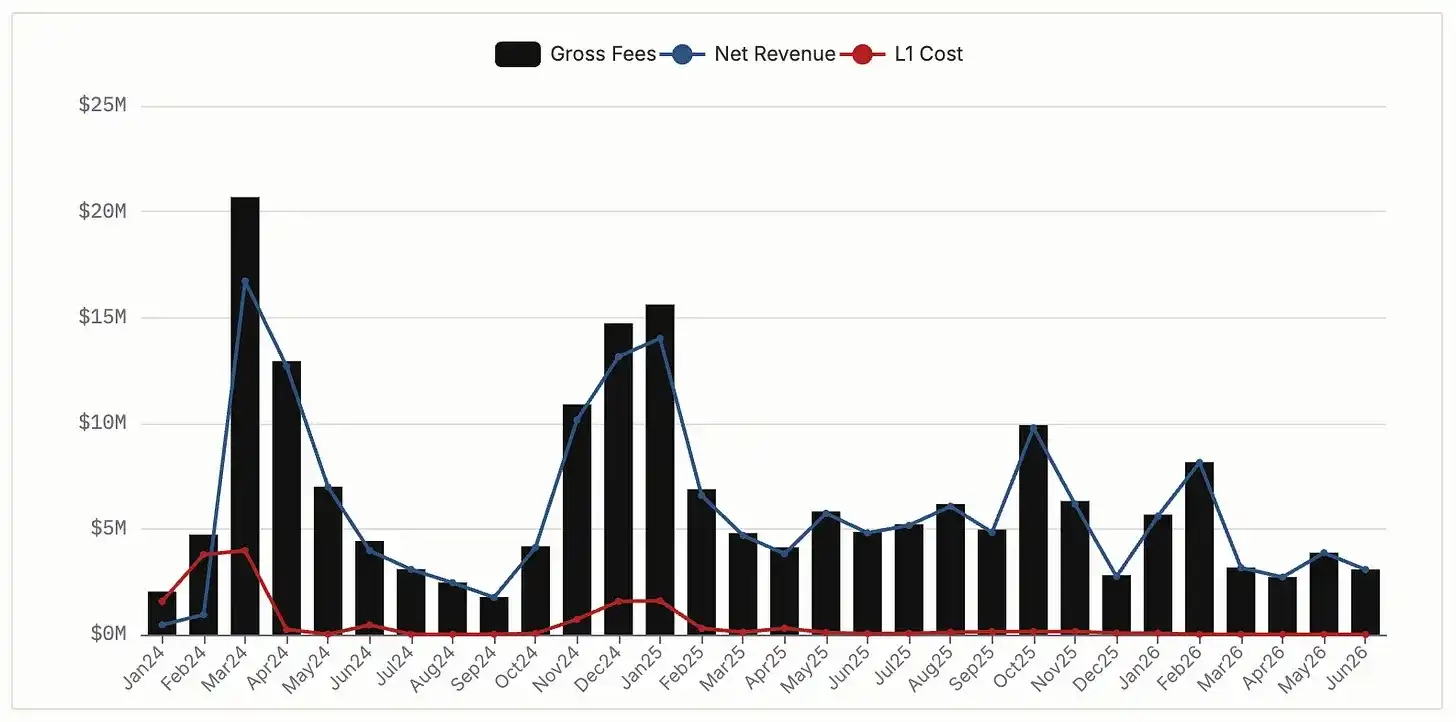
Base Monthly Sequencing Fee Revenue, Data Source: DeFiLlama

Coinbase, relying on Morpho's underlying architecture, launched a $300 million Bitcoin-backed lending product. Its issued wrapped Bitcoin, cbBTC, is the largest collateral asset within Morpho, accounting for 38% of the protocol's total TVL. This creates a mutual interdependence: Morpho holds the underlying core capability of Coinbase's credit products, while Coinbase can extract a revenue share from all of Morpho's business, making it difficult for either side to easily sever the cooperation.

Consider Stripe's case: in early 2025, it spent $11 billion acquiring Bridge. Before that, Stripe's stablecoin business relied on Circle's infrastructure. Circle held the stablecoin issuance rights and earned the floating interest generated by the reserve collateral assets. At that time, all revenue from Stripe's trillion-level stablecoin transactions flowed to Circle. The acquisition of Bridge completely reversed this situation. Bridge issues its own stablecoin, USDB, collateralized by BlackRock money market funds. After switching to USDB, the sizable interest from these reserves remained entirely within Stripe's ecosystem. Stripe's annual payment transaction volume reaches $1.4 trillion; long-term rental of a competitor's profit-generating foundation meant losing hundreds of millions in annual profit.

Patrick Collison once called stablecoins "the room-temperature superconductors of finance." Spending $11 billion to fully own this underlying tool is far more economical than continuously paying tolls to a competitor.

Pure spot exchanges have a natural growth ceiling, with users only able to trade hundreds of tokens. But Kraken wanted to attract institutional investors and sophisticated retail traders, groups that primarily trade via futures and clearing derivatives. Operating a derivatives business requires registration with the U.S. Commodity Futures Trading Commission (CFTC), membership with the National Futures Association (NFA), and broker-dealer licenses. Building this entire compliance system takes years; even building from scratch, regulators could deny approval for various uncontrollable reasons.

This is why Kraken targeted NinjaTrader. The $1.5 billion acquisition in January 2025 brought not only 1.7 million funded trading accounts but, more crucially, directly provided Kraken with the full set of broker-dealer licenses it would have struggled to quickly develop and obtain on its own.

By acquiring ready-made compliance qualifications, Kraken completely freed itself from dependence on external partners. It now fully owns the entire technological system and licenses, needing to rely on no one else nor spend years awaiting regulatory approval.

Some might say: large enterprises swallowing small protocols, isn't that industry norm? What's new here?

Morpho's total TVL is $6.4 billion, with $3.308 billion deployed on Ethereum and $2.488 billion deployed on Base. If Coinbase decided to delist Morpho and use a self-developed lending protocol instead, Morpho would immediately lose 39% of its TVL; but it would still retain 52% on Ethereum, while continuing to expand across multiple chains like Hyperliquid L1, Monad, and Arbitrum, allowing its overall business to operate stably.
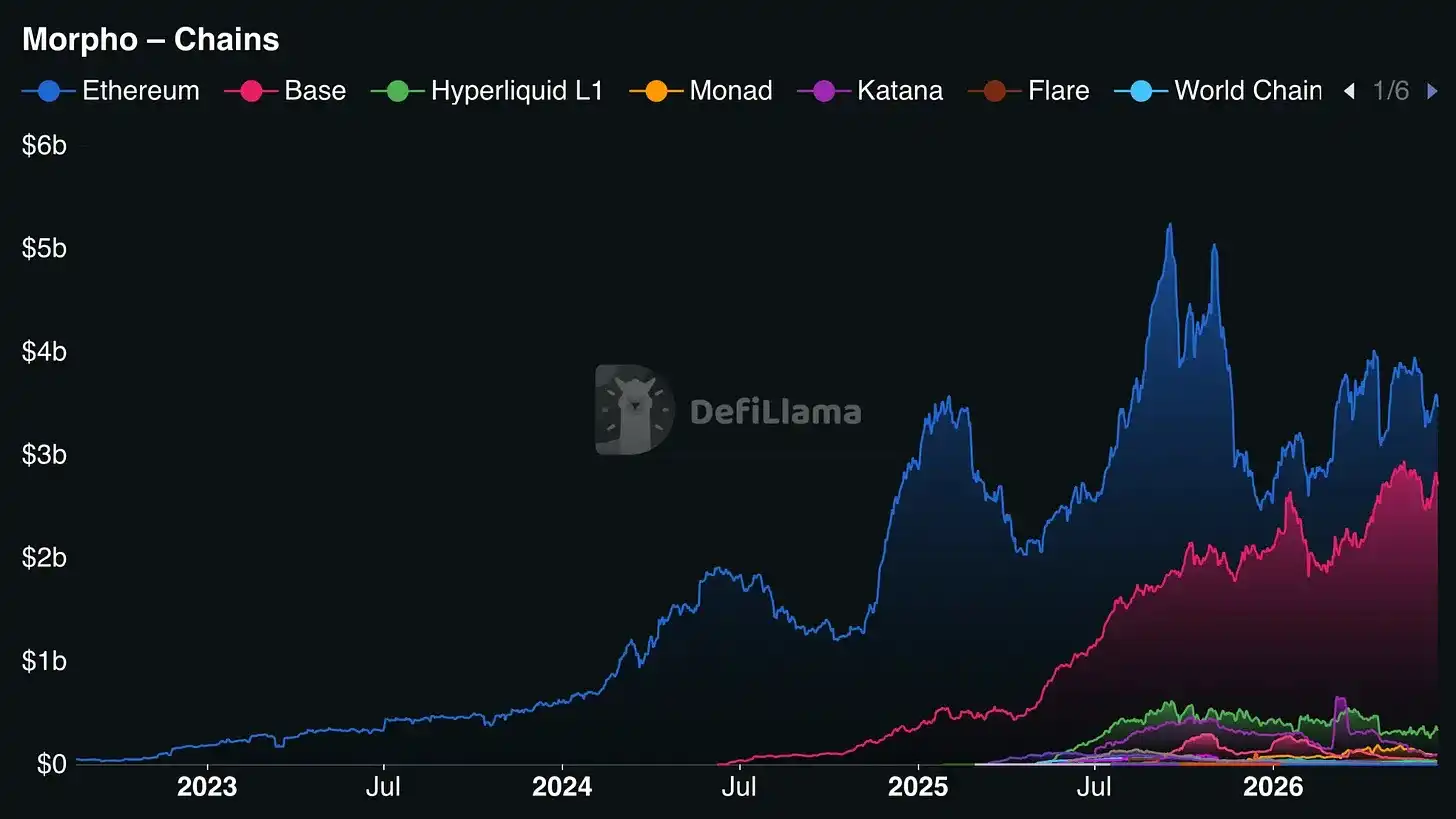
Morpho TVL Distribution Across Chains, Data Source: DeFiLlama

The case of Aerodrome on the Base chain vividly demonstrates the industry impact when a chain operator promotes its own competitor. Aerodrome is Base's native decentralized exchange (DEX), optimized for Base's architecture. Coinbase Ventures holds approximately $20 million worth of AERO tokens, its largest liquidity token investment; meanwhile, the project, through locked AERO token voting, guides liquidity towards Coinbase's products, including cbBTC pools. Aerodrome captures about 51% of Base's DEX trading volume, peaking at 77% in September 2024. Uniswap, deployed across 44 chains, is Base's second-largest DEX, holding 30% trading volume. Even after losing its top position on a single chain, Uniswap did not die: in 2025, it processed $212 billion in volume on Base, with estimated all-chain monthly trading volume around $73 billion.
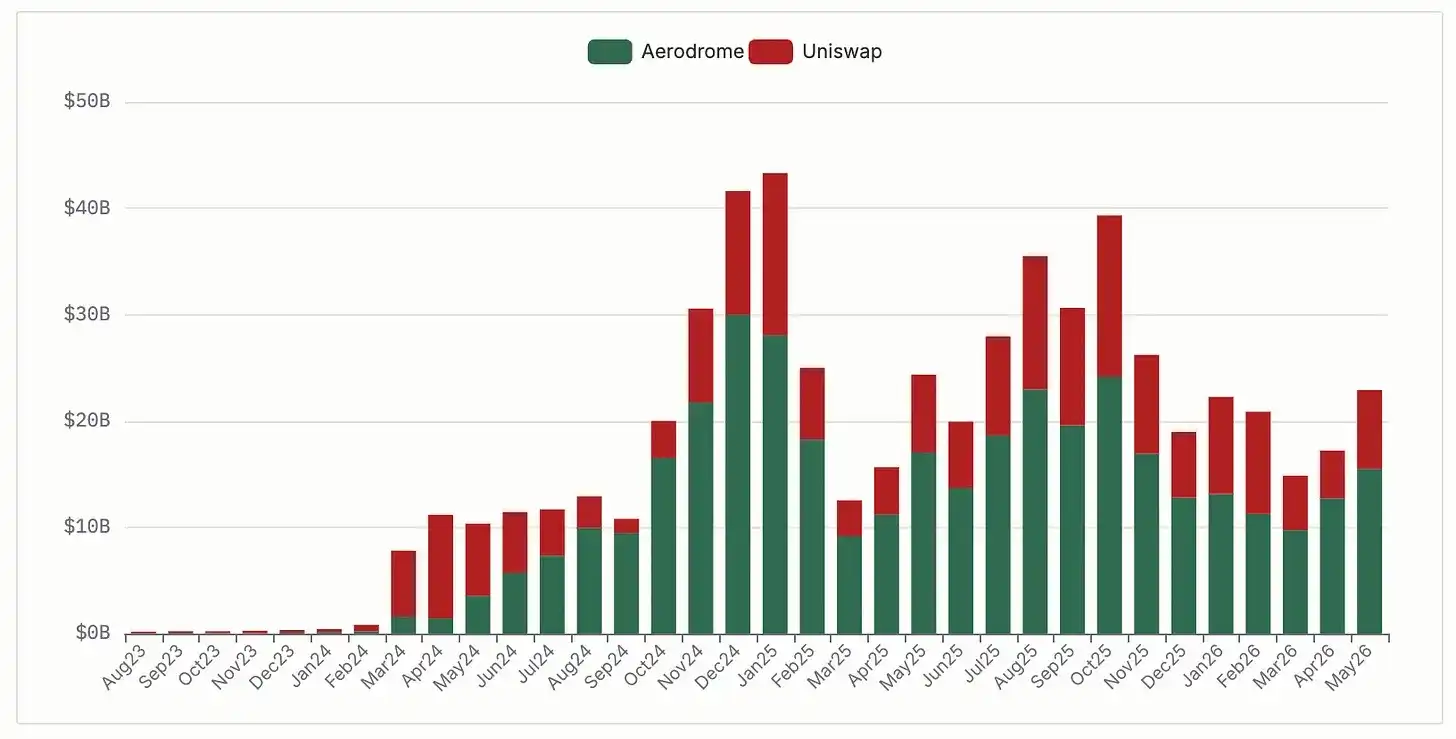
Base DEX Trading Volume Share, Data Source: DeFiLlama

This case confirms that multi-chain deployment is a protocol's natural moat. A project deployed only on a single chain is entirely at the mercy of the chain operator, who can at any time promote a competitor to squeeze its survival space. Conversely, a multi-chain deployed protocol can continue operating normally across other tracks even if it loses one chain's market. After witnessing Uniswap's traffic diversion on Base by Aerodrome, Morpho rapidly expanded its deployment across multiple chains. Large traffic platforms can vertically integrate downwards into the underlying layer, while open-source protocols can horizontally expand across multiple chains to diversify risk.

If you rely on underlying infrastructure you do not own, you do not truly control your business. The party controlling the underlying layer holds overwhelming pricing power over you, can define your product experience, and ultimately influence your operational stability. For companies of this scale, this dependency relation results in tangible profit loss daily. This business logic is not unique to crypto: Amazon built its moat on AWS; Apple, once constrained by Intel's chip roadmap, spent years developing custom chips to break free.

Everyone can check in real-time how much revenue Coinbase earns from Base sequencing fees and clearly view Morpho's TVL across various chains. This value extraction process is entirely transparent, unlike the internal infrastructure profits of traditional internet giants like Amazon.

One potential industry direction is a future market entirely controlled by giants like Coinbase, Stripe, Kraken, and a few banks. They would control the entire industry chain from underlying protocols to payment cards, with open-source protocols merely filling niche gaps the giants haven't yet addressed. This is a fully plausible development path for fintech. Open-source technology would no longer be a free, vast fertile ground for innovation but merely a patch of tape filling tiny crevices in giant enterprises not yet monetized. Like the joke goes: "Look at this high-quality small open-source protocol; let's just build a commercialization system on top of it to harvest the traffic."

However, I lean towards an optimistic view: considering several current acquisition cases, the probability of such complete monopolistic control is not as high as it seems. Underlying protocols are difficult to be exclusively monopolized by giants like traffic channels. Morpho can complete deployment on a new chain in mere weeks; replacing a battle-tested lending protocol deeply embedded in institutional operations incurs extremely high costs, not easily perceptible to outsiders. Coinbase's $300 million Bitcoin lending product still relies on Morpho because replicating Morpho's security system from scratch would take years and introduce security risks Coinbase is unwilling to bear.

Protocols that can survive this wave of giant consolidation share a core condition: completing full multi-chain deployment before traffic giants build their own ecosystems, deeply embedding themselves into major enterprises' backend systems, making the economic cost of replacement prohibitively high. Even Robinhood, a traffic giant with a massive user base, chose to integrate the third-party zero-knowledge proof perpetual contract exchange Lighter as its trading backend. Robinhood Ventures participated in Lighter's $68 million funding round, and founder Vlad Tenev maintains close communication with the project.

If only traffic channels could build moats, Robinhood could have self-developed the entire backend like Coinbase. But it didn't: combining centralized exchange trading speed with zero-knowledge verifiable matching logic is an extremely difficult niche technical challenge; the Lighter team spent over a year solving it. Robinhood calculated that purchasing the right to use mature technology is far more economical than developing from scratch.

Currently, Morpho occupies this favorable position of mutual deterrence, and Uniswap is the pioneer of this path. The speed of institutional expansion and the speed of open-source protocols' horizontal multi-chain expansion are in a game, the outcome of which will determine the direction of the industry landscape.

For now, the underlying operations of giants like Stripe and Coinbase still rely on open-source technology. In the short term, open-source protocols can still stand firm. In two years, we can re-examine the industry landscape.

Criptos en tendencia

Preguntas relacionadas

QWhat is the core issue discussed in the article regarding DeFi protocols and large tech companies?

AThe core issue is how DeFi protocols can survive and compete when large tech companies and centralized platforms (like Coinbase, Stripe, Kraken) that control key distribution channels move to capture the underlying infrastructure and value, extracting fees and potentially replacing the protocols they once relied on.

QAccording to the article, what strategic move did Coinbase make to capture value from protocols like Morpho?

ACoinbase launched its own Layer 2 blockchain, Base. While Morpho deployed on Base to access its user base, all transaction sequencing fees generated on Base flow to Coinbase, not to Morpho, allowing Coinbase to capture value from Morpho's operations.

QHow does the article suggest DeFi protocols like Morpho can build a 'moat' against such centralization pressures?

AThe article suggests that multi-chain deployment is a key defensive moat. By spreading across multiple blockchains (like Ethereum, Arbitrum, Monad), a protocol is not reliant on any single chain operator. If it loses dominance on one chain, its operations on others can sustain it, making it harder for a centralized entity to control its fate.

QWhat example does the article use to illustrate the high cost of replacing a deeply integrated, battle-tested protocol?

AThe article uses Coinbase's own $300 million Bitcoin-backed lending product. Despite having the incentive to replace Morpho, Coinbase continues to use it because replicating Morpho's security and proven system from scratch would take years and introduce unacceptable risks that Coinbase is unwilling to bear.

QWhat contrasting example does the article provide to show that not all large platforms choose to build everything in-house?

AThe article cites Robinhood, which chose to integrate with the third-party ZK-powered perpetual exchange Lighter instead of building its own. Robinhood calculated that licensing the mature, specialized technology from Lighter was more economical than undertaking the difficult and time-consuming in-house development.

Lecturas Relacionadas

Report Interpretation: J.P. Morgan Details Micron's Pre-Earnings Sentiment, Current Hardware Sector Dynamics

Morgan Stanley analyst Joshua Meyers' report (June 21, 2026) highlights key trends in the hardware and semiconductor sector ahead of Micron's earnings. The core takeaways are: 1. **Micron & Memory:** Memory remains a high-conviction long theme, driven by strong AI demand and rising ASPs. However, investor focus is shifting to the sustainability of Micron's >80% gross margins and the specifics of potential new long-term supply agreements (SCAs). 2. **Hardware Supply Chain:** AI-related demand for servers, networking, and storage remains robust, but company performance is diverging. Celestica (CLS) shows improved margin confidence, Western Digital and Seagate benefit from pricing, Fabrinet (FN) sees predictable AI optics growth, and Teradyne (TER) anticipates a new Google customer. 3. **AI Capex & WFE Forecasts:** JPMorgan increased its Wafer Fab Equipment (WFE) market growth forecasts to 28% in 2026 and 29% in 2027. AI infrastructure financing is evolving, with higher project-level debt reducing constraints on capex expansion. The report signals that while the AI-driven hardware cycle is strong, the market is entering a phase focused on execution verification (e.g., Micron's SCA details, Fabrinet's ramp with Amazon) and valuation sustainability. Key near-term signals include Micron's guidance, Arista Networks' outlook, and the pace of demand normalization post potential tariff-related pull-ins.

marsbitHace 1 min(s)

Report Interpretation: J.P. Morgan Details Micron's Pre-Earnings Sentiment, Current Hardware Sector Dynamics

marsbitHace 1 min(s)

Research Report Analysis: The Fed's New Chair's Debut – New Leader, But Same Script?

Report Analysis: Federal Reserve's New Chair Debut – A New Captain, But the Same Script? Morgan Stanley's chief global economist Seth B. Carpenter analyzes the first FOMC meeting under new Fed Chair Kevin Warsh in a June 21 report. Warsh deliberately avoided providing forward guidance on interest rates, aligning with his philosophy. However, market expectations for a rate hike this year were reinforced. Key signals lie elsewhere: inflation may fall more than expected, and quantitative tightening (QT) could be more aggressive than anticipated. The FOMC's "dot plot" suggests only one rate hike in 2026. Carpenter argues that if inflation undershoots forecasts, the logic for even a single hike weakens, especially as projections indicate potential rate cuts in 2027. On QT, Warsh's stance is clear. Carpenter notes that measures like halving the Treasury's account balance could shrink the Fed's balance sheet by around $500 billion with minimal market impact. Combined with adjustments to reserve interest and liquidity rules, the ultimate QT scale may exceed expectations, though its market effect might be less disruptive unless the Fed actively sells Mortgage-Backed Securities (MBS). While Warsh initiated a review of the Fed's policy framework, the 2% inflation target remains intact for now. The report concludes that the market may be overestimating the significance of reduced forward guidance and the near-term rate hike risk, while potentially underestimating the scope and manageable nature of the coming balance sheet reduction. The key debates will hinge on upcoming core PCE data, the specifics of the QT path, and the framework review's findings.

marsbitHace 12 min(s)

Research Report Analysis: The Fed's New Chair's Debut – New Leader, But Same Script?

marsbitHace 12 min(s)

Critical Game Week: BTC Retracement Confirmation vs. HYPE Support Battle | Guest Analysis

This weekly analysis outlines a critical juncture for BTC and HYPE markets, focusing on key price level confirmations. **BTC Analysis:** BTC is at a pivotal point after a five-wave rally from the June 5th low of $59,100. The price has broken below a short-term rising channel's lower boundary, with the current move seen as a pullback to test this breakdown. Failure to reclaim this level could lead to a retest of the $59,000-$60,000 support zone. The core scenario hinges on this channel retest outcome. * **Key Levels:** Resistance at $64,500-$65,000 (channel boundary) and $69,500-$70,500. Support at $59,000-$60,000 and $55,000. * **Strategy:** A core bearish stance is maintained (20% short from last week), with short-term plans for tactical trades. Three detailed contingency plans (A/B/C) are provided for short positions on resistance tests or breakdowns, emphasizing strict stop-loss discipline. **HYPE Analysis:** HYPE shows strong momentum but is currently in a corrective phase after hitting a new high of $76.94. The price is retesting the crucial $64-$66 support area. * **Key Levels:** Resistance near $77 and $80-$82. Support at $64-$66 and $52-$54. * **Strategy:** The short-term approach is "buy on dips, avoid chasing rallies." A long position is considered only if clear stabilization signals appear at the $64-$66 or deeper $52-$54 support zones, with tight risk controls. **General Risk Management:** A standardized trailing stop-loss protocol is emphasized: set initial stop, breakeven at +1% profit, then trail stops upward to lock in gains. *Disclaimer: All analysis is presented as a personal trading framework, not investment advice. Market conditions are complex and require dynamic adjustment.*

marsbitHace 26 min(s)

Critical Game Week: BTC Retracement Confirmation vs. HYPE Support Battle | Guest Analysis

marsbitHace 26 min(s)

Research Report Interpretation: Citi Attends AWS Summit, Bullish on Cloud Business Acceleration but Data Governance Remains Key Variable

Citi analyst Tyler Radke's team attended the AWS New York Summit (June 17-18), engaging with over 10 clients and partners. In a June 19 report, they highlighted the summit's focus on scaling agent AI for enterprise deployment. Citi maintains a "Buy" rating on Amazon, forecasting AWS revenue growth to accelerate to 37% in FY27 from 30% in FY26, noting this estimate may be conservative. Key takeaways: 1. **AWS Strategy Shift:** AWS is moving from proof-of-concepts to scalable deployment. New offerings like AWS Context (building enterprise knowledge graphs), Amazon Quick (cross-application AI assistant), and security tool Continuum address core enterprise pain points for AI adoption. 2. **Data Infrastructure Beneficiaries:** Data infrastructure companies like Snowflake, Elastic, Oracle, and ClickHouse are seen as direct beneficiaries of scaling AI workloads, as evidenced by strong growth and use cases presented. 3. **Critical Role of Data Governance:** As AI agents scale from hundreds to thousands, effective data governance becomes the key variable for deploying AI in core business processes. AWS Context represents AWS's strategic extension from providing compute/models to offering a data governance infrastructure layer. The report emphasizes that without solving data governance, AI will remain confined to pilot projects. The investment thesis focuses on AWS revenue acceleration and data infrastructure vendors' growth, while monitoring signals like AWS's quarterly revenue growth, Bedrock AgentCore task volume, and pricing impacts on companies like Elastic.

marsbitHace 32 min(s)

Research Report Interpretation: Citi Attends AWS Summit, Bullish on Cloud Business Acceleration but Data Governance Remains Key Variable

marsbitHace 32 min(s)

Crucial Week of Contention: BTC Tests Support and HYPE's Key Level Battle | Special Analysis

**Market Enters Critical Week: Bitcoin Pullback Test and HYPE Support Battle** The market enters a crucial phase of contention this week. The marginal shifts in Federal Reserve policy expectations continue to dictate the pricing rhythm for risk assets. Meanwhile, in the crypto market, following a period of sideways consolidation, the divergence between bulls and bears is becoming concentrated at key price levels. **Bitcoin (BTC) Analysis & Strategy** * **Technical View:** The 4-hour chart suggests BTC is in a five-wave structure since the June 5th low near $59,100. Price action shows a short-term rising channel. The recent drop below this channel's lower boundary is now being followed by a pullback attempt (wave 40-41). The outcome of this retest is critical. * **This Week's Outlook:** The core focus is whether BTC can reclaim and hold above the channel's lower boundary. * **Bullish Scenario:** A successful hold could lead to a continued rebound, potentially challenging the $69,500 - $70,500 resistance zone. * **Bearish Scenario:** Failure to hold may trigger a renewed test of the $59,000 - $60,000 core support area, with $55,000 as a deeper support level. * **Operational Strategy:** The author maintains a 20% mid-term short position initiated last week near $64,500, based on a model signaling a shift to a bearish structure. Short-term tactics involve using 30% capital for potential "spread" trades, with three contingency plans (A, B, C) outlined for reacting to resistance tests, breakouts, or support breakdowns. **HYPE Analysis & Strategy** * **Technical View:** On the 4-hour chart, HYPE shows strong momentum, having recently broken to a new high since January. The current pullback presents a clear three-wave correction structure, bringing the price back to the critical $64 - $66 support zone. * **This Week's Outlook:** The focus is on the battle for the $64 - $66 support area. * **Bullish Scenario:** Holding this support could signal a continuation of the uptrend from the June 10th low, leading to new highs. * **Bearish Scenario:** A breakdown could extend the correction, potentially testing the deeper $52 - $54 support band. * **Operational Strategy:** The recommended short-term approach is "buy on dips, avoid chasing rallies." A light long position (under 30% capital) could be considered if HYPE shows stabilization signals at the $64-$66 or $52-$54 support zones, confirmed by model signals. Strict stop-loss discipline is emphasized. **General Risk Management:** A strict trailing stop-loss protocol is advised: set an initial stop; move to breakeven at +1% profit; lock in profits progressively thereafter. *Disclaimer: All analysis is presented as the author's personal technical perspective and trading log, not as investment advice. Markets are complex and dynamic; risk control is paramount.*

Odaily星球日报Hace 32 min(s)

Crucial Week of Contention: BTC Tests Support and HYPE's Key Level Battle | Special Analysis

Odaily星球日报Hace 32 min(s)

Trading

Spot
Futuros

Artículos destacados

Cómo comprar RAY

¡Bienvenido a HTX.com! Hemos hecho que comprar Raydium (RAY) sea simple y conveniente. Sigue nuestra guía paso a paso para iniciar tu viaje de criptos.Paso 1: crea tu cuenta HTXUtiliza tu correo electrónico o número de teléfono para registrarte y obtener una cuenta gratuita en HTX. Experimenta un proceso de registro sin complicaciones y desbloquea todas las funciones.Obtener mi cuentaPaso 2: ve a Comprar cripto y elige tu método de pagoTarjeta de crédito/débito: usa tu Visa o Mastercard para comprar Raydium (RAY) al instante.Saldo: utiliza fondos del saldo de tu cuenta HTX para tradear sin problemas.Terceros: hemos agregado métodos de pago populares como Google Pay y Apple Pay para mejorar la comodidad.P2P: tradear directamente con otros usuarios en HTX.Over-the-Counter (OTC): ofrecemos servicios personalizados y tipos de cambio competitivos para los traders.Paso 3: guarda tu Raydium (RAY)Después de comprar tu Raydium (RAY), guárdalo en tu cuenta HTX. Alternativamente, puedes enviarlo a otro lugar mediante transferencia blockchain o utilizarlo para tradear otras criptomonedas.Paso 4: tradear Raydium (RAY)Tradear fácilmente con Raydium (RAY) en HTX's mercado spot. Simplemente accede a tu cuenta, selecciona tu par de trading, ejecuta tus trades y monitorea en tiempo real. Ofrecemos una experiencia fácil de usar tanto para principiantes como para traders experimentados.

282 Vistas totalesPublicado en 2024.12.10Actualizado en 2026.06.02

Cómo comprar RAY

Discusiones

Bienvenido a la comunidad de HTX. Aquí puedes mantenerte informado sobre los últimos desarrollos de la plataforma y acceder a análisis profesionales del mercado. A continuación se presentan las opiniones de los usuarios sobre el precio de RAY (RAY).

活动图片