ArkInvest Allocates $32.7M to Robinhood as Bitcoin Hyper Pumps

bitcoinistPublicado a 2026-02-03Actualizado a 2026-02-03

Resumen

Ark Invest has acquired $32.7 million worth of Robinhood (HOOD) shares, signaling a strategic bet on increased retail market participation, which historically precedes crypto activity surges. This influx could cause Bitcoin network congestion, driving interest in scalability solutions. Bitcoin Hyper ($HYPER) is highlighted as a key infrastructure project merging Solana's speed with Bitcoin's security via the Solana Virtual Machine, enabling fast, low-cost transactions. With over $32 million raised in its presale and immediate staking options, it aims to attract developers and handle high-frequency BTC use cases, positioning itself as a solution to upcoming liquidity and scalability challenges.

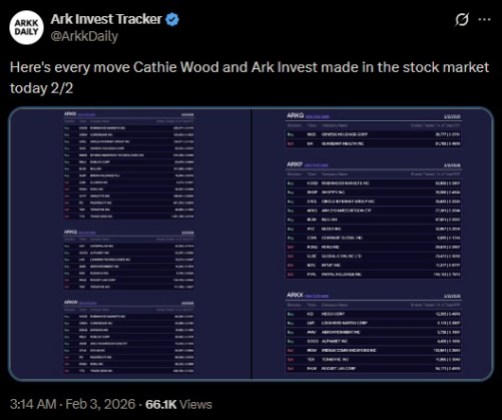
Ark Invest’s latest filing reveals a chunky $32.7M acquisition of Robinhood (HOOD) shares.

On the surface, it’s an equity play, but dig deeper, and it looks like a derivative bet on the resurgence of crypto market participation. Historically, Robinhood’s volume spikes act as a canary in the coal mine for retail capital, typically preceding major on-chain activity by 3-5 weeks.
The timing feels deliberate. As the Federal Reserve signals potential rate pauses, risk-on assets are re-pricing. But buying HOOD is just the surface trade. The inevitable second-order effect of a retail influx? Massive Bitcoin network congestion. When millions of new users try to move $BTC, fees don’t just rise; they skyrocket, making the base layer practically unusable for anyone moving less than six figures.

That bottleneck is exactly why institutional eyes are drifting toward infrastructure that can handle the coming liquidity shock. While Wall Street buys exchange stocks, on-chain capital is positioning into scalability protocols.

Specifically, smart money appears to be front-running the congestion narrative by accumulating Bitcoin Hyper ($HYPER), the first protocol to weld the Solana Virtual Machine (SVM) directly onto a Bitcoin Layer 2.

Buy $HYPER here.

Solving the Velocity Problem: Bitcoin Meets SVM Speed

The thesis here is simple mechanics. Bitcoin is secure but slow; Solana is fast but has faced centralization headaches. By fusing these architectures, Bitcoin Hyper ($HYPER) attempts a ‘best of both worlds’ environment to solve the trilemma plaguing current Layer 2s.

Most existing Bitcoin L2s still feel sluggish compared to modern DeFi standards. Bitcoin Hyper bypasses the lag by using the Solana Virtual Machine (SVM) for execution. The result? Sub-second transaction finality and costs that are fractions of a cent, all while anchoring state to the Bitcoin L1.
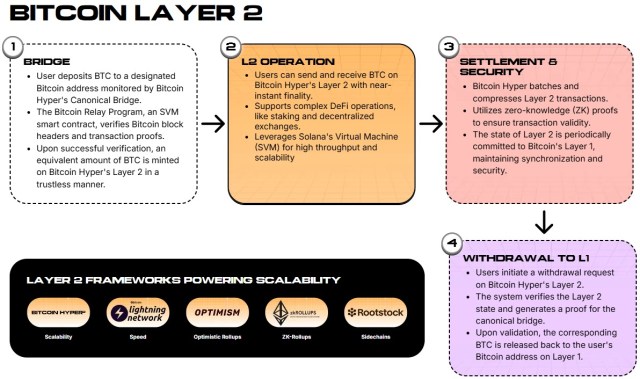
That matters because it finally unlocks high-frequency use cases for $BTC, think gaming, real-time payments, and complex DeFi swaps, that were previously impossible (or just too expensive) on the base layer.

Developers are eyeing the Rust-based environment too. The protocol offers a Developer SDK and API in Rust, meaning the massive pool of Solana devs can port their dApps to the Bitcoin ecosystem without rewriting their codebase. This isn’t just about building a chain; it’s about importing an entire developer economy.

You can buy $HYPER here.

Presale Data Signals Institutional Accumulation

The market’s appetite for high-performance infrastructure shows up in the hard numbers. According to the official presale page, Bitcoin Hyper ($HYPER) has raised over $32M, a figure that frankly outpaces most comparable infrastructure rounds this cycle. The token sits at $0.013675, a valuation that looks modest relative to the utility proposition.
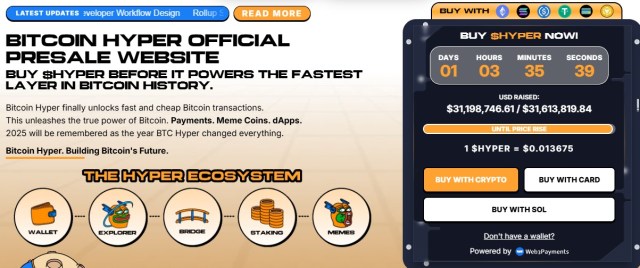
The incentives seem structured to keep that liquidity sticky. Staking opens immediately after the Token Generation Event (TGE), with a 7-day vesting period for presale participants. That lock-up mechanism helps prevent immediate sell-offs, aiming to create a stable floor at launch.

For investors watching Ark Invest buy the ‘shovels’ (Robinhood), Bitcoin Hyper represents the ‘ground’ where the actual digging happens.

Visit the official $HYPER presale here.

The content provided in this article is for informational purposes only and does not constitute financial advice. Cryptocurrency investments, including presales and stocks like Robinhood, carry high risks. Always conduct your own due diligence before investing.


Preguntas relacionadas

QWhat is the significance of Ark Invest's $32.7M acquisition of Robinhood shares according to the article?

AThe article suggests that while it appears to be an equity play on the surface, it is actually a derivative bet on the resurgence of crypto market participation. Historically, Robinhood's trading volume spikes act as an early indicator (a 'canary in the coal mine') for retail capital entering the market, typically preceding major on-chain activity by 3-5 weeks.

QWhat problem does the Bitcoin Hyper ($HYPER) protocol aim to solve?

ABitcoin Hyper aims to solve the blockchain trilemma for Bitcoin Layer 2s by combining the security of Bitcoin with the speed of Solana. It welds the Solana Virtual Machine (SVM) directly onto a Bitcoin L2 to provide sub-second transaction finality and extremely low costs, thereby solving the 'velocity problem' and enabling high-frequency use cases like gaming and real-time payments on Bitcoin.

QHow does the article connect a potential influx of retail users to Bitcoin network congestion?

AThe article states that an influx of retail users, signaled by increased activity on platforms like Robinhood, leads to massive Bitcoin network congestion. When millions of new users try to move BTC, transaction fees don't just rise but 'skyrocket,' making the base layer practically unusable for transactions under six figures.

QWhat advantage does Bitcoin Hyper's Rust-based development environment provide?

ABy offering a Developer SDK and API in Rust, Bitcoin Hyper allows the massive existing pool of Solana developers to easily port their decentralized applications (dApps) to the Bitcoin ecosystem without having to rewrite their entire codebase, effectively importing an entire developer economy.

QWhat does the presale data for Bitcoin Hyper ($HYPER) indicate, as mentioned in the article?

AThe presale data indicates strong institutional accumulation, having raised over $32 million, which the article states outpaces most comparable infrastructure rounds in the current market cycle. The token's valuation is considered modest relative to its utility, and its staking and vesting mechanisms are designed to create liquidity stability post-launch.

Lecturas Relacionadas

OpenAI's Largest Internal Wealth Creation: 600 People Cash Out a Total of $6.6 Billion, 75 Take Home the Maximum $30 Million Each

A Wall Street Journal report reveals OpenAI's unprecedented pre-IPO wealth creation. In a single employee stock sale last October, over 600 current and former employees sold shares, collectively cashing out approximately $6.6 billion. Due to high investor demand, the company tripled the individual sale cap to $30 million, with about 75 employees selling the maximum amount. This event represents the largest such transaction in tech industry history for a private company. OpenAI's valuation was $500 billion for this tender offer. Employees with over two years of tenure were eligible, allowing many post-ChatGPT hires their first liquidity event. The company's stock has reportedly grown over 100-fold in seven years. Following a restructuring, employees collectively hold about 26% of OpenAI. The scale of executive wealth is also staggering. In court testimony related to Elon Musk's lawsuit, President and co-founder Greg Brockman confirmed his OpenAI stake is worth around $30 billion. Analysis indicates about 165 current and former employees hold a combined ~$164.9 billion in equity, averaging nearly $1 billion per person in paper wealth. OpenAI's per-employee stock-based compensation is estimated to be 34 times the average of major tech firms before their IPOs. OpenAI continues its rapid ascent, closing a $122 billion funding round at an $852 billion valuation in March. With monthly revenue hitting $2 billion, over 900 million weekly ChatGPT users, and plans for a potential trillion-dollar IPO in late 2026, this wealth-creation engine shows no signs of stopping.

链捕手Hace 18 min(s)

OpenAI's Largest Internal Wealth Creation: 600 People Cash Out a Total of $6.6 Billion, 75 Take Home the Maximum $30 Million Each

链捕手Hace 18 min(s)

Understanding CPO (Co-Packaged Optics) in One Article: Why Nvidia Is Willing to Spend $3.2 Billion on a Fiber?

NVIDIA and Corning announced a multi-year strategic partnership on May 6, 2026, with NVIDIA committing up to $3.2 billion to support Corning's U.S. expansion. This investment will triple Corning's manufacturing plants and significantly boost its optical fiber and communications production capacity. The core driver behind this massive investment is the fundamental shift from copper to optical interconnect technology within AI data centers. As GPU clusters scale, copper wires face critical limitations: severe signal attenuation over distance, high energy consumption for signal integrity, and excessive heat generation. Optical fiber, transmitting light instead of electrical signals, solves these issues with minimal loss, near-light speed, and lower power needs. The article outlines a three-stage evolution of data center interconnect: 1. **Traditional Copper Interconnects:** The mainstream solution of the 2010s, now being phased out due to scaling bottlenecks. 2. **Pluggable Optical Modules:** The current mainstream, where modules convert electrical signals to light externally. This process still introduces energy loss and latency. 3. **CPO (Co-Packaged Optics):** The next-generation technology where the optical engine is integrated directly with the GPU chip package. This drastically reduces the electrical signal travel distance to mere millimeters, slashing power consumption and latency while boosting data density. NVIDIA CEO Jensen Huang has identified CPO as an essential core technology for AI infrastructure. NVIDIA's investment signifies a strategic shift from being a buyer to actively controlling its supply chain for critical components. With demand for specialized optical fiber far outstripping supply—evidenced by soaring prices—securing long-term manufacturing capacity has become a competitive necessity. While Corning's expansion may pressure some suppliers, a projected global fiber supply gap of 5-15% over the next few years creates a significant opportunity window, particularly for Chinese manufacturers competitive in optical preforms, chips, and modules. Ultimately, NVIDIA's move is not about chasing a trend but an engineering imperative. The transition to light-based interconnects like CPO is driven by the physical limits of copper, marking a definitive step in the ongoing AI computing revolution.

marsbitHace 43 min(s)

Understanding CPO (Co-Packaged Optics) in One Article: Why Nvidia Is Willing to Spend $3.2 Billion on a Fiber?

marsbitHace 43 min(s)

KOL's Perspective: Why Is SOL Set to Rise from This Point?

**Summary: Why SOL is Positioned for Growth at This Level** The article argues that SOL is poised for an upward move from its current price point, citing several key factors. Primarily, SOL has just broken out of a 4-month consolidation phase. This breakout signals a return of risk appetite to the broader crypto market, as SOL is seen as a key indicator of overall crypto health. The token's ownership has reportedly shifted from short-term traders and tourists to long-term accumulators, leading to low volume. Any meaningful increase in trading activity could thus trigger significant upward momentum. Fundamental strengths include strong institutional adoption, integration with DeFi and RWAs (Real-World Assets), and the potential benefits from the Clarity Act. Despite its high volatility—having dropped 70% from its all-time high but still up 12x from its bear market low—SOL is highlighted as one of the few tokens from the last cycle to reach new highs. It boasts a robust ecosystem of applications, users, and protocols. Future catalysts include the expected influx of AI developers following the Miami Accelerate conference, which focused on AI on Solana. Furthermore, Solana is positioned as the premier chain for memecoin activity, a trend expected to continue and drive network usage and fees. The article concludes that recent price action reflects a healthy transfer to long-term holders, setting the stage for growth.

marsbitHace 1 hora(s)

KOL's Perspective: Why Is SOL Set to Rise from This Point?

marsbitHace 1 hora(s)

Trading

Spot
Futuros
活动图片




