Argentina court orders nationwide block of Polymarket over gambling

cointelegraphPublicado a 2026-03-17Actualizado a 2026-03-17

Resumen

An Argentine court has ordered a nationwide block of the crypto-based prediction market platform Polymarket, citing unauthorized gambling operations. The ruling, issued by a Buenos Aires court on March 11, instructed the national communications regulator ENACOM to restrict access to the platform and its variants across the country. The investigation was initiated following a complaint by the Buenos Aires City Lottery (LOTBA), which raised concerns over insufficient identity and age verification, potentially allowing minors to gamble. The court also directed Apple and Google to remove Polymarket’s mobile apps in Argentina. This action follows earlier scrutiny of the platform, particularly regarding its inflation prediction markets, which closely mirrored official data and sparked insider trading concerns. Similar restrictions have been implemented in other countries, including Colombia in Latin America.

A court in Argentina has ordered a nationwide block of major crypto-based prediction market platform Polymarket over unauthorized gambling.

Argentina’s national communications and media regulator, Ente Nacional de Comunicaciones (ENACOM), received a court order to block access to Polymarket website and its variants across the country, according to a ruling dated March 11.

The order was issued by the Buenos Aires Court of First Instance in Criminal, Contravention and Minor Offenses No. 31, which is investigating Polymarket under Argentina’s Criminal Code for allegedly offering gambling services without authorization.

The judge asked ENACOM to carry out the measure either directly or through internet service providers (ISPs) and to promptly inform the court or the specialized gambling prosecutor’s office if technical or other obstacles prevent full compliance.

Buenos Aires regulator initiated the case

According to local media reports, the case was brought by the Buenos Aires City Lottery (LOTBA), the state-owned company that regulates gambling activities in the city.

After receiving a complaint from LOTBA about Polymarket’s alleged operation without authorization, prosecutor Juan Rozas, in charge of the City’s Specialized Gaming Prosecutor’s Office (FEJA), opened the investigation that led to the court order.

Authorities argued that Polymarket allowed users to place bets without sufficient identity and age verification, raising concerns that minors could access the platform.

“In practice, this meant that anyone — including children and adolescents — could access and start betting without any control,” the authorities reportedly said.

Inflation bets deepen scrutiny

In addition to instructing ENACOM to block access to Polymarket, the court reportedly ordered Google and Apple to remove and restrict the platform’s mobile applications on Android and iOS throughout Argentina, including for existing users.

Social media reports indicate users are discussing workarounds such as VPNs, while observers note that the order comes from a Buenos Aires city court rather than the national government.
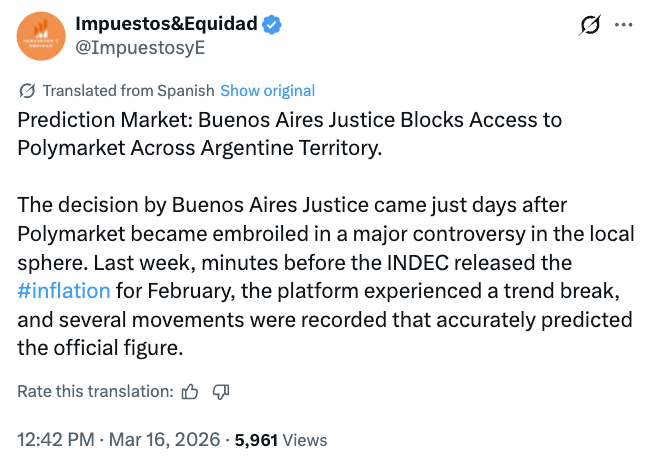
Source: ImpuestosyE (translated by Grok)

The action adds to earlier Polymarket’s scrutiny after its inflation-related prediction markets closely mirrored official data from Argentina’s statistics agency, reigniting controversy over potential insider trading, according to local reports.

Polymarket did not immediately respond to a request for comment from Cointelegraph.

Related: CFTC chair backs blockchain-based prediction markets as ‘truth machines’

Argentina’s action is the latest example of moves against prediction markets globally, with countries including the Netherlands, Hungary, Portugal and Ukraine taking similar steps to restrict access.

In Latin America, Colombia was among the first to take action, with its gambling regulator reportedly warning about Polymarket’s unauthorized operations in September 2025.

Magazine: How crypto laws changed in 2025 — and how they’ll change in 2026

Preguntas relacionadas

QWhy did the Argentina court order a nationwide block of Polymarket?

AThe court ordered the block because Polymarket was allegedly offering unauthorized gambling services, violating Argentina's Criminal Code.

QWhich regulatory body in Argentina is responsible for implementing the block on Polymarket?

AEnte Nacional de Comunicaciones (ENACOM), the national communications and media regulator, is responsible for implementing the block.

QWhat concerns did authorities raise about Polymarket's operations that led to the investigation?

AAuthorities were concerned that Polymarket allowed users to bet without proper identity and age verification, potentially enabling minors to access the platform.

QBesides blocking the website, what additional actions did the court order against Polymarket?

AThe court also ordered Google and Apple to remove and restrict Polymarket's mobile applications on Android and iOS throughout Argentina.

QWhich other countries have taken similar actions to restrict prediction markets like Polymarket?

ACountries including the Netherlands, Hungary, Portugal, Ukraine, and Colombia have taken similar steps to restrict access to such prediction markets.

Lecturas Relacionadas

9.42 Million Retail Investors Compete for Changxin Technology, Who Got Allotted?

Evergreen Technology's IPO subscription results are now available. On July 20, the domestic memory chip giant announced the offline preliminary allotment results and online lottery results for its IPO. A total of approximately 9.43 million retail investors participated in the online subscription, generating 770,000 winning lots with a final winning rate of about 0.4714%, setting a record for new shares on the STAR Market. After triggering a clawback mechanism from institutional to retail investors, the online retail allocation was significantly increased to 3.851 billion shares. Simultaneously, 285 institutional investors participated in the offline subscription, ultimately receiving 2.173 billion shares at an allotment rate of approximately 0.1756%. Leading insurers and public funds were among the major recipients. Notably, Liang Wenfeng, founder of the major AI model company DeepSeek, through his quantitative investment firms Ningbo Huanfang Quantitative and Zhejiang Jiuzhang Asset, secured the largest share among private funds, with a total allotment worth approximately 175 million yuan. Estimates suggest potential profits could reach 730 million yuan if Evergreen Technology's market capitalization reaches 3 trillion yuan post-listing. The company is expected to list on July 27 and could become the highest-valued tech stock on the A-share market, with various brokerages providing valuations ranging from 1 trillion to over 4 trillion yuan. However, recent significant corrections in global tech stocks may impact its post-listing performance. (Character count: 1,196)

marsbitHace 47 min(s)

9.42 Million Retail Investors Compete for Changxin Technology, Who Got Allotted?

marsbitHace 47 min(s)

L2 'Recalibration': When L1 Becomes Its Own Rollup, What Is Ethereum's Endgame?

The article discusses the evolving relationship between Ethereum's Layer 1 (L1) and Layer 2 (L2) solutions, moving beyond the initial "L2 for scaling" model. As Ethereum L1 itself scales (increasing Gas Limit, statelessness, zkEVM), the unique value proposition of L2s shifts from merely providing cheap execution to offering differentiated features like application-specific optimization, privacy, and flexible governance. The piece explores three key themes: 1. **L2's New Role:** L2s are transitioning from a pure scaling technology to a spectrum of execution environments with varying degrees of security inheritance from Ethereum L1. 2. **Interoperability as State Trust:** Solving L2 fragmentation is less about cross-chain bridges and more about enabling faster, trust-minimized state verification between environments. This involves initiatives like faster L1 finality, intent-based architectures (Open Intents Framework), and native account abstraction. 3. **Blurring Layers:** With the potential integration of zk-proofs into L1 validation (making L1 akin to its own "Rollup") and the concept of "Native Rollups," the rigid boundary between L1 and L2 may fade. The future could be a unified system with multiple execution domains (for DeFi, gaming, privacy, etc.) sharing a common security, settlement, and state framework. In conclusion, Ethereum's goal is not to abandon L2s or re-centralize everything on L1, but to re-integrate the fragmented user experience—liquidity, accounts, applications—while preserving the scaling benefits of a multi-environment ecosystem. The endgame is a cohesive "one chain" feeling for users, powered by diverse but securely interconnected execution layers.

marsbitHace 1 hora(s)

L2 'Recalibration': When L1 Becomes Its Own Rollup, What Is Ethereum's Endgame?

marsbitHace 1 hora(s)

Trading

Spot
活动图片