Argentina Bans Polymarket Over Illegal Gambling Concerns Following Colombia

TheNewsCryptoPublicado a 2026-03-17Actualizado a 2026-03-17

Resumen

Argentina has blocked the prediction market platform Polymarket following a court ruling in Buenos Aires that declared its operations illegal under the country's gambling regulations. Authorities have directed internet service providers and app stores to restrict access to the platform. Officials raised concerns over the use of cryptocurrencies for betting and the lack of user identity checks, which could allow minors to participate. The decision follows similar action taken by Colombia, where Polymarket was also classified as an illegal gambling operation for failing to meet licensing requirements. The case reflects growing global regulatory scrutiny of crypto-based prediction markets, which are increasingly being treated as gambling platforms due to their structure and potential risks to market integrity.

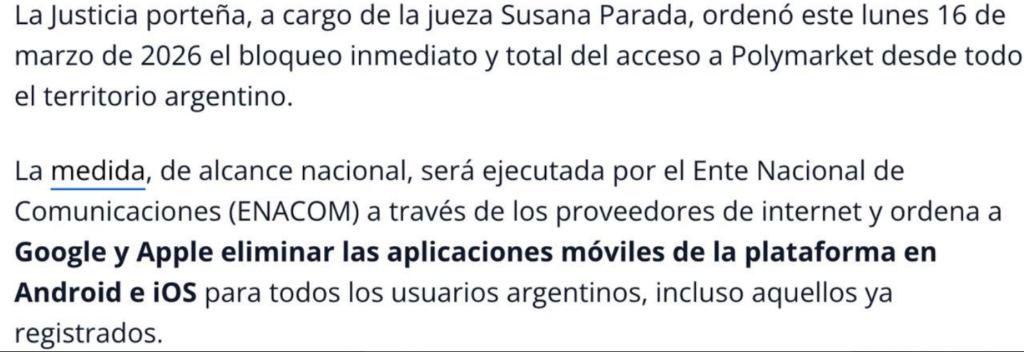
Argentina’s authorities have blocked Polymarket across the country after a ruling by a Buenos Aires court. It declared that it operated illegally and outside the country’s legal framework and regulations regarding gambling. The country’s authorities have asked ENACOM to impose a blockade against Polymarket by internet service providers. The limited access to mobile applications across the country. They have also asked app stores to remove Polymarket applications to prevent users from accessing them.

It was also determined that the platform enabled users to place bets using cryptocurrencies. And the traditional forms of payment in an easy manner. There were also concerns raised by officials regarding the lack of verification measures for the identity of users. This may lead minors to indulge in illegal betting activities. Complaints from local gambling organizations prompted legal action against the platform’s operations.
Regulatory Concerns and Regional Crackdown Expand

Investigations were conducted regarding suspicious trading activities related to inflation prediction markets. This have recently received significant regulatory interest from financial oversight organizations. Reports have been received about unusual betting patterns that have sparked concerns about a potential case. The officials have studied the trading and have observed that some behaviors may have suggested a potential information advantage for some groups in the entire system. This may have compromised the overall integrity and transparency in the current decentralized prediction markets operating globally.

It is worth noting that the authorities concluded that the platform operated like an online betting system. The authorities noted that prediction markets generally take a similar form to gambling structures, in which users of the platforms make predictions about real-world events in order to obtain financial rewards. The classification of prediction markets as gambling structures increases the need for stricter regulation and enforcement of the existing gambling laws.

Argentina’s decision comes in the wake of a similar decision made by the Colombian authorities, banning Polymarket from operating within their jurisdiction since it did not comply with the licensing requirements. The Colombian authorities classified the prediction platform as an illegal gambling platform and asked all the internet service providers within the country to block the platform immediately. The case is a testament to the increasing global scrutiny of crypto-based platforms that take a similar form to gambling and trading mechanisms.

Highlighted Crypto News:

Polymarket Users Threaten Journalist Over Iran Missile Report Dispute

TagsArgentinaBlockchainCRYPTO GAMBLINGCryptocurrencyexchangegamblingPolymarket

Preguntas relacionadas

QWhy did Argentina block Polymarket?

AArgentina blocked Polymarket because a Buenos Aires court ruled that it operated illegally outside the country's legal gambling framework and regulations.

QWhat actions did Argentine authorities take against Polymarket?

AAuthorities asked ENACOM to impose an ISP blockade, restricted access to its applications, and requested app stores to remove Polymarket's apps.

QWhat were the specific concerns officials had about Polymarket platform?

AOfficials raised concerns about the use of cryptocurrencies for betting, lack of user identity verification, and the risk of minors engaging in illegal betting activities.

QHow did Argentina classify Polymarket's operations?

AArgentina classified Polymarket as an online betting system, noting that prediction markets function similarly to gambling structures where users predict real-world events for financial rewards.

QWhich other country recently took similar action against Polymarket?

AColombia recently banned Polymarket for operating without complying with licensing requirements, classifying it as an illegal gambling platform.

Lecturas Relacionadas

Must-Watch Events Next Week|CLARITY Act Could Face Senate Vote; SpaceX, Circle to Report Earnings (8.3-8.9)

**Summary: Key Events and Developments to Watch (August 3-9)** The upcoming week is marked by significant financial disclosures, key legislative deadlines, and notable product updates. **Major Financial Events:** Several companies are scheduled to release their Q2 2026 earnings. American Bitcoin (ABTC) will report on August 3, followed by SpaceX and Hut 8 Mining Corp. on August 4, and Circle on August 5. Notably, a significant portion of SpaceX shares (up to 12% of total shares) will be unlocked on August 6 following their earnings release. **Key Legislative Deadline:** The U.S. Senate faces an August 7 deadline to secure 60 votes for the CLARITY Act, a bipartisan bill aiming to establish a federal regulatory framework for cryptocurrencies. The Senate may hold a full vote on the bill during the week. **Economic Data:** The U.S. July Non-Farm Payrolls report will be released on August 7, providing crucial labor market data. **Technology & Product Updates:** * **Shutdowns:** DeFi portfolio tracker Zapper and wallet app Ctrl Wallet will cease operations on August 3. * **Upgrades:** LayerZero will deprecate its v1 relayers on August 3. XRP Ledger's new version 3.3.0, featuring five new functions, is expected next week. * **AI:** Elon Musk announced that the advanced Grok 4.6 AI model is set for release around August 7. * **Bitcoin:** The BIP-110 forced signaling for a potential Bitcoin network change is scheduled to begin around August 8. **Other Notable Events:** Chinese robotics firm Unitree Tech has set its preliminary price inquiry for its IPO for August 5. South Korean exchange Upbit will delist AQT and AERGO tokens on August 3.

marsbitHace 46 min(s)

Must-Watch Events Next Week|CLARITY Act Could Face Senate Vote; SpaceX, Circle to Report Earnings (8.3-8.9)

marsbitHace 46 min(s)

Stocks Are Plummeting More Sharply Than Cryptocurrencies. Where Has the Money Gone?

Stock Markets Plunge Deeper Than Cryptocurrencies: Where Did the Money Go? In late July, Seoul's Kospi index triggered circuit breakers for two consecutive days, plummeting over 40% from its June high. The collapse was led by heavyweight stocks like SK Hynix, whose record profits still disappointed investors, and devastating leveraged ETFs, with one major product losing over 83% of its value. This signaled a global, forced deleveraging targeting the most crowded trades. Interestingly, while stocks exhibited extreme volatility akin to crypto markets, Bitcoin rose nearly 15% in July after a prior steep drop. Analysis shows the money fleeing equities did not flow into Bitcoin. Instead, Bitcoin had already absorbed its sell-off in May-June, when U.S. spot Bitcoin ETFs saw historic outflows. The true safe-haven beneficiary was gold, whose price rose over 20% year-on-year, highlighting a decoupling between Bitcoin and gold as "digital gold." The sell-off was a targeted unwinding of leveraged positions in tech and semiconductors, accelerated by broker-dealer risk management and shifts in the AI narrative, including new competition from Chinese memory chipmakers. The retreat path was clear: from high-valuation tech stocks to cash and U.S. Treasuries, then to gold. For Bitcoin to attract sustained institutional inflows, conditions like eased global liquidity pressure, a "soft-landing" Fed rate cut, and U.S. regulatory clarity via legislation like the stalled CLARITY Act are needed. Currently, Bitcoin is not a safe haven but an already-cleared asset. Its low correlation with tech stocks, however, makes it a potential diversification play for institutional portfolios once the storm passes. The money isn't here yet, but the positioning is underway.

marsbitHace 46 min(s)

Stocks Are Plummeting More Sharply Than Cryptocurrencies. Where Has the Money Gone?

marsbitHace 46 min(s)

In Conversation with Ray Dalio: We Are Currently in an AI Bubble, with 1% of My Portfolio in Bitcoin

Ray Dalio, founder of Bridgewater Associates, warns in an interview that the current AI boom shows classic bubble characteristics, which could lead to significant economic downturns as seen in past cycles like 1929 or 2000. He explains that speculative enthusiasm, fueled by debt and overvaluation, often precedes a crash when rising rates or taxation force asset sales, causing widespread losses and recession. Dalio also outlines his "Big Cycle" theory, describing an approximate 80-year pattern where widening wealth gaps, massive government deficits, and shifting geopolitical power (like China's rise) create internal conflict and global instability. He emphasizes that we are in a late-cycle, transitional phase where traditional powers like the US and UK face decline. For personal wealth protection, Dalio advises diversification beyond cash into assets like stocks, bonds, real estate, and particularly gold, which he prefers over Bitcoin. While he holds about 1% of his portfolio in Bitcoin as a non-printable hard asset, he views gold as more secure from technological or governmental threats. Regarding AI's impact, Dalio believes it will disproportionately benefit capital owners, worsening inequality by replacing both physical and cognitive labor. He suggests that human intuition and emotional intelligence, combined with AI, will be key for future workers. On taxation, Dalio argues that wealth taxes are impractical and risk triggering asset sell-offs, reducing productive investment. He points to the UK as a cautionary example of debt, low productivity, and political strife. Geopolitically, Dalio foresees a more regionalized world, with the US showing weakness in prolonged conflicts like with Iran, akin to past imperial declines. The ideal outcome, he suggests, is coexisting powerful blocs (e.g., Americas, China-Asia Pacific) without major war.

marsbitHace 4 hora(s)

In Conversation with Ray Dalio: We Are Currently in an AI Bubble, with 1% of My Portfolio in Bitcoin

marsbitHace 4 hora(s)

Daily 7.2 Trillion KRW: Foreign Capital's Record Net Buying on Friday! Wall Street Says Headwinds for Korean Stock Fund Flows Have Subsided

South Korean stock market sees a dramatic shift in fund flows. On July 31, foreign investors made a record net purchase of approximately KRW 7.2 trillion in KOSPI stocks, marking a fundamental reversal from the persistent large-scale net outflows seen in previous months. This contributed to a significant narrowing of foreign net selling in July to KRW 9.8 trillion, down sharply from KRW 48.4 trillion in June and KRW 44.5 trillion in May. Simultaneously, domestic institutional pressure eased. South Korean pension funds and asset managers turned to a net buying position in July, purchasing KRW 1.0 trillion worth of KOSPI shares, contrasting with net sales in May and June. Market volatility is expected to be dampened by new financial regulations. Effective July 31, the Financial Services Commission tightened access for retail investors to single-stock leveraged ETFs by raising the minimum cash deposit requirement. Trading volumes for these products subsequently dropped to about 50% of their monthly average. Citigroup Research maintains its year-end KOSPI target of 10,000 points. The firm cites several supportive factors: the substantial easing of headwinds from capital outflows, a robust fundamental outlook for the semiconductor sector, historically low market valuations, strong economic fundamentals, and the potential for policy support from financial authorities if needed.

marsbitHace 4 hora(s)

Daily 7.2 Trillion KRW: Foreign Capital's Record Net Buying on Friday! Wall Street Says Headwinds for Korean Stock Fund Flows Have Subsided

marsbitHace 4 hora(s)

Trading

Spot
活动图片





