Are Rising U.S. Stocks Getting More Dangerous? Goldman Sachs: Downside Protection Mechanisms Have Almost Failed

marsbitPublicado a 2026-06-01Actualizado a 2026-06-01

Resumen

The US stock market rally is showing signs of becoming increasingly precarious as key downside protection mechanisms fail, according to Goldman Sachs. Derivatives strategist Brian Garrett notes that the S&P 500 options volatility skew has plunged to an 18-month low, indicating the market now prices an 8% probability for both a 10% drop and a 10% rise—a sign of "skew failure." Concurrently, Goldman's Panic Index hit a two-year low, reflecting minimal demand for tail-risk hedging. This complacency emerges amid a relentless market surge, with the S&P 500 setting new records frequently in 2024. Garrett highlights three major concerns: extreme concentration in the top ten stocks (40% of index weight), heavy reliance on AI-themed performance, and a price pattern eerily similar to the 1998-1999 period. Despite pervasive media pessimism, this fear is absent in options pricing. Downside hedge costs are historically low. Goldman suggests tactical trades: buying RSP outperformance options versus the SPX for a broadening rally, purchasing VIX calls for protection, and going long on Bitcoin ETF volatility. Hedge funds have been net buyers for two weeks, with sector rotation into financials and out of industrials. Notably, the global single-stock leveraged/ inverse ETF AUM has doubled to over $60 billion in two months, underscoring growing speculative activity.

The market's fear of downside risk has nearly vanished, and a core pricing mechanism in the options market is failing.

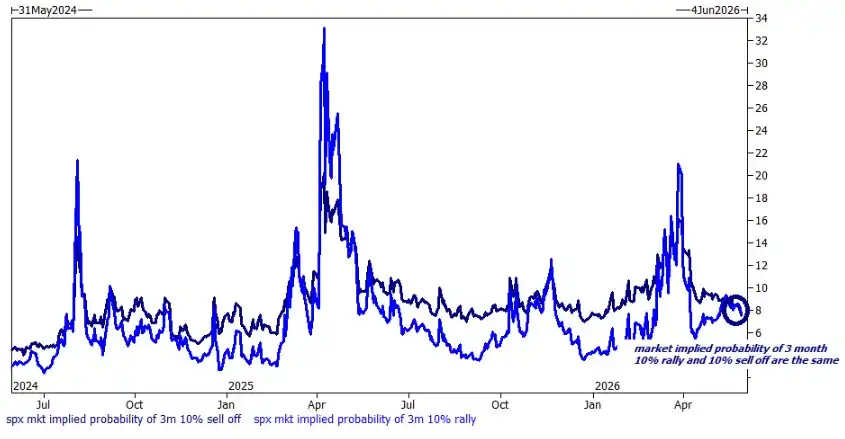
In a latest weekend report, Goldman Sachs derivatives strategist Brian Garrett pointed out that the volatility skew of S&P 500 options has fallen to an 18-month low. The market is pricing a roughly 8% probability for both a 10% decline and a 10% rise—a phenomenon directly characterized by Goldman's volatility team as 'Skew Failure.'

At the same time, the Goldman Sachs Panic Index closed in single digits, hitting a two-year low, indicating that market demand for hedging against tail risks has fallen to extremely low levels.
This signal appears against the backdrop of the U.S. stock market's continued surge. The S&P 500 has been hitting record highs on average every five trading days this year, and Micron's stock price surpassed $1,000 for the first time after hours on Sunday.

Garrett admitted that internal team discussions have evolved from 'Make it stop' in March to 'This is still going up?' in May. However, his own stance is shifting from cautious optimism to increasing pessimism, and he clearly listed several bearish reasons.

Three Bearish Signals Emerge, Cracks Appear Between Market Sentiment and Fundamentals

Garrett listed three major concerns in the current market.

First, market leadership is extremely narrow. The top ten weighted stocks in the S&P 500 now account for 40% of the index's weight, and the last four record highs occurred when overall market breadth was negative—a phenomenon that has never occurred before.

Second, thematic concentration is extremely high. Year-to-date, the S&P 500 excluding AI-related stocks has lagged the overall index by 700 basis points.

Third, price action is highly similar to history. Garrett noted that the 2026 price pattern closely resembles that of late 1998 to 1999.

Although bearish voices are flooding media headlines and social media, Garrett emphasized that this concern is not reflected in the pricing of the options market—at least, the fear of downside risk is almost nowhere to be seen.

Skew Failure: Downside Hedging Costs Fall to Historic Lows

Goldman's volatility team provided three key observations from the options market.

First, the S&P 500 volatility skew has fallen to an 18-month low. This move is driven by two forces: the put wing is unusually cheap, while the call wing is relatively expensive.

Second, the Goldman Sachs Panic Index closed in single digits last Friday, hitting a two-year low. This index synthesizes the two-year percentile rankings of VVIX, VIX, Skew, and at-the-money volatility.

Third, and most crucially: the market prices the probability of a 10% decline and a 10% rise as exactly the same, both around 8%. This means the options market no longer assigns extra premium to downside risk; the protective function of Skew has effectively failed.

Garrett pointed out that the direct implication of the above phenomena is: for investors looking to hedge correlation risk, the current hedging cost is extremely low.

Low-Cost Hedging Paired with Right-Tail Positioning

Based on the above assessment, Garrett provided several specific trade recommendations.

For investors bullish on market style rotation, expecting the rally to shift from concentration to dispersion, Goldman recommends buying RSP (Invesco S&P 500 Equal Weight ETF) outperformance options relative to SPX, with a 1-month 100% outperformance option costing about 145 basis points. It also recommends buying VIX call options as a hedging tool, noting that the term structure for August and beyond is extremely flat, with VVIX at 86.

For investors seeking simple downside protection, Garrett suggests directly buying S&P 500 put options—given the extremely low put skew, the payout structure is quite attractive.

Additionally, Goldman recommends going long Bitcoin ETF volatility with delta-neutral hedging. Garrett noted that Bitcoin has historically performed like a 'leveraged Nasdaq,' but its current pricing is at a two-year low and about 10 volatility points lower than SMH.

Fund Flows: Hedge Funds Net Buyers for Two Consecutive Weeks, Single-Stock ETF Assets Double

According to Goldman's latest Prime Brokerage data, hedge funds have been net buyers for two consecutive weeks, at the fastest pace this year, mainly reflected in long additions and macro short covering.

Significant sector rotation is evident: Financials (down 6% YTD) saw net buying, while Industrials (up 11.5% YTD) saw net selling.

On the futures side, end-user positioning has rebounded to near 2024 highs. Goldman's team specifically noted that levered ETFs are mechanically expanding their balance sheet size; CTA strategies are currently positioned near neutral, but systematic strategies show clear asymmetry towards the left tail—buying about $12 billion in a flat 1-month scenario versus selling about $100 billion in a down 1-month scenario.

Notably, global leveraged and inverse single-stock ETF assets under management have surpassed $60 billion, doubling in two months. The size of this niche market can no longer be ignored.


Preguntas relacionadas

QAccording to Goldman Sachs, what is currently malfunctioning in the equity options market and what does it indicate?

AGoldman Sachs states that the volatility skew (Skew) for S&P 500 options is malfunctioning, having dropped to an 18-month low. This indicates that the market is pricing the probability of a 10% decline and a 10% rise as virtually identical (both around 8%), meaning the protective mechanism against downside risk has nearly failed.

QWhat are the three major concerns or bearish signals listed by Goldman's Brian Garrett regarding the current market?

AThe three concerns are: 1) Extremely narrow market leadership, where the top 10 stocks account for 40% of the S&P 500 weight and recent highs occurred with negative market breadth. 2) High thematic concentration, with the S&P 500 ex-AI significantly underperforming the full index. 3) Price action that is highly similar to the 1998-1999 period.

QWhat is the Goldman Sachs Panic Index, and what level did it recently reach?

AThe Goldman Sachs Panic Index is a composite index that incorporates the 2-year percentile rankings of the VVIX, VIX, Skew, and at-the-money volatility. It recently closed in single digits, hitting a two-year low, signaling extremely low demand for hedging tail risks.

QWhat specific trading recommendations did Goldman Sachs provide based on its market analysis?

ARecommendations include: 1) Buying RSP (Invesco S&P 500 Equal Weight ETF) outperform options vs. SPX for investors betting on a market rotation. 2) Buying VIX call options for hedging. 3) Buying S&P 500 put options for direct downside protection. 4) Going long Bitcoin ETF volatility with delta-neutral hedging.

QWhat notable trend was observed in hedge fund activity and single-stock ETFs according to Goldman's prime brokerage data?

AHedge funds have been net buyers for two consecutive weeks at the fastest pace this year, driven by long additions and macro short covering. Meanwhile, the assets under management (AUM) for global leveraged and inverse single-stock ETFs surpassed $60 billion, doubling in two months.

Lecturas Relacionadas

TaiJi Completes $3.5 Million Strategic Financing with Participation from Castrum Capital, Becker Ventures, and Coinvestor Ventures

TaiJi, an AI-driven market intelligence platform for Web3, has completed a $3.5 million strategic funding round. The investment was led by Castrum Capital, Becker Ventures, and Coinvestor Ventures. The funds will be allocated to product R&D, upgrading its AI inference engine, building a multi-agent analysis system, improving market data infrastructure, expanding its global community, and advancing ecosystem partnerships, particularly within the BSC ecosystem. TaiJi aims to transform how users understand the Web3 market by moving beyond simple data display. It integrates market data, on-chain signals, liquidity changes, social sentiment, and news events into a unified AI system. This system generates structured event inferences, impact pathways, risk assessments, and follow-up indicators. The platform's core approach involves a multi-agent framework where specialized agents (Market, On-chain, Sentiment, Risk, Event) collaboratively analyze disparate signals to produce coherent market intelligence. Its initial product will feature modules including Market Intelligence, a Scenario Engine for AI-powered event analysis, an Impact Map, Risk Signals, and a personalized user dashboard called "My TaiJi." TaiJi emphasizes that it does not custody user assets, execute trades, provide investment advice, or promise returns. Following this funding round, the company plans to accelerate product development and testing, gradually rolling out its core features to the broader Web3 market.

marsbitHace 28 min(s)

TaiJi Completes $3.5 Million Strategic Financing with Participation from Castrum Capital, Becker Ventures, and Coinvestor Ventures

marsbitHace 28 min(s)

Huang Renxun and Marvell CEO Discuss on Stage: The Future of AI Competition is Not Computing Power but Connectivity, 'Use Copper Where You Can, Use Optics Only Where You Must'

Summary: At Computex 2024, NVIDIA CEO Jensen Huang joined Marvell CEO Matt Murphy on stage, highlighting the strategic partnership between their companies. The core theme was that the next decisive battleground for AI infrastructure is not compute or memory, but connectivity. As AI models evolve into vast agent-based systems, the ability to connect millions of processors efficiently is becoming the critical bottleneck. Huang announced NVIDIA's strategic $20 billion investment in Marvell, reflecting the deep integration between their technologies for AI data centers. A key discussion point was the transition from copper to optical interconnects within racks. The guiding principle, articulated by Huang, is: "You use optics wherever you must, you use copper wherever you can." While copper remains cost-effective for short distances, its physical limits are being reached as bandwidth demands double. When moving to 400Gbps, copper can no longer fully connect an entire rack. This shift necessitates innovations like Co-Packaged Optics (CPO), which integrates optical engines directly into the chip package to solve density and power challenges. Marvell demonstrated its 51.2T CPO-based switch, eliminating copper traces on the PCB. The future vision is a "distance-free data center," where optical connectivity removes physical constraints. This allows for fully disaggregated, dynamic architectures where compute, memory, and storage pools can be combined on-demand based on workload requirements, rather than being limited by connection boundaries. Marvell, positioned as a neutral "Switzerland" in the ecosystem with a comprehensive portfolio across all connectivity distances, is central to enabling this next era of AI infrastructure.

marsbitHace 34 min(s)

Huang Renxun and Marvell CEO Discuss on Stage: The Future of AI Competition is Not Computing Power but Connectivity, 'Use Copper Where You Can, Use Optics Only Where You Must'

marsbitHace 34 min(s)

Trading

Spot
Futuros

Artículos destacados

Cómo comprar CORE

¡Bienvenido a HTX.com! Hemos hecho que comprar CORE (CORE) sea simple y conveniente. Sigue nuestra guía paso a paso para iniciar tu viaje de criptos.Paso 1: crea tu cuenta HTXUtiliza tu correo electrónico o número de teléfono para registrarte y obtener una cuenta gratuita en HTX. Experimenta un proceso de registro sin complicaciones y desbloquea todas las funciones.Obtener mi cuentaPaso 2: ve a Comprar cripto y elige tu método de pagoTarjeta de crédito/débito: usa tu Visa o Mastercard para comprar CORE (CORE) al instante.Saldo: utiliza fondos del saldo de tu cuenta HTX para tradear sin problemas.Terceros: hemos agregado métodos de pago populares como Google Pay y Apple Pay para mejorar la comodidad.P2P: tradear directamente con otros usuarios en HTX.Over-the-Counter (OTC): ofrecemos servicios personalizados y tipos de cambio competitivos para los traders.Paso 3: guarda tu CORE (CORE)Después de comprar tu CORE (CORE), guárdalo en tu cuenta HTX. Alternativamente, puedes enviarlo a otro lugar mediante transferencia blockchain o utilizarlo para tradear otras criptomonedas.Paso 4: tradear CORE (CORE)Tradear fácilmente con CORE (CORE) en HTX's mercado spot. Simplemente accede a tu cuenta, selecciona tu par de trading, ejecuta tus trades y monitorea en tiempo real. Ofrecemos una experiencia fácil de usar tanto para principiantes como para traders experimentados.

207 Vistas totalesPublicado en 2024.12.13Actualizado en 2026.06.02

Cómo comprar CORE

Discusiones

Bienvenido a la comunidad de HTX. Aquí puedes mantenerte informado sobre los últimos desarrollos de la plataforma y acceder a análisis profesionales del mercado. A continuación se presentan las opiniones de los usuarios sobre el precio de CORE (CORE).

活动图片