Are Dogecoin ETFs Dead On Arrival? Dwindling Volume Suggests Investors Are Not Interest – Details

bitcoinistPublicado a 2025-12-11Actualizado a 2025-12-11

Resumen

Dogecoin ETFs have experienced consistently low demand and dwindling trading volumes since their launch in late November, indicating a lack of institutional interest. Data from SoSoValue shows daily volumes have declined significantly, with only three days reaching seven-figure trades out of twelve. Total net assets for these funds stand at just $6.01 million, far below Grayscale’s Chainlink ETF, which has $77.71 million in assets. Analysts had predicted lower interest for meme coins like DOGE compared to major cryptos, and this is reflected as even newer Solana and XRP ETFs are performing better. DOGE’s status as a meme coin with limited utility is seen as a key reason for its poor ETF uptake. The token’s price also fell over 6% to $0.138 at the time of writing.

The Dogecoin ETFs have continued to record low demand since they launched last month, indicating the lack of interest from institutional investors in the meme coin. Notably, DOGE has also seen the lowest demand through these ETFs among the top coins by market cap.

Dogecoin ETFs Record Dwindling Volume And Inflows

SoSoValue data shows that the Dogecoin ETFs have continued to see their daily volume and inflows decline since they launched last month. On December 10, the Grayscale and Bitwise DOGE ETFs recorded a trading volume of $125,100. Meanwhile, these funds as a group saw a total net inflow of $171,920 on the day.

Further data from SoSo Value shows that the Dogecoin ETFs trading volume has been on a decline since December 2, when they recorded a daily trading volume of $1.09 million. These funds have recorded only three 7-figure trading volume days out of 12 trading days since November 24, when Grayscale’s Dogecoin fund launched.
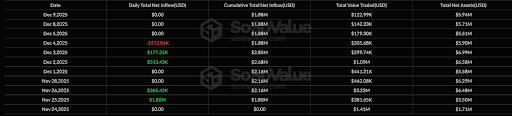
Source: Chart from SoSoValue on X

This is relatively low and signifies little demand for the DOGE ETFs among institutional investors. For context, Grayscale’s Chainlink ETF, the only LINK fund at the moment, has outperformed the Dogecoin ETFs despite launching at the start of this month. Grayscale’s LINK ETF has a total net asset of $77.71 million, while the DOGE ETFs have total net assets of $6.01 million.

The net flows also highlight the underperformance of these Dogecoin ETFs. Since launching, Bitwise’s DOGE fund has recorded a net outflow of $972,840. Meanwhile, Grayscale’s fund has taken in just over $3 million. The funds, as a group, have recorded net inflows on five of 12 trading days.

Possible Reason For The Underperformance

Bloomberg analyst Eric Balchunas had warned before now that crypto ETFs like the Dogecoin ETFs would record fewer assets given their distance from Bitcoin in terms of market cap. “’The further away you get from BTC, the less asset there will be,’ he said. Notably, DOGE funds have the lowest net assets among the top 10 cryptos by market cap with ETF wrappers.

The Solana and XRP ETFs, which also just launched last month, have outperformed the Dogecoin ETFs, although there are more funds offering SOL and XRP. Meanwhile, Balachunas’ theory hasn’t applied to the LINK ETF, as it has outperformed DOGE funds despite Chainlink having a lower market cap than Dogecoin.

Furthermore, the Hedera and Litecoin ETFs also boast larger net assets than the Dogecoin ETFs, indicating that institutional investors are simply not bullish on DOGE, possibly due to its meme coin status and lack of utility. DOGE is, so far, the only meme coin with an ETF wrapper.

At the time of writing, the DOGE price is trading at around $0.138, down over 6% in the last 24 hours, according to data from CoinMarketCap.


DOGE trading at $0.13 on the 1D chart | Source: DOGEUSDT on Tradingview.com

Lecturas Relacionadas

Why is HYPE Still Surging? Has it Peaked?

The article analyzes the reasons behind the recent sharp rise of the HYPE token. It attributes the price surge to several key developments that are causing the market to re-evaluate Hyperliquid, transitioning its perception from just a high-performance perpetual DEX to a broader on-chain trading system. Major catalysts include the launch of HYPE ETFs by 21Shares (THYP) and Bitwise (BHYP), which are opening new compliant capital channels. Bitwise's plan to allocate 10% of BHYP's management fee revenue to buy and stake HYPE is seen as a potential source of sustained buying pressure. The return of USDC to the platform, facilitated by Coinbase and Circle, is projected to generate a new, stable revenue stream for Hyperliquid from reserve yields, estimated to potentially fund daily HYPE buybacks worth over $400,000. Furthermore, Hyperliquid is expanding into new areas like prediction markets with HIP-4 (which requires significant HYPE staking) and Real-World Assets (RWA), where its Open Interest has hit a record $2.6 billion. A potential U.S. SEC exemption for tokenized stock trading could further boost its RWA business. While these fundamentals strengthen HYPE's long-term value proposition, the article notes that short-term price action is currently influenced by a large-scale showdown between whale long and short positions exceeding $60 million, making near-term direction uncertain.

Odaily星球日报Hace 11 min(s)

Why is HYPE Still Surging? Has it Peaked?

Odaily星球日报Hace 11 min(s)

Review of Over 30 Humanoid Robot Companies: Who Will Prevail in 2026?

This article provides an overview of the rapidly expanding humanoid robot industry, highlighting over 30 key companies and predicting which might succeed by 2026. Key companies discussed include Tesla (Optimus), which leverages its AI and manufacturing scale; Figure AI, the fastest-growing and highest-valued startup at $39B; Boston Dynamics, with 30+ years of expertise; Agility Robotics, the first to achieve commercial deployment (Digit in logistics); and Unitree Robotics, offering the most affordable humanoid (G1 at $16,000). Other notable firms mentioned are Apptronik (Apollo, focused on ROI), 1X Technologies (home-use NEO), Sanctuary AI (Phoenix with advanced hydraulic hands), and UBTech Robotics (a major commercial player). Companies from China, like Xiaomi, AgiBot, and Fourier Intelligence, are also prominent. The industry is driven by trends including price disruption (robots under $20K), AI breakthroughs in vision-language-action models, massive production scaling (Tesla targeting 1M units/year), and Robot-as-a-Service (RaaS) models. Investment is substantial, with billions from backers like NVIDIA, Jeff Bezos, Microsoft, and Amazon. The market, valued at $2.9B in 2025, is projected to reach $4-18B by 2030. The conclusion states that no single company yet dominates, with the next 2-3 years being critical for transitioning from prototypes to viable commercial products.

marsbitHace 12 min(s)

Review of Over 30 Humanoid Robot Companies: Who Will Prevail in 2026?

marsbitHace 12 min(s)

Trading

Spot
Futuros
活动图片




