Are Dogecoin ETFs Dead On Arrival? Dwindling Volume Suggests Investors Are Not Interest – Details

bitcoinistPublicado a 2025-12-11Actualizado a 2025-12-11

Resumen

Dogecoin ETFs have experienced consistently low demand and dwindling trading volumes since their launch in late November, indicating a lack of institutional interest. Data from SoSoValue shows daily volumes have declined significantly, with only three days reaching seven-figure trades out of twelve. Total net assets for these funds stand at just $6.01 million, far below Grayscale’s Chainlink ETF, which has $77.71 million in assets. Analysts had predicted lower interest for meme coins like DOGE compared to major cryptos, and this is reflected as even newer Solana and XRP ETFs are performing better. DOGE’s status as a meme coin with limited utility is seen as a key reason for its poor ETF uptake. The token’s price also fell over 6% to $0.138 at the time of writing.

The Dogecoin ETFs have continued to record low demand since they launched last month, indicating the lack of interest from institutional investors in the meme coin. Notably, DOGE has also seen the lowest demand through these ETFs among the top coins by market cap.

Dogecoin ETFs Record Dwindling Volume And Inflows

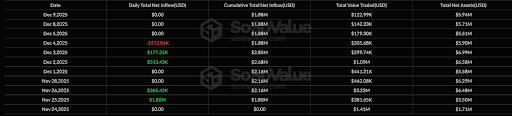
SoSoValue data shows that the Dogecoin ETFs have continued to see their daily volume and inflows decline since they launched last month. On December 10, the Grayscale and Bitwise DOGE ETFs recorded a trading volume of $125,100. Meanwhile, these funds as a group saw a total net inflow of $171,920 on the day.

Further data from SoSo Value shows that the Dogecoin ETFs trading volume has been on a decline since December 2, when they recorded a daily trading volume of $1.09 million. These funds have recorded only three 7-figure trading volume days out of 12 trading days since November 24, when Grayscale’s Dogecoin fund launched.
Source: Chart from SoSoValue on X

This is relatively low and signifies little demand for the DOGE ETFs among institutional investors. For context, Grayscale’s Chainlink ETF, the only LINK fund at the moment, has outperformed the Dogecoin ETFs despite launching at the start of this month. Grayscale’s LINK ETF has a total net asset of $77.71 million, while the DOGE ETFs have total net assets of $6.01 million.

The net flows also highlight the underperformance of these Dogecoin ETFs. Since launching, Bitwise’s DOGE fund has recorded a net outflow of $972,840. Meanwhile, Grayscale’s fund has taken in just over $3 million. The funds, as a group, have recorded net inflows on five of 12 trading days.

Possible Reason For The Underperformance

Bloomberg analyst Eric Balchunas had warned before now that crypto ETFs like the Dogecoin ETFs would record fewer assets given their distance from Bitcoin in terms of market cap. “’The further away you get from BTC, the less asset there will be,’ he said. Notably, DOGE funds have the lowest net assets among the top 10 cryptos by market cap with ETF wrappers.

The Solana and XRP ETFs, which also just launched last month, have outperformed the Dogecoin ETFs, although there are more funds offering SOL and XRP. Meanwhile, Balachunas’ theory hasn’t applied to the LINK ETF, as it has outperformed DOGE funds despite Chainlink having a lower market cap than Dogecoin.

Furthermore, the Hedera and Litecoin ETFs also boast larger net assets than the Dogecoin ETFs, indicating that institutional investors are simply not bullish on DOGE, possibly due to its meme coin status and lack of utility. DOGE is, so far, the only meme coin with an ETF wrapper.

At the time of writing, the DOGE price is trading at around $0.138, down over 6% in the last 24 hours, according to data from CoinMarketCap.


DOGE trading at $0.13 on the 1D chart | Source: DOGEUSDT on Tradingview.com

Lecturas Relacionadas

Moutai Moment: When Liquidity Dries Up, Everyone Huddles Around HYPE and ZEC

In May 2026, a notable sentiment shift is occurring in the crypto market, symbolized by prominent Ethereum advocate David Hoffman selling his remaining ETH. While major assets like ETH and SOL struggle—ETH is down over 50% from its 2025 high—two assets, HYPE and ZEC, are rallying strongly. This divergence mirrors the "core asset crowding" phenomenon seen in traditional markets during liquidity crunches, where capital concentrates in few perceived safe havens. The market faces liquidity pressure, partly due to Bitcoin ETF outflows and stalled narratives for major Layer 1s. In contrast, Hyperliquid (HYPE) attracts capital due to its strong fundamentals as a leading decentralized perp exchange with substantial protocol revenue and a share of USDC reserve yields. Its tokenomics, heavily favoring users, add to its appeal. Meanwhile, Zcash (ZEC) surges as a "privacy beta" play, driven by growing fears over AI-driven deanonymization and quantum computing threats. Endorsements from figures like Arthur Hayes and Multicoin Capital's Tushar Jain, alongside regulatory clarity and ETF expectations, fuel its rise. This crowding poses risks. Similar to the A股白酒 rally that ended when liquidity returned, the current crypto crowding could unravel if macro conditions improve or if positions become too concentrated, leading to a sharp correction. The article concludes by questioning whether investors hold assets out of conviction or inertia and prompts consideration of what the next crowded trade might be.

marsbitHace 10 min(s)

Moutai Moment: When Liquidity Dries Up, Everyone Huddles Around HYPE and ZEC

marsbitHace 10 min(s)

Trading

Spot
Futuros
活动图片