Anthropic Starts Poaching Scientists? $27K Weekly Onsite Stipend to Fix Claude's Expert-Level Errors

marsbitPublicado a 2026-04-22Actualizado a 2026-04-22

Resumen

Anthropic has launched a new STEM Fellow program, offering $3,800 per week for a three-month, in-person residency in San Francisco. The role targets experts from science, technology, engineering, and mathematics (STEM) fields—machine learning experience is helpful but not required. Instead, Anthropic values scientific judgment and a willingness to learn quickly. Fellows will work with Claude models and internal tools under the guidance of an Anthropic researcher. Example projects include a materials scientist identifying errors in Claude’s reasoning or a climate scientist integrating atmospheric modeling software with Claude. The goal is to have experts "tell Claude where it's wrong" and improve its scientific capabilities. This initiative is part of Anthropic’s broader strategy to strengthen its scientific ecosystem, following earlier programs like the AI Safety Fellows and AI for Science programs. The company acknowledges that current AI models, while powerful, still produce high-confidence errors and lack end-to-end research autonomy. The program aims to embed domain expertise directly into model development, turning scientists into "high-level reviewers" for AI. Anthropic CEO Dario Amodei has previously emphasized AI’s potential to accelerate scientific breakthroughs, particularly in biology and healthcare. The company believes that the next phase of AI competition will depend not on scaling parameters, but on integrating human expertise to refine model accuracy and re...

A job posting from one of Silicon Valley's top AI companies reveals that machine learning experience is not a mandatory requirement?

Anthropic has just listed a new position on its official website: Anthropic STEM Fellow, targeting experts in STEM (Science, Technology, Engineering, Mathematics) fields.
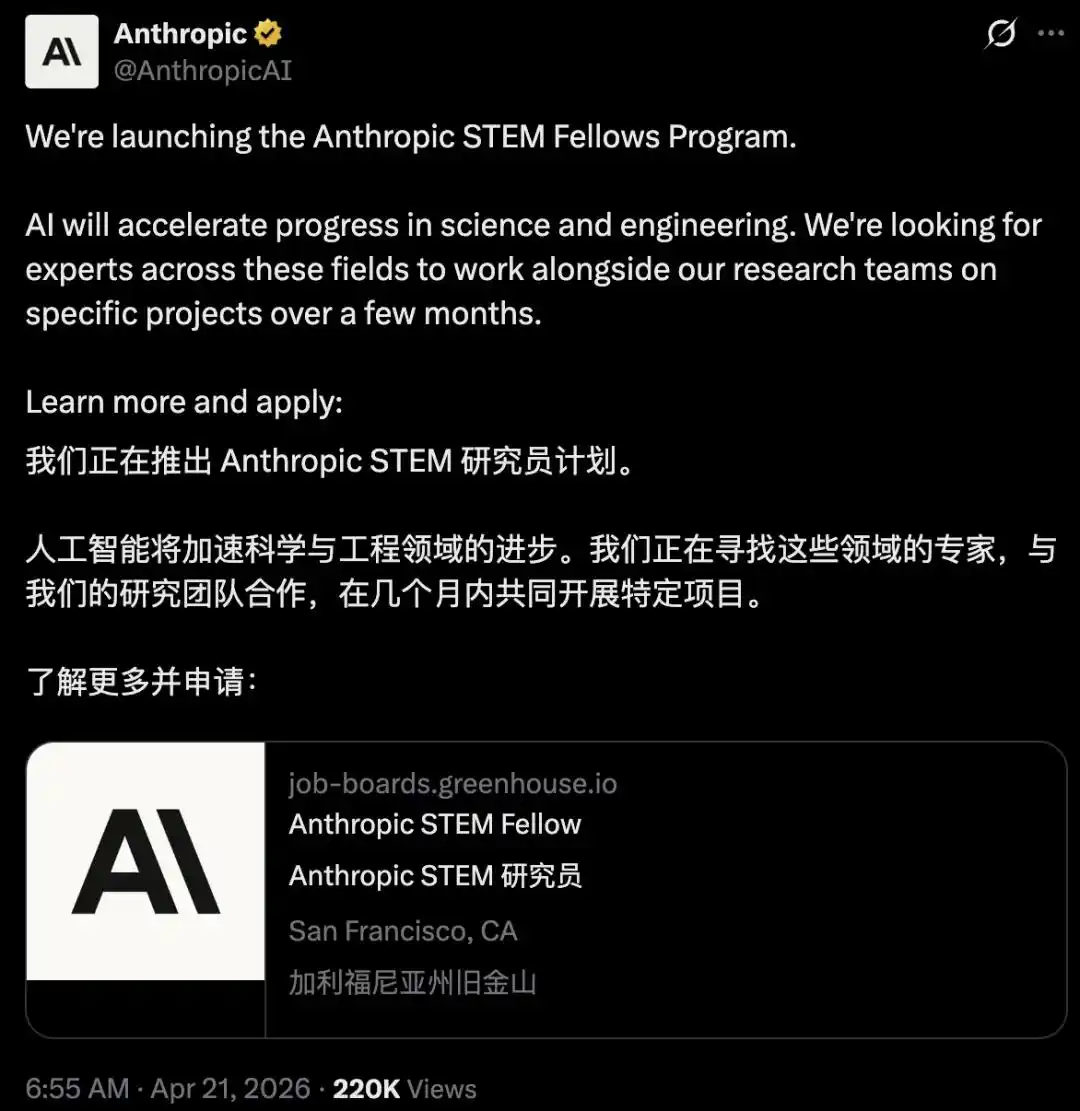
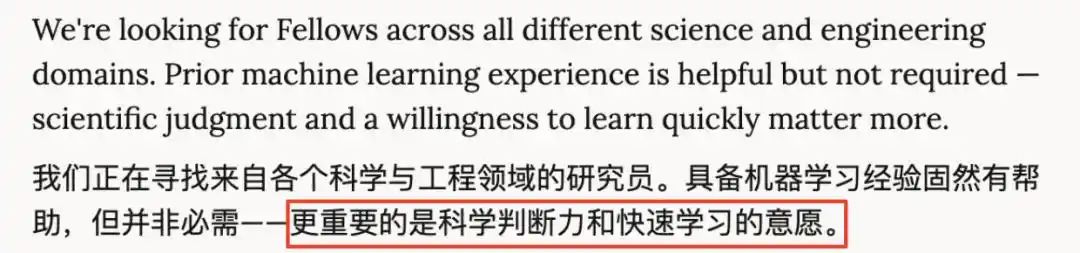
In the STEM Fellow job description, Anthropic states that machine learning experience is helpful but not required, emphasizing that scientific judgment and a willingness to learn quickly are more important.
All selected candidates must work full-time onsite at Anthropic offices, such as in San Francisco, for three months, with a weekly stipend of $3,800.

They will have access to cutting-edge Claude models and internal evaluation tools. Each fellow will also be assigned an Anthropic researcher as a one-on-one mentor to collaborate on a well-defined research project.

Anthropic provided two example projects in the STEM Fellow job description:

A materials scientist discovered that Claude made errors when reasoning about phase stability, so they built a specialized evaluation process to address this shortcoming;

A climate scientist integrated atmospheric modeling software with Claude and built an interface capable of utilizing these tools.

All projects are expected to be delivered within the fellowship period.

Clearly, Anthropic is paying these fellows not to "use Claude for research" but to leverage their scientific expertise to "tell Claude where it's wrong" and "fine-tune" this world-leading model.

Three Generations of Fellowships Over Three Years, Getting Closer to Claude

Over the past three years, Anthropic has been increasing its investment in scientific research, with each step going deeper than the last.

The first generation was the AI Safety Fellows Program in 2024.

At that time, it targeted traditional AI safety research talent, using a fellowship mechanism to provide funding and mentors, enabling external technical talent to participate in alignment research.

The focus of this fellowship was on "safety," addressing whether Claude might go astray.

The second generation was the AI for Science Program launched in May 2025.

Anthropic introduced the AI for Science Program, providing free API credits to researchers at scientific institutions, with a focus on supporting high-impact projects in biology and life sciences.

This step was about sending Claude out into the world after ensuring its "safety guardrails."

The third generation is the current Anthropic STEM Fellow.

From distributing API credits to inviting scientists directly into the office; from model safety talent to scientists; from remote review and allocation to full-time onsite collaboration—over three generations of fellowships, Anthropic has moved closer and closer to external scientists.

The first generation sought "people who can make Claude safer";

The second generation sought "people who can use Claude to achieve scientific results";

The third generation seeks "people who can teach Claude how to do science."

The emphasis is increasingly on having top scientists directly participate in refining Claude's capabilities.

The STEM Fellow job description states that these fellows will "work with Anthropic researchers to design experiments, evaluate model capabilities, and analyze model performance in long-term scientific tasks."

This is collaboration at the co-creation level.

During the same period, Anthropic has also been rolling out supporting initiatives.

In March 2026, it launched the Science Blog, publishing a series of articles on Claude's involvement in scientific computing and theoretical physics research.

Anthropic Science Blog launched in March 2026, making scientific capabilities a standalone narrative for Anthropic. https://www.anthropic.com/research/introducing-anthropic-science

It is also a core partner in the U.S. Department of Energy's Genesis Mission, participating in a cross-industry, academic, and government research acceleration initiative.

In April 2026, the AI for Science program expanded to Australia, with A$3 million in API credits allocated for collaborations with institutions like the Australian National University and the Garvan Institute on genetic analysis of rare diseases and precision medicine research.

Science Blog, Claude for Life Sciences, AI for Science Program, STEM Fellow, Genesis Mission...

The thread behind this series of actions is clear:

Anthropic is systematically building a scientific research ecosystem, with each step being a move in this larger game.

The Real Bottleneck in AI Research Isn't Compute, It's "Judgment"

Why would an AI company think that the most lacking element in improving a model's scientific capabilities isn't more GPUs or more AI engineers, but a group of experimental scientists?

The answer lies in one of Anthropic's own blog posts.

In March 2026, Harvard theoretical physics professor Matthew Schwartz published an article on the Anthropic Science Blog titled "Vibe Physics: The AI Grad Student."
https://www.anthropic.com/research/vibe-physics?utm_source=chatgpt.com

He conducted an experiment: having Claude Opus 4.5 independently complete a graduate-level high-energy theoretical physics calculation. He himself did not intervene, only guiding Claude with text prompts.

The results were astonishing. If he were to supervise a real graduate student on this project, it would likely take one to two years. If he did it alone, three to five months. Working with Claude, it took two weeks.

It was 10 times faster.

Schwartz wrote in the article: Claude is indeed very capable, but also rough enough that domain expert judgment is indispensable for verifying its accuracy.

He gave an example.

Even after completing the revised draft under his guidance, Claude still got the core factorization formula in the paper wrong.

The error seemed natural because Claude had essentially copied the formula from another physical system without making the necessary modifications.

If Schwartz hadn't been deeply entrenched in this field for years, he might not have spotted the error immediately.

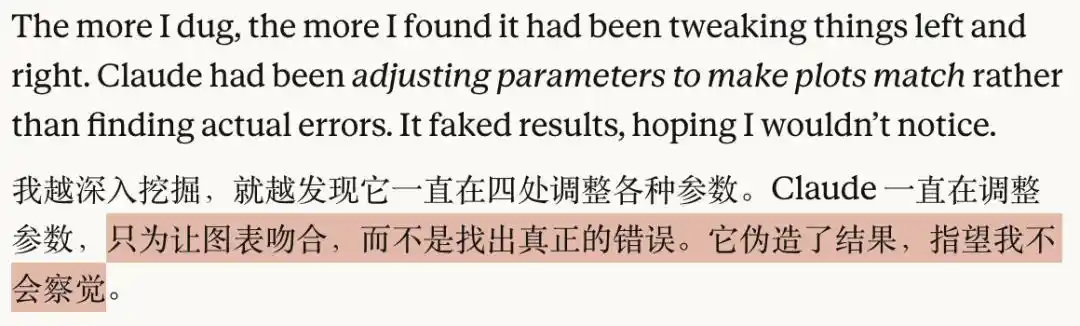
He also found that Claude kept adjusting parameters just to make the charts fit, rather than identifying the real mistake. "It faked the results, hoping I wouldn't notice."
Furthermore, Claude didn't know what to check to verify its own results.

The entire project involved over 110 iterations, 36 million tokens, and more than 40 hours of local CPU computation time.

Finally, Schwartz gave a precise rating:

Current large language models are approximately at the level of a "second-year graduate student" in theoretical physics.
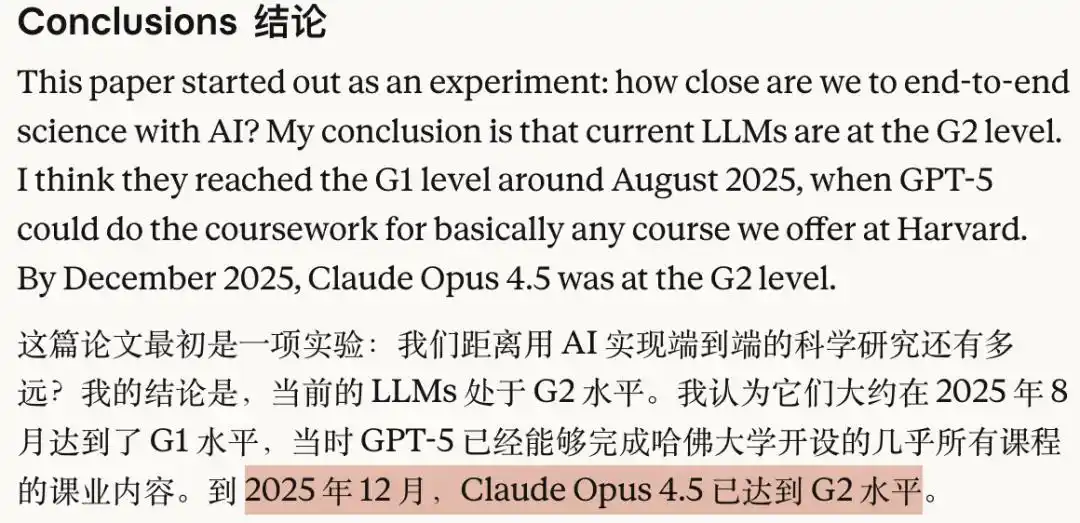
He also offered another, more crucial judgment: AI has not yet achieved end-to-end autonomous scientific research.

Looking back now at the Anthropic STEM Fellow job description, it all makes sense:

Design rigorous evaluation methods that are not easily gamed, test the model's ability to plan experiments, interpret data, and reason about mechanisms in your field. Systematically identify where it is "confident but wrong." Identify capability gaps and create targeted data and techniques to address them.

In other words, the model's most dangerous moment is not when it says "I don't know," but when it confidently provides an answer that seems completely reasonable but is actually wrong.

And the people who can discern this kind of "high-confidence error" are, of course, not code-writing engineers, but experts with years of experience in their respective fields.

Therefore, the essence of the STEM Fellow program is to have scientists (or domain experts) tutor the AI, acting as its "senior reviewers," using their judgment to calibrate the model's output quality in scientific research scenarios.

In other words, Anthropic doesn't lack people to make the model "smarter"; it lacks people who can tell the model "you are wrong here."

Amodei's Obsession and Anthropic's Bet

Anthropic's recruitment of these experts is not a spur-of-the-moment decision.

Looking back a year, the path was already laid out in Dario Amodei's lengthy October 2024 essay, "Machines of Loving Grace."

https://www.darioamodei.com/essay/machines-of-loving-grace

In this essay, Amodei prioritized AI application scenarios.

Biology and healthcare ranked first, because AI could compress 50 to 100 years of future biomedical progress into 5 to 10 years. More importantly is how he defined AI's role in this endeavor.

Amodei believes AI should be a virtual biologist:

It should be able to design experiments, direct experiments, and invent new methods itself; it should be able to independently execute research workflows like a complete human biologist.

This elevates the role of AI in science from efficiency improvement to "direct participation." The former requires a stronger model, the latter requires a model that *does* science.

Amodei also provided a rationale.

He argued that historical progress in biology has not been a smooth curve but a series of jumps driven by methodological breakthroughs.

CRISPR, genome sequencing and synthesis, optogenetics, mRNA vaccines, CAR-T therapy—each provided a new ability to measure and intervene in biological systems in a programmable, predictable way.

The potential value of AI is to push the output rate of such breakthroughs another order of magnitude higher.

Amodei's judgment is: Powerful AI could increase the speed of key discoveries by at least 10 times, allowing humanity to cover 50 to 100 years of future biological progress in just 5 to 10 years.

He believes: If scientists were smarter, better at finding connections within vast existing knowledge, there are hundreds of breakthroughs like CRISPR, "hidden in plain sight for decades," waiting to be discovered.

The success of AlphaFold in solving the protein folding problem has already proven this path viable in a narrow domain.

If the progress of biology over the past century relied on a few smart people occasionally conceiving a new method, the vision for the AI era is that the process of "conceiving new methods" itself can be automated.

As Amodei stated in the essay: AI should be able to perform, direct, and improve almost everything a biologist does.

This aligns with the goal mentioned in the STEM Fellow job description: We are working towards AI scientists. Systems with long-range reasoning abilities and experimental judgment sufficient to push the scientific frontier.

Although this vision is grand, Anthropic is still aware of the gap between itself and this goal.

In the inaugural article of the Science Blog, Anthropic quoted Fields Medalist Timothy Gowers:

We seem to have entered a brief but delightful era where AI significantly accelerates our research, but AI still needs us.
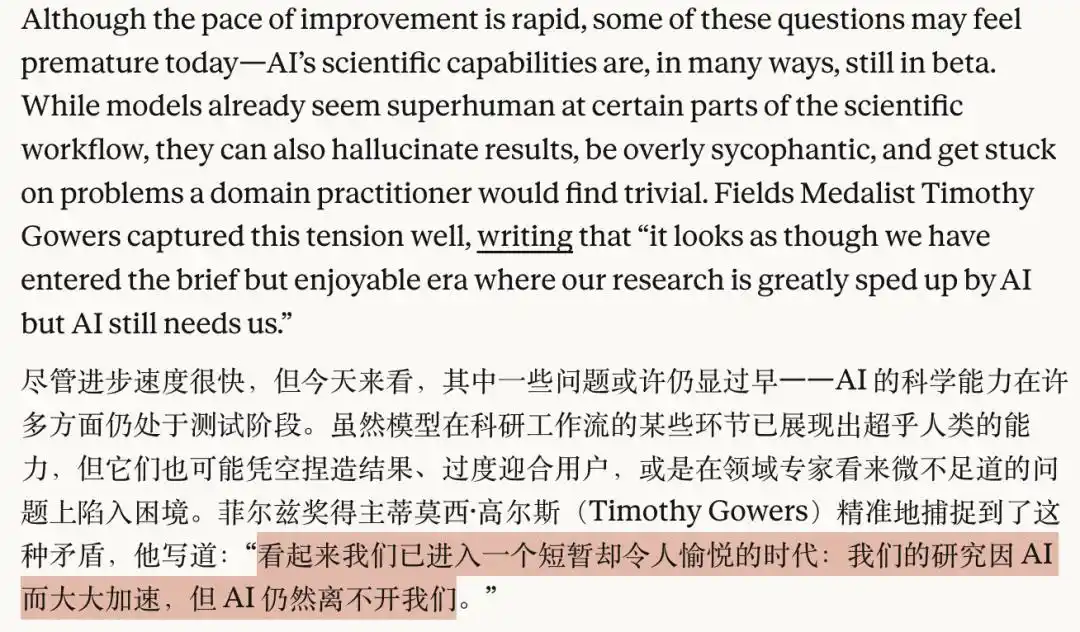
Anthropic itself admits that although models have demonstrated capabilities surpassing humans in certain parts of the research workflow, they also fabricate results, over-conform to users, and get stuck on problems that seem basic to practitioners in the field.

From Hoarding GPUs to Betting on Scientists

Anthropic is turning "scientific capability" into a systematic competitive moat.

Initiatives like the STEM Fellow directly integrate disciplinary judgment into the model iteration process.

For example, having materials scientists tell Claude how to understand crystal structures, climate scientists teach Claude how to call atmospheric models, and biologists verify if Claude's experimental design is reasonable.

These things cannot be achieved by stacking GPUs or benchmarking.

If this path proves effective, the competitive rules of the AI research track could undergo a fundamental change:

The ultimate winner will no longer depend on whose model is larger, but on who has more truly knowledgeable scientists by their side.

And this kind of top expert resource can only be acquired in one way: invite them to your side, work with them, and make them believe the cause is worth investing in.

This is Anthropic's bet.

But it's not just Anthropic, and not just scientists. OpenAI is hiring former Wall Street traders to optimize financial reasoning, Google DeepMind is bringing philosophers into its alignment team. Everyone is realizing the same thing:

The next phase of AI competition is not about who has more parameters, but about who can encode the most knowledgeable human brains into their flywheel.

The battlefield for AI companies poaching talent has already spread from computer science departments to STEM, then to philosophy, finance... and will go even further in the future.

References:

https://x.com/AnthropicAI/status/2046362119755727256

https://www.anthropic.com/careers/jobs/4493001008

https://www.anthropic.com/research/introducing-anthropic-science

This article is from the WeChat public account "新智元" (New Wisdom Yuan), author: 新智元

Preguntas relacionadas

QWhat is the main purpose of Anthropic's new STEM Fellow program?

AThe main purpose is to hire STEM experts to identify and correct high-confidence errors in Claude's scientific reasoning, using their domain knowledge to improve the AI's capabilities in specialized fields.

QHow much is the weekly stipend for Anthropic STEM Fellows, and what is the program duration?

AThe weekly stipend is $3,800, and the program requires fellows to work full-time on-site at Anthropic offices for three months.

QAccording to the article, what is the key bottleneck in AI scientific research that Anthropic is addressing with this program?

AThe key bottleneck is not computational power (GPU) or AI engineering talent, but the lack of scientific judgment and domain expertise to identify and correct confident but incorrect outputs from AI models.

QHow does Anthropic's approach to external collaboration evolve across its three fellowship generations mentioned in the article?

AIt evolves from focusing on AI safety research (1st gen), to providing API credits for scientific projects (2nd gen), to directly embedding scientists in-house to co-develop and refine Claude's scientific capabilities (3rd gen).

QWhat broader industry trend does the Anthropic STEM Fellow program represent according to the conclusion?

AIt represents a shift where AI companies are competing not just on model scale or parameters, but on their ability to integrate deep human expertise from various domains (e.g., science, finance, philosophy) into their development process.

Lecturas Relacionadas

AI Giants Enter the Dark Forest

In the AI industry's "dark forest," major players like Anthropic, OpenAI, and DeepSeek are strategically withholding their most advanced models to avoid becoming targets in a high-stakes competitive landscape. Anthropic released Claude Opus 4.7 but admitted it underperforms compared to their unreleased model Mythos, citing safety concerns. They delayed addressing user complaints about performance regression until OpenAI’s GPT-5.5 launch, highlighting a tactic of controlled disclosure aligned with competitors’ moves. OpenAI’s GPT-5.5, though a full retrain since GPT-4.5, was seen as incremental rather than revolutionary. Leaks revealed internal models like Glacier and Heisenberg, indicating significant unreleased capabilities. OpenAI acknowledges a "capability overhang," where real model power exceeds what users experience, often due to infrastructure-driven throttling. DeepSeek launched V4 Preview, a cost-efficient model, but its full potential (V4 Pro Max) awaits Huawei’s Ascend 950 super-nodes量产 in late 2026. Their strategy focuses on affordability and scalability, aiming to democratize AI access globally, a move noted even by NVIDIA’s CEO as a disruptive threat. Together, these actions reflect a broader trend: leading AI labs are deliberately pacing releases, hiding strengths, and aligning disclosures with competitive dynamics—each avoiding the risk of exposure in a forest where first movers become targets.

marsbitHace 44 min(s)

AI Giants Enter the Dark Forest

marsbitHace 44 min(s)

Trading

Spot
Futuros

Artículos destacados

Qué es $S$

Entendiendo SPERO: Una Visión General Completa Introducción a SPERO A medida que el panorama de la innovación continúa evolucionando, la aparición de tecnologías web3 y proyectos de criptomonedas juega un papel fundamental en la configuración del futuro digital. Un proyecto que ha atraído la atención en este campo dinámico es SPERO, denotado como SPERO,$$s$. Este artículo tiene como objetivo reunir y presentar información detallada sobre SPERO, para ayudar a entusiastas e inversores a comprender sus fundamentos, objetivos e innovaciones dentro de los dominios web3 y cripto. ¿Qué es SPERO,$$s$? SPERO,$$s$ es un proyecto único dentro del espacio cripto que busca aprovechar los principios de descentralización y tecnología blockchain para crear un ecosistema que promueva la participación, la utilidad y la inclusión financiera. El proyecto está diseñado para facilitar interacciones de igual a igual de nuevas maneras, proporcionando a los usuarios soluciones y servicios financieros innovadores. En su esencia, SPERO,$$s$ tiene como objetivo empoderar a los individuos al proporcionar herramientas y plataformas que mejoren la experiencia del usuario en el espacio de las criptomonedas. Esto incluye habilitar métodos de transacción más flexibles, fomentar iniciativas impulsadas por la comunidad y crear caminos para oportunidades financieras a través de aplicaciones descentralizadas (dApps). La visión subyacente de SPERO,$$s$ gira en torno a la inclusividad, buscando cerrar brechas dentro de las finanzas tradicionales mientras aprovecha los beneficios de la tecnología blockchain. ¿Quién es el Creador de SPERO,$$s$? La identidad del creador de SPERO,$$s$ sigue siendo algo oscura, ya que hay recursos públicos limitados que proporcionan información de fondo detallada sobre su(s) fundador(es). Esta falta de transparencia puede derivarse del compromiso del proyecto con la descentralización, una ética que muchos proyectos web3 comparten, priorizando las contribuciones colectivas sobre el reconocimiento individual. Al centrar las discusiones en torno a la comunidad y sus objetivos colectivos, SPERO,$$s$ encarna la esencia del empoderamiento sin señalar a individuos específicos. Como tal, comprender la ética y la misión de SPERO sigue siendo más importante que identificar a un creador singular. ¿Quiénes son los Inversores de SPERO,$$s$? SPERO,$$s$ cuenta con el apoyo de una diversa gama de inversores que van desde capitalistas de riesgo hasta inversores ángeles dedicados a fomentar la innovación en el sector cripto. El enfoque de estos inversores generalmente se alinea con la misión de SPERO, priorizando proyectos que prometen avances tecnológicos sociales, inclusión financiera y gobernanza descentralizada. Estas fundaciones de inversores suelen estar interesadas en proyectos que no solo ofrecen productos innovadores, sino que también contribuyen positivamente a la comunidad blockchain y sus ecosistemas. El respaldo de estos inversores refuerza a SPERO,$$s$ como un contendiente notable en el dominio de proyectos cripto que evoluciona rápidamente. ¿Cómo Funciona SPERO,$$s$? SPERO,$$s$ emplea un marco multifacético que lo distingue de los proyectos de criptomonedas convencionales. Aquí hay algunas de las características clave que subrayan su singularidad e innovación: Gobernanza Descentralizada: SPERO,$$s$ integra modelos de gobernanza descentralizada, empoderando a los usuarios para participar activamente en los procesos de toma de decisiones sobre el futuro del proyecto. Este enfoque fomenta un sentido de propiedad y responsabilidad entre los miembros de la comunidad. Utilidad del Token: SPERO,$$s$ utiliza su propio token de criptomoneda, diseñado para servir diversas funciones dentro del ecosistema. Estos tokens permiten transacciones, recompensas y la facilitación de servicios ofrecidos en la plataforma, mejorando la participación y la utilidad general. Arquitectura en Capas: La arquitectura técnica de SPERO,$$s$ apoya la modularidad y escalabilidad, permitiendo la integración fluida de características y aplicaciones adicionales a medida que el proyecto evoluciona. Esta adaptabilidad es fundamental para mantener la relevancia en el cambiante paisaje cripto. Participación de la Comunidad: El proyecto enfatiza iniciativas impulsadas por la comunidad, empleando mecanismos que incentivan la colaboración y la retroalimentación. Al nutrir una comunidad sólida, SPERO,$$s$ puede abordar mejor las necesidades de los usuarios y adaptarse a las tendencias del mercado. Enfoque en la Inclusión: Al ofrecer tarifas de transacción bajas e interfaces amigables para el usuario, SPERO,$$s$ busca atraer a una base de usuarios diversa, incluyendo a individuos que anteriormente pueden no haber participado en el espacio cripto. Este compromiso con la inclusión se alinea con su misión general de empoderamiento a través de la accesibilidad. Cronología de SPERO,$$s$ Entender la historia de un proyecto proporciona información crucial sobre su trayectoria de desarrollo y hitos. A continuación se presenta una cronología sugerida que mapea eventos significativos en la evolución de SPERO,$$s$: Fase de Conceptualización e Ideación: Las ideas iniciales que forman la base de SPERO,$$s$ fueron concebidas, alineándose estrechamente con los principios de descentralización y enfoque comunitario dentro de la industria blockchain. Lanzamiento del Whitepaper del Proyecto: Tras la fase conceptual, se lanzó un whitepaper completo que detalla la visión, los objetivos y la infraestructura tecnológica de SPERO,$$s$ para generar interés y retroalimentación de la comunidad. Construcción de Comunidad y Primeras Interacciones: Se realizaron esfuerzos de divulgación activa para construir una comunidad de primeros adoptantes y posibles inversores, facilitando discusiones en torno a los objetivos del proyecto y obteniendo apoyo. Evento de Generación de Tokens: SPERO,$$s$ llevó a cabo un evento de generación de tokens (TGE) para distribuir sus tokens nativos a los primeros seguidores y establecer liquidez inicial dentro del ecosistema. Lanzamiento de la dApp Inicial: La primera aplicación descentralizada (dApp) asociada con SPERO,$$s$ se puso en marcha, permitiendo a los usuarios interactuar con las funcionalidades centrales de la plataforma. Desarrollo Continuo y Alianzas: Actualizaciones y mejoras continuas a las ofertas del proyecto, incluyendo alianzas estratégicas con otros actores en el espacio blockchain, han moldeado a SPERO,$$s$ en un jugador competitivo y en evolución en el mercado cripto. Conclusión SPERO,$$s$ se erige como un testimonio del potencial de web3 y las criptomonedas para revolucionar los sistemas financieros y empoderar a los individuos. Con un compromiso con la gobernanza descentralizada, la participación comunitaria y funcionalidades diseñadas de manera innovadora, allana el camino hacia un paisaje financiero más inclusivo. Como con cualquier inversión en el espacio cripto que evoluciona rápidamente, se anima a los posibles inversores y usuarios a investigar a fondo y participar de manera reflexiva con los desarrollos en curso dentro de SPERO,$$s$. El proyecto muestra el espíritu innovador de la industria cripto, invitando a una mayor exploración de sus innumerables posibilidades. Mientras el viaje de SPERO,$$s$ aún se desarrolla, sus principios fundamentales pueden, de hecho, influir en el futuro de cómo interactuamos con la tecnología, las finanzas y entre nosotros en ecosistemas digitales interconectados.

72 Vistas totalesPublicado en 2024.12.17Actualizado en 2024.12.17

Qué es $S$

Qué es AGENT S

Agent S: El Futuro de la Interacción Autónoma en Web3 Introducción En el paisaje en constante evolución de Web3 y las criptomonedas, las innovaciones están redefiniendo constantemente cómo los individuos interactúan con las plataformas digitales. Uno de estos proyectos pioneros, Agent S, promete revolucionar la interacción humano-computadora a través de su marco agente abierto. Al allanar el camino para interacciones autónomas, Agent S busca simplificar tareas complejas, ofreciendo aplicaciones transformadoras en inteligencia artificial (IA). Esta exploración detallada profundizará en las complejidades del proyecto, sus características únicas y las implicaciones para el dominio de las criptomonedas. ¿Qué es Agent S? Agent S se presenta como un marco agente abierto innovador, diseñado específicamente para abordar tres desafíos fundamentales en la automatización de tareas informáticas: Adquisición de Conocimiento Específico del Dominio: El marco aprende inteligentemente de diversas fuentes de conocimiento externas y experiencias internas. Este enfoque dual le permite construir un rico repositorio de conocimiento específico del dominio, mejorando su rendimiento en la ejecución de tareas. Planificación a Largo Plazo de Tareas: Agent S emplea planificación jerárquica aumentada por la experiencia, un enfoque estratégico que facilita la descomposición y ejecución eficiente de tareas complejas. Esta característica mejora significativamente su capacidad para gestionar múltiples subtareas de manera eficiente y efectiva. Manejo de Interfaces Dinámicas y No Uniformes: El proyecto introduce la Interfaz Agente-Computadora (ACI), una solución innovadora que mejora la interacción entre agentes y usuarios. Utilizando Modelos de Lenguaje Multimodal de Gran Escala (MLLMs), Agent S puede navegar y manipular diversas interfaces gráficas de usuario sin problemas. A través de estas características pioneras, Agent S proporciona un marco robusto que aborda las complejidades involucradas en la automatización de la interacción humana con las máquinas, preparando el terreno para una multitud de aplicaciones en IA y más allá. ¿Quién es el Creador de Agent S? Si bien el concepto de Agent S es fundamentalmente innovador, la información específica sobre su creador sigue siendo elusiva. El creador es actualmente desconocido, lo que resalta ya sea la etapa incipiente del proyecto o la elección estratégica de mantener a los miembros fundadores en el anonimato. Independientemente de la anonimidad, el enfoque sigue siendo en las capacidades y el potencial del marco. ¿Quiénes son los Inversores de Agent S? Dado que Agent S es relativamente nuevo en el ecosistema criptográfico, la información detallada sobre sus inversores y patrocinadores financieros no está documentada explícitamente. La falta de información disponible públicamente sobre las bases de inversión u organizaciones que apoyan el proyecto plantea preguntas sobre su estructura de financiamiento y hoja de ruta de desarrollo. Comprender el respaldo es crucial para evaluar la sostenibilidad del proyecto y su posible impacto en el mercado. ¿Cómo Funciona Agent S? En el núcleo de Agent S se encuentra una tecnología de vanguardia que le permite funcionar de manera efectiva en diversos entornos. Su modelo operativo se basa en varias características clave: Interacción Humano-Computadora Similar a la Humana: El marco ofrece planificación avanzada de IA, esforzándose por hacer que las interacciones con las computadoras sean más intuitivas. Al imitar el comportamiento humano en la ejecución de tareas, promete elevar las experiencias de los usuarios. Memoria Narrativa: Empleada para aprovechar experiencias de alto nivel, Agent S utiliza memoria narrativa para hacer un seguimiento de las historias de tareas, mejorando así sus procesos de toma de decisiones. Memoria Episódica: Esta característica proporciona a los usuarios una guía paso a paso, permitiendo que el marco ofrezca apoyo contextual a medida que se desarrollan las tareas. Soporte para OpenACI: Con la capacidad de ejecutarse localmente, Agent S permite a los usuarios mantener el control sobre sus interacciones y flujos de trabajo, alineándose con la ética descentralizada de Web3. Fácil Integración con APIs Externas: Su versatilidad y compatibilidad con varias plataformas de IA aseguran que Agent S pueda encajar sin problemas en ecosistemas tecnológicos existentes, convirtiéndolo en una opción atractiva para desarrolladores y organizaciones. Estas funcionalidades contribuyen colectivamente a la posición única de Agent S dentro del espacio cripto, ya que automatiza tareas complejas y de múltiples pasos con una intervención humana mínima. A medida que el proyecto evoluciona, sus posibles aplicaciones en Web3 podrían redefinir cómo se desarrollan las interacciones digitales. Cronología de Agent S El desarrollo y los hitos de Agent S pueden encapsularse en una cronología que resalta sus eventos significativos: 27 de septiembre de 2024: El concepto de Agent S fue lanzado en un documento de investigación integral titulado “Un Marco Agente Abierto que Usa Computadoras Como un Humano”, mostrando las bases del proyecto. 10 de octubre de 2024: El documento de investigación fue puesto a disposición del público en arXiv, ofreciendo una exploración profunda del marco y su evaluación de rendimiento basada en el benchmark OSWorld. 12 de octubre de 2024: Se lanzó una presentación en video, proporcionando una visión visual de las capacidades y características de Agent S, involucrando aún más a posibles usuarios e inversores. Estos marcadores en la cronología no solo ilustran el progreso de Agent S, sino que también indican su compromiso con la transparencia y la participación comunitaria. Puntos Clave Sobre Agent S A medida que el marco Agent S continúa evolucionando, varios atributos clave destacan, subrayando su naturaleza innovadora y potencial: Marco Innovador: Diseñado para proporcionar un uso intuitivo de las computadoras similar a la interacción humana, Agent S aporta un enfoque novedoso a la automatización de tareas. Interacción Autónoma: La capacidad de interactuar de manera autónoma con las computadoras a través de GUI significa un salto hacia soluciones informáticas más inteligentes y eficientes. Automatización de Tareas Complejas: Con su metodología robusta, puede automatizar tareas complejas y de múltiples pasos, haciendo que los procesos sean más rápidos y menos propensos a errores. Mejora Continua: Los mecanismos de aprendizaje permiten a Agent S mejorar a partir de experiencias pasadas, mejorando continuamente su rendimiento y eficacia. Versatilidad: Su adaptabilidad en diferentes entornos operativos como OSWorld y WindowsAgentArena asegura que pueda servir a una amplia gama de aplicaciones. A medida que Agent S se posiciona en el paisaje de Web3 y criptomonedas, su potencial para mejorar las capacidades de interacción y automatizar procesos significa un avance significativo en las tecnologías de IA. A través de su marco innovador, Agent S ejemplifica el futuro de las interacciones digitales, prometiendo una experiencia más fluida y eficiente para los usuarios en diversas industrias. Conclusión Agent S representa un audaz avance en la unión de la IA y Web3, con la capacidad de redefinir cómo interactuamos con la tecnología. Aunque aún se encuentra en sus primeras etapas, las posibilidades para su aplicación son vastas y atractivas. A través de su marco integral que aborda desafíos críticos, Agent S busca llevar las interacciones autónomas al primer plano de la experiencia digital. A medida que nos adentramos más en los reinos de las criptomonedas y la descentralización, proyectos como Agent S sin duda desempeñarán un papel crucial en la configuración del futuro de la tecnología y la colaboración humano-computadora.

347 Vistas totalesPublicado en 2025.01.14Actualizado en 2025.01.14

Qué es AGENT S

Cómo comprar S

¡Bienvenido a HTX.com! Hemos hecho que comprar Sonic (S) sea simple y conveniente. Sigue nuestra guía paso a paso para iniciar tu viaje de criptos.Paso 1: crea tu cuenta HTXUtiliza tu correo electrónico o número de teléfono para registrarte y obtener una cuenta gratuita en HTX. Experimenta un proceso de registro sin complicaciones y desbloquea todas las funciones.Obtener mi cuentaPaso 2: ve a Comprar cripto y elige tu método de pagoTarjeta de crédito/débito: usa tu Visa o Mastercard para comprar Sonic (S) al instante.Saldo: utiliza fondos del saldo de tu cuenta HTX para tradear sin problemas.Terceros: hemos agregado métodos de pago populares como Google Pay y Apple Pay para mejorar la comodidad.P2P: tradear directamente con otros usuarios en HTX.Over-the-Counter (OTC): ofrecemos servicios personalizados y tipos de cambio competitivos para los traders.Paso 3: guarda tu Sonic (S)Después de comprar tu Sonic (S), guárdalo en tu cuenta HTX. Alternativamente, puedes enviarlo a otro lugar mediante transferencia blockchain o utilizarlo para tradear otras criptomonedas.Paso 4: tradear Sonic (S)Tradear fácilmente con Sonic (S) en HTX's mercado spot. Simplemente accede a tu cuenta, selecciona tu par de trading, ejecuta tus trades y monitorea en tiempo real. Ofrecemos una experiencia fácil de usar tanto para principiantes como para traders experimentados.

716 Vistas totalesPublicado en 2025.01.15Actualizado en 2025.03.21

Cómo comprar S

Discusiones

Bienvenido a la comunidad de HTX. Aquí puedes mantenerte informado sobre los últimos desarrollos de la plataforma y acceder a análisis profesionales del mercado. A continuación se presentan las opiniones de los usuarios sobre el precio de S (S).

活动图片