The last player at Nvidia's table has drawn a card. Within a single month, Anthropic first poached OpenAI chip veteran Clive Chan, and then held talks with Samsung about 2nm. With Trainium, TPU, and Nvidia GPU already in hand, why insist on drawing a fourth card themselves? What are they after?
The world's most skilled "chip renter" among AI giants is now reaching for the most capital-intensive path: chip-making itself.
Just now, The Information has revealed: Anthropic has initiated early-stage work on self-developing AI chips and has discussed potential foundry collaboration with Samsung Electronics.
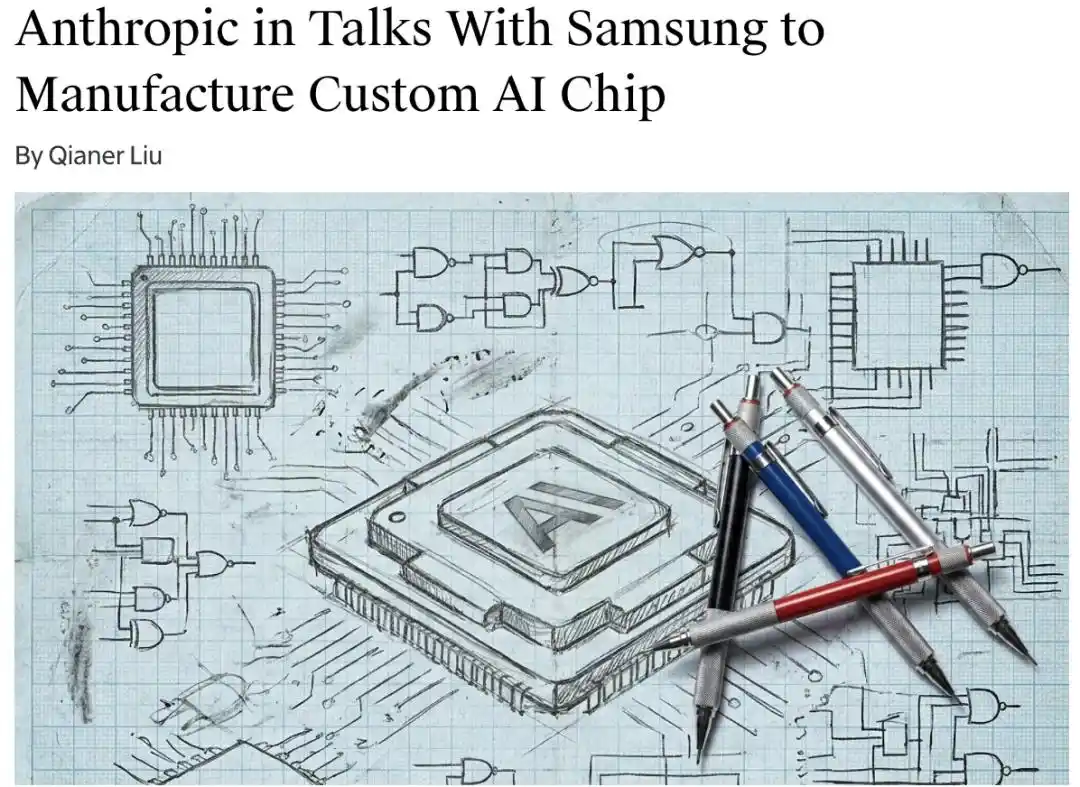
According to informed sources, options under consideration include Samsung's 2nm process and advanced packaging.
2nm is one of the most advanced process technologies currently available, allowing more transistors to be packed into the same chip area, resulting in faster and more power-efficient operation; advanced packaging is akin to "assembling" processors and high-speed memory together - the closer they are, the faster data can be transferred, reducing the time chips spend waiting for data.
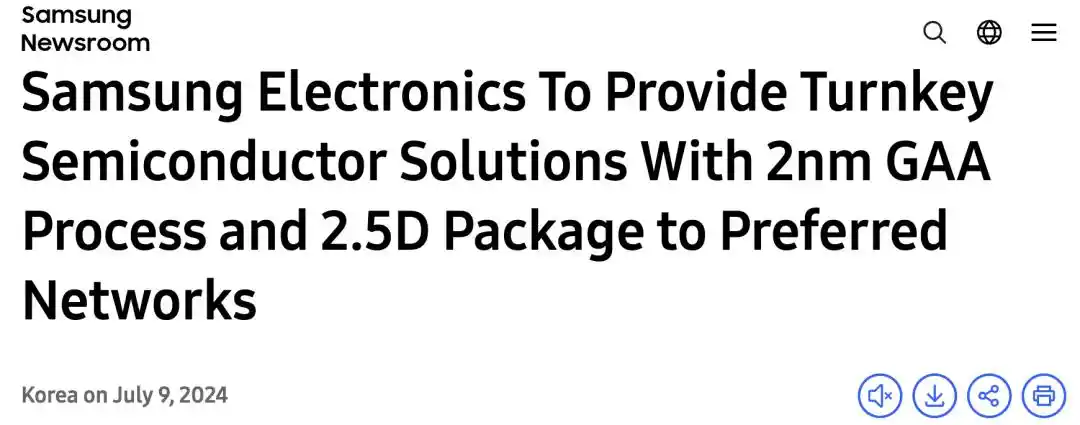
In July 2024, Samsung announced a turnkey solution providing its 2nm GAA process plus 2.5D packaging to the Japanese AI company Preferred Networks. This exact combination is one of the options Anthropic is considering. (Image source: Samsung official)
These two items are currently the most sought-after hard currencies in the AI chip race.
What's intriguing is that just three months ago, Anthropic emphasized in an official blog post that AWS Trainium, Google TPU, and Nvidia GPU would remain the core of its compute strategy.
"Multi-platform, not betting on a single hardware vendor" has been its distinctive hallmark compared to OpenAI and xAI: the latter two are deeply tied to Nvidia, while Anthropic has placed its training and inference bets on the aforementioned three cards.
Now, it wants its own chip too.
Is this about to break its own rule with its own hands?
Three individuals directly familiar with the project stated that even the "appearance" of this chip hasn't been decided: what it should do, how powerful it should be, and how to integrate it into servers and clusters are all still being pondered by Anthropic.
They have held talks with several chip design companies, but have not yet entered the detailed design, testing, and manufacturing stages.
Anthropic's official response was also impeccably vague—AWS's Trainium, Google TPU, and Nvidia GPU "will continue to be central to the company's compute scaling strategy," with roadmap details refused.
But two actions have made the intent quite clear.
The first is hiring.
Just last month, Anthropic poached Clive Chan, an early member of OpenAI's custom chip team. Job postings for chip engineers have also been listed.

Clive Chan, the second hardware engineer on OpenAI's custom chip team, previously involved in Tesla's Dojo supercomputer project, joined Anthropic in June of this year.
The second is preparation.
As early as April this year, Reuters reported that Anthropic was considering developing its own chips to address chip shortages. Less than three months have passed from "consideration" to "engaging with a foundry."
At the table of AI giants, Google, Amazon, Meta, and Microsoft have long revealed their own chips, and OpenAI has also brought Broadcom into the game.
Looking around, among the top players who haven't yet shown their cards, almost only Anthropic itself remains.
The Fourth Card Forced by the Bill
To understand why Anthropic is making chips, first look at its revenue curve.
By the end of 2025, its annualized run-rate revenue was approximately $9 billion.
By April 2026, it exceeded $30 billion. By the end of May, it surpassed $47 billion. In five months, it increased more than fivefold.
Two years ago, one wouldn't dare imagine such a growth curve.
While revenue is surging aggressively, the compute bill is rising even more ferociously.
Anthropic itself admitted in an April announcement that such growth pace has placed "inevitable pressure" on its infrastructure.
Thus, over the past few months, this company's compute expansion has been nearly frenzied:
April: Signed multiple gigawatts of next-generation TPU capacity with Google and Broadcom, to come online starting in 2027;

Anthropic official blog: Announced on April 6th the expanded partnership with Google and Broadcom to secure multi-gigawatt next-generation TPU compute.
May: Officially announced a $65 billion Series H financing round, with a post-money valuation of $965 billion. At the same time, signed a deal with Amazon for up to 5 gigawatts of new capacity, and secured GPU compute power from SpaceX for Colossus 1 and Colossus 2.
Amazon remains its primary cloud and training partner to this day, with Project Rainier progressing steadily.
According to The Information report, it is even in talks to use Microsoft's chips, as well as inference chips from the UK startup Fractile.
Counting them up, Anthropic's list of chip suppliers has already reached the fifth.
This is interesting: a company with an extremely diversified compute supply, a revenue curve that's almost vertical, and which just received $65 billion in cash, why still jump into chip-making?
The answer in two words: Scale.
Frontier models run on clusters of tens of thousands of processors. At this scale, even a few percentage points of efficiency improvement can save real money counted in the billions of dollars.
The more aggressively a company burns cash, the more incentive it has to squeeze every watt of electricity and every chip to its utmost efficiency.
Besides the compute bill, there's another crucial point: Leverage.
When all AI companies are scrambling for processors, data center space, and electricity, no matter how much compute power is rented, the bargaining power always lies with others.
Having your own chip on the table changes the bargaining dynamics when negotiating prices with other suppliers.
Therefore, self-development is the fourth card forced out by bill and bargaining power anxiety.
Anthropic's move is not about replacing anyone, but about pulling the cost curve and supply chain initiative a bit closer to its own side.
The Path OpenAI Walked Three Years Ago
OpenAI has already traversed this path.
In 2024, OpenAI approached Broadcom to begin designing its own chips.
In October 2025, both parties announced a collaboration to deploy 10GW of custom AI accelerators — roughly equivalent to the installed capacity of ten nuclear power units — with deployment scheduled to begin in the second half of 2026 and be completed before the end of 2029.
Last month, the first product, Jalapeño, was unveiled. It is a chip specifically designed for large model inference.

OpenAI CEO Sam Altman and Broadcom CEO Hock Tan holding a Jalapeño wafer commemorative plaque. The plaque reads: May we scale smoothly, exponentially, and uneventfully to AGI. (Image source: OpenAI)
This chip took only 9 months from initial design to tape-out. Both parties claim this is the fastest ASIC development cycle in high-performance semiconductor history. Interestingly, part of the design and optimization work was accelerated using OpenAI's own models.
See, using AI to design chips that run AI — the flywheel has already started spinning.
Early test results disclosed by OpenAI show that Jalapeño's performance per watt will significantly surpass the current state-of-the-art.
OpenAI President Greg Brockman has emphasized this logic: the world is moving towards a "compute-driven economy." Developing custom chips is part of a full-stack infrastructure strategy aimed at making compute more abundant, and AI faster, more reliable, and cheaper.
Altman even boldly stated: "Intelligence so cheap it doesn't need to be metered is within our grasp."
But don't forget the time cost. From poaching people to form a team to the chip seeing the light of day, OpenAI took roughly three years.
And the position Anthropic stands at now is precisely the starting point OpenAI was at three years ago: people just onboarded, specifications undecided, foundry still in talks.
Looking further back, Google's TPU and Amazon's Trainium have been proven for years, and Meta and Microsoft each have their own layouts.
Among the top players, the number of those without their own chips can be counted on one hand.
Who Can Overturn Nvidia's Table?
Although having decided to enter the self-developed chip game, Anthropic emphasizes that Amazon remains its main cloud and training partner, and Google TPU and Nvidia GPU will still be central to the company's compute scaling strategy.
The more cards the better, not discarding a single one — this has always been Anthropic's consistent approach.
But here's a noteworthy number.
According to The Information's estimates, despite the bustling financing and design activity in the inference chip market, Nvidia's market share has not decreased but rather increased in recent years, now sitting at approximately 74%.
Jensen Huang has proclaimed that Nvidia chips run inference more efficiently than any alternative.
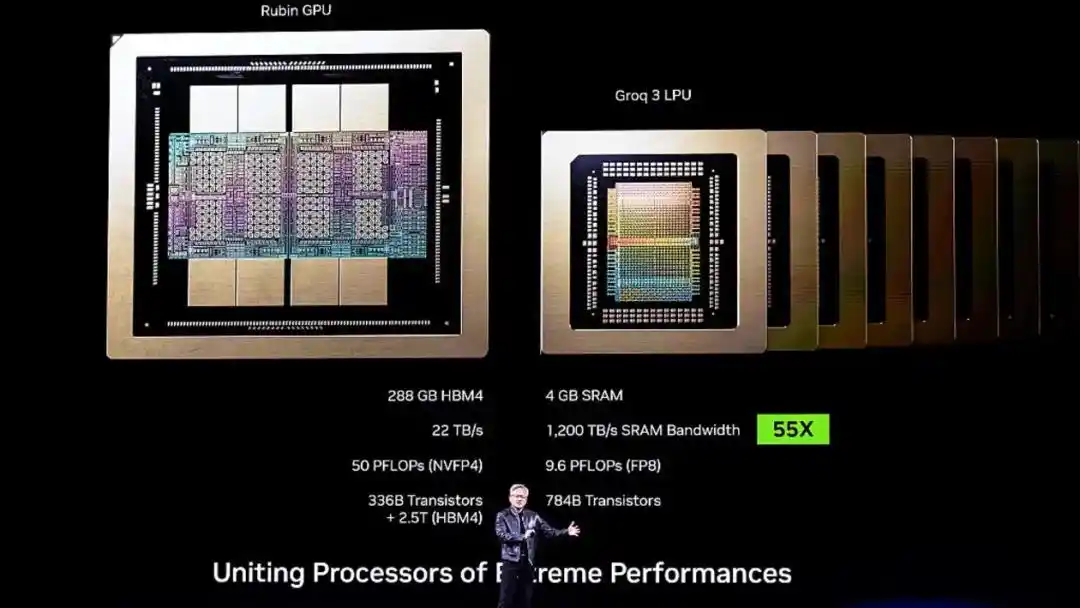
At GTC 2026, Jensen Huang showcased the Rubin GPU alongside the Groq 3 LPU on stage. The latter boasts an SRAM bandwidth of 1200TB/s, 55 times that of the former. Inference is precisely the territory Nvidia defends most fiercely. (Image source: Nvidia)
For years, custom chips have been heralded. Google, Amazon, Meta, Microsoft have all entered the field. On paper, Nvidia, whose share should have been eroded, has instead become stronger.
This precisely illustrates that custom chips are not challenging Nvidia's today, but rather securing one's own tomorrow.
So, how should we view Anthropic's step?
For itself, it's an additional long-term bargaining chip on the multi-vendor table, trading for pricing power and efficiency.
Poaching Clive Chan indicates it's seriously building capability. But the project is still in its early stages. From defining requirements to tape-out, mass production, and cluster deployment, lies the most brutal chasm in the chip industry.
In the previous era, chip companies determined the form of computing, and software companies grew on top of it.
In the AI era, companies building models are starting to define chips in reverse. The power structure of the compute pyramid is being rewritten from the top down.
Whether Samsung can truly secure this order, whether Anthropic will push this chip to mass production, there are no answers yet.
The only certainty is that in the 26% chip battlefield outside Nvidia's 74%, Anthropic has entered with $47 billion in annualized revenue and a $965 billion valuation.
Only when "intelligence is so cheap it doesn't need to be metered" will superintelligence move out of giant data centers and become a daily commodity affordable to everyone.
References:
https://www.theinformation.com/articles/anthropic-talks-samsung-manufacture-custom-ai-chip?rc=epv9gi
https://x.com/itsclivetime/status/2063356118525792542https://www.anthropic.com/news/google-broadcom-partnership-compute
This article is from the WeChat public account "New Zhiyuan", author: ASI Apocalypse