Android Flaw Leaves 30 Million Crypto Wallets Open To Attack: Microsoft Analysts

bitcoinistPublicado a 2026-04-11Actualizado a 2026-04-11

Resumen

Microsoft analysts revealed a critical security flaw in the EngageLab SDK (v4.5.4), leaving over 30 million Android crypto wallets vulnerable to attack. The "intent redirection" vulnerability allowed a malicious app to bypass Android's sandbox and gain read/write access to a wallet's private data, including seed phrases and keys, without any user interaction. A patch (SDK 5.2.1) was released in mid-2025. Users who haven't updated their apps since then are advised to not only update but also move their funds to new wallets with fresh seed phrases, as any unpatched wallet is considered compromised. The flaw also affected over 50 million apps in total.

A patch has been available for nearly a year, but millions of Android users may still be running vulnerable crypto wallet apps — leaving their funds and private keys exposed to a known security flaw.

Microsoft’s Defender Security Research Team went public last week with details of a vulnerability it first caught in April 2025. The flaw lived inside a widely used software component called the EngageLab SDK, version 4.5.4.

Because that SDK is baked into thousands of Android apps, a single malicious app could trigger a chain reaction that reached far beyond itself.

How The Attack Works

The method is called “intent redirection.” An attacker’s app sends a specially crafted message to any app running the flawed SDK version. Once that message lands, the targeted app is tricked into handing over read and write access to its own data — including stored seed phrases and wallet addresses.
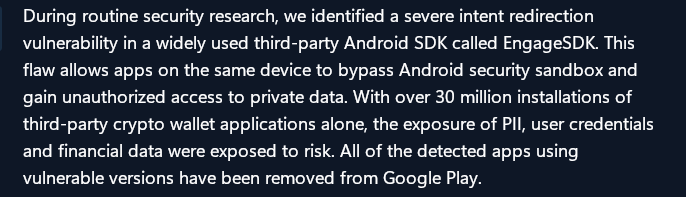
Source: Microsoft

Android’s built-in sandbox system, which normally keeps apps from seeing each other’s data, was bypassed entirely. According to Microsoft, the attack affected more than 50 million apps across the Android ecosystem, with roughly 30 million of those being crypto wallets.

The vulnerability did not require the user to do anything wrong. No suspicious links. No phishing pages. Just having the wrong apps installed at the same time was enough.
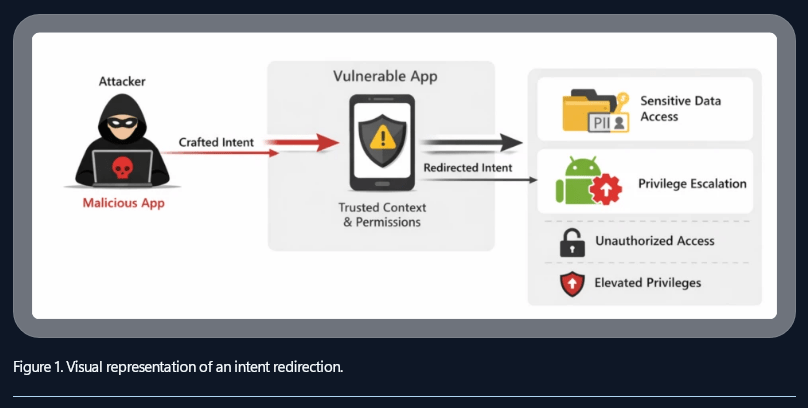
Source: Microsoft

Response From Microsoft And Google

Microsoft moved quickly after its discovery. By May 2025, the company had brought Google and the Android Security Team into the response. EngageLab released a fixed version — SDK 5.2.1 — shortly after.

Reports indicate that both Microsoft and Google have since directed users on how to verify whether their wallet apps have been updated through Google Play Protect.

BTCUSD trading at $72,906 on the 24-hour chart: TradingView

Officials also pointed to a broader concern: apps installed as APK files from outside the Play Store are at higher risk, since they bypass the security checks that Google applies to apps listed in its official marketplace.

What Users Should Do Now

For most users who update their apps regularly, the risk has likely passed. But for anyone who has not updated since mid-2025, the recommended action goes beyond a simple app refresh.

Security teams are advising those users to move their funds into entirely new wallets, generated with fresh seed phrases. Any wallet that was active and unpatched during the exposure window should be treated as potentially compromised.

The disclosure comes alongside a separate Android chip vulnerability flagged the previous month and a new US Treasury initiative that pairs government agencies with crypto firms to share cybersecurity threat information — a sign that mobile security in the crypto space is drawing attention at the highest levels.

Featured image from Bleeping Computer, chart from TradingView

Preguntas relacionadas

QWhat is the name of the vulnerable software component and which version was affected?

AThe vulnerable software component is the EngageLab SDK, specifically version 4.5.4.

QWhat is the attack method called and how does it work?

AThe attack method is called 'intent redirection.' A malicious app sends a specially crafted message to an app running the flawed SDK, tricking it into granting read and write access to its own data, including seed phrases and wallet addresses.

QHow many crypto wallet apps were estimated to be affected by this vulnerability?

ARoughly 30 million crypto wallet apps were estimated to be affected.

QWhat is the primary action recommended for users who had an unpatched wallet app?

AUsers are advised to move their funds into entirely new wallets generated with fresh seed phrases, as the old wallet should be treated as potentially compromised.

QWhich two major companies collaborated on the response to this vulnerability after its discovery?

AMicrosoft and Google (specifically the Android Security Team) collaborated on the response.

Lecturas Relacionadas

Global Stock Market's Storm Center: South Korea's Stock Market De-leveraging Is Largely Complete

Storm's Eye: South Korean Market De-leveraging Nears Completion The recent sharp correction in South Korean equities, with the KOSPI index dropping 32% from its June high, has been a key trigger for global tech stock volatility. The core driver was not a fundamental shift but a forced de-leveraging process within the market's unique structure, which is now largely complete. Two main leverage channels amplified the sell-off: 1. **Leveraged ETFs:** Their size, proportionally four times larger than in the U.S., peaked near $50 billion. Their mandatory daily rebalancing mechanism created a vicious cycle of "price drop → forced selling → further drop." Approximately 75% of this excess has been unwound, shrinking to $26 billion, with regulatory curbs now blocking new inflows. 2. **Hedge Fund Leverage:** Using swaps to magnify exposure, hedge funds saw their net long positioning fall by over 50% from peak levels. The most intense phase of this institutional de-leveraging is over. In contrast, **retail margin debt** poses minimal systemic risk. At 0.5% of market cap, it is far lower than in the U.S. or China, lacks automatic triggers, and is concentrated in smaller stocks. The conclusion: the high-leverage structures most prone to "chain-reaction selling" have been substantially cleared. The market is transitioning from a liquidity-driven crash to one priced more on fundamentals. The article argues that the AI trend—centered on Korean memory chips—remains intact. This episode represents a painful but necessary clearing of crowded trades, not the end of the AI revolution. For investors, the key question is conviction in the long-term AI direction; if the trend is real, current volatility is a cost of entry, not a terminal risk.

链捕手Hace 58 min(s)

Global Stock Market's Storm Center: South Korea's Stock Market De-leveraging Is Largely Complete

链捕手Hace 58 min(s)

The Eternal Fragments of Money: Third-Party Payment Has No First Principle

"The Enduring Fragments of Money: Third-Party Payments Lack a First Principle" Stripe is reportedly attempting to acquire PayPal, marking a significant shift reminiscent of PayPal's merger with the original X.com 30 years ago. The article analyzes Stripe's strategic challenges and the broader payments industry landscape. Despite its initial success with a developer-friendly API model, Stripe missed its optimal IPO window during the pandemic and has since seen its valuation decline. Its attempts to expand through acquisitions and new ventures, particularly in stablecoins (like its OUSD project) and Agent-focused payments (ACP/MPP protocols), have faced headwinds. The author argues that the payment industry remains highly fragmented and is ultimately an adjunct to the traditional banking system. This structure limits the potential for any single player, including Stripe, to achieve complete dominance. While stablecoins and the future rise of autonomous Agent economies present potential growth avenues, they are not yet mainstream and still require integration with the existing financial system. For now, Agent-based transactions are largely used for speculative "volume boosting" rather than substantive business applications. Stripe's current move to acquire PayPal is seen as an attempt to bolster its weak consumer-facing (C-side) business after its stablecoin-focused strategies faltered. Meanwhile, PayPal is described as structurally outdated, unable to revive itself through new products like Venmo or PYUSD. The future of payments may lie not in payments themselves but in value-added services like more efficient settlement networks. The author suggests that companies like Stripe and Circle, which are building their own blockchains (Tempo, Arc) and stablecoins, are positioning themselves to eventually profit from high-efficiency settlement systems. These new networks could potentially bypass some traditional banking layers. In conclusion, the article posits that third-party payment is a perpetually fragmented battlefield where scale alone cannot ensure victory. Players must find new models, focusing on efficiency to compete with the entrenched banking system. Stripe's acquisition of PayPal represents a bet on this uncertain future.

链捕手Hace 1 hora(s)

The Eternal Fragments of Money: Third-Party Payment Has No First Principle

链捕手Hace 1 hora(s)

Trading

Spot
活动图片





