Analyzing whether Decred’s [DCR] buyers will push price towards $36.7 liquidity

ambcryptoPublicado a 2026-03-06Actualizado a 2026-03-06

Resumen

Decred (DCR) has experienced significant gains, with a double-digit price surge in the last 24 hours. It is currently trading within a bullish structure on the daily chart, remaining above the EMA, indicating buyer control in the short term. Both spot and derivatives market data show strong buying pressure, suggesting traders are positioning for further upward movement. Whale activity has also increased slightly, with more addresses holding over $1,000 worth of DCR, supporting the potential for sustained growth. The next key resistance and liquidity zone is identified at $36.7. If bullish momentum continues, DCR could target this level, though maintaining buyer dominance will be critical for achieving this move.

DCR’s price action has registered significant gains over the last 24 hours by recording a double-digit surge on the charts.

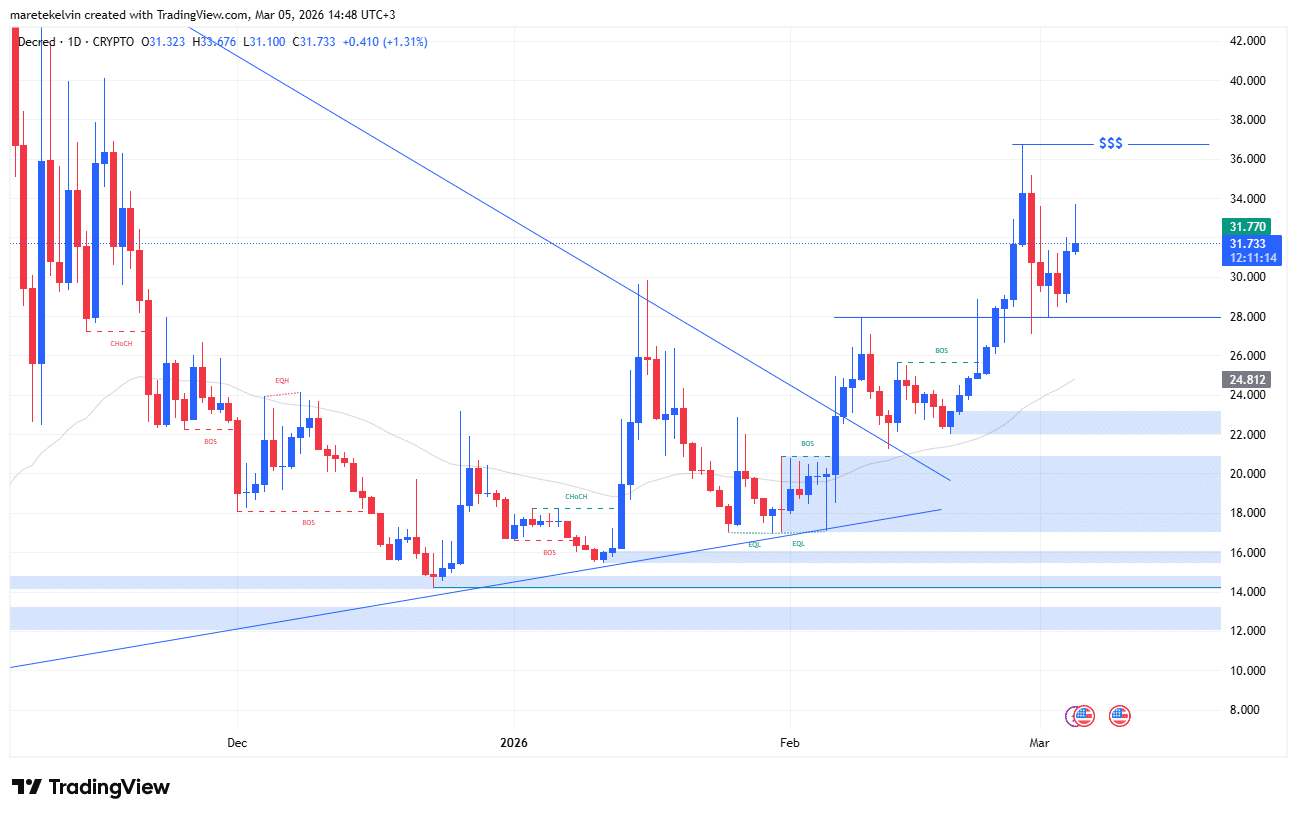
At the time of writing, the altcoin was trading within a bullish structure on the daily chart. Its price has also remained above the EMA – A signal that buyers might still control the short-term trend.

Meanwhile, the momentum appeared to be steady. However, the next question is whether the rally has enough strength to extend itself towards the next liquidity zone.
Source: TradingView

Buyers maintain market control

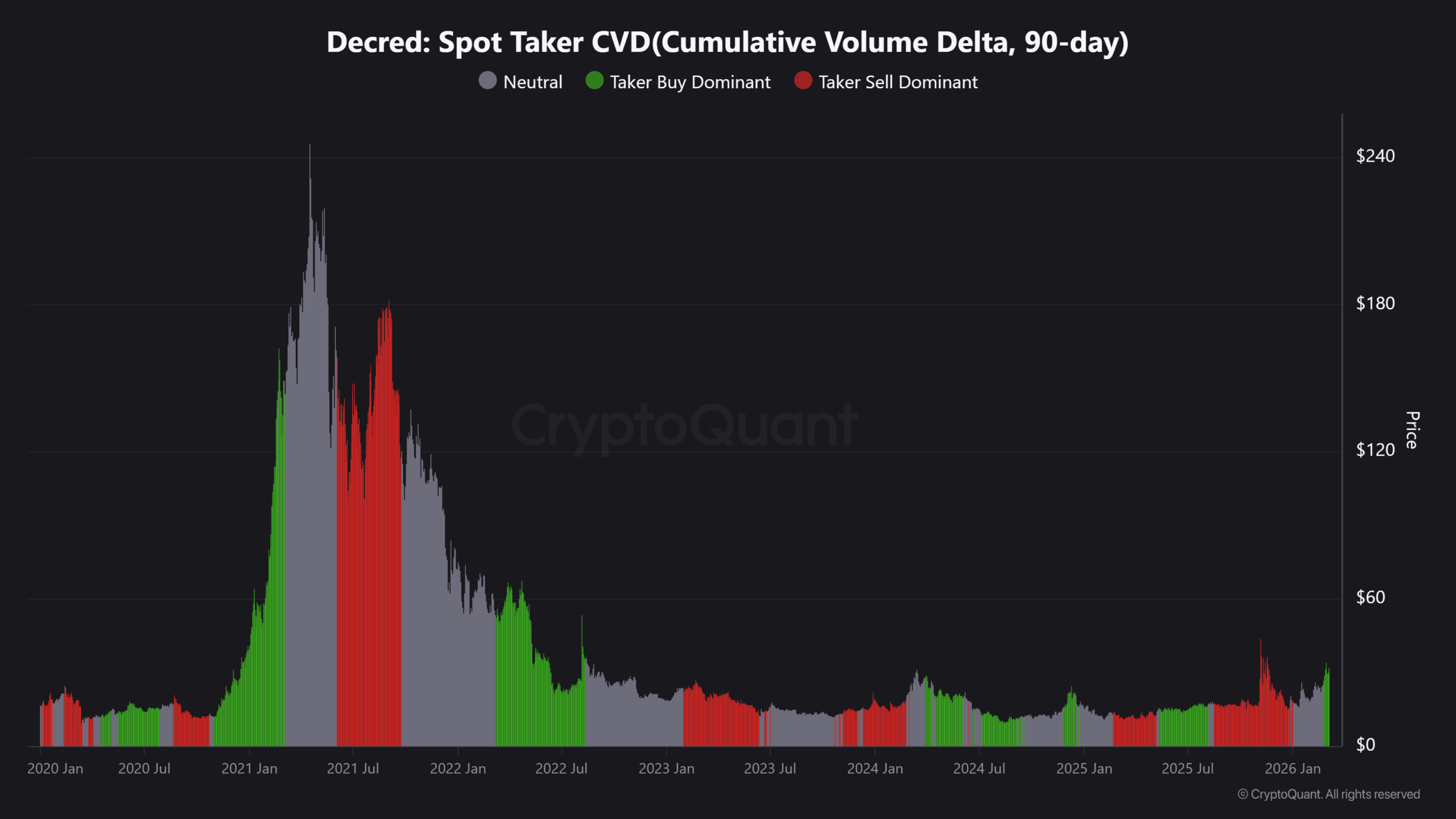
According to the recent Spot Taker CVD data, buyers have been dominating activity across the market.

On the spot market, buying pressure seemed to be stronger than sellers’ orders. This suggested that traders may be positioning themselves in anticipation of a further rally.

The same trend was visible in the derivatives market too. Buyers have continued to control the order flow, reinforcing the ongoing bullish momentum.

Usually, when both spot and derivatives markets align on the buy side, rallies often gain additional strength. The same scenario could replicate itself for DCR.
Source: CryptoQuant

Whale activity symbolizes early growth

Another supportive signal seemed to be emerging from the network activity too.

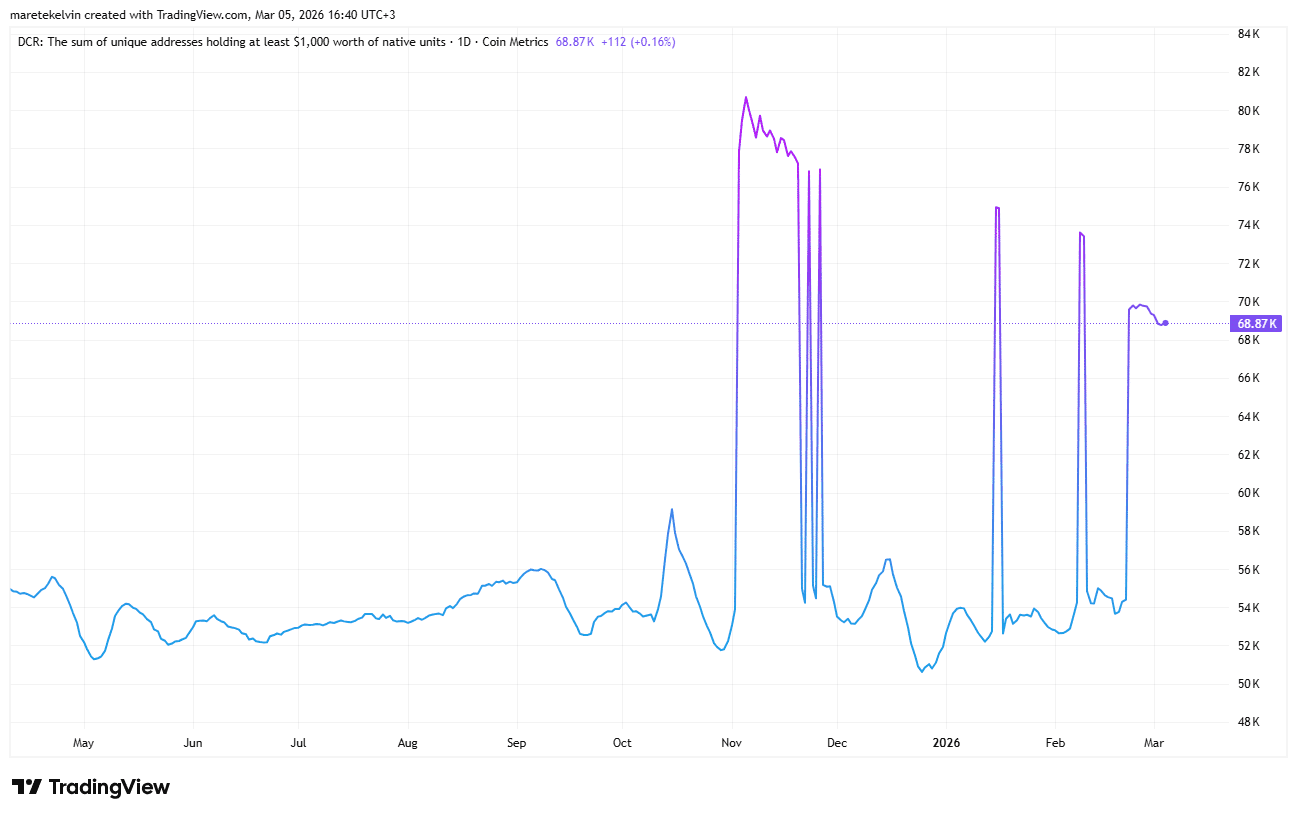
The number of addresses holding more than $1,000 worth of DCR recorded a slight increase over the last 24 hours. While the growth seemed modest, it indicated that more investors may be gradually entering the market.

Cumulatively, rising holder distribution often supports sustained rallies, especially when it appears in coincidence with a bullish price structure.
Source: TradingView

Liquidity at $36.7 now the next focus

Finally, from a technical perspective, the next key area now lies above the press time trading range.

Liquidity clusters remain concentrated around the $36.7-resistance level. These zones often act as magnets for the price when bullish momentum builds.

If buyer dominance continues and the current structure holds above the EMA, DCR could extend its move higher. A push towards $36.7 would represent the next logical step in the rally.

At press time, the trend was firmly in the bulls’ favour. The key factor will be whether buyers can maintain control long enough to trigger the next liquidity sweep.


Final Summary

  • DCR has been holding on to a bullish structure above the EMA as buyers dominated both spot and derivatives markets.
  • Growing investor participation could drive a liquidity sweep towards the $36.7 resistance zone.
Next: Why PI’s 14% price uptick will face downside risk from its correlation with Bitcoin
Share
  • Share
  • Tweet

Preguntas relacionadas

QWhat is the main technical indicator suggesting that buyers are in control of DCR's short-term trend?

ADCR's price remaining above the Exponential Moving Average (EMA) on the daily chart is the key technical indicator suggesting buyers control the short-term trend.

QAccording to the data, which two markets showed alignment in buy-side dominance for DCR?

ABoth the spot market and the derivatives market showed alignment in buy-side dominance, with stronger buying pressure in spot and buyers controlling order flow in derivatives.

QWhat specific on-chain metric indicated growing investor participation in DCR's network?

AThe number of addresses holding more than $1,000 worth of DCR recorded a slight increase, indicating growing investor participation.

QWhat is the next key price target (liquidity zone) for DCR's rally mentioned in the analysis?

AThe next key price target and liquidity zone for DCR's rally is the $36.7 resistance level.

QWhat is the primary condition needed for DCR to extend its move towards the $36.7 level?

AThe primary condition is for buyer dominance to continue and for the current bullish structure to hold above the EMA.

Lecturas Relacionadas

Near Returns to the AI Stage: Transformation into a Public Chain Due to 'Payroll Difficulties,' Agent and Privacy Emerge as New Growth Narratives

NEAR Returns to AI Origins: From Payroll Struggles to Blockchain, Now Focusing on AI Agents and Privacy NEAR Protocol's journey began not with grand blockchain ambitions, but from a practical hurdle: its AI startup founders, including Transformer paper co-author Illia Polosukhin, couldn't efficiently pay international developers in 2017. This led them to pivot and build a high-performance, scalable blockchain. After years navigating various crypto narratives like sharding and cross-chain interoperability, NEAR is now leveraging its AI roots to re-enter the AI arena. A key driver is its "NEAR Intents" layer, which abstracts complex cross-chain transactions. Users simply state their goal (e.g., swap BTC for ETH), and a solver network finds the optimal route. This system has processed over $20B in cross-chain volume, generating significant fee revenue. A major growth area is private transactions via "Confidential Intents/Swaps," which hide trade details until settlement to protect against MEV and front-running. Remarkably, private swaps recently accounted for over 40% of NEAR's transaction volume, highlighting strong demand but also potential regulatory scrutiny. With its AI-founder pedigree, NEAR is positioning itself at the intersection of blockchain, AI agents, and privacy, aiming to become infrastructure for the emerging agent economy while navigating the challenges of its rapid adoption.

marsbitHace 33 min(s)

Near Returns to the AI Stage: Transformation into a Public Chain Due to 'Payroll Difficulties,' Agent and Privacy Emerge as New Growth Narratives

marsbitHace 33 min(s)

From Ethereum to AI's 'CROPS': What Exactly is This Set of 'Slow Variables' That Vitalik Repeatedly Emphasizes?

In recent discussions, Vitalik Buterin has frequently emphasized the concept of "CROPS," a framework defining core values for Ethereum's development. CROPS stands for Censorship Resistance, Capture Resistance, Open Source, Privacy, and Security. Initially outlined in the Ethereum Foundation's "EF Mandate," it represents a commitment to user sovereignty, ensuring that the network resists external control, remains open, protects privacy, and prioritizes security. The relevance of CROPS extends beyond Ethereum's foundational principles, becoming crucial in the context of AI integration. As AI agents begin handling wallet operations and automated transactions, the risk increases that users may cede control over their digital assets, privacy, and intentions to centralized AI service providers. A "CROPS AI" would therefore emphasize local execution where possible, privacy-preserving remote model calls (e.g., using zero-knowledge proofs), and transparent, verifiable processes to maintain user agency. Vitalik highlights a significant convergence between "CROPS Ethereum access layer" and "CROPS AI." Both address the same fundamental challenge: how users can access powerful services—be it blockchain data via RPCs or AI models—without exposing sensitive information or relinquishing ultimate control. This intersection points toward a future digital entry point that is more private, secure, and user-controlled. Ultimately, CROPS is not merely an abstract ideal but a practical guidepost. It steers development—from protocol resilience and wallet design to AI agent safety—towards a future where users retain self-sovereignty even as digital systems grow more complex and powerful. In an era of accelerating AI adoption, these "slow variables" of censorship resistance, openness, privacy, and security may define Ethereum's enduring value.

marsbitHace 44 min(s)

From Ethereum to AI's 'CROPS': What Exactly is This Set of 'Slow Variables' That Vitalik Repeatedly Emphasizes?

marsbitHace 44 min(s)

Silicon Valley 'Startup Guru' Steve Hoffman: Web3 + AI Could Be a Trap

Silicon Valley investor and "Godfather of Startups" Steve Hoffman warns that combining Web3 with AI is likely a trap, not a promising venture. In an interview, Hoffman argues that while AI is a foundational technology touching all industries, Web3 adds complexity, friction, and regulatory risk without solving mainstream consumer or business needs. He advises founders to focus on deep, specialized applications where startups can out-iterate giants, rather than on generic features easily replicated by large tech companies. Hoffman observes that Silicon Valley will lead foundational AI research, while China excels at rapid, large-scale application and commercialization, particularly in robotics. He stresses that AI-driven autonomous agents capable of collaborative, multi-step tasks are 2-4 years away, which will cause significant job displacement. The solution is not to slow AI but to redesign business models around human-AI collaboration and reform social systems like education and retraining. For startups, Hoffman recommends focusing on vertical, expertise-heavy domains to build defensibility. He sees major opportunities in AI fraud detection and cybersecurity. Key founder mindsets include systemic thinking over feature-focus, relentless customer centricity, building adaptive teams, and deeply understanding AI's capabilities and limits. Hoffman is also leading a non-profit initiative to establish university centers aimed at training future leaders in responsible, human-value-aligned AI innovation.

marsbitHace 2 hora(s)

Silicon Valley 'Startup Guru' Steve Hoffman: Web3 + AI Could Be a Trap

marsbitHace 2 hora(s)

Token Inefficient, Economy Tokenless

The article "Tokens Aren't Economical, Economics Aren't Tokenized" analyzes a pivotal shift in the AI industry from a technology-driven narrative to one dominated by capital efficiency. It highlights two concurrent trends: a severe capital shortage due to the exorbitant and recurring costs of compute (e.g., OpenAI's high burn rate) and a wave of corporate spin-offs where major tech companies are separating their AI units (like Kuaishou's Kling and Baidu's Kunlunxin). The core argument is that AI's "anti-internet" business model, where user growth increases costs rather than profits, has created a disconnect between high valuations and actual cash flow. Spin-offs address this by allowing AI assets to be valued independently. Within a parent company, they are seen as cost centers, but as standalone entities, they are priced based on their growth potential and scarcity in the primary market, leading to massive valuation premiums (e.g., Kling's estimated value tripling post-spin-off). The industry is at an inflection point, moving from "model worship" to "value realization." The competition is evolving from a pure compute (GPU) race to a broader focus on systemic efficiency and full-stack engineering (involving CPUs and orchestration) to achieve viable commercialization. The year 2026 is framed as a critical moment where the industry must definitively answer how to economically translate AI capability into tangible business value, reshaping the sector's future power structure.

marsbitHace 2 hora(s)

Token Inefficient, Economy Tokenless

marsbitHace 2 hora(s)

Trading

Spot
Futuros

Artículos destacados

Cómo comprar DCR

¡Bienvenido a HTX.com! Hemos hecho que comprar Decred (DCR) sea simple y conveniente. Sigue nuestra guía paso a paso para iniciar tu viaje de criptos.Paso 1: crea tu cuenta HTXUtiliza tu correo electrónico o número de teléfono para registrarte y obtener una cuenta gratuita en HTX. Experimenta un proceso de registro sin complicaciones y desbloquea todas las funciones.Obtener mi cuentaPaso 2: ve a Comprar cripto y elige tu método de pagoTarjeta de crédito/débito: usa tu Visa o Mastercard para comprar Decred (DCR) al instante.Saldo: utiliza fondos del saldo de tu cuenta HTX para tradear sin problemas.Terceros: hemos agregado métodos de pago populares como Google Pay y Apple Pay para mejorar la comodidad.P2P: tradear directamente con otros usuarios en HTX.Over-the-Counter (OTC): ofrecemos servicios personalizados y tipos de cambio competitivos para los traders.Paso 3: guarda tu Decred (DCR)Después de comprar tu Decred (DCR), guárdalo en tu cuenta HTX. Alternativamente, puedes enviarlo a otro lugar mediante transferencia blockchain o utilizarlo para tradear otras criptomonedas.Paso 4: tradear Decred (DCR)Tradear fácilmente con Decred (DCR) en HTX's mercado spot. Simplemente accede a tu cuenta, selecciona tu par de trading, ejecuta tus trades y monitorea en tiempo real. Ofrecemos una experiencia fácil de usar tanto para principiantes como para traders experimentados.

119 Vistas totalesPublicado en 2024.12.11Actualizado en 2026.06.02

Cómo comprar DCR

Discusiones

Bienvenido a la comunidad de HTX. Aquí puedes mantenerte informado sobre los últimos desarrollos de la plataforma y acceder a análisis profesionales del mercado. A continuación se presentan las opiniones de los usuarios sobre el precio de DCR (DCR).

活动图片













