Analyzing 10 Key BTC Top Indicators: Why Is the Current Bull Market Different from Previous Ones?

深潮Publicado a 2025-12-22Actualizado a 2025-12-22

Resumen

"Analysis of 10 Key Bitcoin Top Indicators: Why the Current Bull Run Differs from the Past" This analysis examines 10 classic on-chain and technical indicators to assess whether Bitcoin has reached its cycle top. Historically, market peaks were marked by multiple indicators flashing extreme overbought signals simultaneously. However, the current bull run (as of Q4 2025) shows notably divergent, more moderate readings. Key findings include: The Pi Cycle Top indicator has not yet triggered a crossover signal. The Puell Multiple remains in a moderate 1-2 range, indicating miner selling pressure is not extreme. The Bitcoin Rainbow Chart shows price is in the yellow-orange zone, not the red "sell" bubble territory. The MVRV Z-Score sits in a neutral 2-4 range, far from previous cycle peaks of 7-10. The Altcoin Season Index remains low (30-40), showing no major capital rotation from BTC to altcoins. Long-Term Holder (LTH) supply shows a slow distribution, but Short-Term Holder (STH) supply, while rising, did not peak concurrently with the price high on October 6th. Net Unrealized Profit/Loss (NUPL) has declined to 0.34 from a high of 0.64 in March 2024. The analysis concludes that the market's structure has fundamentally changed. The explosive, retail-driven peaks of 2017 and 2021 are being replaced by a more gradual, institutional-led market, largely attributed to Bitcoin ETF inflows providing stability. This suggests Bitcoin is transitioning from a cyclical asset to a mainstr...

Author: WEEX Labs

In past Bitcoin bull market cycles, the price peak has often been accompanied by signs of market overheating. However, this bull market appears to have undergone some significant changes—many previously reliable indicators have not yet signaled a top, while the price of Bitcoin has been in a steady decline since hitting a new high on October 6th, further driving several indicators to turn bearish.

Below, we will examine 10 classic indicators, evaluate their characteristics and limitations, and outline the underlying changes in Bitcoin and the broader crypto market.

1. Pi Cycle Top Indicator: Has the Cycle Peak Been Reached?

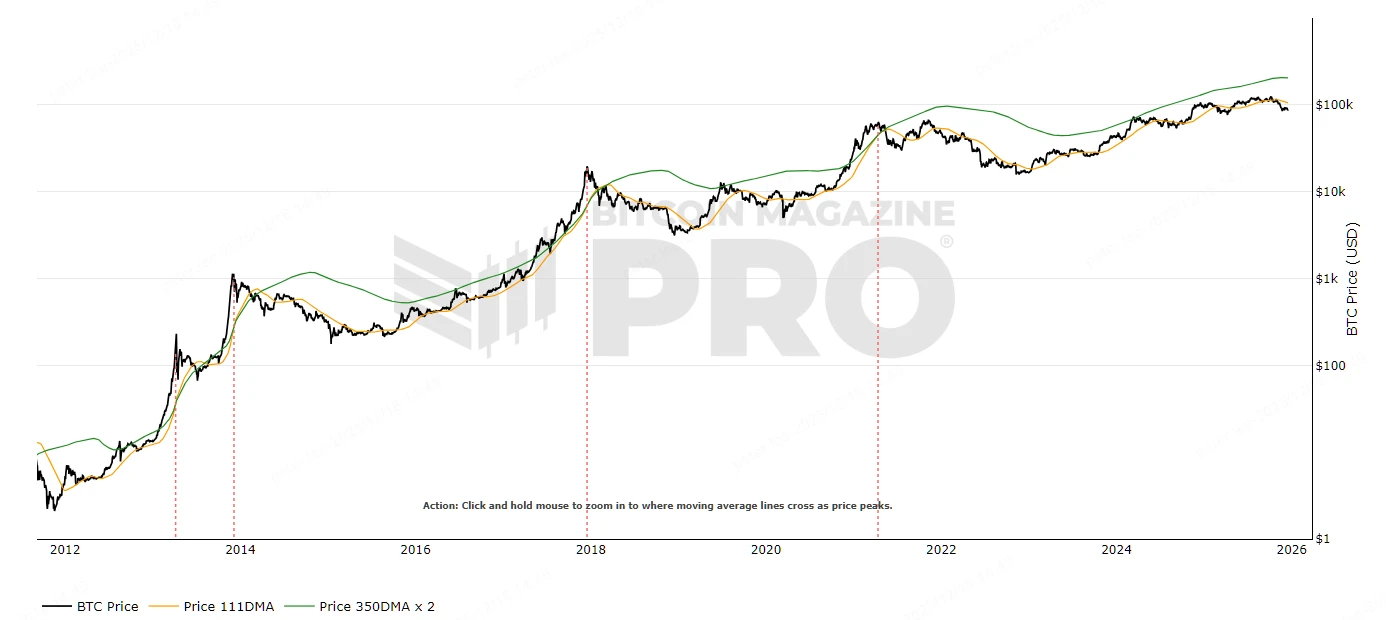
The Pi Cycle indicator is a classic tool for identifying Bitcoin price tops using the 111-day moving average (111DMA) and the 350-day moving average multiplied by 2 (350DMA x 2).

Typically, when the short-term line crosses above the long-term line, it often signals a market top, as it indicates that the price is rising too quickly and detaching from fundamental support.

Historically, the Pi Cycle Top Indicator has shown crossover behavior before each bull market peak:

2017 peak: The 111DMA crossed above the 350DMA x 2, marking the subsequent bubble burst;

2021 double top: A similar crossover occurred before the first top, followed by a rapid market correction;

Currently (Q4 2025), as shown in the chart below, the two lines have not yet crossed.
Source: https://www.bitcoinmagazinepro.com/charts/pi-cycle-top-indicator

2. Puell Multiple: Are Miner Profits Excessive?

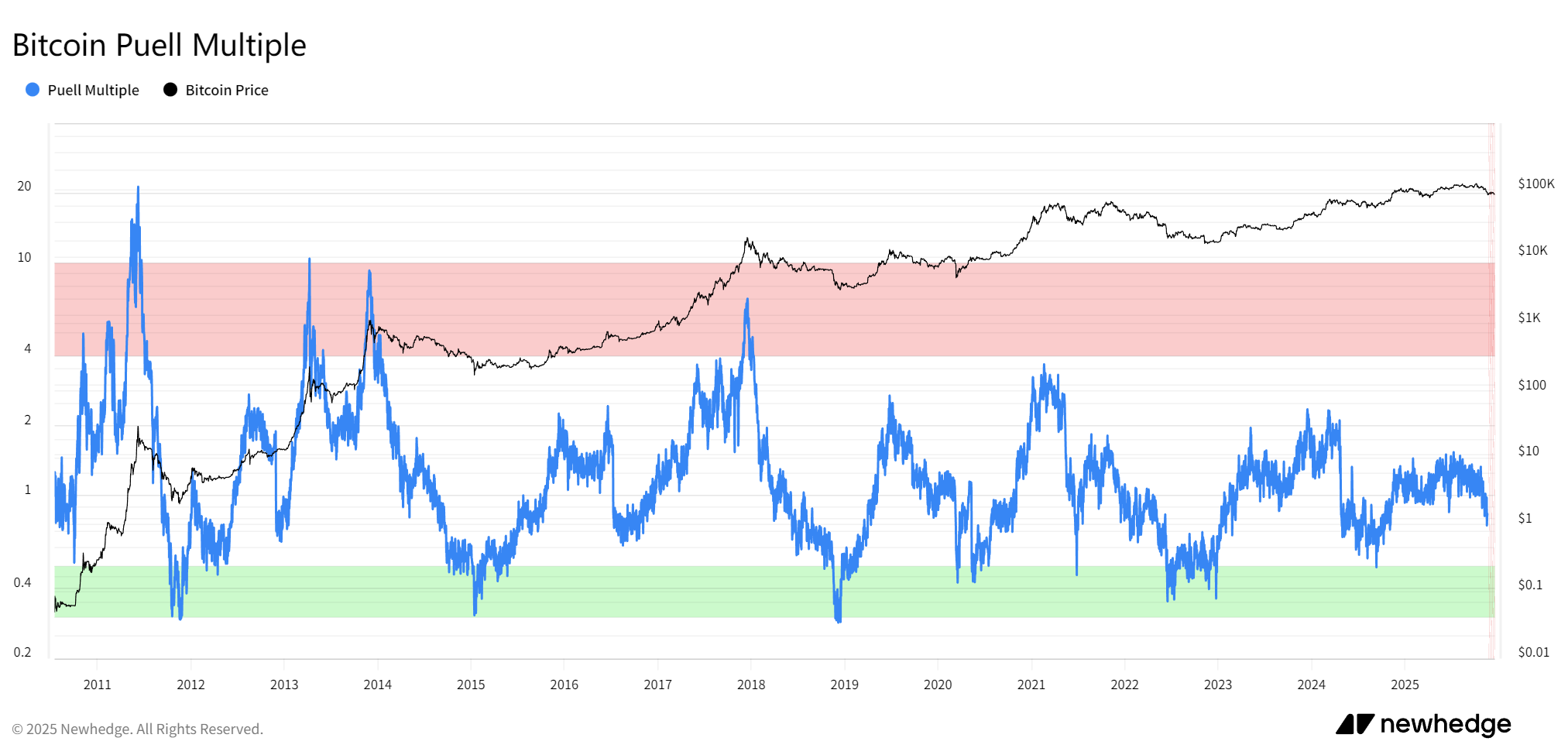
The Puell Multiple measures the ratio of miners' daily revenue to its 365-day moving average, used to assess miner profitability and market cycles.

Its principle is based on miner behavior: when the ratio is too high, miners are highly profitable and may increase selling pressure, forming a top; when it is too low, it indicates miner capitulation, signaling a bottom. In other words, a high Puell Multiple reflects that "miners are making too much money," accumulating supply pressure.

Historically, the Puell Multiple has also shown extreme spikes before each bull market peak:

2017 peak: Exceeded 7, a historical high;

2021 double top: Exceeded 3, followed by a crash;

Currently (Q4 2025), the Puell Multiple is in the 1~2 range, indicating moderate miner pressure.
Source: https://newhedge.io/bitcoin/puell-multiple

3. Bitcoin Rainbow Chart: Has the Price Entered the "Sell" Zone?

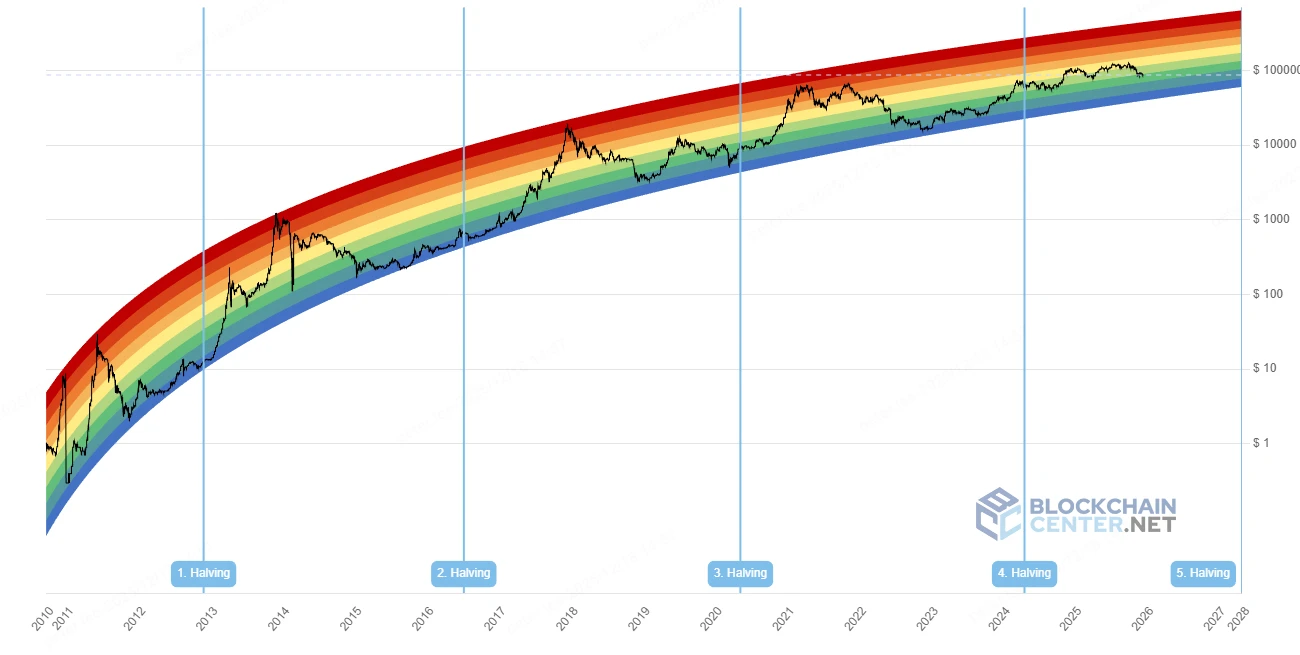
The Bitcoin Rainbow Chart uses a logarithmic growth curve overlaid with rainbow-colored bands to evaluate Bitcoin's long-term valuation levels.

Its principle maps prices to color bands: the blue zone indicates undervaluation (buy), and the red zone indicates overvaluation (sell). The bands are based on historical growth curves, helping to identify extreme market sentiment.

Historically, the Bitcoin Rainbow Chart has entered the red zone before each bull market peak:

2017 peak: Deep red zone, bubble peak;

2021 double top: Orange-red zone, followed by a correction;

Currently (Q4 2025), the price is in the yellow to orange range, not yet reaching the red bubble zone. We have also seen many analysts adjust this indicator, but regardless of the adjustments, the price has indeed not reached the red bubble area based on past historical experience.
Source: https://www.blockchaincenter.net/en/bitcoin-rainbow-chart/

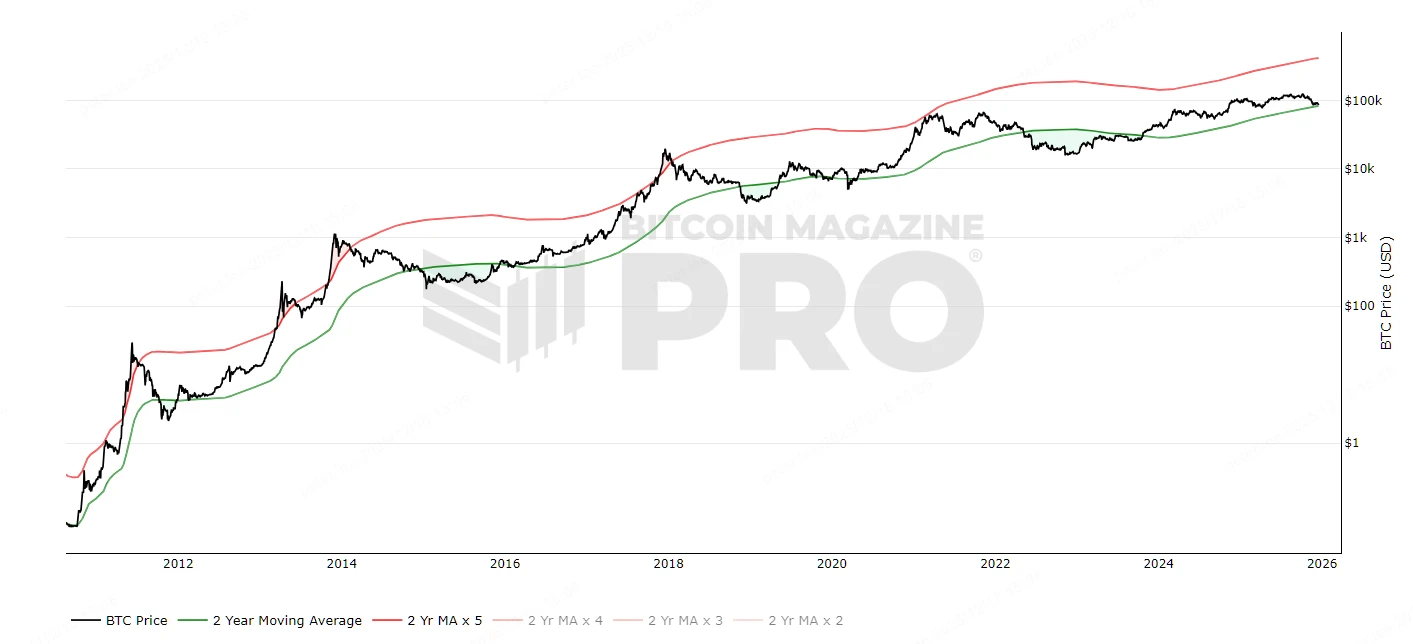
4. 2-Year MA Multiplier: Has the Multiple Peaked?

The 2-Year MA Multiplier (also known as the Golden Ratio Multiplier) identifies price resistance zones by multiplying the 2-year moving average by Fibonacci ratios.

Its principle combines the golden ratio (1.6) and Fibonacci sequences to evaluate the multiple of the price relative to the long-term average: a high multiple indicates overheating, signaling a correction. In other words, a high multiple means the price has "deviated too far from the long-term trend," accumulating risk.

Historically, the 2-Year MA Multiplier has shown extreme multiples before each bull market peak:

2017 peak: The indicator differed from the price by up to 10 times, with the price crossing above 2 Yr MA *5 one month before the peak;

2021 double top: Exceeded 5 times, with the price just touching 2 Yr MA *5 before the first top;

Currently (Q4 2025), the multiple is in the 2~3 range, not yet entering the high multiple zone.
Source: https://www.bitcoinmagazinepro.com/charts/bitcoin-investor-tool/

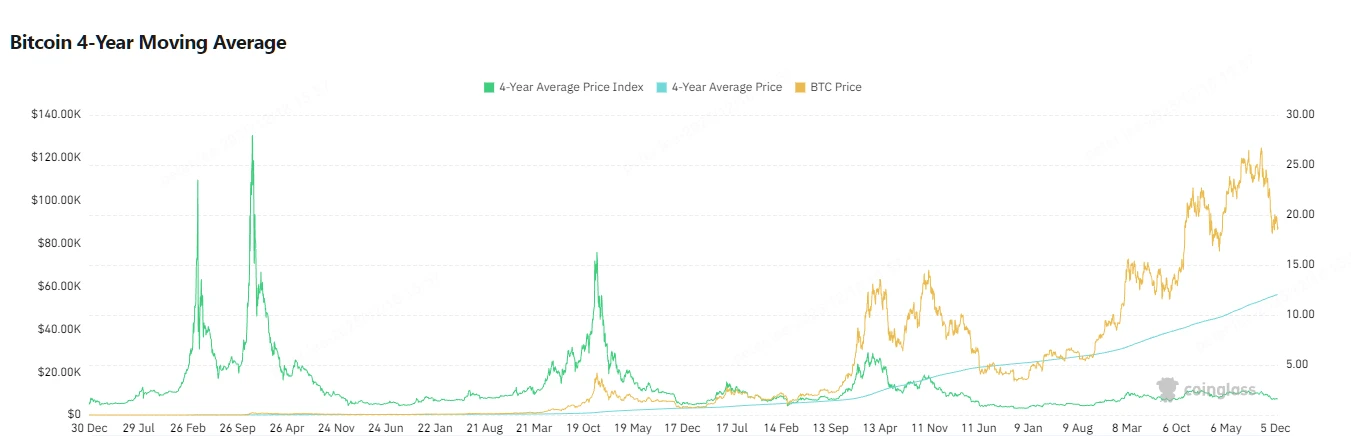
5. Bitcoin 4-Year Moving Average: Is the Price Far Above the Long-Term Average?

The Bitcoin 4-Year Moving Average calculates the 4-year price average to assess Bitcoin's macro trend.

Its principle smooths out cyclical fluctuations: a price far above the average indicates overheating; closeness to the average indicates equilibrium. In other words, a large deviation means a "cyclical bubble," accumulating risk.

Historically, the Bitcoin 4-Year Moving Average has shown extreme price deviations before each bull market peak:

2017 peak: The indicator reached 16;

2021 double top: Reached 6 at the first top, followed by a crash;

Currently (Q4 2025), the price reached a maximum of 2.3, showing a decreasing peak trend.
Source: https://www.coinglass.com/pro/i/four-year-moving-average

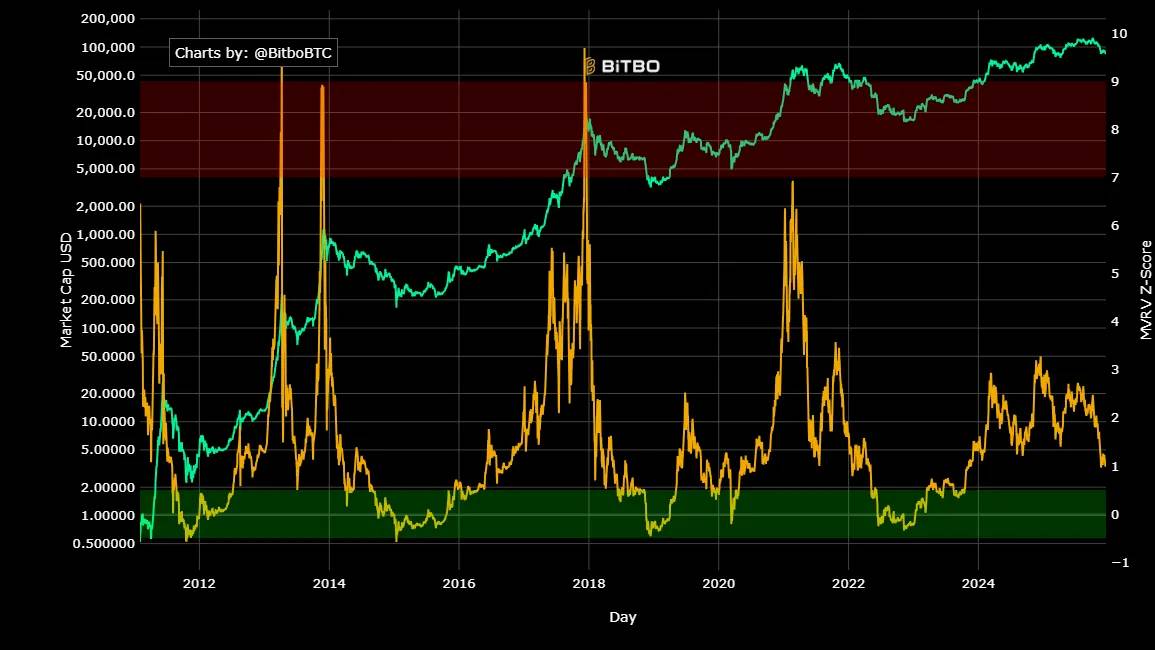
6. Bitcoin MVRV Z-Score: Has Valuation Entered the Risk Zone?

The MVRV Z-Score is a classic on-chain indicator for judging whether Bitcoin's valuation has "deviated from its true value."

Its principle compares Bitcoin's current market cap to its "realized cap" (the total cost basis of all coins) and calculates the standard deviation of the difference. In other words: a higher Z-Score means most people are in a state of unrealized profits, the market is "making too much money," and risk is accumulating.

Historically, the MVRV Z-Score has shown extreme spikes before each bull market peak:

2017 peak: Approached 10, a historical extreme;

2021 double top: Exceeded 7 at the first top, followed by a market crash;

Currently (Q4 2025), the Z-Score is in the 2~4 range, indicating neutral valuation.
Source: https://charts.bitbo.io/mvrv-z-score

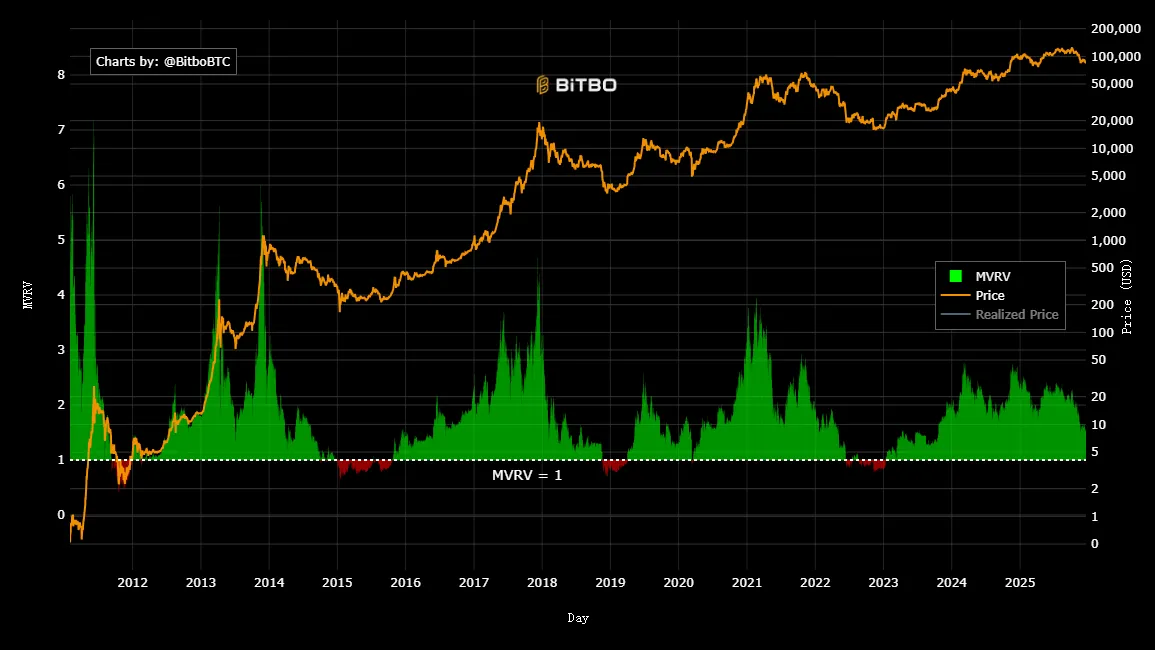
It is worth mentioning that the MVRV Rate adds statistical analysis to MVRV, measuring the standard deviation between the current MVRV and its historical average. This standardization helps identify when Bitcoin is trading above or below "fair value." However, as shown below, the peak values of this indicator at each bull market top have shown a decreasing trend, and the price has even diverged from the peaks, greatly increasing the difficulty of using this indicator to predict tops.
Source: https://charts.bitbo.io/mvrv

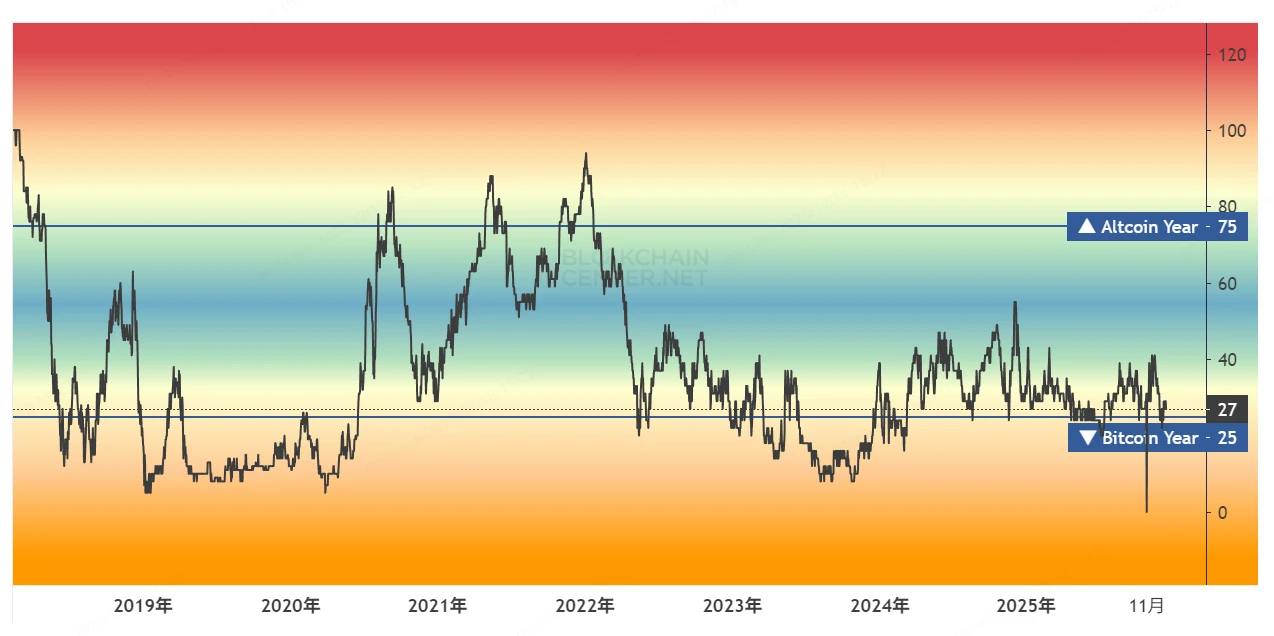
7. Altcoin Season Index: Has Altcoin Season Started?

The Altcoin Season Index tracks the performance of the top 100 altcoins relative to Bitcoin to assess whether an "alt season" has begun.

Its principle is based on relative performance: an index above 75 indicates the start of an alt season, often occurring after a BTC top, as funds flow from BTC to alts. In other words, a high index means BTC's dominance is weakening, and market risk is accumulating through diversification.

Historically, each bull market peak has ended with the狂欢 (狂欢) of an alt season as a closing signal:

2017 peak: Exceeded 90, alt season erupted;

2021 double top: Exceeded 80, followed by a BTC correction;

Currently (Q4 2025), the index is in the 30~40 range, with the altcoin sector performing sluggishly. In fact, since the start of this BTC bull run, this indicator has not even reached 60 at its highest, possibly due to insufficient liquidity and an oversupply of new coins.
Source: https://www.blockchaincenter.net/en/altcoin-season-index

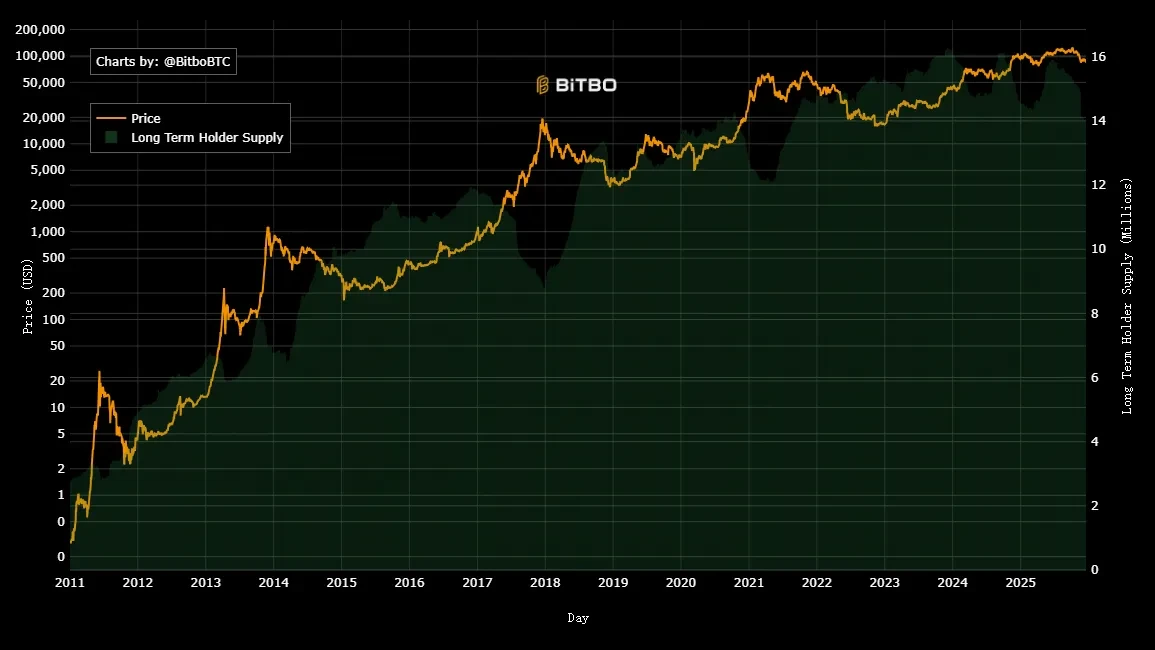
8. Bitcoin Long Term Holder Supply (LTH): Is Long-Term Holder Supply Decreasing?

Bitcoin Long Term Holder Supply (LTH) tracks the supply of Bitcoin held for more than 155 days, reflecting HODLer behavior.

Its principle observes supply changes: at tops, LTHs often sell to realize profits; at bottoms, they accumulate. In other words, a decrease in LTH supply means "smart money" is exiting, indicating high risk.

Historically, LTH has also shown significant decreases before each bull market peak:

2017 peak: The selling period lasted a year, reaching a selling climax at the top;

2021 double top: The first top followed a trend of continuous selling for half a year, but the accumulation at the second top reached a historical high;

Currently (Q4 2025), slow selling has been ongoing for half a year, but the top in October does not align with historical patterns.
Source: https://charts.bitbo.io/long-term-holder-supply

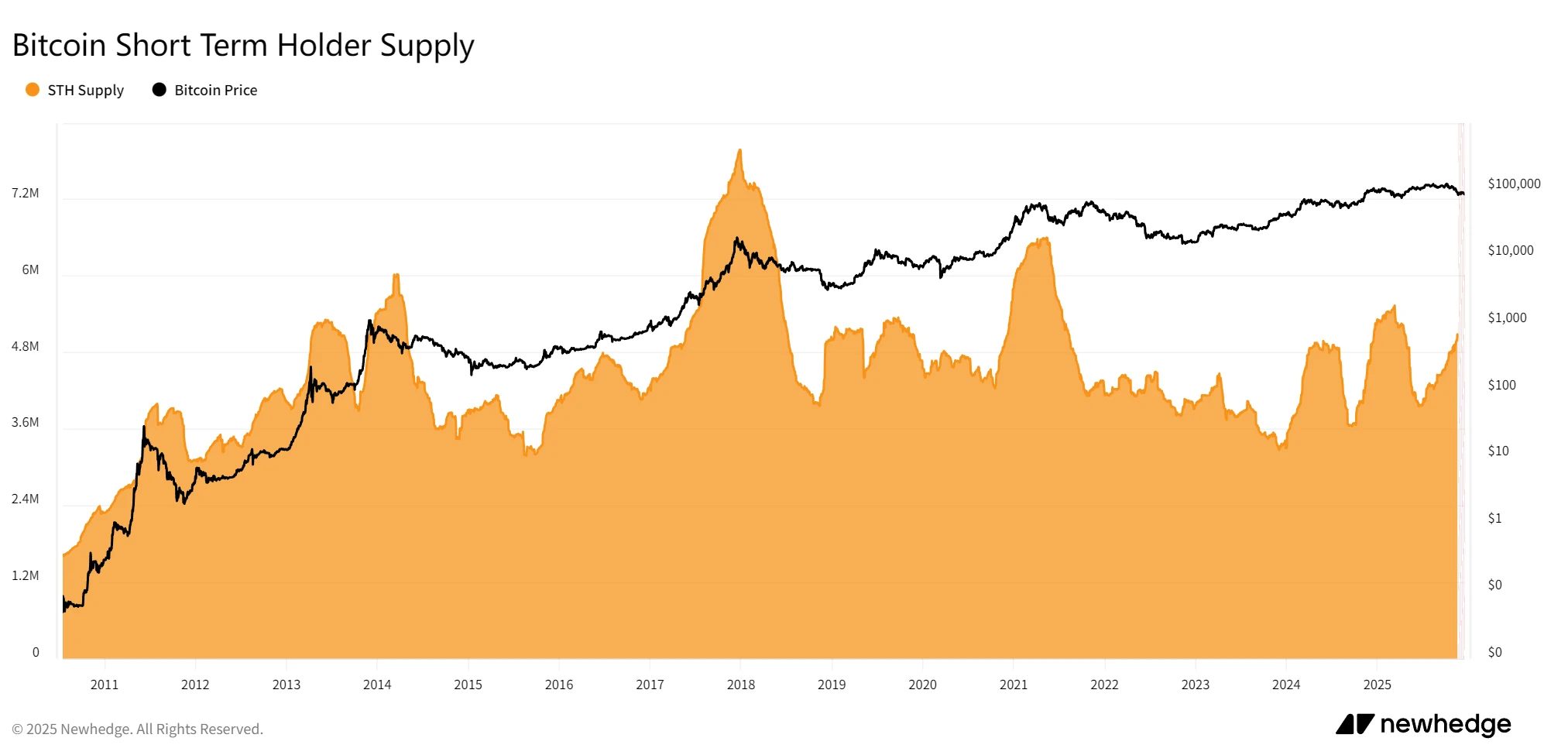
9. Bitcoin Short Term Holder Supply (STH): Has Short-Term Holder Supply Surged?

Bitcoin Short Term Holder Supply (STH) tracks the proportion of Bitcoin held for less than 155 days, assessing novice speculation.

Its principle captures new capital inflows: a high proportion indicates rampant speculation, often signaling a top; a low proportion indicates market maturity. In other words, high STH means "too many newcomers," making the bubble prone to bursting.

Historically, STH has shown surges before each bull market peak:

2017 peak: Nearly 8M BTC, peak speculation;

2021 double top: Nearly 6.5M BTC at the first top; the selling at the second absolute top did not reach a peak;

Currently, STH is continuously climbing, approaching 5.5M BTC, but the price peak was on October 6th, unlike the previous two bull markets where the STH peak and price top were closely aligned in time.
Source: https://newhedge.io/bitcoin/short-term-holder-supply

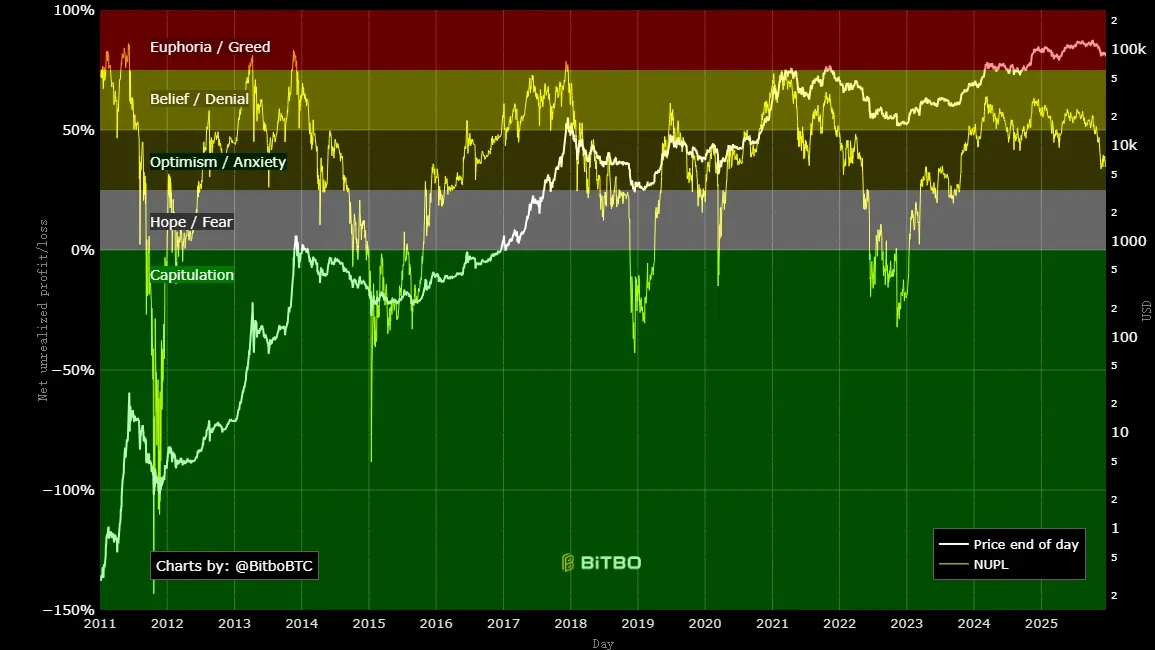
10. Bitcoin Net Unrealized Profit/Loss (NUPL): Has Unrealized Profit/Loss Entered the Greed Zone?

Bitcoin NUPL measures the overall network's ratio of unrealized profit to loss, assessing market sentiment.

Its principle is: calculate market cap minus realized cap, then divide by market cap: above 0.75 indicates greed (top signal); below 0 indicates fear (bottom). In other words, high NUPL means "everyone is in profit," indicating high selling risk.

Historically, Bitcoin NUPL has shown extremely high values before each bull market peak:

2017 peak: Exceeded 0.8, a historical extreme;

2021 double top: Exceeded 0.7, followed by a crash;

Currently (Q4 2025), NUPL reached a high of 0.64 in early March 2024 and has been fluctuating since, now falling to 0.34.
Source: https://charts.bitbo.io/net-unrealized-profit-loss

Conclusion: Structural Changes in This Bitcoin Bull Market

Judging from the above indicators, the current Bitcoin market trend does not highly align with the extreme performances seen at past bull market tops. Historical tops were often accompanied by multiple indicators overheating simultaneously, such as high Z-Score, high Puell Multiple, NUPL entering the greed zone, accompanied by LTH selling and STH surges. However, the performance of these indicators now is quite moderate.

This does not mean that the current Bitcoin price has not yet peaked; these indicators are all based on spatial judgment. The following schematic, which uses a 3-year time cycle to predict price tops,似乎 (seems to) indicate that Bitcoin has already peaked.
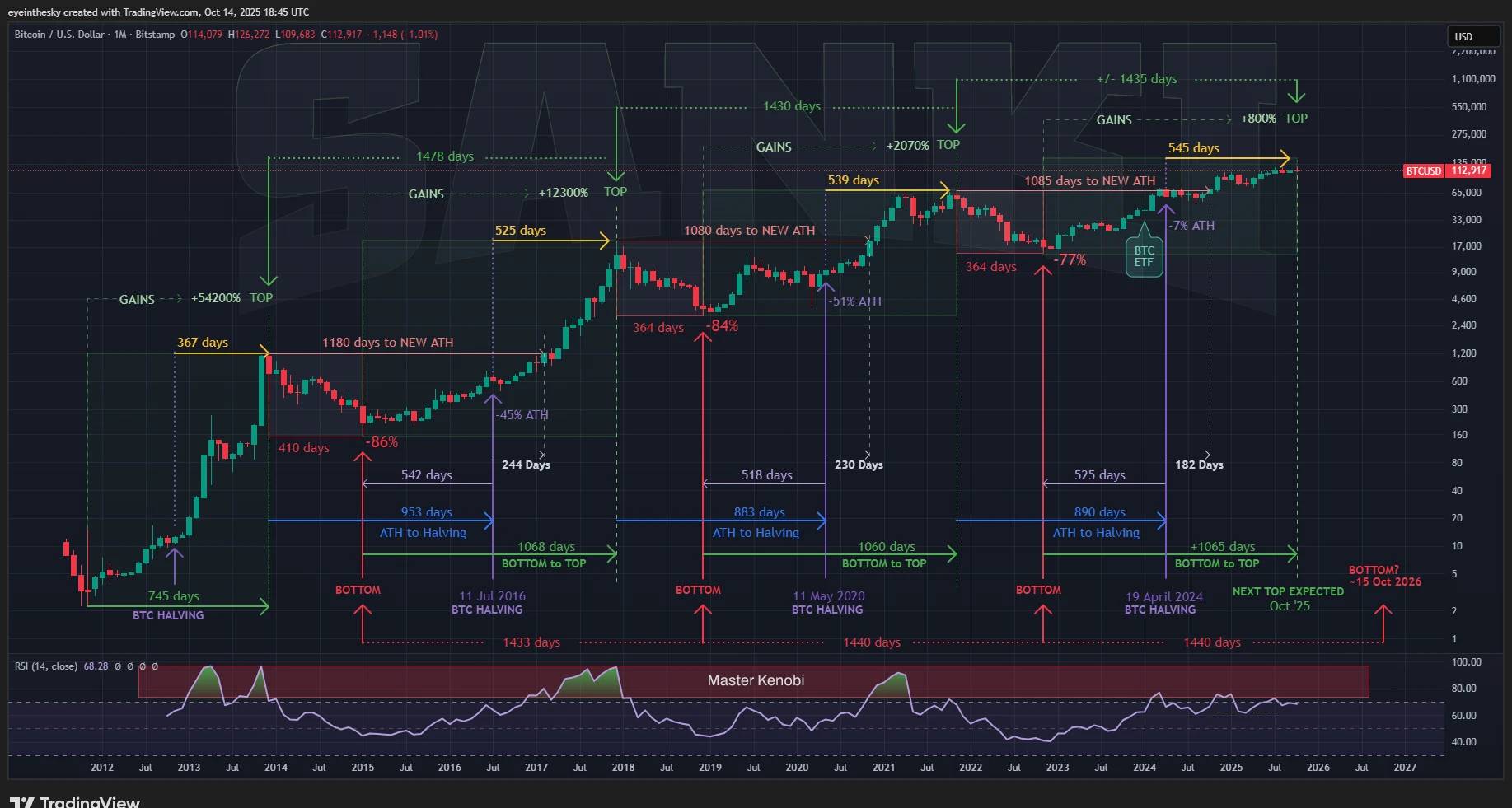
Source: https://x.com/btc_MasterPlan/status/1978180632410042828/photo/1

Of course, while analyzing the above indicators, we also found that these tools, based on linear price predictions, have already shown signs of decay in predicting top regions, exhibiting a characteristic of marginal diminishment. For example, the peak MVRV values at the 2017, 2021, and 2025 bull market tops were 10, 7, and 3 respectively. We can obviously no longer expect the MVRV to reach 7 in this bull run, and it is also not easy to predict a reliable numerical value corresponding to the top of this bull run from MVRV.

In other words, while these indicators show the market is in a neutral or moderate range, they do not confirm that the bull market is still ongoing or that a bear market has arrived. Instead, they suggest that the growth of the current Bitcoin market has become more gradual rather than explosive, which may be attributed to:

• Firstly, the introduction of Bitcoin ETFs has attracted a large amount of long-term capital, stabilizing supply dynamics. This contrasts with past retail-driven bubbles, slowing down the pace of overheating.

• Secondly, changes in global liquidity in 2025 (Fed rate cuts VS BOJ rate hikes) and geopolitical changes have repeatedly disturbed BTC's price, and the平稳 (steady) changes in various indicators恰恰 (precisely) show a more mature market.

In summary, whether the recent high on October 6th is the peak of this bull market or not, we need to acknowledge that Bitcoin price fluctuations may have broken through past historical frameworks and experiences. It seems to be undergoing a structural transformation from a "cyclical asset" to a "mainstream reserve." It is important to remind investors that these indicators may need adjusted thresholds or to be used in combination with each other to be more effective for investment decisions.

About Us

WEEX Labs is the research department under WEEX Exchange, dedicated to tracking and analyzing cryptocurrencies, blockchain technology, and emerging market trends, providing professional assessments.

The team adheres to the principles of objective, independent, and comprehensive analysis, aiming to explore cutting-edge trends and investment opportunities through rigorous research methods and前沿 (frontier) data analysis, outputting comprehensive, rigorous, and clear insights for the industry, and providing全方位 (all-round) construction and investment guidance for Web3 startups and investors.

Disclaimer

The views expressed in this article are for reference only and do not constitute an endorsement of any products or services discussed, nor do they constitute any investment, financial, or trading advice. Readers should consult qualified professionals before making financial decisions. Please note that WEEX Labs may restrict or prohibit all or part of the services from restricted areas.


Preguntas relacionadas

QWhat is the Pi Cycle Top Indicator and what does it currently indicate about the Bitcoin market?

AThe Pi Cycle Top Indicator uses the 111-day moving average (111DMA) and the 350-day moving average multiplied by 2 (350DMA x 2) to identify market tops. Historically, a crossover where the 111DMA moves above the 350DMA x 2 has signaled a market peak. As of Q4 2025, the lines have not yet crossed, suggesting this classic top signal has not been triggered.

QHow does the Puell Multiple gauge market cycles and what is its current reading?

AThe Puell Multiple measures the ratio of miners' daily revenue to its 365-day moving average. A high ratio indicates miners are highly profitable and may increase selling pressure, often preceding a market top. As of Q4 2025, the Puell Multiple is in the 1-2 range, indicating moderate miner pressure and not the extreme levels seen at past cycle tops.

QAccording to the article, what is a key structural change making the current Bitcoin bull market different from previous ones?

AA key structural change is the introduction of Bitcoin ETFs, which has attracted substantial long-term institutional capital. This has stabilized supply dynamics and created a more gradual, mature market growth pattern, contrasting with the retail-driven, explosive bubbles of the past.

QWhat does the MVRV Z-Score measure and what trend has been observed in its peak values over the last three bull markets?

AThe MVRV Z-Score measures how far Bitcoin's market value deviates from its 'realized value' (the total cost basis of all coins) in terms of standard deviation. It identifies when the market is 'too profitable.' A clear trend of diminishing peaks has been observed: the Z-Score peaked at around 10 in 2017, over 7 in 2021, and only reached approximately 3 in the current cycle, indicating its predictive power for absolute tops may be weakening.

QWhy has the Altcoin Season Index remained relatively low during this bull run, according to the analysis?

AThe Altcoin Season Index, which tracks the performance of top altcoins relative to Bitcoin, has remained in the 30-40 range and has not exceeded 60 in this cycle. The analysis suggests this is likely due to insufficient liquidity and the market being flooded with too many newly issued tokens, which has suppressed altcoin performance and delayed a classic 'altseason'.

Lecturas Relacionadas

iQiyi Is Too Impatient

The article "iQiyi Is Too Impatient" discusses the controversy surrounding the Chinese streaming platform IQiyi's recent announcement of an "AI Actor Library" during its 2026 World Conference. IQiyi claimed over 100 actors, including well-known names like Zhang Ruoyun and Yu Hewei, had joined the initiative. CEO Gong Yu suggested AI could enable actors to "star in 14 dramas a year instead of 4" and that "live-action filming might become a world cultural heritage." The announcement quickly sparked backlash. Multiple actors named in the list issued urgent statements denying they had signed any AI-related authorization agreements. This forced IQiyi to clarify that inclusion in the library only indicated a willingness to *consider* AI projects, with separate negotiations required for any specific role. The incident, which trended on social media with hashtags like "IQiyi is crazy," is presented as a sign of the company's growing desperation. Facing intense competition from short-video platforms like Douyin and Kuaishou, as well as Bilibili and Xiaohongshu, IQiyi's financial performance has weakened, with revenues declining for two consecutive years. The author argues that IQiyi is "too impatient" to tell a compelling AI story to reassure the market, especially as it pursues a listing on the Hong Kong stock exchange. The piece concludes by outlining three key "AI questions" IQiyi must answer: defining its role as a tool provider versus a content creator, balancing the "coldness" of AI with the human element audiences desire, and properly managing the interests of platforms, actors, and viewers. The core dilemma is that while AI can reduce costs and increase efficiency, it risks creating homogenized, formulaic content and devaluing human performers.

marsbitHace 45 min(s)

iQiyi Is Too Impatient

marsbitHace 45 min(s)

Trading

Spot
Futuros

Artículos destacados

Qué es BITCOIN

Entendiendo HarryPotterObamaSonic10Inu (ERC-20) y Su Posición en el Espacio Cripto En los últimos años, el mercado de criptomonedas ha sido testigo de un aumento en la popularidad de las monedas meme, capturando el interés no solo de los comerciantes, sino también de aquellos que buscan compromiso comunitario y valor de entretenimiento. Entre estos tokens únicos se encuentra HarryPotterObamaSonic10Inu (ERC-20), un proyecto intrigante que mezcla referencias culturales en el tejido de las criptomonedas. Este artículo profundiza en los aspectos clave de HarryPotterObamaSonic10Inu, explorando sus mecanismos, ethos impulsado por la comunidad y su relación con el paisaje cripto más amplio. ¿Qué es HarryPotterObamaSonic10Inu (ERC-20)? Como su nombre sugiere, HarryPotterObamaSonic10Inu es una moneda meme construida sobre la blockchain de Ethereum, clasificada bajo el estándar ERC-20. A diferencia de las criptomonedas tradicionales que pueden enfatizar la utilidad práctica o el potencial de inversión, este token prospera en el valor de entretenimiento y la fuerza de su comunidad. El proyecto tiene como objetivo fomentar un entorno donde los usuarios comprometidos puedan reunirse, compartir ideas y participar en actividades inspiradas por diversos fenómenos culturales. Una característica notable de HarryPotterObamaSonic10Inu es su cero impuestos en las transacciones. Este atractivo elemento tiene como objetivo incentivar el comercio y la participación comunitaria, sin cargos adicionales que puedan disuadir a los comerciantes de pequeña escala. El suministro total de la moneda está establecido en mil millones de tokens, una cifra que marca su intención de mantener una circulación sustancial dentro de la comunidad. Creador de HarryPotterObamaSonic10Inu (ERC-20) Los orígenes de HarryPotterObamaSonic10Inu están algo envueltos en misterio; los detalles sobre el creador siguen siendo desconocidos. El desarrollo de este token carece de un equipo identificable o de un plan explícito, lo cual no es inusual dentro del sector de monedas meme. En cambio, el proyecto ha surgido de manera orgánica, con su progreso muy dependiente del entusiasmo y la participación de su comunidad. Inversores de HarryPotterObamaSonic10Inu (ERC-20) En cuanto a inversiones externas y respaldo, HarryPotterObamaSonic10Inu también sigue siendo ambiguo. El token no lista ninguna fundación de inversión conocida o apoyo organizacional significativo. En cambio, la savia del proyecto es su comunidad de base, que informa su crecimiento y sostenibilidad a través de la acción colectiva y el compromiso en el espacio cripto. ¿Cómo Funciona HarryPotterObamaSonic10Inu (ERC-20)? Como una moneda meme, HarryPotterObamaSonic10Inu opera principalmente fuera de los marcos tradicionales que a menudo rigen el valor de los activos. Hay varios aspectos distintivos que definen cómo funciona el proyecto: Transacciones Sin Impuestos: Sin tarifas impositivas en las transacciones, los usuarios pueden comprar y vender el token libremente sin preocuparse por costos ocultos. Compromiso Comunitario: El proyecto prospera en la interacción comunitaria, aprovechando plataformas de redes sociales para crear entusiasmo y facilitar la participación. Las discusiones, el intercambio de contenido y el compromiso son elementos cruciales que ayudan a expandir su alcance y fomentar la lealtad entre los seguidores. Sin Utilidad Práctica: Cabe señalar que HarryPotterObamaSonic10Inu no ofrece utilidad concreta dentro del ecosistema financiero. Más bien, se clasifica como un token principalmente para actividades de entretenimiento y comunitarias. Referencia Cultural: El token incorpora astutamente elementos de la cultura popular para atraer interés, conectando con entusiastas de los memes y seguidores de las criptomonedas por igual. HarryPotterObamaSonic10Inu ejemplifica cómo las monedas meme operan de manera diferente a los proyectos de criptomonedas más tradicionales, ingresando al mercado como construcciones sociales innovadoras en lugar de activos utilitarios. Cronología de HarryPotterObamaSonic10Inu (ERC-20) La historia de HarryPotterObamaSonic10Inu está marcada por varios hitos notables: Creación: El token surgió de un meme viral, capturando la imaginación de muchos entusiastas de las criptomonedas. Las fechas específicas de creación no están disponibles, subrayando su ascenso orgánico. Listado en Exchanges: HarryPotterObamaSonic10Inu ha llegado a varios exchanges, permitiendo un acceso y comercio más fácil por parte de la comunidad. Iniciativas de Compromiso Comunitario: Actividades continuas destinadas a mejorar la interacción comunitaria, incluyendo concursos, campañas en redes sociales y generación de contenido por parte de fanáticos y defensores. Planes de Expansión Futuros: La hoja de ruta del proyecto incluye el lanzamiento de una colección de NFT, mercancía y un sitio de comercio electrónico relacionado con sus temas culturales, involucrando aún más a la comunidad e intentando añadir más dimensiones a su ecosistema. Puntos Clave Sobre HarryPotterObamaSonic10Inu (ERC-20) Naturaleza Impulsada por la Comunidad: El proyecto prioriza la participación colectiva y la creatividad, asegurando que la involucración de los usuarios esté a la vanguardia de su desarrollo. Clasificación como Moneda Meme: Representa la epítome de las criptomonedas basadas en el entretenimiento, diferenciándose de los vehículos de inversión tradicionales. Sin Afiliación Directa con Bitcoin: A pesar de la similitud en el nombre del ticker, HarryPotterObamaSonic10Inu es distinto y no tiene relación con Bitcoin u otras criptomonedas establecidas. Enfoque en la Colaboración: HarryPotterObamaSonic10Inu está diseñado para crear un espacio para la colaboración y el intercambio de historias entre sus poseedores, proporcionando una vía para la creatividad y el vínculo comunitario. Perspectivas Futuras: La ambición de expandirse más allá de su premisa inicial hacia NFTs y mercancías describe un camino para que el proyecto potencialmente ingrese a avenidas más tradicionales dentro de la cultura digital. A medida que las monedas meme continúan capturando la imaginación de la comunidad de criptomonedas, HarryPotterObamaSonic10Inu (ERC-20) se destaca debido a sus lazos culturales y su enfoque centrado en la comunidad. Si bien puede no encajar en el molde típico de un token impulsado por la utilidad, su esencia radica en la alegría y la camaradería fomentadas entre sus seguidores, destacando la naturaleza en evolución de las criptomonedas en una era cada vez más digital. A medida que el proyecto continúa desarrollándose, será importante observar cómo las dinámicas comunitarias influyen en su trayectoria en el cambiante paisaje de la tecnología blockchain.

1.3k Vistas totalesPublicado en 2024.04.01Actualizado en 2024.12.03

Qué es BITCOIN

Cómo comprar BTC

¡Bienvenido a HTX.com! Hemos hecho que comprar Bitcoin (BTC) sea simple y conveniente. Sigue nuestra guía paso a paso para iniciar tu viaje de criptos.Paso 1: crea tu cuenta HTXUtiliza tu correo electrónico o número de teléfono para registrarte y obtener una cuenta gratuita en HTX. Experimenta un proceso de registro sin complicaciones y desbloquea todas las funciones.Obtener mi cuentaPaso 2: ve a Comprar cripto y elige tu método de pagoTarjeta de crédito/débito: usa tu Visa o Mastercard para comprar Bitcoin (BTC) al instante.Saldo: utiliza fondos del saldo de tu cuenta HTX para tradear sin problemas.Terceros: hemos agregado métodos de pago populares como Google Pay y Apple Pay para mejorar la comodidad.P2P: tradear directamente con otros usuarios en HTX.Over-the-Counter (OTC): ofrecemos servicios personalizados y tipos de cambio competitivos para los traders.Paso 3: guarda tu Bitcoin (BTC)Después de comprar tu Bitcoin (BTC), guárdalo en tu cuenta HTX. Alternativamente, puedes enviarlo a otro lugar mediante transferencia blockchain o utilizarlo para tradear otras criptomonedas.Paso 4: tradear Bitcoin (BTC)Tradear fácilmente con Bitcoin (BTC) en HTX's mercado spot. Simplemente accede a tu cuenta, selecciona tu par de trading, ejecuta tus trades y monitorea en tiempo real. Ofrecemos una experiencia fácil de usar tanto para principiantes como para traders experimentados.

4.6k Vistas totalesPublicado en 2024.12.12Actualizado en 2025.03.21

Cómo comprar BTC

Qué es $BITCOIN

ORO DIGITAL ($BITCOIN): Un Análisis Integral Introducción al ORO DIGITAL ($BITCOIN) ORO DIGITAL ($BITCOIN) es un proyecto basado en blockchain que opera en la red Solana, cuyo objetivo es combinar las características de los metales preciosos tradicionales con la innovación de las tecnologías descentralizadas. Aunque comparte un nombre con Bitcoin, a menudo referido como “oro digital” debido a su percepción como un refugio de valor, ORO DIGITAL es un token separado diseñado para crear un ecosistema único dentro del paisaje Web3. Su meta es posicionarse como un activo digital alternativo viable, aunque los detalles sobre sus aplicaciones y funcionalidades aún están en desarrollo. ¿Qué es ORO DIGITAL ($BITCOIN)? ORO DIGITAL ($BITCOIN) es un token de criptomoneda diseñado explícitamente para su uso en la blockchain de Solana. A diferencia de Bitcoin, que proporciona un papel de almacenamiento de valor ampliamente reconocido, este token parece centrarse en aplicaciones y características más amplias. Aspectos notables incluyen: Infraestructura Blockchain: El token está construido sobre la blockchain de Solana, conocida por su capacidad para manejar transacciones de alta velocidad y bajo costo. Dinámicas de Suministro: ORO DIGITAL tiene un suministro máximo limitado a 100 cuatrillones de tokens (100P $BITCOIN), aunque los detalles sobre su suministro circulante no se han divulgado actualmente. Utilidad: Si bien las funcionalidades precisas no están delineadas explícitamente, hay indicios de que el token podría ser utilizado para diversas aplicaciones, potencialmente involucrando aplicaciones descentralizadas (dApps) o estrategias de tokenización de activos. ¿Quién es el Creador de ORO DIGITAL ($BITCOIN)? En la actualidad, la identidad de los creadores y el equipo de desarrollo detrás de ORO DIGITAL ($BITCOIN) sigue siendo desconocida. Esta situación es típica entre muchos proyectos innovadores dentro del espacio blockchain, particularmente aquellos alineados con las finanzas descentralizadas y fenómenos de monedas meme. Si bien tal anonimato puede fomentar una cultura impulsada por la comunidad, intensifica las preocupaciones sobre la gobernanza y la responsabilidad. ¿Quiénes son los Inversores de ORO DIGITAL ($BITCOIN)? La información disponible indica que ORO DIGITAL ($BITCOIN) no tiene patrocinadores institucionales conocidos ni inversiones destacadas de capital de riesgo. El proyecto parece operar en un modelo de peer-to-peer centrado en el apoyo y la adopción de la comunidad en lugar de rutas de financiamiento tradicionales. Su actividad y liquidez se sitúan principalmente en intercambios descentralizados (DEX), como PumpSwap, en lugar de plataformas de trading centralizadas establecidas, lo que resalta aún más su enfoque de base. Cómo Funciona ORO DIGITAL ($BITCOIN) Los mecanismos operativos de ORO DIGITAL ($BITCOIN) pueden elaborarse en función de su diseño blockchain y atributos de red: Mecanismo de Consenso: Al aprovechar el único proof-of-history (PoH) de Solana combinado con un modelo de proof-of-stake (PoS), el proyecto asegura una validación de transacciones eficiente que contribuye al alto rendimiento de la red. Tokenómica: Si bien los mecanismos deflacionarios específicos no se han detallado extensamente, el vasto suministro máximo de tokens implica que podría atender microtransacciones o casos de uso nicho que aún están por definirse. Interoperabilidad: Existe el potencial de integración con el ecosistema más amplio de Solana, incluyendo varias plataformas de finanzas descentralizadas (DeFi). Sin embargo, los detalles sobre integraciones específicas permanecen no especificados. Cronología de Eventos Clave Aquí hay una cronología que destaca hitos significativos relacionados con ORO DIGITAL ($BITCOIN): 2023: El despliegue inicial del token ocurre en la blockchain de Solana, marcado por su dirección de contrato. 2024: ORO DIGITAL gana visibilidad al estar disponible para trading en intercambios descentralizados como PumpSwap, permitiendo a los usuarios comerciar contra SOL. 2025: El proyecto presencia actividad de trading esporádica y potencial interés en compromisos liderados por la comunidad, aunque no se han documentado asociaciones notables o avances técnicos hasta el momento. Análisis Crítico Fortalezas Escalabilidad: La infraestructura subyacente de Solana soporta altos volúmenes de transacciones, lo que podría mejorar la utilidad de $BITCOIN en varios escenarios de transacción. Accesibilidad: El potencial bajo precio de trading por token podría atraer a inversores minoristas, facilitando una participación más amplia debido a oportunidades de propiedad fraccionada. Riesgos Falta de Transparencia: La ausencia de patrocinadores, desarrolladores o un proceso de auditoría conocidos públicamente puede generar escepticismo sobre la sostenibilidad y confiabilidad del proyecto. Volatilidad del Mercado: La actividad de trading depende en gran medida del comportamiento especulativo, lo que puede resultar en una volatilidad de precios significativa y en incertidumbre para los inversores. Conclusión ORO DIGITAL ($BITCOIN) surge como un proyecto intrigante pero ambiguo dentro del ecosistema de Solana en rápida evolución. Si bien intenta aprovechar la narrativa del “oro digital”, su alejamiento del papel establecido de Bitcoin como refugio de valor subraya la necesidad de una diferenciación más clara de su utilidad y estructura de gobernanza previstas. La aceptación y adopción futura dependerán probablemente de abordar la actual opacidad y de definir sus estrategias operativas y económicas de manera más explícita. Nota: Este informe abarca información sintetizada disponible hasta octubre de 2023, y pueden haber ocurrido desarrollos más allá del período de investigación.

83 Vistas totalesPublicado en 2025.05.13Actualizado en 2025.05.13

Qué es $BITCOIN

Discusiones

Bienvenido a la comunidad de HTX. Aquí puedes mantenerte informado sobre los últimos desarrollos de la plataforma y acceder a análisis profesionales del mercado. A continuación se presentan las opiniones de los usuarios sobre el precio de BTC (BTC).

活动图片