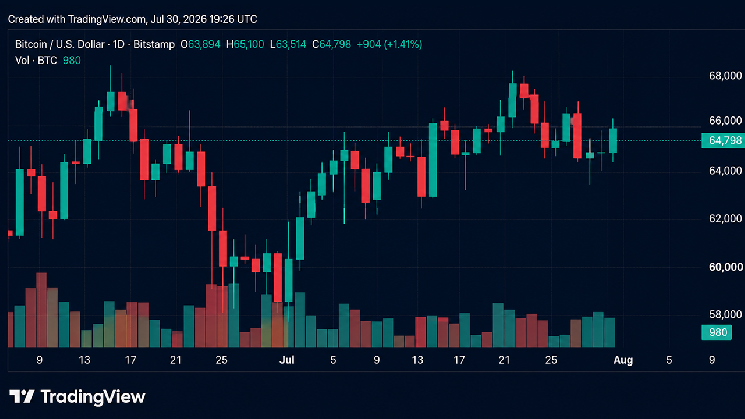
Analyst warns Bitcoin may enter ‘new redistribution phase’ – $63,700 next?

ambcryptoPublicado a 2026-03-08Actualizado a 2026-03-08

Resumen

The crypto market is experiencing cooling volatility after a period of heightened tension. Bitcoin, which peaked at $73,000 amid the US-Iran conflict, is now in a corrective phase, trading around $67,174. Analysts highlight $63,700 as a critical on-chain support level; a break below could lead to further declines toward $57,000 or even $52,400. A drop to $48,700 would signal a stronger correction and challenge the medium-term bullish outlook. Analyst Joao Wedson warns that losing key structural levels may mark the start of a "new redistribution phase." Bitcoin's current trading range ($67k–$74k) places it in a "high heat" zone, indicating a stretched market. However, long-term holders remain calm, with the Cumulative Value Days Destroyed (CVDD) metric at 0.34—well below the 2.0 level typical of market tops—suggesting accumulation rather than distribution. Short-term signals remain weak, with the MVRV Ratio near -10%, indicating unrealized losses for recent buyers. Market sentiment reflects "Extreme Fear," with a reading of 12 on the Crypto Fear & Greed Index. Upcoming geopolitical developments, particularly potential Middle East ceasefire talks, could influence Bitcoin's direction. A ceasefire may boost risk appetite, while prolonged tensions could favor traditional safe-haven assets, potentially limiting Bitcoin's upside above $70,000.

The crypto market is currently navigating a period of cooling volatility following a high-stakes week of global tension.

After a significant rally fueled by the fallout of the US-Iran conflict, which pushed Bitcoin to a peak of $73,000, the leading cryptocurrency has entered a corrective phase.

As of press time, BTC was trading at $67,174, marking a modest 1.25% decline over the last 24 hours.

Despite the pullback since the 6th of March, the price action remains constructive for bulls as long as it stays North of the $65,000 psychological support level.

However, analysts are closely watching the $63,700 on-chain level as a critical support. If this level breaks, downside risks could increase, with $57,000 as the first major support, followed by $52,400.

A deeper drop toward $48,700 would signal a much stronger correction and could force a reassessment of Bitcoin’s medium-term bullish outlook.

For now, the battle is for the $63,000–$65,000 range.

Analysts and their fears surrounding Bitcoin

Remarking on the same, Joao Wedson, Founder and CEO of Alphractal, said,

“When the market loses key on-chain structural levels, it often marks the beginning of a new redistribution phase.”

Explaining his fear with some context, Wedson also attached a Fibonacci-Adjusted Market Mean Price model chart.

According to the chart, when Bitcoin [BTC] trades within the lower green and blue bands, it usually signals strong accumulation and sustainable growth.

However, as of early March 2026, Bitcoin trading between $67,000 and $74,000 has pushed it into the yellow-to-orange “high heat” zone, meaning the market is becoming stretched.

While it hasn’t reached the extreme red-zone peaks seen during past market tops, it has moved beyond the steady growth phase into a more volatile, late-cycle stage.

Adding more weight to the current situation, market decoder – Darkfost noted,

“While volatility is in full swing across the markets and everyone seems to be reacting, some participants remain calm and simply observe.”

The analyst noted that while some traders may be preparing to sell, long-term Bitcoin holders appear to be holding steady.

What do on-chain metrics tell us about Bitcoin?

As per Darkfost, the Cumulative Value Days Destroyed (CVDD) metric was around 0.34, showing very little movement of older coins.

Such low activity is typically associated with accumulation phases, where experienced investors prefer to hold rather than distribute.

Historically, major market tops begin forming only when CVDD rises above 2.0, signaling large-scale selling by long-term holders.

Since the metric remains far below that level, it suggests that long-term investors do not yet believe the market has reached its peak, despite Bitcoin trading in a higher valuation zone.

In contrast, short-term signals remain weak.

The 30-day MVRV Ratio and Active Addresses data analysed by AMBCrypto indicate Bitcoin was still recovering from February’s volatility.

While activity briefly spiked around the 10th of February, it likely reflected volatility-driven trading rather than real growth.

Meanwhile, the MVRV Ratio hovered near −10%. This meant many recent buyers still held unrealized losses.

That structure could create selling pressure if BTC approached its break-even levels.

‘Extreme Fear’ and upcoming events that will shape Bitcoin

Market sentiment remained fragile. The Crypto Fear & Greed Index showed Extreme Fear, with a reading near 12.

Even so, macro developments could shape the next directional move. Markets watched the 12th of March geopolitical timeline closely.

Some analysts expected diplomatic progress in the Middle East.

Oil prices also surged sharply during the week, increasing inflation concerns across global markets. That dynamic placed Bitcoin’s geopolitical hedge narrative under scrutiny.

A confirmed ceasefire could restore risk appetite and trigger a relief rally.

However, prolonged tensions and rising oil prices could push investors toward traditional safe-haven assets.

In that scenario, Bitcoin might struggle to reclaim levels above $70,000.


Final Summary

  • A break below $63,700 could trigger a deeper correction, with $57K and $52.4K as the next major downside levels.
  • The potential Middle East ceasefire could act as a catalyst, either restoring risk appetite or reinforcing caution if tensions persist.


Preguntas relacionadas

QWhat is the critical on-chain support level for Bitcoin that analysts are closely watching?

A$63,700

QAccording to the Alphractal CEO, what does it often mark when the market loses key on-chain structural levels?

AThe beginning of a new redistribution phase.

QWhat does a Cumulative Value Days Destroyed (CVDD) metric reading well below 2.0 suggest about long-term Bitcoin holders?

AIt suggests they are not selling on a large scale and do not yet believe the market has reached its peak.

QWhat was the reading on the Crypto Fear & Greed Index mentioned in the article, and what sentiment did it indicate?

AA reading near 12, indicating 'Extreme Fear'.

QWhat are the two potential outcomes for Bitcoin's price mentioned, depending on the developments in the Middle East?

AA confirmed ceasefire could trigger a relief rally, while prolonged tensions could cause Bitcoin to move towards traditional safe-haven assets and struggle to reclaim $70,000.

Lecturas Relacionadas

Warsh Hearing Concludes: What Are the Notable Signals for the Crypto Industry?

The Senate Banking Committee held a confirmation hearing for Judy Shelton, a Federal Reserve nominee, who faced intense questioning regarding her ability to maintain the central bank's independence amid pressure from President Trump to lower interest rates. Shelton denied any pre-arranged commitments on rate cuts and emphasized her independence, though Democrats remained skeptical, citing contradictions with Trump's public statements. Shelton characterized post-pandemic inflation as a major policy failure and called for a "regime change" in the Fed’s approach, including reforms to inflation measurement and communication strategies. She criticized the current practice of Fed officials frequently signaling future rate moves and did not commit to maintaining post-meeting press conferences, suggesting potential reductions in transparency. Regarding crypto markets, Shelton’s extensive investments in digital asset companies—including Solana, DeFi, and blockchain infrastructure—were noted, though she has pledged to divest these holdings due to ethics rules. Her familiarity with the crypto industry and deregulatory leanings may signal a more open, though cautious, stance toward digital assets. However, concerns were raised about potential conflicts of interest, especially given Trump family involvement in crypto-financial ventures. The timing of her confirmation remains uncertain, pending a Justice Department investigation into current Chair Powell. Shelton’s potential leadership could lead to a more hawkish, productivity-focused Fed with tighter policy communication—factors that may significantly influence liquidity conditions and macro narratives for crypto markets.

marsbitHace 6 hora(s)

Warsh Hearing Concludes: What Are the Notable Signals for the Crypto Industry?

marsbitHace 6 hora(s)

Trading

Spot
Futuros
活动图片