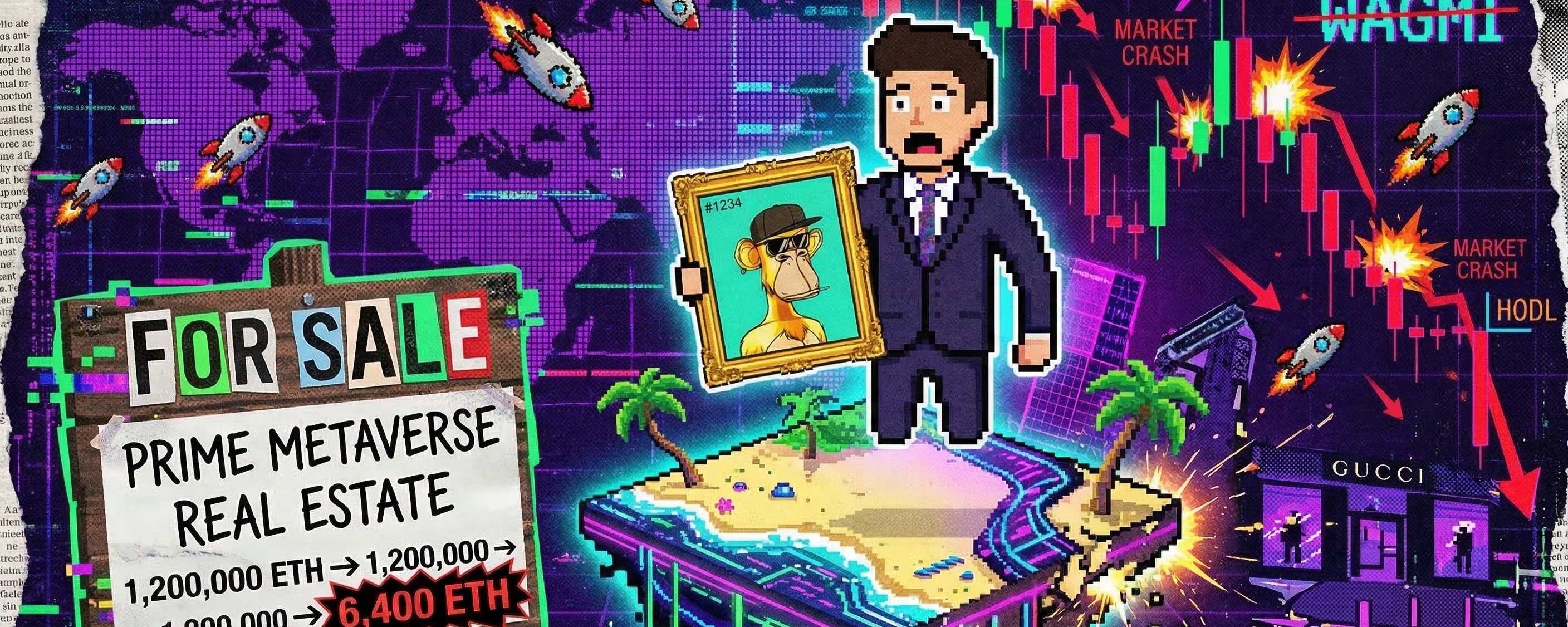
An Expensive Fantasy: The Evaporation of Wealth in Metaverse Real Estate

比推Publicado a 2026-03-20Actualizado a 2026-03-20

Resumen

An investor recounts losing a $1.2 million fortune in the metaverse real estate crash, with their portfolio now valued at just $6,400. They purchased 11 virtual properties across platforms like Decentraland, The Sandbox, and Meta’s Horizon Worlds, driven by hype and promises of a digital frontier. Despite early enthusiasm, low user engagement, corporate pullouts (like Gucci), and platform shutdowns led to catastrophic value declines. The investor reflects on the culture of “diamond hands” (holding assets despite massive losses) and irrational optimism, while also noting losses from NFT investments like a Bored Ape. Meta’s $84 billion loss on its metaverse division underscores the speculative bubble’s collapse. The narrative concludes with a shift to AI-based virtual land investment, repeating the cycle of high-risk speculation.

Author: @gothburz

Compiled by: Big Pliers | PANews Lobster

Original Title: Metaverse Real Estate Victim's Account: My $1.2 Million Is Now Only $6,400


"Diamond hands" means: even if your investment drops by 94%, you never sell. We’ve packaged this financial paralysis as a personality trait.

My net worth peaked at $1.2 million.

But not a single cent of that money was real.

I’m not speaking philosophically. I mean, it existed on some servers—and those servers are now shut down.

I owned eleven properties in the metaverse. Three in Decentraland, four in The Sandbox, two in Voxels, one in Otherside. And a seaside villa in Horizon Worlds—I paid $214,000 for it because Mark Zuckerberg himself said it was the "next frontier."

Last week, that "frontier" closed.

It’s now a mobile app.

Last year, I sent the same message to 340 people: "You have no idea how early we were."

I stopped sending those messages later. Not because I admitted I was wrong, but because most of them had blocked me.

I entered the metaverse real estate market in November 2021. Everyone was buying back then. Someone spent $450,000 just to be Snoop Dogg’s neighbor in a game. In a video game. Where the avatars didn’t even have legs.

Yes, those avatars had no legs.

But I thought that was actually a good sign.

"Legs are coming eventually," I told everyone in the Discord group. "Legs are on the product roadmap." Three hundred people immediately replied with rocket emojis.

I gave myself a title—"Digital Real Estate Tycoon."

I put it in my Twitter bio.

I put it in my LinkedIn job title.

I even went on a podcast to talk about it. That podcast had eleven listeners. Three were bots. The rest were my own alt accounts.

My combined virtual properties were larger than my actual apartment.

But my actual apartment has furniture.

Location, location, location.

My most valuable asset was a plot right next to a virtual Gucci store.

In 2023, Gucci pulled out.

The store is still there. No one goes in. It’s like a shopping mall in Ohio—but with worse graphics and no food court.

I didn’t sell.

Diamond hands.

That’s what we always said—"diamond hands." It means: even if your investment drops by 94%, you never sell. We packaged this financial paralysis as a personality trait.

There was a guy in my Discord group who spent $2.4 million on a manor on a prime 618 plot in Decentraland. Prime location. High foot traffic.

I asked him what "foot traffic" meant on a platform with a daily active user count of 38.

He said I didn’t understand the technology.

He was right, I didn’t.

But I kept buying more.

We had a DAO—a decentralized autonomous organization. Meaning, everyone votes on decisions.

There were nine of us total. Three never showed up. Two voted on everything without reading the proposals. The other four were me and my alt accounts.

We voted to "acquire strategic plots."

Unanimously approved.

I cast four votes myself.

My portfolio peaked at $1.2 million. I told everyone. I made a spreadsheet. I predicted a 40x return by 2025. I made a business plan. One slide said:

"We are building a digital economy."

That slide had a rocket emoji.

That was my entire financial model.

In 2023, I spent $189,000 on a Bored Ape NFT.

Now it’s worth $14,000.

I don’t talk about that ape.

But I still use it as my profile picture. If someone asks, I say "I’m long-term bullish."

"Long-term bullish" means: if I sold, I’d cry in a Panera Bread.

My mom asked me what a Bored Ape was.

I said: "Digital art on the blockchain."

She asked why it was more expensive than her car.

I said: "You don’t understand Web3."

She said: "All I know is you live in a studio apartment."

She’s not in my Discord group.

Justin Bieber spent $1.3 million on one.

Now it’s probably worth around $90,000.

Hearing that made me feel better.

That’s the power of community.

WAGMI. We're All Gonna Make It.

We said it every day. In group chats. As the floor price kept dropping. As trading volume dried up. As 95% of NFT projects went to zero.

We’re all gonna make it.

None of us made it.

But we said it with absolute conviction, paired with laser-eye profile pictures. That has to count for something, right?

It doesn’t.

But we said it did. That’s called decentralized consensus.

Meta spent $84 billion on the metaverse.

Let me say that again.

$84 billion.

More than the GDP of Luxembourg. More than the combined GDPs of Iceland, Luxembourg, and Malta. They poured that money into a platform where avatars had no legs, the graphics looked like a 2006 Wii game, and the concurrent user count was lower than the lunch rush at a Chipotle in Des Moines.

They just removed Horizon Worlds from VR headsets.

It continues to exist as a mobile app.

My seaside villa is now a mobile app.

Location, location, location.

Zuckerberg renamed the entire company for this. Facebook became Meta. A $900 billion company changed its legal name because the CEO watched *Ready Player One* and said, "I want that."

Reality Labs division: lost $10 billion in 2021, $14 billion in 2022, $16 billion in 2023, $18 billion in 2024, $19 billion in 2025.

This isn’t strategy; it’s speedrunning.

This year, they laid off 1,500 employees from Reality Labs. Shut down three VR studios. Canceled Supernatural. Put the entire VR social vision in a coffin and announced: "We’re pivoting to AI and wearables."

This pivot took four years and burned $84 billion.

I pivoted too.

I’m now an AI real estate investor.

I bought a plot in an AI-generated virtual world that doesn’t exist yet. The founder said it’s at the "intersection of spatial computing and large language models."

I have no idea what that means.

I gave him $40,000.

He has a whitepaper, 47 pages. I read the title and the tokenomics section. That section was a pie chart. I love pie charts. They make everything look planned.

This project has a roadmap. Q1: Build community. Q2: Launch beta. Q3: Expand ecosystem. Q4: Blank.

Q4 is always blank.

That’s the slot reserved for the exit.

My accountant asked me to value my metaverse portfolio for tax purposes.

I said: $1.2 million.

He said: Current market value.

I said: $6,400.

He stared at me for eleven seconds.

I know because I counted.

He asked if I had any other investments.

I showed him my NFTs.

He stared longer.

I said these are "cultural artifacts with long-term provenance."

He asked if I had considered buying a 401(k).

I said 401(k)s are "legacy artifacts of traditional finance."

He told me to leave his office.

The metaverse is dead.

I don’t accept that.

I am a digital real estate tycoon. I own eleven properties across four platforms. I have a seaside villa that’s now a mobile app, a plot next to an empty Gucci store, and a cartoon monkey that cost more than my actual car.

Location, location, location.

This location is nothingness.

But I was early.

I’m always early.

It’s the same thing as being wrong—just said with more confidence.


Twitter:https://twitter.com/BitpushNewsCN

Bitpush TG Discussion Group:https://t.me/BitPushCommunity

Bitpush TG Subscription: https://t.me/bitpush

Original article link:https://www.bitpush.news/articles/7621504

Preguntas relacionadas

QWhat was the peak value of the author's metaverse real estate portfolio, and what is its current estimated value?

AThe peak value of the author's metaverse real estate portfolio was $1.2 million. Its current estimated value is $6,400.

QAccording to the author, what does the term 'diamond hands' mean in the context of their investment strategy?

AAccording to the author, 'diamond hands' means refusing to sell an investment even after it has fallen by 94%, a form of financial paralysis that was packaged as a personality trait.

QWhich major company invested heavily in the metaverse, how much did it lose, and what was the consequence for the author's property?

AMeta (formerly Facebook) invested heavily in the metaverse, losing over $100 billion across several years. A consequence for the author was that their $214,000 Horizon Worlds 'ocean-view villa' was moved from VR to a mobile app after the platform was shut down on VR headsets.

QWhat expensive NFT did the author purchase and what is the significant difference between its purchase price and its current value?

AThe author purchased a Bored Ape Yacht Club (BAYC) NFT for $189,000. It is now worth approximately $14,000, representing a significant loss.

QWhat ironic justification does the author use for their continued investment in digital assets despite the massive financial losses?

AThe author ironically justifies their continued investment by claiming they were 'early,' which they state is the same thing as being wrong, but said with more confidence.

Lecturas Relacionadas

Will the Next Crypto Bull Run Start with On-Chain Trading of SpaceX?

This article presents a scenario-based forecast for the crypto industry from 2026 to 2029, arguing that the next major cycle will be driven not by technological narratives but by legal access to real-world assets. The author predicts that by mid-2026, pre-IPO perpetual contracts for top private companies like SpaceX, OpenAI, and Anthropic on platforms like Hyperliquid will become the primary gateway for accessing quality assets, as most crypto-native tokens fail to capture real value. The much-hyped AI x Crypto intersection largely fails except for prediction markets, which thrive on betting on AI model supremacy. By 2027, public blockchain foundations are forced to choose between catering to retail speculation or building compliant infrastructure for institutions, with many opting for the latter. Growth in stablecoins and tokenized private credit/equity hits a "triple ceiling" due to regulatory and political uncertainty rather than market demand. The pivotal shift is forecast for 2028. A major liquidation event in pre-IPO perpetuals exposes the structural flaw of synthetic markets lacking a real underlying asset anchor. In response, regulatory changes finally allow the public solicitation of private securities resales to verified accredited investors. This creates a legitimate secondary market for real company equity, which then becomes the core asset class of the new bull market, relegating synthetic perps to a niche role. By 2029, the industry becomes "boring" but foundational. Tokens without claims on real cash flows or assets cease trading. Stablecoin growth is steady but politically capped. Crypto infrastructure fades from view as it gets absorbed into traditional finance backends. The article's central thesis is that the key bottleneck for crypto's next phase is legal and regulatory channels for real asset ownership, not technology.

marsbitHace 25 min(s)

Will the Next Crypto Bull Run Start with On-Chain Trading of SpaceX?

marsbitHace 25 min(s)

The Value Distribution of Stablecoins

**Summary: The Value Distribution of Stablecoins** The article argues that stablecoins are evolving from mere trading tools into broader channels for dollar access. It divides the stablecoin ecosystem into four layers to analyze how value is distributed: 1. **Issuance Layer:** Mints stablecoins, holds reserve assets, and captures the spread between reserve yield and user costs (e.g., Tether, Circle). This layer currently earns the largest profit margin. 2. **Infrastructure Layer:** Connects stablecoins to the traditional financial system, handling fiat on/off-ramps, banking integration, compliance (KYC/AML), and asset management (e.g., Bridge, BVNK). This is the "unglamorous" but critical work, building the essential bridges between crypto and real-world finance. 3. **Acquiring/Distribution Layer:** Integrates stablecoins into merchant systems, manages payment flows, and provides enterprise financial software (e.g., Stripe, Coinbase). They act as the access point for businesses. 4. **Application Layer:** The end-users and businesses that ultimately use stablecoins for payments, settlements, or as a store of value. They benefit from convenience but have little pricing power. The core thesis is that while the issuance layer currently dominates profits, the often-overlooked **infrastructure layer holds significant long-term potential**. The real challenge and barrier to mass adoption is not the on-chain transfer of stablecoins (which is simple), but the complex "last mile" integration into existing business workflows, banking systems, and regulatory frameworks across different countries. Companies in this layer are currently in a "land grab" phase, investing heavily to build networks, secure bank partnerships, and establish compliance pathways. While their position is currently pressured by the profitable issuers above and distribution platforms below, the article suggests that if stablecoins become a default financial rail for businesses, the infrastructure providers who have done the hard work of integration will ultimately gain strong pricing power and become entrenched, essential players.

marsbitHace 7 hora(s)

The Value Distribution of Stablecoins

marsbitHace 7 hora(s)

The Value Distribution of Stablecoins

The Value Distribution of Stablecoins The article argues that stablecoins are evolving from a mere trading tool into a broad "dollar channel." It analyzes the industry's value chain through four layers: 1. **Issuance Layer (e.g., Tether, Circle):** The top layer that mints stablecoins, holds reserve assets, and captures the thickest interest rate spread. 2. **Infrastructure Layer (e.g., Bridge, BVNK):** Connects stablecoins to the traditional financial system, handling critical but complex "dirty work" like fiat on/off-ramps, banking integration, compliance (KYC/AML), and cross-border settlement. 3. **Acquiring/Distribution Layer (e.g., Stripe, Coinbase):** Embeds stablecoins into merchant systems, manages payment flows, and integrates with enterprise software. 4. **Application Layer:** End-users and businesses that ultimately use stablecoins for payments, settlement, or storing value. The author posits that while the issuance layer currently captures the most profit, the most overlooked and potentially critical layer is infrastructure. The core challenge for stablecoin adoption isn't the on-chain transfer (which is simple), but bridging the gap between blockchain and the real-world financial system. This involves solving practical problems for businesses: fiat conversion, reconciliation, tax handling, and user onboarding. Infrastructure companies are currently in a difficult "land-grab" phase—building networks, securing banking relationships, and achieving compliance country-by-country. They face pressure from both the profitable issuance layer above and distribution platforms below. However, the author suggests this layer is building a crucial moat. Once stablecoins become a default business rail, the infrastructure players who have done the hard work of integration may gain significant, durable value and pricing power.

链捕手Hace 7 hora(s)

The Value Distribution of Stablecoins

链捕手Hace 7 hora(s)

Trading

Spot
Futuros
活动图片





