Amplify ETFs for stablecoins, tokenization go live for trading

cointelegraphPublicado a 2025-12-24Actualizado a 2025-12-24

Resumen

Amplify has launched two new exchange-traded funds: the Amplify Stablecoin Technology ETF (STBQ) and the Amplify Tokenization Technology ETF (TKNQ), both now trading on NYSE Arca. These ETFs track indexes of companies involved in stablecoin and tokenization infrastructure, including major players like Visa, Circle, Mastercard, PayPal, BlackRock, and JPMorgan. The launch comes amid growing regulatory clarity in the U.S. and Europe, with laws like the GENIUS Act and MiCA positioning stablecoins as compliant digital finance tools. Tokenization and stablecoins have gained significant traction this year as institutions explore digitizing traditional financial services.

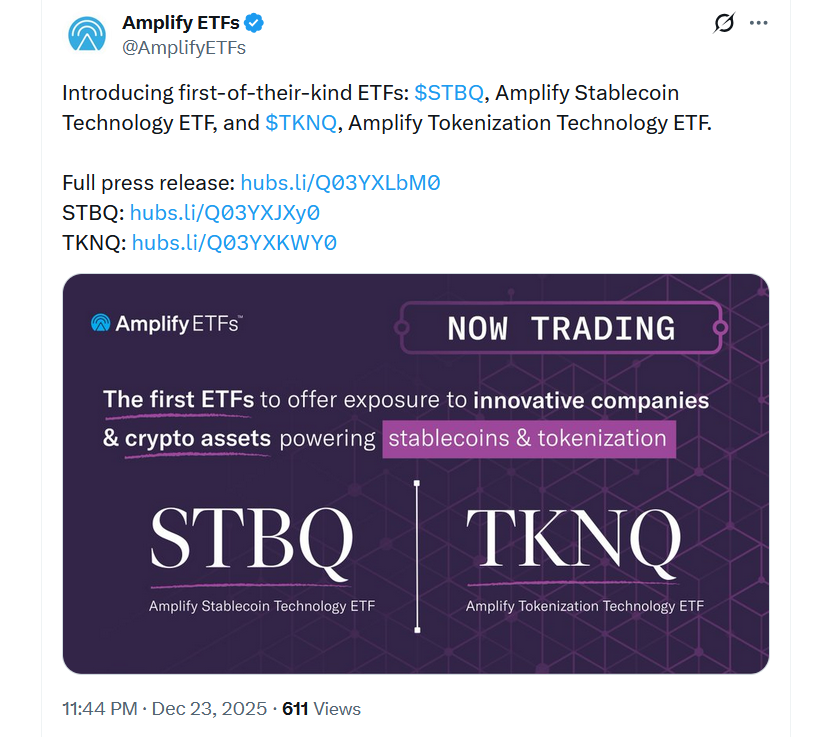
Digital asset manager Amplify has launched two exchange-traded funds tracking blockchain projects across stablecoins and tokenization.

The company said on Tuesday that its Amplify Stablecoin Technology ETF (STBQ) and Amplify Tokenization Technology ETF (TKNQ) both went live on the NYSE Arca exchange.

Both funds track a diversified index of companies working on products or infrastructure, along with projects that generate revenue from tokenization and stablecoins.

“These new ETFs expand Amplify’s lineup at a time when the infrastructure behind stablecoins and the growth of tokenization are shaping the next phase of digital finance,” the company said.
Source: Amplify ETFs

Stablecoins and tokenization have been among the most popular themes in crypto this year, with the US passing laws that have given institutions confidence to launch stablecoins, and regulators opening dialogue on how they should treat assets such as tokenized stocks.

Amplify said its stablecoin-focused ETF tracks shares of companies “generating significant revenue from payments technology, digital asset infrastructure, and trading platforms.”

It holds shares in companies working on stablecoins such as Visa, Circle, Mastercard and PayPal, alongside crypto ETFs from Grayscale, iShares and Bitwise.

The firm pointed to regulatory developments in the US and EU, noting that the “GENIUS Act in the US and MiCA in Europe are positioning stablecoins as the compliant backbone of digital finance.”

Related: Clarity Act delays led to $952M in crypto fund outflows: CoinShares

Meanwhile, the tokenization fund includes exposure to BlackRock, JPMorgan, Figure Technology Solution, Citigroup and the Nasdaq, which all have made tokenization plays over the past few years as they seek opportunities to digitize traditional financial services.

Crypto and blockchain ETFs stormed onto the market in 2025 after the US Securities and Exchange Commission under chair Paul Atkins loosened requirements for crypto ETFs.

Magazine: Big questions: Would Bitcoin survive a 10-year power outage?

Preguntas relacionadas

QWhat are the names of the two new ETFs launched by Amplify and on which exchange did they go live?

AThe two new ETFs are the Amplify Stablecoin Technology ETF (STBQ) and the Amplify Tokenization Technology ETF (TKNQ). They both went live on the NYSE Arca exchange.

QWhat is the primary focus of the Amplify Stablecoin Technology ETF (STBQ)?

AThe Amplify Stablecoin Technology ETF (STBQ) tracks shares of companies generating significant revenue from payments technology, digital asset infrastructure, and trading platforms related to stablecoins.

QWhich major companies are included in the stablecoin-focused ETF's holdings?

AThe stablecoin-focused ETF holds shares in companies such as Visa, Circle, Mastercard, PayPal, as well as crypto ETFs from Grayscale, iShares, and Bitwise.

QWhat regulatory developments does Amplify cite as supporting the growth of stablecoins?

AAmplify points to the GENIUS Act in the US and the Markets in Crypto-Assets (MiCA) regulation in Europe, which are positioning stablecoins as the compliant backbone of digital finance.

QWhich types of companies does the Amplify Tokenization Technology ETF (TKNQ) provide exposure to?

AThe tokenization fund provides exposure to companies like BlackRock, JPMorgan, Figure Technology Solution, Citigroup, and Nasdaq, which are involved in tokenizing traditional financial services.

Lecturas Relacionadas

SpaceX Ties Up with Cursor: A High-Stakes AI Gambit of 'Lock First, Acquire Later'

SpaceX has secured an option to acquire AI programming company Cursor for $60 billion, with an alternative clause requiring a $10 billion collaboration fee if the acquisition does not proceed. This structure is not merely a potential acquisition but a strategic move to control core access points in the AI era. The deal is designed as a flexible, dual-path arrangement, allowing SpaceX to either fully acquire Cursor or maintain a binding partnership through high-cost collaboration. This "option-style" approach minimizes immediate regulatory and integration risks while ensuring long-term alignment between the two companies. At its core, the transaction exchanges critical AI-era resources: SpaceX provides its Colossus supercomputing cluster—one of the world’s most powerful AI training infrastructures—while Cursor contributes its AI-native developer environment and strong product adoption. This synergy connects compute power, models, and application layers, forming a closed-loop AI capability stack. Cursor, founded in 2022, has achieved rapid growth with over $1 billion in annual revenue and widespread enterprise adoption. Its value lies in transforming software development through AI agents capable of coding, debugging, and system design—positioning it as a gateway to future software production. For SpaceX, this move is part of a broader strategy to evolve from a aerospace company into an AI infrastructure empire, integrating xAI, supercomputing, and chip manufacturing. Controlling Cursor fills a gap in its developer tooling layer, strengthening its AI narrative ahead of a potential IPO. The deal reflects a shift in AI competition from model superiority to ecosystem and entry-point control. With programming tools as a key battleground, securing developer loyalty becomes crucial for dominating the software production landscape. Risks include questions around Cursor’s valuation, technical integration challenges, and potential regulatory scrutiny. Nevertheless, the deal underscores a strategic bet: controlling both compute and software development access may redefine power dynamics in the AI-driven future.

marsbitHace 7 min(s)

SpaceX Ties Up with Cursor: A High-Stakes AI Gambit of 'Lock First, Acquire Later'

marsbitHace 7 min(s)

Trading

Spot
Futuros
活动图片