On August 4th local time in the US, AMD released its fiscal second quarter results for the period ended June 27, 2026.
The earnings report shows that driven by a 107% year-over-year increase in Data Center business revenue, AMD achieved quarterly revenue of $11.536 billion, up 50% year-over-year, setting a new historical record. GAAP net income reached $2.297 billion, an increase of 163% year-over-year, with diluted earnings per share at $1.38. The significant year-over-year growth in AMD's net profit is primarily due to the low base in the same period last year.
However, despite the sustained rapid growth in performance, AMD's stock price declined in after-hours trading following the earnings release, once falling by 8.79%.
While the company's performance continues to improve, market expectations for its future growth are also rising. At the same time, factors such as supply chain bottlenecks and changes in procurement strategies by hyperscale customers have drawn more market attention to the sustainability of subsequent growth.
01. Revenue Hits Record High, AI Demand Drives Growth
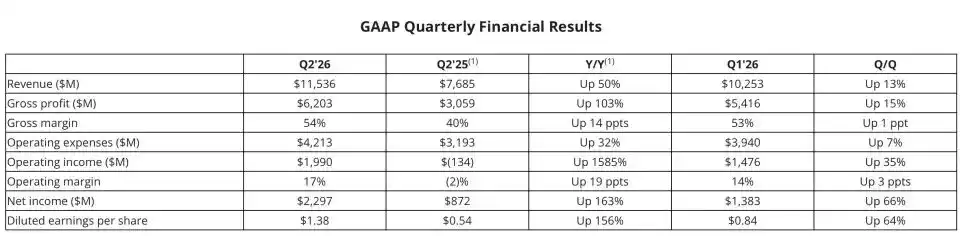
The earnings report shows that AMD's total revenue for the quarter reached $11.536 billion, a significant 50% increase compared to $7.685 billion in the same period last year, and a 13% sequential growth, slightly above expectations of $11.28 to $11.3 billion from institutions like FactSet.
From a profit perspective, under GAAP, the company's net income was $2.297 billion (diluted EPS of $1.38), surpassing Wall Street's expectation of $1.7 billion and representing a 163% surge compared to $872 million in the prior-year period. Under Non-GAAP, net income reached $2.760 billion, up 253% year-over-year, with diluted EPS at $1.66, a 246% increase year-over-year.
GAAP operating income was $1.990 billion (Non-GAAP operating income was $3.094 billion), slightly below the $2 billion threshold favored by some analysts.
Regarding gross margin, GAAP gross margin was 54%; Non-GAAP gross margin reached 56%, an improvement of 13 percentage points year-over-year.
In terms of guidance, AMD officially expects revenue for the third quarter of fiscal 2026 to be approximately $13.0 billion (plus or minus $300 million), corresponding to roughly 41% year-over-year growth and 13% sequential growth.
This figure, while above the LSEG consensus of $12.52 billion, did not meet the optimistic expectations of some buy-side institutions, which had anticipated figures as high as $14.0 billion. Third-quarter Non-GAAP gross margin is expected to remain around 56%.
AMD management stated in the earnings report that AI development is driving sustained growth in market demand for computing power, and the company is optimistic about accelerated business growth in the second half of the year.
02. Data Center Doubles Leading Growth, Client Steady, Gaming Business Under Pressure
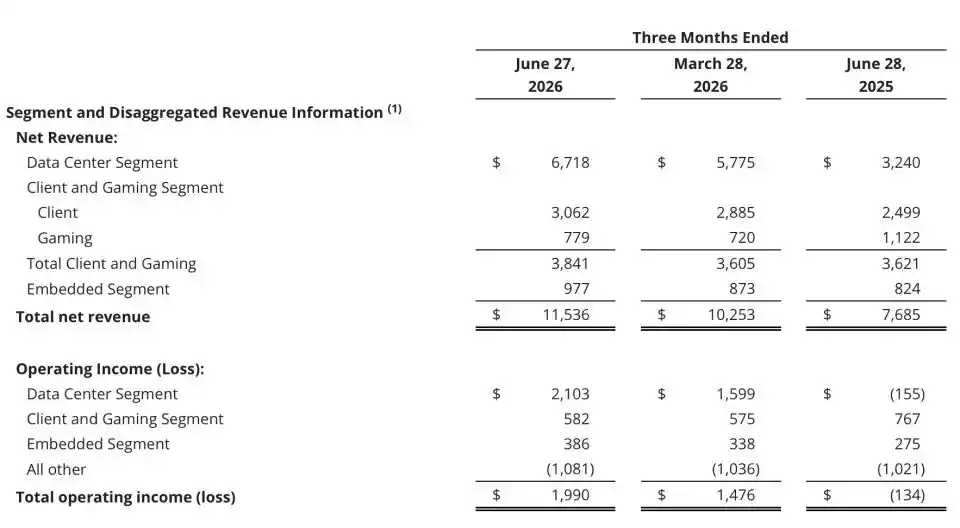
Looking at specific business segments, this quarter AMD exhibited a pattern of "Data Center strongly pulling up growth, Client and PC providing steady support, and Gaming business under pressure and declining."
The Data Center business, serving as the main platform for AI computing power and server chips, performed most impressively, with quarterly revenue reaching a record $6.72 billion, a massive 107% year-over-year increase, primarily driven by strong demand for EPYC server processors and Instinct GPUs.
In the Data Center field, media and market analysts point out that with the rise of inference workloads and agentic AI, tasks such as coding and automated reasoning are seeing exponentially increasing demand for computing power. This not only drives GPU deployment but also boosts demand for CPUs, accelerating the penetration of EPYC processors into internal computing and public cloud architectures of hyperscale cloud service providers like AWS, Microsoft, Google, and Oracle, continuing to capture market share from main competitor Intel.
AMD noted in its earnings report that the company has officially launched the Helios whole-system solution, the Instinct MI400 series GPUs, and the 6th Gen EPYC processors, marking AMD's expansion from a chip supplier to a provider of whole-system AI solutions.
Information shows that the Helios system has been adopted by several leading technology companies and cloud service providers, including Anthropic, Meta, Microsoft, OpenAI, and Oracle, with related deployments expanding. Additionally, AMD announced a strategic partnership with Anthropic to deploy up to 2 GW of MI450 series GPUs. Furthermore, according to media reports, AMD indicated in the management conference call that Helios will begin large-scale shipments in the fourth quarter, and the company recently secured up to 2.5 GW of data center capacity from Core Scientific through third-party channels.
Regarding the Client and Gaming businesses, Client revenue reached $3.1 billion, a 23% year-over-year increase, primarily driven by strong demand for Ryzen processors. Gaming revenue declined 31% to $779 million, with the official earnings report explicitly stating this was mainly due to a decrease in semi-custom chip revenue. Combined revenue for the Client and Gaming segments was $3.84 billion, a 6% year-over-year increase.
Embedded business revenue was $977 million, a 19% year-over-year increase, indicating a steady recovery in demand from industrial and multi-endpoint markets.
03. Beyond High Growth, AMD Faces Higher Market Expectations
However, despite AMD delivering a record quarterly performance, the focus of the capital markets has shifted from earnings growth to the quality of growth.
For a company whose market capitalization has significantly increased and whose AI business is expanding rapidly, merely beating expectations is no longer sufficient to support valuation. Investors are more concerned about whether future growth can be sustained and when massive capital investments can translate into stable profitability.
First, the rapid growth in capital expenditures has become a key concern for the market. According to third-party data and analyst estimates, AMD's second-quarter capital expenditures were approximately $808 million, nearly three times market expectations, and free cash flow consequently fell to about $784 million, below market consensus.
With increasing investments in AI servers, whole-system solutions, and advanced packaging, the capital markets are beginning to focus more on changes in the company's return on capital in the coming years, rather than just the speed of revenue growth.
Second, high expectations have become a factor weighing on the stock price. AMD expects third-quarter revenue of about $13.0 billion, above the market consensus of around $12.5 billion, but some buy-side institutions had previously raised their expectations to close to $14.0 billion.
After a year of sustained gains in the AI sector, the market's tolerance for error among leading companies has noticeably decreased. Even if overall earnings are strong, failure to meet the most optimistic expectations may prompt some investors to sell and lock in previous gains.
Meanwhile, the competitive landscape continues to evolve. On the same day AMD released its earnings, Elon Musk stated on a SpaceX conference call that SpaceX will build AI infrastructure based on NVIDIA's Blackwell architecture in the future.
While this statement does not mean AMD is losing existing customers, it somewhat dampened market expectations for SpaceX expanding its procurement of AMD AI chips in the future, affecting investor sentiment to a degree.
Furthermore, supply chain factors continue to limit the expansion pace of the AI industry chain. Although AMD has launched the Helios whole-system solution and the MI400 series GPUs and continues to expand partnerships with customers like Anthropic, Microsoft, Meta, and OpenAI, the large-scale delivery of AI servers is still affected by factors such as TSMC's CoWoS advanced packaging capacity.
Against the backdrop of continued heating investment in AI infrastructure, the capital markets are waiting for these massive investments to truly translate into sustained revenue growth and profit realization.
Special contributor Wuji contributed to this article.
This article is from the WeChat public account "Tencent Technology", author: Li Hailun