Amazon Invests Additional $25 Billion in Anthropic, AI Infrastructure 'Arms Race' Escalates

marsbitPublicado a 2026-04-21Actualizado a 2026-04-21

Resumen

Amazon announces an additional investment of up to $25 billion in Anthropic, with $5 billion delivered immediately and the remaining contingent on performance milestones. This follows a recent $50 billion investment in OpenAI, highlighting Amazon's strategy of backing leading AI labs. The deal includes a commitment from Anthropic to spend over $100 billion on AWS infrastructure over the next decade, securing up to 5 gigawatts of computing power to address growing demand and capacity constraints. Anthropic’s annualized revenue has surpassed $30 billion, but the company faces infrastructure strain due to rapid user growth. The investment will support scaling Claude’s capabilities using Amazon’s custom Trainium and Graviton chips. The move deepens integration between Anthropic and AWS, allowing Claude to be accessed natively within AWS services. Over 100,000 organizations already use Claude via Amazon Bedrock. This investment is part of a broader AI infrastructure race, with Amazon planning around $200 billion in capital expenditures this year, largely focused on expanding AI compute capacity.

Author: Claude, Deep Tide TechFlow

Deep Tide Guide: Amazon announced on Monday an additional investment of up to $25 billion in Anthropic (with $5 billion immediately available), securing a commitment from the latter for over $100 billion in AWS spending over the next decade.

This is Amazon's second hundred-billion-dollar check to a leading AI lab within two months—it had just invested $50 billion in OpenAI.

Anthropic's annualized revenue has exceeded $30 billion, but computing power bottlenecks are hampering the user experience; the core goal of this deal is to resolve the capacity crisis.
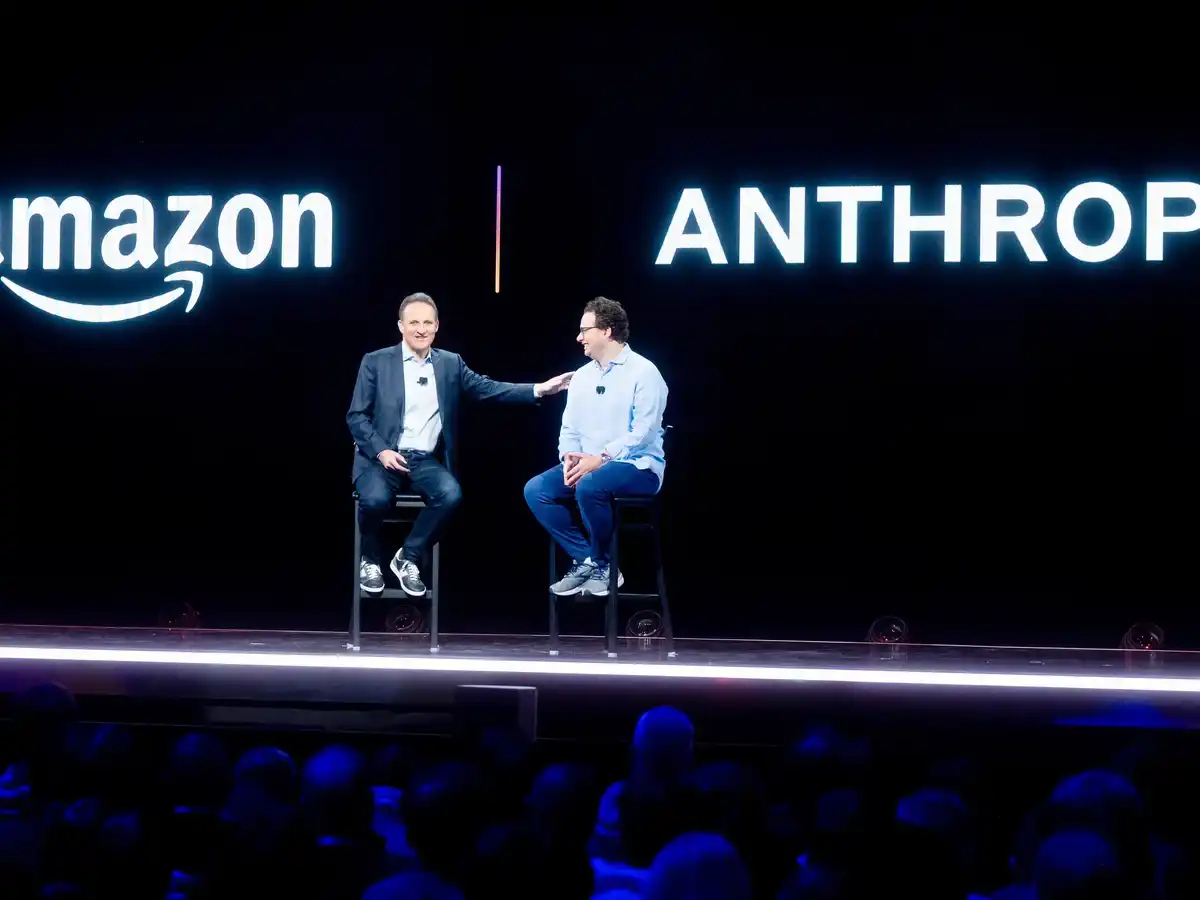
Amazon is placing bets on both of the AI field's top labs simultaneously, and the stakes are getting larger.

According to reports from CNBC, Bloomberg, and other media outlets on April 20, Amazon announced an additional investment of up to $25 billion in Anthropic, with $5 billion available immediately and the remaining $20 billion tied to specific business milestones. This investment is executed at Anthropic's $380 billion valuation from its Series G financing in February of this year. Combined with the previous cumulative investment of $8 billion, Amazon's total investment commitment to Anthropic now reaches a cap of $33 billion.

Two months ago, Amazon had just invested $50 billion in OpenAI, Anthropic's main competitor, and reached a cloud services agreement of a similar scale. Amazon CEO Andy Jassy stated in an announcement that Anthropic's commitment to running its large language models on AWS Trainium for up to ten years "reflects the progress we have made in the field of custom chips."

Following the news, Amazon's stock price rose approximately 2.5% in after-hours trading.

$100 Billion Cloud Commitment for 5 Gigawatts of Compute Power, Responding to OpenAI's 'Insufficient Compute' Allegations

The core of this deal is not just equity investment but a deeply binding infrastructure agreement.

Anthropic has committed to investing over $100 billion in AWS technology over the next decade, covering Amazon's custom AI chips Trainium (from Trainium2 to Trainium4 and future generations) and tens of millions of Graviton CPU cores. In exchange, Anthropic will receive up to 5 gigawatts of computing capacity for training and deploying Claude models. According to Anthropic's blog disclosure, the company currently uses over 1 million Trainium2 chips to train and serve Claude and plans to put nearly 1 gigawatt of Trainium2 and Trainium3 capacity into operation by the end of 2026.

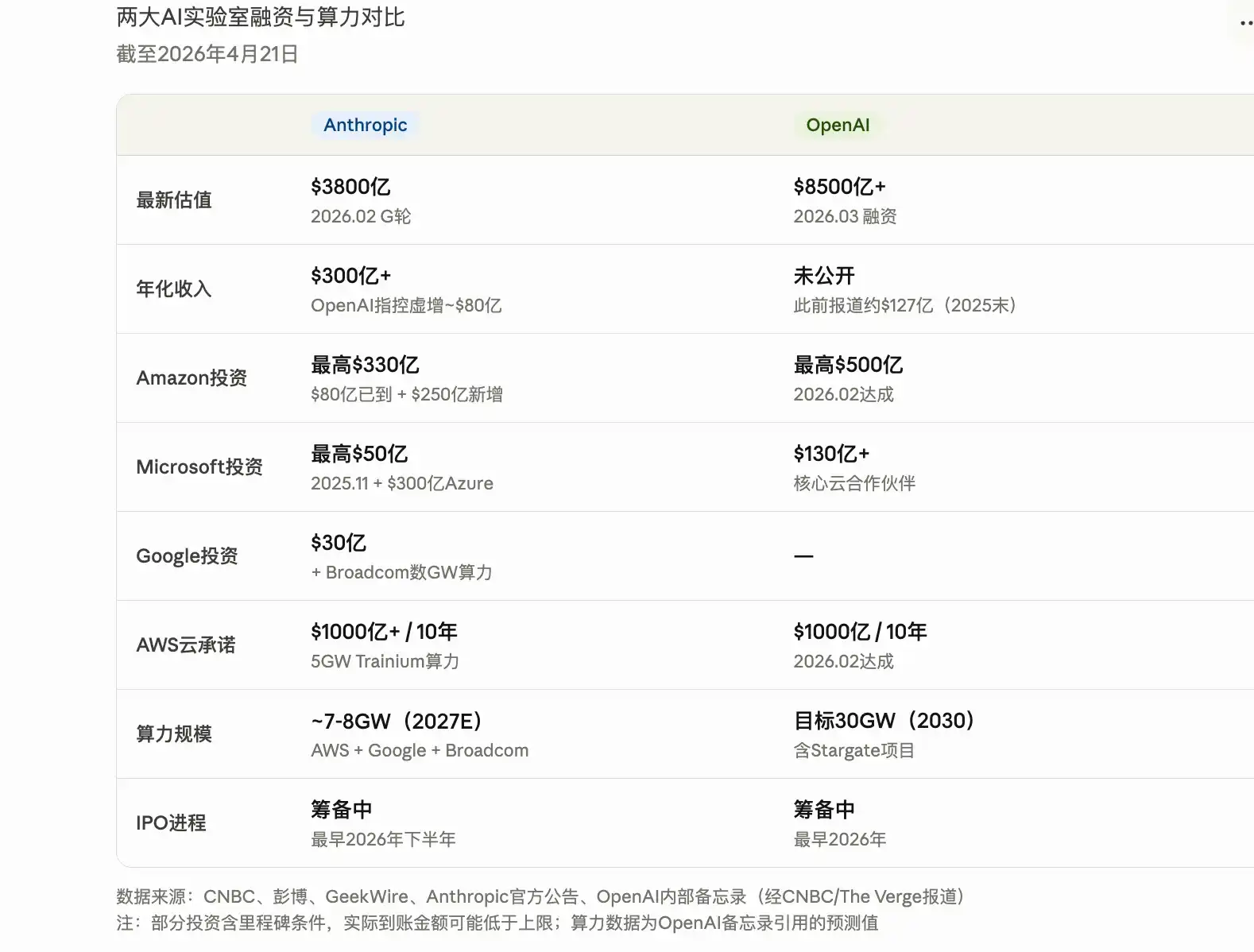
This expansion in computing scale directly responds to recent public attacks from OpenAI. OpenAI's Chief Revenue Officer, Denise Dresser, claimed in an internal memo last week that Anthropic made a "strategic error by failing to secure sufficient computing power" and predicted that OpenAI would have 30 gigawatts of computing power by 2030, while Anthropic would have only 7 to 8 gigawatts by the end of 2027. In its announcement that day, Anthropic frankly admitted that demand for Claude from enterprises and developers is accelerating, and consumer usage has seen a "sharp increase," putting "inevitable pressure" on infrastructure and affecting reliability and performance during peak periods.

Anthropic CEO Dario Amodei stated in a declaration: "Users tell us that Claude is becoming increasingly important to their work, and we need to build infrastructure to keep up with the rapidly growing demand."
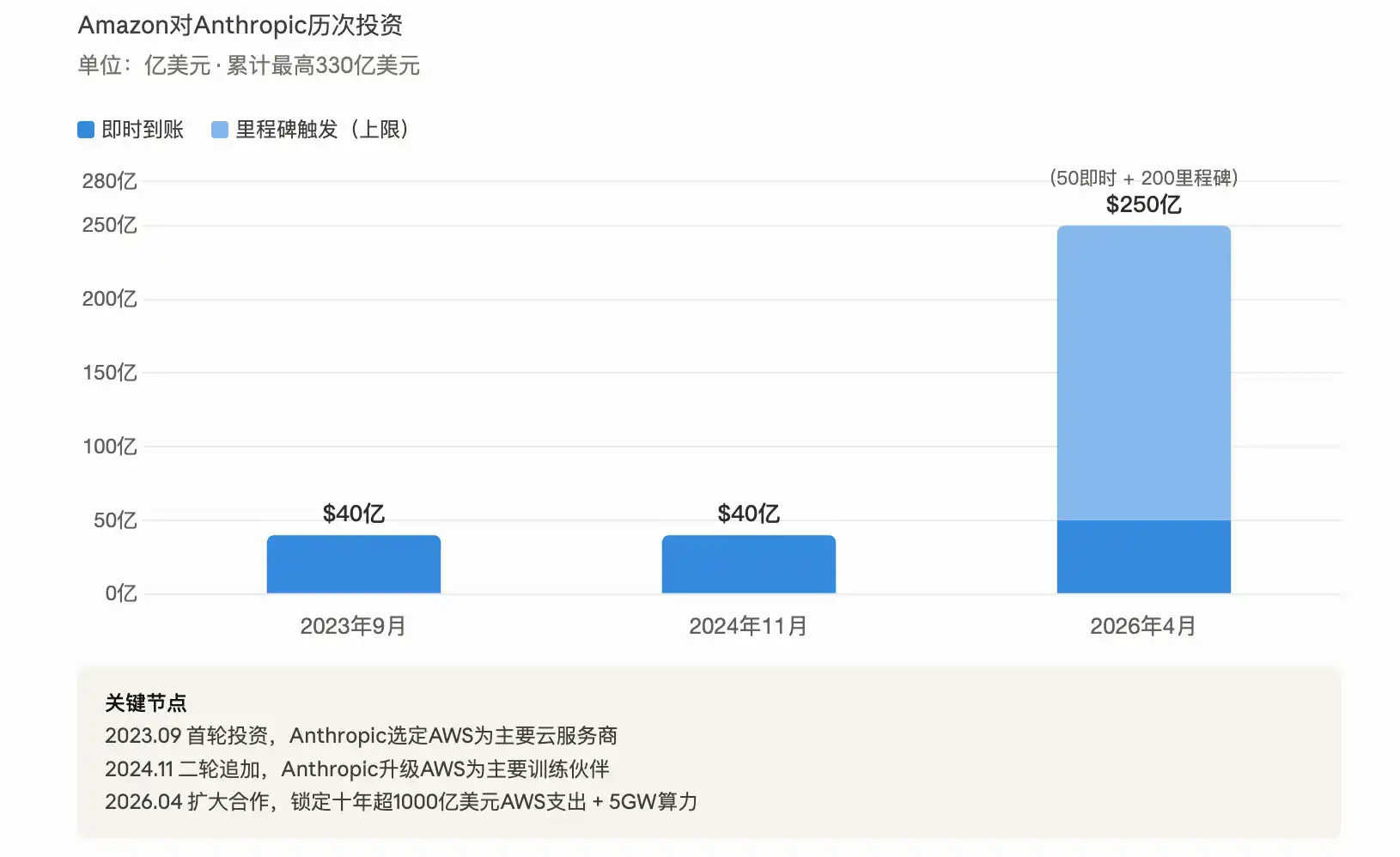
Amazon Writes Hundred-Billion-Dollar Checks to Two AI Labs in Two Months

Amazon's investment strategy is now very clear: bet on both top players in the AI race simultaneously.

In February of this year, Amazon announced an investment of up to $50 billion in OpenAI, also accompanied by a $100 billion AWS cloud service commitment. The structure of the deal with Anthropic is almost identical—$25 billion in investment plus a lock on over $100 billion in cloud spending. According to GeekWire, Amazon is executing the "same playbook" for both labs.

The two major AI companies are also racing to prove their strength to investors. According to CNBC, both Anthropic and OpenAI are preparing for potential IPOs that could land as early as this year. OpenAI's latest funding round valued it at over $850 billion, while Anthropic is valued at $380 billion. Anthropic claims its annualized revenue has exceeded $30 billion (approximately $9 billion at the end of 2025), while OpenAI's memo alleged that this figure was inflated by about $8 billion because Anthropic accounted for revenue from cloud partnerships with Amazon and Google on a gross rather than net basis.

Microsoft is also betting on both sides—it had already invested over $13 billion in OpenAI and in November 2025 invested up to $5 billion in Anthropic, which committed to purchasing $30 billion in Azure computing power.
Claude Platform Integrates with AWS, Battle for Over 100,000 Customers

Beyond investment, integration at the product level is also deepening.

According to the announcement, the native Claude platform will be directly embedded into AWS. Users will be able to access the full Claude console through their existing AWS accounts, permission controls, and billing systems, without needing additional registration or new contracts. This goes a step further than the previous offering of Claude services through the Amazon Bedrock marketplace. Amazon disclosed that over 100,000 organizations are currently running Claude models on Amazon Bedrock.

Anthropic also emphasized in its blog that Claude is the only frontier AI model simultaneously available on all three major global cloud platforms (AWS Bedrock, Google Cloud Vertex AI, Microsoft Azure Foundry). This multi-platform strategy allows enterprise customers to flexibly choose their deployment path based on needs and is also one of Anthropic's differentiated advantages in competing with OpenAI.

On the client side, after Lyft used Claude via Amazon Bedrock to power its customer service AI assistant, the average resolution time for customer service was reduced by 87%. Pfizer uses Claude to help scientists perform voice searches in drug development documents, saving approximately 16,000 hours of retrieval time per year.

AI Infrastructure Race: Amazon's Capital Expenditure Expected to Reach $200 Billion This Year

The larger context embedding this deal is the AI infrastructure arms race among cloud computing giants.

Amazon stated in February that it expects capital expenditure to reach approximately $200 billion in 2026, with the vast majority directed toward AI infrastructure. The previously co-developed Project Rainier (a super-large-scale computing cluster with nearly 500,000 Trainium2 chips) was once one of the world's largest AI computing clusters, which Anthropic is using to train and deploy current and future versions of Claude.

Earlier this month, Anthropic also expanded its cooperation with Google and Broadcom, locking in computing power on the scale of "several gigawatts," expected to come online starting in 2027. Combined with this 5-gigawatt agreement with Amazon, Anthropic is expanding its computing power reserves across multiple lines simultaneously.

Amazon's custom chip business itself is also accelerating. Jassy recently revealed that the business's annualized revenue has exceeded $20 billion, doubling from the $10 billion reported earlier this year, which in his words is "on fire."


Preguntas relacionadas

QWhat is the total maximum investment commitment Amazon has made to Anthropic after the latest $25 billion addition?

AAmazon's total investment commitment to Anthropic has reached a maximum of $33 billion, which includes the previous $8 billion and the newly added up to $25 billion.

QWhat is the core infrastructure agreement between Amazon and Anthropic, and what does Anthropic receive in exchange?

AAnthropic commits to spending over $100 billion on AWS technology over the next decade, including Amazon's custom AI chips and CPU cores. In exchange, Anthropic will receive up to 5 gigawatts of computing capacity for training and deploying Claude models.

QHow does Amazon's investment strategy in AI labs appear, based on recent deals with Anthropic and OpenAI?

AAmazon is simultaneously betting on both leading AI labs, having invested up to $50 billion in OpenAI and up to $25 billion in Anthropic, each accompanied by a $100 billion cloud service commitment, following a similar playbook.

QWhat product integration advancement was announced between Anthropic's Claude platform and AWS?

AThe native Claude platform will be directly embedded into AWS, allowing users to access the full Claude console through their existing AWS accounts, permissions, and billing systems without needing separate registration or contracts.

QWhat is Amazon's projected capital expenditure for 2026, and what is the primary focus of this spending?

AAmazon expects its capital expenditure to reach approximately $200 billion in 2026, with the majority allocated towards AI infrastructure investments.

Lecturas Relacionadas

Xiaohongshu's Second Great Voyage, This Time Sailing Towards AI

Xiaohongshu's Second Voyage: Navigating Towards AI Since ChatGPT's emergence, Xiaohongshu's founder Mao Wenchao has been acutely aware of AI's potential threat, recognizing that the life advice people seek from chatbots overlaps directly with his platform's core business. Founded in 2013 as a PDF shopping guide for Chinese tourists, Xiaohongshu evolved into a massive community where millions share authentic, personal experiences—from product reviews to travel tips. This vast repository of "I've tried this" human judgment became its most valuable asset. However, the rise of AI, which delivers instant answers, challenges the very need for users to sift through numerous personal notes. Fearing its treasure trove of lived experience could become mere training data for others, Xiaohongshu is proactively adapting. In 2026, it established a dedicated AI division (Dots), launched RED Skill to turn user experiences into usable AI tools, and acquired the AI search product "Diandian." Its investments now extend to AI firms like MiniMax and hardware startups, moving upstream to address needs before they even become search queries. The platform's commercialization strategy is also evolving. With a newly acquired payment license and tools like the AIPS model to track consumer decision journeys, Xiaohongshu aims to seamlessly integrate recommendations with transactions, embedding commerce within AI-generated answers. Yet, a critical tension remains. While building smarter machines to organize and leverage its human experiences, Xiaohongshu must prevent AI from drowning out the authentic, flawed, and trustworthy "I've tried this" voices that built its community. Its core challenge is to harness AI's power without letting the map—the machine's perfect, synthesized answer—replace the territory of genuine human experience. This balance between technological advancement and preserving human trust defines its current journey and its future.

marsbitHace 12 min(s)

Xiaohongshu's Second Great Voyage, This Time Sailing Towards AI

marsbitHace 12 min(s)

SharpLink CEO: How to Understand Ethereum Developers Just Exceeded 1 Million?

SharpLink CEO reflects on the milestone of Ethereum surpassing 1 million historical developers, emphasizing that this figure represents the largest pool of technical talent ever assembled around an open, permissionless blockchain network. While approximately 232,000 developers remain active, the key question for the crypto industry is not which chain is fastest, but where the best builders choose to build long-term. Ethereum's advantage lies in a decade-long accumulation of infrastructure, standards, tools, liquidity, and a cohesive culture, making it the default operating system for programmable finance. This developer base is tackling complex challenges: the Glamsterdam upgrade aims to enhance scalability while preserving core principles; synchronous composability seeks to unify Rollup ecosystems; and significant efforts are underway for post-quantum security. Ethereum's deeper network effects stem from composability and shared standards (like the EVM and Solidity), creating a flywheel of more developers, tools, and liquidity. Three reinforcing strengths cement Ethereum's lead: credible neutrality (secured by ~900k validators), a modular architecture with interconnected Rollups, and a culture that attracts top researchers. The ecosystem is consolidating as the trusted coordination layer for internet-native finance, favored by large institutions valuing security and liquidity. The future of Ethereum is being built by this global community of founders and architects.

链捕手Hace 27 min(s)

SharpLink CEO: How to Understand Ethereum Developers Just Exceeded 1 Million?

链捕手Hace 27 min(s)

A Clod of Chinese Soil Chokes Two Japanese Giants

"Chinese Soil Chokes Japanese Giants" The production of a key electronic specialty gas, tungsten hexafluoride (WF6), vital for manufacturing AI chips, was halted by two leading Japanese producers—Kanto Denka and Central Glass. Their shutdown was not due to a technological failure but a sudden, critical shortage of a raw material they had long taken for granted: ultra-high-purity (6N-grade) tungsten powder, which is almost entirely sourced from China. Following a quiet Chinese export announcement in January 2026, tungsten powder shipments to Japan dropped to zero for months. Despite frantic efforts, Japanese companies found no viable alternative; imported powder was three times more expensive and lacked the required purity. Their existing stockpiles were exhausted by mid-2026. WF6 is essential for depositing tungsten into the microscopic contact holes of High Bandwidth Memory (HBM) chips, which are crucial for advanced processors like those from Nvidia. While Japanese firms had mastered producing ultra-pure WF6 gas, their entire supply chain relied on China's 6N tungsten powder—a dependency now revealed as a fatal vulnerability. China's dominance in this "soil" results from decades of painstaking R&D by companies like Xiamen Tungsten and China Tungsten & Hightech. They overcame immense technical hurdles, such as separating chemically similar molybdenum from tungsten, to achieve mass production of the world's purest tungsten powder. With their primary suppliers gone, Kanto Denka and Central Glass announced a permanent halt to WF6 production starting July 1, 2026. This immediately created a supply crisis for major semiconductor manufacturers like Samsung and SK Hynix, forcing them to urgently seek and certify new Chinese suppliers for WF6 itself. The reversal marks a dramatic shift: China has moved from exporting low-value raw materials to controlling the high-purity foundation of a critical global tech supply chain, upending a long-established industrial hierarchy.

marsbitHace 58 min(s)

A Clod of Chinese Soil Chokes Two Japanese Giants

marsbitHace 58 min(s)

Trading

Spot
Futuros
活动图片