Amazon Invests Additional $25 Billion in Anthropic, AI Infrastructure 'Arms Race' Escalates

marsbitPublicado a 2026-04-21Actualizado a 2026-04-21

Resumen

Amazon announces an additional investment of up to $25 billion in Anthropic, with $5 billion delivered immediately and the remaining contingent on performance milestones. This follows a recent $50 billion investment in OpenAI, highlighting Amazon's strategy of backing leading AI labs. The deal includes a commitment from Anthropic to spend over $100 billion on AWS infrastructure over the next decade, securing up to 5 gigawatts of computing power to address growing demand and capacity constraints. Anthropic’s annualized revenue has surpassed $30 billion, but the company faces infrastructure strain due to rapid user growth. The investment will support scaling Claude’s capabilities using Amazon’s custom Trainium and Graviton chips. The move deepens integration between Anthropic and AWS, allowing Claude to be accessed natively within AWS services. Over 100,000 organizations already use Claude via Amazon Bedrock. This investment is part of a broader AI infrastructure race, with Amazon planning around $200 billion in capital expenditures this year, largely focused on expanding AI compute capacity.

Author: Claude, Deep Tide TechFlow

Deep Tide Guide: Amazon announced on Monday an additional investment of up to $25 billion in Anthropic (with $5 billion immediately available), securing a commitment from the latter for over $100 billion in AWS spending over the next decade.

This is Amazon's second hundred-billion-dollar check to a leading AI lab within two months—it had just invested $50 billion in OpenAI.

Anthropic's annualized revenue has exceeded $30 billion, but computing power bottlenecks are hampering the user experience; the core goal of this deal is to resolve the capacity crisis.
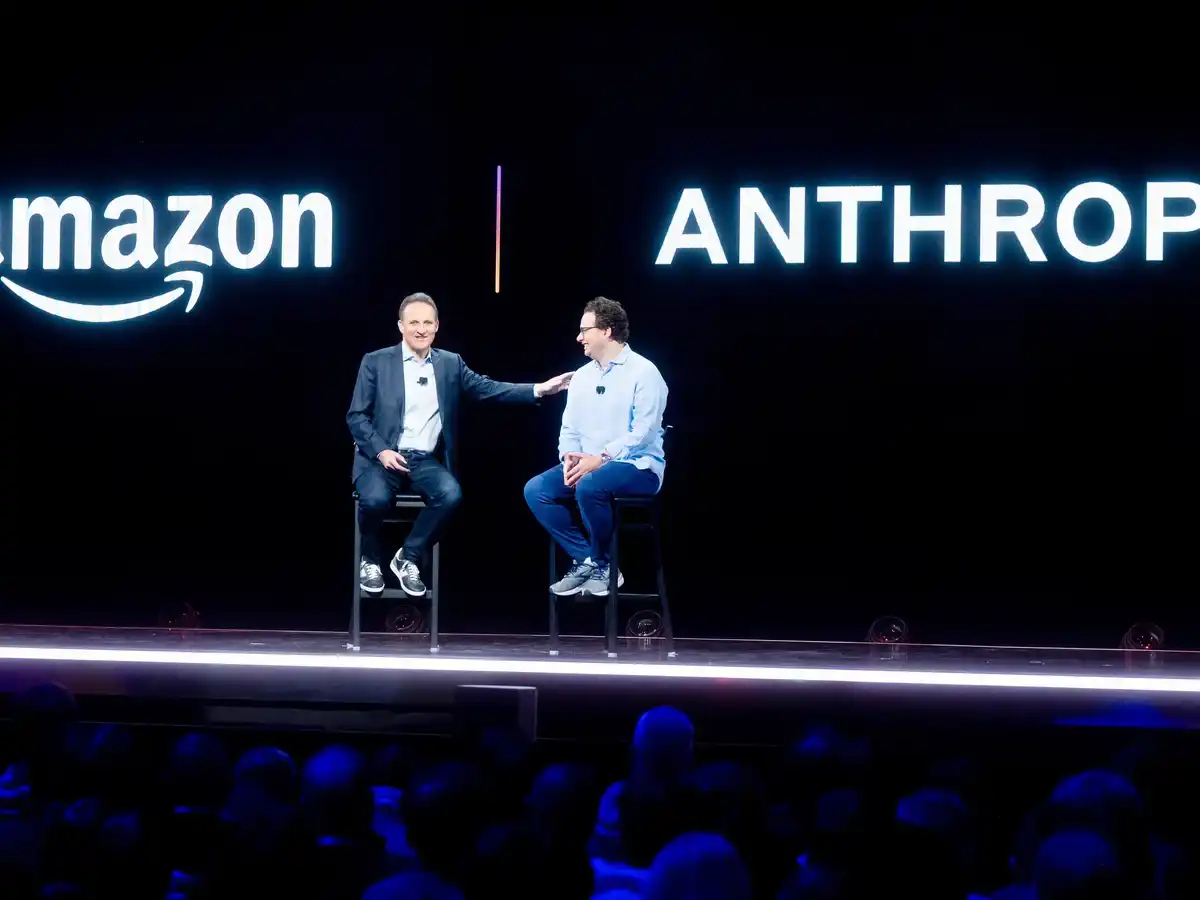
Amazon is placing bets on both of the AI field's top labs simultaneously, and the stakes are getting larger.

According to reports from CNBC, Bloomberg, and other media outlets on April 20, Amazon announced an additional investment of up to $25 billion in Anthropic, with $5 billion available immediately and the remaining $20 billion tied to specific business milestones. This investment is executed at Anthropic's $380 billion valuation from its Series G financing in February of this year. Combined with the previous cumulative investment of $8 billion, Amazon's total investment commitment to Anthropic now reaches a cap of $33 billion.

Two months ago, Amazon had just invested $50 billion in OpenAI, Anthropic's main competitor, and reached a cloud services agreement of a similar scale. Amazon CEO Andy Jassy stated in an announcement that Anthropic's commitment to running its large language models on AWS Trainium for up to ten years "reflects the progress we have made in the field of custom chips."

Following the news, Amazon's stock price rose approximately 2.5% in after-hours trading.

$100 Billion Cloud Commitment for 5 Gigawatts of Compute Power, Responding to OpenAI's 'Insufficient Compute' Allegations

The core of this deal is not just equity investment but a deeply binding infrastructure agreement.

Anthropic has committed to investing over $100 billion in AWS technology over the next decade, covering Amazon's custom AI chips Trainium (from Trainium2 to Trainium4 and future generations) and tens of millions of Graviton CPU cores. In exchange, Anthropic will receive up to 5 gigawatts of computing capacity for training and deploying Claude models. According to Anthropic's blog disclosure, the company currently uses over 1 million Trainium2 chips to train and serve Claude and plans to put nearly 1 gigawatt of Trainium2 and Trainium3 capacity into operation by the end of 2026.

This expansion in computing scale directly responds to recent public attacks from OpenAI. OpenAI's Chief Revenue Officer, Denise Dresser, claimed in an internal memo last week that Anthropic made a "strategic error by failing to secure sufficient computing power" and predicted that OpenAI would have 30 gigawatts of computing power by 2030, while Anthropic would have only 7 to 8 gigawatts by the end of 2027. In its announcement that day, Anthropic frankly admitted that demand for Claude from enterprises and developers is accelerating, and consumer usage has seen a "sharp increase," putting "inevitable pressure" on infrastructure and affecting reliability and performance during peak periods.

Anthropic CEO Dario Amodei stated in a declaration: "Users tell us that Claude is becoming increasingly important to their work, and we need to build infrastructure to keep up with the rapidly growing demand."
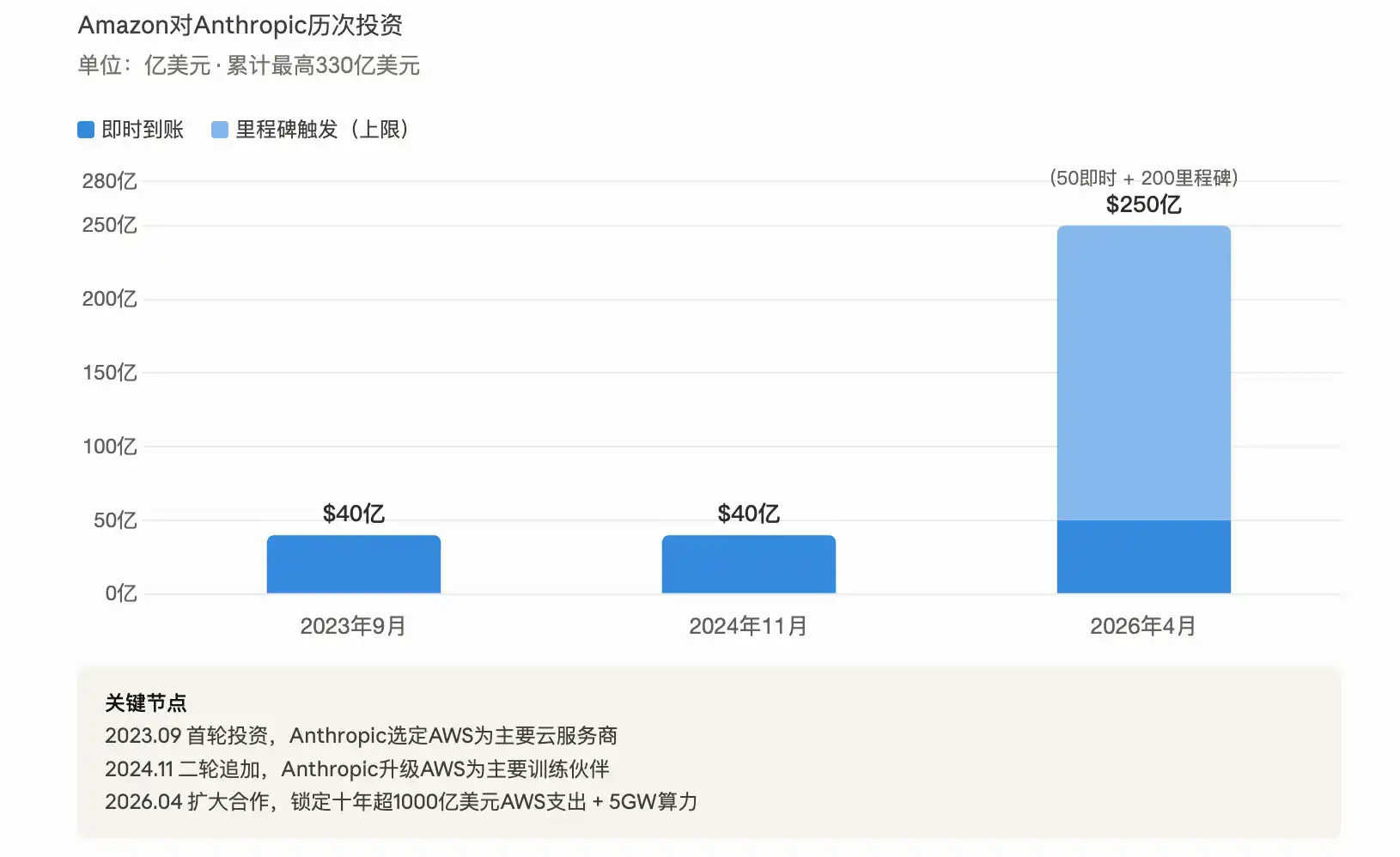
Amazon Writes Hundred-Billion-Dollar Checks to Two AI Labs in Two Months

Amazon's investment strategy is now very clear: bet on both top players in the AI race simultaneously.

In February of this year, Amazon announced an investment of up to $50 billion in OpenAI, also accompanied by a $100 billion AWS cloud service commitment. The structure of the deal with Anthropic is almost identical—$25 billion in investment plus a lock on over $100 billion in cloud spending. According to GeekWire, Amazon is executing the "same playbook" for both labs.

The two major AI companies are also racing to prove their strength to investors. According to CNBC, both Anthropic and OpenAI are preparing for potential IPOs that could land as early as this year. OpenAI's latest funding round valued it at over $850 billion, while Anthropic is valued at $380 billion. Anthropic claims its annualized revenue has exceeded $30 billion (approximately $9 billion at the end of 2025), while OpenAI's memo alleged that this figure was inflated by about $8 billion because Anthropic accounted for revenue from cloud partnerships with Amazon and Google on a gross rather than net basis.

Microsoft is also betting on both sides—it had already invested over $13 billion in OpenAI and in November 2025 invested up to $5 billion in Anthropic, which committed to purchasing $30 billion in Azure computing power.
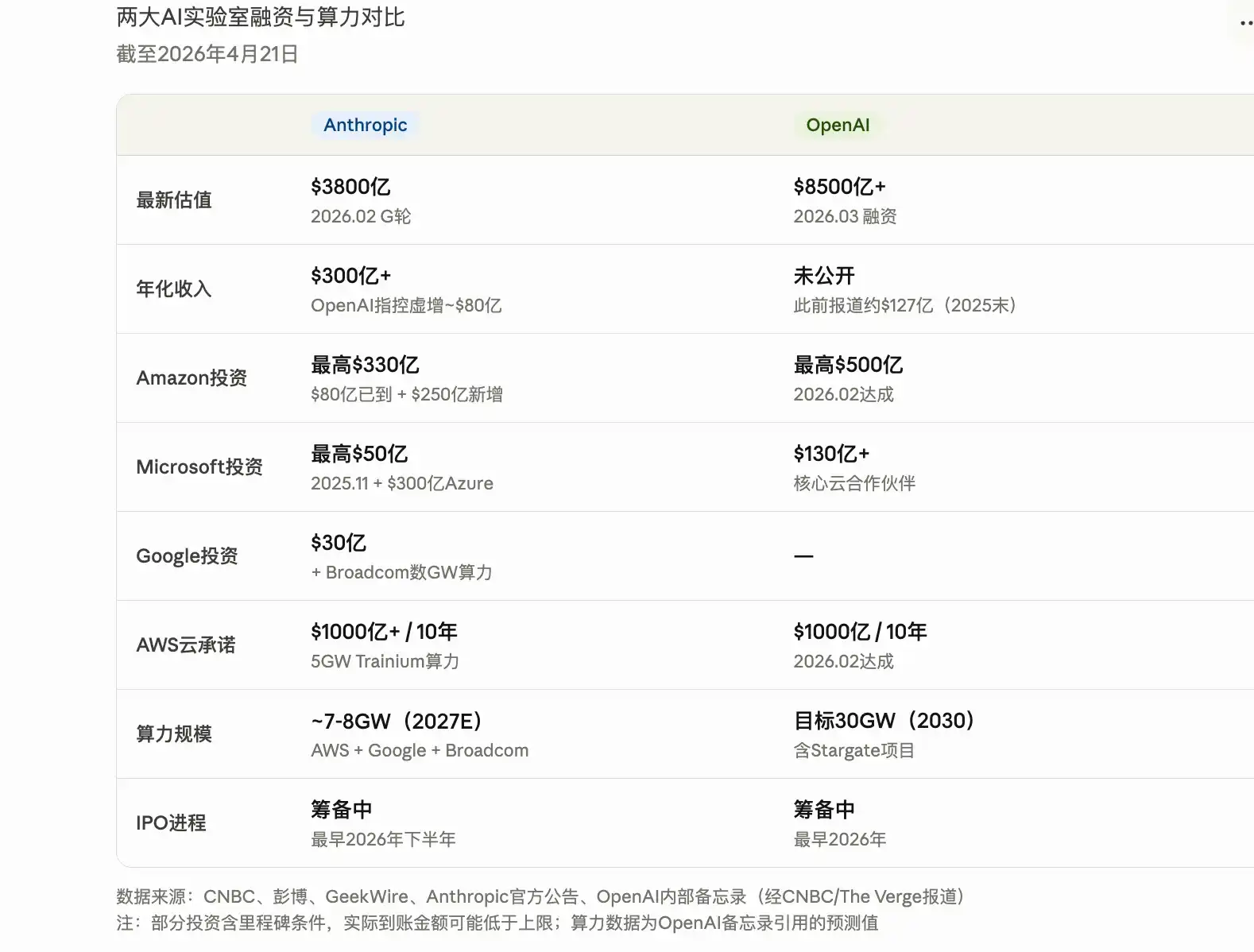
Claude Platform Integrates with AWS, Battle for Over 100,000 Customers

Beyond investment, integration at the product level is also deepening.

According to the announcement, the native Claude platform will be directly embedded into AWS. Users will be able to access the full Claude console through their existing AWS accounts, permission controls, and billing systems, without needing additional registration or new contracts. This goes a step further than the previous offering of Claude services through the Amazon Bedrock marketplace. Amazon disclosed that over 100,000 organizations are currently running Claude models on Amazon Bedrock.

Anthropic also emphasized in its blog that Claude is the only frontier AI model simultaneously available on all three major global cloud platforms (AWS Bedrock, Google Cloud Vertex AI, Microsoft Azure Foundry). This multi-platform strategy allows enterprise customers to flexibly choose their deployment path based on needs and is also one of Anthropic's differentiated advantages in competing with OpenAI.

On the client side, after Lyft used Claude via Amazon Bedrock to power its customer service AI assistant, the average resolution time for customer service was reduced by 87%. Pfizer uses Claude to help scientists perform voice searches in drug development documents, saving approximately 16,000 hours of retrieval time per year.

AI Infrastructure Race: Amazon's Capital Expenditure Expected to Reach $200 Billion This Year

The larger context embedding this deal is the AI infrastructure arms race among cloud computing giants.

Amazon stated in February that it expects capital expenditure to reach approximately $200 billion in 2026, with the vast majority directed toward AI infrastructure. The previously co-developed Project Rainier (a super-large-scale computing cluster with nearly 500,000 Trainium2 chips) was once one of the world's largest AI computing clusters, which Anthropic is using to train and deploy current and future versions of Claude.

Earlier this month, Anthropic also expanded its cooperation with Google and Broadcom, locking in computing power on the scale of "several gigawatts," expected to come online starting in 2027. Combined with this 5-gigawatt agreement with Amazon, Anthropic is expanding its computing power reserves across multiple lines simultaneously.

Amazon's custom chip business itself is also accelerating. Jassy recently revealed that the business's annualized revenue has exceeded $20 billion, doubling from the $10 billion reported earlier this year, which in his words is "on fire."


Preguntas relacionadas

QWhat is the total maximum investment commitment Amazon has made to Anthropic after the latest $25 billion addition?

AAmazon's total investment commitment to Anthropic has reached a maximum of $33 billion, which includes the previous $8 billion and the newly added up to $25 billion.

QWhat is the core infrastructure agreement between Amazon and Anthropic, and what does Anthropic receive in exchange?

AAnthropic commits to spending over $100 billion on AWS technology over the next decade, including Amazon's custom AI chips and CPU cores. In exchange, Anthropic will receive up to 5 gigawatts of computing capacity for training and deploying Claude models.

QHow does Amazon's investment strategy in AI labs appear, based on recent deals with Anthropic and OpenAI?

AAmazon is simultaneously betting on both leading AI labs, having invested up to $50 billion in OpenAI and up to $25 billion in Anthropic, each accompanied by a $100 billion cloud service commitment, following a similar playbook.

QWhat product integration advancement was announced between Anthropic's Claude platform and AWS?

AThe native Claude platform will be directly embedded into AWS, allowing users to access the full Claude console through their existing AWS accounts, permissions, and billing systems without needing separate registration or contracts.

QWhat is Amazon's projected capital expenditure for 2026, and what is the primary focus of this spending?

AAmazon expects its capital expenditure to reach approximately $200 billion in 2026, with the majority allocated towards AI infrastructure investments.

Lecturas Relacionadas

TechFlow Intelligence Bureau: Chip Stocks Lose Trillions in a Single Day, Bitcoin Falls Below $60,000, US-Iran Conflict Escalates

**Daily Tech & Markets Roundup: AI Advances, Market Turmoil, and Geopolitical Tensions** **AI / LLMs**: Anthropic's internal report on AI self-improvement sparked serious discussions about Recursive Self-Improvement (RSI). Meanwhile, debate continues on AI coding tools after Claude was accused of introducing bugs into the rsync codebase. In positive news, DeepSeek V4 Flash impressed in local deployment tests, and GitHub Copilot now supports custom endpoints for local models. A surprising research turn suggests removing chain-of-thought prompting can sometimes improve LLM performance. **Crypto / Web3**: Bitcoin plunged below $60,000, with its RSI hitting levels last seen during the COVID-19 crash, driven by strong U.S. jobs data reviving interest rate hike fears. Discussions highlight Ethereum DeFi's continued lack of a smooth consumer payment layer. **Chips / Hardware**: Chip stocks suffered a massive sell-off, with the Philadelphia Semiconductor Index posting its worst single-day drop in six years, erasing over a trillion dollars in value. Marvell, Micron, AMD, and Intel were among the biggest losers. **Tech Companies**: A leaked Microsoft document revealing goals to make Copilot "addictive" drew criticism. LinkedIn founder Reid Hoffman left Microsoft's board to focus full-time on his AI agent startup, Manus. Google was revealed to be paying SpaceX $920 million monthly for AI training compute. **Markets & Macro**: A blowout U.S. jobs report (172k vs. 80k expected) crushed hopes for near-term rate cuts, sending Treasury yields soaring and triggering a broad market sell-off. CEOs from Kraft, McDonald's, and Whirlpool simultaneously warned U.S. consumers are exhausting their savings. **Geopolitics**: U.S.-Iran tensions escalated with missile/drone interceptions and U.S. strikes on Iranian radar sites, keeping the critical Strait of Hormuz largely closed since late February and posing ongoing oil supply risks. **The Bottom Line**: The strong jobs data acted as a single trigger for correlated sell-offs across equities, crypto, and chips. Underlying the volatility is a stark contradiction between robust employment data and warnings of consumer weakness, alongside geopolitical risks that could reignite inflation, leaving markets to price in a fraught macro outlook with no clear "soft landing" path.

marsbitHace 31 min(s)

TechFlow Intelligence Bureau: Chip Stocks Lose Trillions in a Single Day, Bitcoin Falls Below $60,000, US-Iran Conflict Escalates

marsbitHace 31 min(s)

It Took Me a Year to See the Bitter Truth About Agent Payments

After a year building infrastructure for the Agent economy, engaging with major players like Stripe, Visa, and Coinbase, the author shares a sobering analysis of the current state of Agent payments. The core finding is a stark lack of genuine, immediate demand across most envisioned use cases. The article breaks down four key market segments: 1. **Agent-to-Merchant (Consumer Shopping):** For most product categories (e.g., clothing, electronics), conversational AI shopping is a step backwards from visual e-commerce interfaces. While agents excel at understanding needs, they can't replace side-by-side product comparison. Real merchant interest is defensive "Agent Engine Optimization," not driven by current customer demand. Potential exists for high-frequency, low-decision purchases (like food delivery) or navigating complex store UIs, but these require massive B2C distribution channels dominated by giants like Amazon. 2. **Agent-to-API (Developer Services):** Developers already have subscriptions and billing relationships for APIs (compute, data). Prepaid balances solve micro-payment issues for low transaction volumes. A deeper structural problem is that major SaaS vendors' business models rely on enterprise contracts, resisting granular pay-per-call pricing. While protocols like MPP and x402 serve the long tail of niche services, this market is small and developers are historically low-willingness-to-pay. 3. **Agent-to-Agent:** This remains largely theoretical with minimal transaction volume. While it represents a long-term bet on a fundamentally new transaction infrastructure (sub-second, micro-penny to million-dollar, multi-party settlements), it does not constitute a present market. 4. **Agent-to-Finance:** This is the only category with existing, paying demand. Integrating AI into financial workflows (trading, portfolio management) is a natural evolution and enables new capabilities like autonomous rebalancing. However, competition favors established, regulated institutions. The "real problem" is not moving money between agents, but the broader challenge of **coordination**—orchestrating work between agents and humans, verifying outcomes, and settling results. Payment is just one component of settlement, which is itself part of coordination. Companies that solve the coordination layer will subsume payment, not the other way around. While well-funded incumbents build defensively for a long-term future, startups must find where the market is today—which, for the author's team, lies outside these four categories in an area of real, growing, and underserved activity.

marsbitHace 1 hora(s)

It Took Me a Year to See the Bitter Truth About Agent Payments

marsbitHace 1 hora(s)

It Took Me a Year to See the Hard Truth About Agent Payments

**Title: It Took Me a Year to See the Hard Truth About Agent Payments** Over the past year, I've worked on infrastructure for the Agent economy, engaging with major players like Stripe, Visa, Coinbase, and numerous startups. The findings reveal a stark reality: genuine, widespread demand for Agent-based payments does not yet exist. **Key Observations:** * **Agent-to-Merchant (Shopping):** The user experience for AI shopping often falls short, especially for visual product discovery. While AI excels at understanding needs, conversational interfaces can't yet replace browsing and comparing multiple products visually. Current merchant interest is largely defensive ("Agent Engine Optimization") for a future that hasn't arrived. High-frequency, low-friction purchases (like food delivery) are potential fits, but lack open APIs and face high AI inference costs. Simpler, more affordable, or cross-language interactions for complex UIs are a niche opportunity but require massive consumer distribution to scale. * **Agent-to-API (Developer Tools):** Developer payment needs for APIs (computing, data, models) are already met through subscriptions and prepaid credits. The core challenge is not payment friction but supplier economics: most large SaaS providers prefer enterprise contracts over micropayments for API calls. Protocols like MPP and x402 suit the long-tail of smaller services but cater to a developer market historically reluctant to pay for these tools. Major infrastructure needs at the top of the stack are already being addressed. * **Agent-to-Agent (Machine Commerce):** This is a long-term vision with almost no current transaction volume. While a future with high-speed, high-frequency, multi-party machine-to-machine transactions would require novel infrastructure, it remains theoretical. The market is not here yet. * **Agent-to-Finance:** This is the only category with clear, present demand. Financial professionals and DeFi users already pay for tools, and AI augmentation is a natural evolution. Autonomous AI agents can enable entirely new financial strategies. However, competition is fierce from established, regulated incumbents who can more easily layer AI onto their existing products. **The Core Insight:** Companies, especially giants with long time horizons, are building defensively for a potential future of mass machine commerce. For them, early investment is a low-cost hedge. For startups, the current market reality is different. The primary challenge isn't just moving money between agents (payments). The larger, unsolved problem is **orchestration** – coordinating work between agents and humans, verifying outcomes, and then settling. Payment is just a part of settlement, which is just a part of orchestration. Companies that solve the orchestration problem will subsume payments, not the other way around. After a year of building, we see the real, growing, and underserved market opportunity lies in this broader domain of orchestration.

链捕手Hace 1 hora(s)

It Took Me a Year to See the Hard Truth About Agent Payments

链捕手Hace 1 hora(s)

Claude Opus 4.8 Finds a $4.5 Billion Bug: The AI Era is Mass-Producing Hackers

A researcher discovered a critical "infinite mint" vulnerability in the Zcash cryptocurrency's Orchard protocol using Claude Opus 4.8, leading to a swift fix but also a 50% market drop, erasing billions in value. This incident highlights a new era where powerful, accessible AI models are dramatically lowering the barrier to finding software vulnerabilities. Previously, the security community feared specialized models like Claude Mythos Preview, capable of finding decades-old zero-day exploits. The Zcash case, however, involved a publicly available, general-purpose model. This shift makes advanced security auditing—and attack capabilities—accessible to far more people, not just experts. The mass democratization of vulnerability discovery brings a dual challenge: a flood of low-quality, AI-generated false reports that overwhelm maintainers, and the real, rapid uncovering of deep, dangerous bugs. Open-source projects, often understaffed and unfunded, are particularly vulnerable to this "attention DDoS." The article cites examples like curl shutting down its bug bounty program due to the unsustainable workload. Our perceived digital safety has often been luck, relying on the high cost and effort required to find deeply hidden flaws in complex systems, as seen with historical vulnerabilities like Heartbleed or Baron Samedit. AI changes this cost structure, effectively "mass-producing flashlights" to illuminate every corner of our codebase. While large companies operate extensive security chains involving external white-hat hackers and massive defensive operations, the global cybersecurity workforce faces a severe shortage, especially of experienced personnel capable of analyzing complex threats and coordinating fixes. The core dilemma emerges: AI makes *finding* bugs cheap and scalable, but *fixing* them remains a slow, expensive, and human-intensive process. The article concludes that AI won't destroy the internet but acts as a bright light, revealing that our digital existence is not inherently secure but is precariously maintained by ongoing human effort. The true cost in the AI era may not be discovery, but whether there will be enough people left willing and able to do the hard work of repair.

marsbitHace 2 hora(s)

Claude Opus 4.8 Finds a $4.5 Billion Bug: The AI Era is Mass-Producing Hackers

marsbitHace 2 hora(s)

Trading

Spot
Futuros
活动图片