All Metrics Smashing Records, Yet Stock Prices Plunge Across the Board

marsbitPublicado a 2026-08-07Actualizado a 2026-08-07

Resumen

Memory giants like Western Digital (WDC) and SanDisk (SNDK) reported blockbuster earnings in the summer of 2026, featuring毛利率 exceeding 80%, massive customer prepayments, and long-term supply agreements. Despite this seemingly perfect performance, their stocks plummeted post-earnings (WDC down 13%, SNDK down 7%), along with peers like Micron. The collapse highlights a core market rule: "good" isn't enough; results must beat already sky-high expectations. With valuations at peak "perfect asset" levels, even slightly conservative forward guidance triggered a sell-off. The market saw "peak performance" as a signal to exit. Beneath the stellar numbers, four反常 trends emerged: 1. **Financialized Pricing:** Customers provide百亿级 in upfront "interest-free deposits" to secure future capacity. 2. **Reversed Cost Curve:** Advanced DRAM (HBM4, DDR6) costs are rising per bit due to complex packaging, breaking Moore's Law. 3. **AI vs. Consumer Split:** Data center storage demand soars (+103% for SanDisk), while consumer electronics demand weakens under high costs. 4. **HDD Revival:** Hard drives, now used for AI agent context caching, see毛利率 near 55-57%. Underlying隐忧 persist. Soaring capital expenditure (CapEx) by SK Hynix and Micron risks future oversupply. Revenue growth is increasingly driven by price hikes, not surging shipment volumes (bit growth), making profits vulnerable to any price correction. In conclusion, while AI has created a long-term growth narrative, transforming s...

Storage giants have just delivered what can be described as "epic" earnings reports.

Gross margins soaring into the 80%+ "money-printing" mode, long-term take-or-pay customer agreements spanning 3-5 years, and even customers eagerly handing over tens of billions of dollars in "interest-free deposits"... If one looked solely at the financials, the semiconductor memory industry is in the midst of the most ferocious super-boom period in history.

However, the capital market's reaction has been brutally cold.

Last night, Western Digital (WDC) plummeted over 13% after earnings, SanDisk (SNDK) dropped 7%, with Micron and SK Hynix also following the decline.

The performance is dazzlingly bright, yet stock prices tumble on the news. What exactly is the logic behind this great memory market crash occurring in the summer of 2026?

01. What Killed the Stock Price is Precisely the "Flawless" Expectations

In the rulebook of the capital market, being "good" is not enough; being "better than expected" is the hard rule.

When an industry's gross margin is pushed to a historical absolute peak above 80%, the market no longer prices it as a "cyclical stock" but as a "perfect asset."

Guidance falling short of "super-high expectations": SanDisk and Western Digital's quarterly results may have crushed consensus, but even a slight hint of "conservatism" in the next quarter's guidance became the perfect excuse for funds to take profits.

Extremely crowded positioning: Over the past few quarters, the bullish news surrounding AI memory (HBM, high-capacity eSSDs, nearline HDDs) has been thoroughly priced in by all corners of the market. Any slight signal of "marginal slowdown" triggers a stampede-like retreat from the long side.

As Wall Street traders' subtext goes: The day good news materializes is the day it becomes old news.
02. Four "Anomalous" Phenomena in the Earnings Reports: This is No Longer the Familiar Memory Cycle

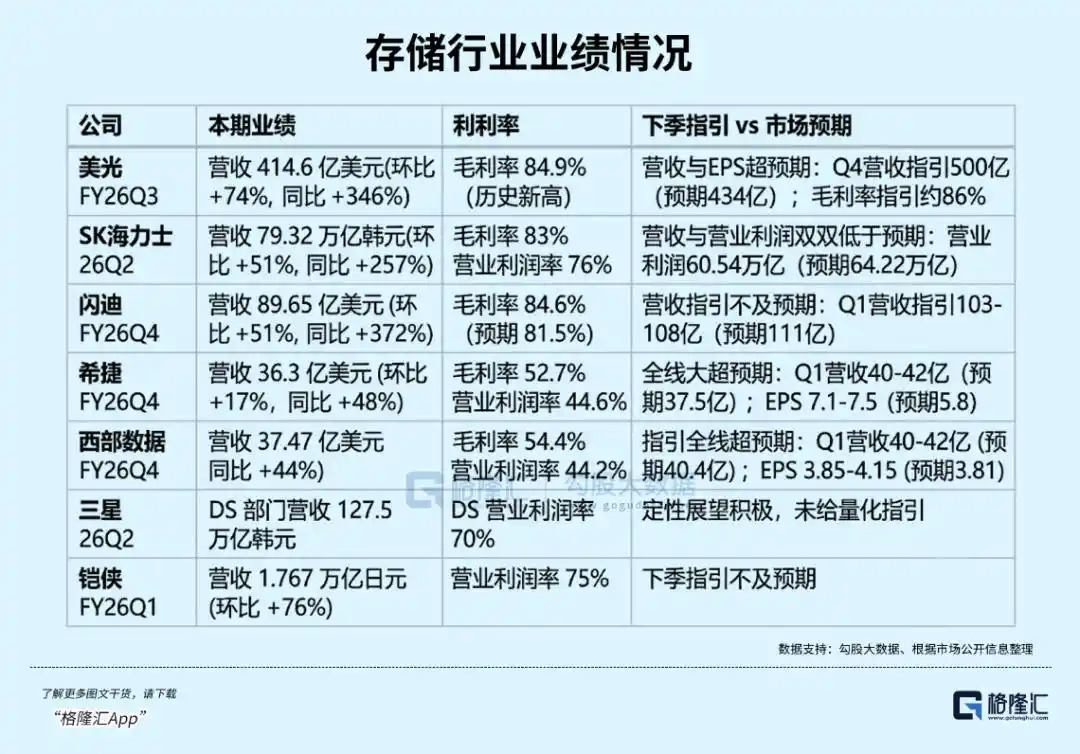
Analyzing the earnings reports from Micron, SK Hynix, SanDisk, Seagate, and Western Digital reveals that the current memory market has deviated from the traditional trajectory of Moore's Law, exhibiting four unprecedented "anomalous signals":

Customers Rushing to Offer "Interest-Free Deposits": The Financialized Pricing Mechanism

In Micron and SanDisk's reports, a phenomenon rare in semiconductor manufacturing history emerged—customer prepayments were directly classified under "financing cash flow" rather than "deferred revenue." Micron received up to $18 billion in customer cash deposits, and SanDisk secured $16.5 billion in financial guarantees.

This is essentially tens of billions of dollars in interest-free supply chain financing willingly provided by downstream industry giants to secure a "membership ticket" in future capacity allocation.

Moore's Law Completely "Broken": Cost Curve Inverts Upwards

For decades, the semiconductor industry followed "process node scaling -> cost per bit declines." However, in Micron's earnings call, management clearly stated: as DRAM advances towards HBM4/4E and high-end DDR6, the cost per bit is rising against the trend!

Complex 3D TSV packaging, stringent thermal dissipation, and yield requirements have completely reversed the cost curve for high-end memory. Future "price increases" will no longer be purely due to hoarding but will be underpinned by a permanent elevation in the physical cost structure.

"Fire and Ice" Between Consumer End and AI Data Centers

SanDisk's data center business revenue surged 103% quarter-over-quarter, while its consumer business conversely declined by 32%. This exposes a deeper concern: as AI monopolizes all advanced wafer capacity, end consumer electronics (smartphones, PCs), unable to absorb the high memory costs, are seeing some demand permanently eroded.

The Comeback of HDDs: From "Cold Storage" to "AI Warm Inference"

Seagate and Western Digital's HDD gross margins are nearing a staggering 55%-57%. Supporting this phenomenon is the advent of the Agentic AI era.

In multi-turn interactions, context caches (KV Cache) are being layered and placed extensively on HDDs to avoid GPU recomputation. High-capacity hard disk drives have forcefully transformed from "cost centers" for cold data archiving into "key enablers" for improving computational efficiency.

03. Hidden Worries Behind the Boom: Peak Capacity Battle and "Volume-Price Decoupling"

Although giants claim "supply tightness will persist beyond 2027," the frenzy in capital expenditures (CapEx) has already sown the seeds for future trouble:

Capital Expenditures (CapEx) Run Amok: SK Hynix's 2026 CapEx is hitting a high of 40 trillion KRW, with expansions accelerating at Yongin Fab1 and M15X; Micron's FY26 CapEx stands at a massive $27 billion. Launching an unprecedented wave of factory construction during the peak of industry profitability has historically been a precursor to the next supply glut cycle.

Rampant Profitability Relying Solely on "Price Hikes," Bit Shipment Growth Slows: Western Digital's Q4 hard drive bit shipment (Exabyte) growth has slowed from 30%+ to 22%, yet revenue skyrocketed by 44%.

When the core driver of explosive earnings growth becomes entirely "skyrocketing unit prices" rather than "a surge in absolute demand," the fragility of extremely high gross margins becomes starkly exposed. Once price support shows any marginal weakness, the retreat in profits will be extraordinarily sharp.

04. Conclusion: The Cycle Hasn't Disappeared, It Just Put on an AI Suit

The Microns of the world are trying to tell the market a new story—memory has transformed from a "strongly cyclical commodity" into a strategically scarce asset akin to "data infrastructure utility."

The narrative is perfect: AI-generated data has a "compound interest effect," data, once created, does not disappear; therefore, memory demand will grow perpetually.

But the capital market is always sober and cruel. The post-earnings stock plunge is smart money voting with its feet: they acknowledge AI has brought a historic, long runway for memory, but they are also acutely aware that when valuations and earnings expectations are pushed to their zenith, the margin of safety has vanished.

Keep the music playing, keep dancing? Perhaps the giants in the ballroom are still intoxicated, but funds on the sidelines have already begun quietly exiting.

AI isn't over; it's just that money is starting to move elsewhere.

Disclaimer: The copyright of this article belongs to the investment research team of Beijing Glonhui Investment Advisory Co., Ltd. (Duan Yuehan: A0160625050003). This report is prepared based on independent, objective, fair, and prudent principles. Information is sourced from publicly available materials and legally, reasonably, and appropriately collected, summarized, and edited.

The stock market carries risks, and investment requires caution. Any investment suggestions herein do not constitute a basis for your trading decisions. You must make independent investment decisions and bear your own risks. Any unit or individual who publishes, copies, disseminates, or network-publishes or reprints this article without the company's permission will be deemed as infringement, and the company will pursue legal liability.

This article is from the WeChat public account "Gelonghui Financial Hotspots" (ID: glh_finance), author: Gelonghui editor.


Preguntas relacionadas

QDespite reporting record-breaking financial performance, why did semiconductor memory stocks like Western Digital and SanDisk experience significant price drops?

AThe stock prices plummeted because the stellar results had already been fully anticipated and priced in by the market. The subsequent quarterly guidance, even if only slightly conservative, was perceived as falling short of the extremely high expectations. This triggered profit-taking, as the positive news was considered already reflected in the valuations ('sell the news').

QWhat are the four 'abnormal' or unprecedented signals identified in the memory market reports that break from the traditional cycle?

A1. Financialized Pricing: Customers are paying massive 'interest-free deposits' to secure future supply (like Micron's $18B and SanDisk's $16.5B). 2. Inversion of Moore's Law: The cost per bit for advanced DRAM (e.g., HBM4, DDR6) is increasing due to complex 3D packaging. 3. Divergence Between Consumer & AI: Data center (AI-driven) revenue is surging while consumer electronics (phones, PCs) is declining due to high memory costs. 4. HDD's AI Revival: Hard Disk Drives are becoming crucial for AI 'warm inference,' improving compute efficiency by storing KV Cache, and achieving ~55% margins.

QAccording to the article, what is a major hidden risk behind the current profitability surge in the memory sector?

AThe major risk is a potential future supply glut driven by uncontrolled capital expenditure (CapEx). Companies like SK Hynix and Micron are investing massively in new capacity during the peak of the profit cycle. This, coupled with slowing bit shipment growth and a heavy reliance on price increases rather than volume demand, makes the current high-margin structure vulnerable. Any future price correction could lead to a sharp profit contraction.

QHow is the role of Hard Disk Drives (HDD) changing in the AI era, according to the report on Seagate and Western Digital?

AHDDs are transforming from a 'cold storage' cost center into a key enabler for AI computational efficiency. In the Agentic AI era, they are used to store context caches (KV Cache) for multi-turn interactions. This allows GPUs to avoid recalculations, making high-capacity HDDs essential for 'AI warm inference' and driving their gross margins to impressive levels of 55%-57%.

QWhat is the new narrative that memory companies are trying to sell to the market, and how is the market reacting to it?

AMemory companies are promoting a narrative that storage has transformed from a cyclical commodity into a strategically scarce 'data infrastructure utility' due to AI. They argue that AI-generated data has a 'compound interest' effect and creates perpetual demand. However, the market's reaction (the sharp stock sell-off) shows that while investors acknowledge AI's long-term potential ('long slope'), they believe current valuations have become excessive, leaving no margin of safety, and are therefore taking profits.

Lecturas Relacionadas

Meme Coins Peak in 17.2 Days on Average: Ephemeral Fervor and the Great Capital Migration

Meme Coins' Average Peak: 17.2 Days - A Fleeting Frenzy and a Capital Exodus A Bloomberg analysis reveals the stark reality behind meme coin mania: extreme short-term speculation. On average, a new meme coin reaches its all-time high (ATH) a mere 17.2 days after its first trade. Alarmingly, 25% of projects peak within just 38.4 hours. The subsequent decline is brutal, with the median time to drop 95% from the peak and enter dormancy being 370 days. Only about 3% ever break their previous ATH again. This drastic compression of the speculative lifecycle is driven by zero-barrier token creation on platforms like Pump.fun and automated trading tools like sniper bots, which enable instant deployment and rapid pump-and-dump schemes. The market is saturated, diluting liquidity and forcing a predatory, player-versus-player environment where early holders quickly exit with minimal gains. As the odds of success in traditional meme coins diminish, speculative capital is migrating. Decentralized prediction markets like Polymarket, offering transparent, event-driven betting, are attracting significant liquidity. Concurrently, AI agent tokens are drawing funds with their combination of high volatility and long-term narrative tied to artificial intelligence. This capital shift marks a move away from simplistic "greater fool" assets toward platforms with clearer mechanisms or dynamic technological themes.

marsbitHace 3 min(s)

Meme Coins Peak in 17.2 Days on Average: Ephemeral Fervor and the Great Capital Migration

marsbitHace 3 min(s)

CoreWeave Default Probability Exceeds 60%! Huang Renxun 'Puts Out Fire': Financing Costs Declining, No Need for NVIDIA to Provide Backstop

CoreWeave, a major AI cloud service provider and key NVIDIA customer, is facing heightened credit market concerns. Its five-year credit default swap (CDS) spreads soared to a record high of over 1190 basis points, implying a perceived default probability exceeding 60%. Concurrently, its bond prices plummeted, with yields surging above 15-16%, reflecting intense investor worries about its ability to service nearly $50 billion in debt while remaining unprofitable. This stress is spreading within the AI infrastructure sector. CDS spreads for companies like Oracle, SoftBank, NVIDIA, and others also widened significantly, indicating a broader market reassessment of the debt risks behind massive AI capital expenditures. In response, NVIDIA CEO Jensen Huang publicly expressed confidence in CoreWeave, stating its "financial strength is growing daily" and its cost of capital is declining. He explicitly stated NVIDIA sees no need to provide a financial backstop for CoreWeave, in which it holds a roughly 10% stake. His comments helped CoreWeave's stock recover from early losses. The core issue under scrutiny is whether the future cash flows from AI investments can cover the enormous upfront costs and interest burdens, especially as financing becomes more expensive. The situation highlights a critical shift in market focus: from purely evaluating AI compute demand to questioning the sustainability of the debt-fueled expansion models used to build that capacity.

marsbitHace 23 min(s)

CoreWeave Default Probability Exceeds 60%! Huang Renxun 'Puts Out Fire': Financing Costs Declining, No Need for NVIDIA to Provide Backstop

marsbitHace 23 min(s)

Farcaster Changes Hands Again: The Hottest Potato in the Decentralized World

The decentralized social protocol Farcaster has changed ownership for the third time in nine months, being described as a "hot potato" in the decentralized world. On October 15, 2026, Rish, co-founder of Neynar, announced that Network School, founded by Balaji Srinivasan, would take over Farcaster, including its application, protocol codebase, and related products. This followed Neynar's acquisition of Farcaster from its original creator, Merkle Manufactory, in January 2026. Farcaster, which achieved a $1 billion valuation after a $150 million Series A round in 2024, saw its user activity and revenue decline sharply post-2025. Daily active users (DAU) dropped 40% from its peak of nearly 100,000, and monthly revenue fell to around $10,000. After taking over, Neynar pivoted Farcaster toward developers, but protocol revenue (including from Clanker) plummeted by 99% from Q1 to Q3 2026, leading to the search for a new owner. Network School, Balaji Srinivasan's venture practicing his "network state" theory and recently valued at $2 billion, plans to rebrand Farcaster as the "Network State Protocol." Significant rule changes include requiring users to accept a "social smart contract" to mint an NFT for full access, implementing content moderation based on Singaporean public conduct codes, and introducing AI-assisted review with potential human verification. These changes, particularly the centralized control over content and access via the dominant official app (formerly Warpcast), have sparked community debate. The repeated ownership transfers highlight a core tension in decentralized social networking: while the protocol layer is technically decentralized, control over the primary user application grants centralized power over the entire network's experience and direction. Each new owner brings a different vision, but all face the fundamental challenge of reviving a platform with declining users and revenue.

marsbitHace 24 min(s)

Farcaster Changes Hands Again: The Hottest Potato in the Decentralized World

marsbitHace 24 min(s)

US Stock Market Trends (October 16): Dow Surges Over 550 Points, TSMC's Net Profit Rises Nearly 70% but Stock Closes Lower

**U.S. Market Trends (October 16): Dow Jumps Over 550 Points, TSMC Falls Despite 69% Net Profit Surge** U.S. stocks reversed early losses on Thursday. The Dow Jones surged over 550 points (1.08%), while the Nasdaq Composite edged up 0.08%. The Philadelphia Semiconductor Index fell for a seventh consecutive session, closing down 0.88%. The S&P 500 rose 0.33%, with healthcare, materials, and financials leading gains. Energy and tech sectors declined. Major tech stocks were mixed. Microsoft and Alphabet gained, while Nvidia and Tesla fell. Server stocks like Dell and Hewlett Packard Enterprise dropped sharply. Despite reporting strong Q3 results—a 69% year-on-year jump in net profit and raising its full-year revenue growth forecast to ~44%—TSMC's U.S.-listed shares fell 1.80%. Investor concerns persist about funding for massive AI/data center expansions and their eventual returns. CoreWeave's stock rebounded to close nearly 6% higher after Nvidia CEO Jensen Huang stated the AI cloud provider was strengthening and did not need rescue, easing equity investor worries. However, its bonds remained under pressure due to high leverage and funding needs. Economic data showed mixed signals. September PPI surged 1.3% month-on-month (the highest since March 2022), driven by energy prices. Retail sales grew 0.8%, largely fueled by gasoline spending. Excluding autos and gas, growth was minimal. Despite hot inflation prints, Treasury yields retreated, with the 10-year near 5.09%. Oil (WTI) rose over 3%, while gold gained 2%. Bitcoin traded around $82,300. Focus turns to upcoming remarks from Fed officials ahead of the quiet period and key data like industrial production, as investors weigh inflation against growth concerns and tech sector volatility.

marsbitHace 39 min(s)

US Stock Market Trends (October 16): Dow Surges Over 550 Points, TSMC's Net Profit Rises Nearly 70% but Stock Closes Lower

marsbitHace 39 min(s)

Trading

Spot
活动图片