All about Revolut moving $1.2B on Polygon and if that makes it faster than SWIFT

ambcryptoPublicado a 2026-03-28Actualizado a 2026-03-28

Resumen

Digital banking giant Revolut has processed over $1.2 billion in stablecoin transfers on the Polygon network, demonstrating blockchain's growing role in mainstream finance. These transactions settled in seconds with total fees under $700, showcasing significant cost and efficiency advantages over traditional systems like SWIFT, which can take days and involve high intermediary fees. Polygon's low transaction costs—up to 426x cheaper than Ethereum—make it an attractive infrastructure for institutional payments. This milestone signals a structural shift toward blockchain-based settlements, with stablecoins enabling near-instant, low-cost, and transparent cross-border transactions.

Across the Internet and socials, there has been a heated debate between traditional finance and blockchain. However, as it stands, most investors and institutions are now accepting blockchain as an equal competitor.

Just recently, digital banking giant Revolut crossed a major milestone, processing over $1.2 billion in stablecoin transfers on the Polygon network. The figure reflects real user activity, not test flows, while highlighting how blockchain rails are quietly entering mainstream finance.

In fact, according to Polygon’s official report, these transactions settled in seconds and cost fractions of a cent, making them significantly cheaper than legacy systems.

Why are institutions choosing Polygon?

The economics behind this shift are hard to ignore. Revolut reportedly processed the entire $1.2 billion volume for less than $700 in total fees, demonstrating the scale advantage of blockchain-based settlements.

Polygon consistently offers the lowest transaction costs among major chains – Up to 426x cheaper than Ethereum and 4x cheaper than Solana in many cases.

For institutions moving large capital, this difference compounds quickly. What would cost millions in traditional infrastructure can now be executed almost instantly at near-zero cost.

Traditional cross-border transfers still lag behind

Despite decades of innovation, traditional cross-border systems remain slow and expensive. Payments routed through correspondent banking networks like SWIFT can take 1–5 business days and involve multiple intermediaries.

Fees are another major drawback. Global remittance costs average around 6.49%, with banks often charging over 14% in some corridors.

On the contrary, Polygon-based transfers eliminate intermediaries, settle in seconds, and offer 1:1 stablecoin conversions with no hidden FX spreads.

A structural shift, not a trend

Revolut’s $1.2 billion milestone is more than a headline. In fact, it’s a proof point. Institutions are no longer experimenting with blockchain; they’re deploying it at scale.

As stablecoin infrastructure matures, networks like Polygon are positioning themselves as the back end for global money movement – Faster, cheaper and increasingly invisible to the end user.

Polygon’s network token is benefiting from network adoption

On the daily chart, POL seemed to be gaining some traction at press time. This, despite the fact that the token’s prices have been consolidating over the last few weeks.

If the network keeps recording these significant gains, the altcoin’s prices could usher in a potential breakout as long as the demand zone at around $0.095 holds.
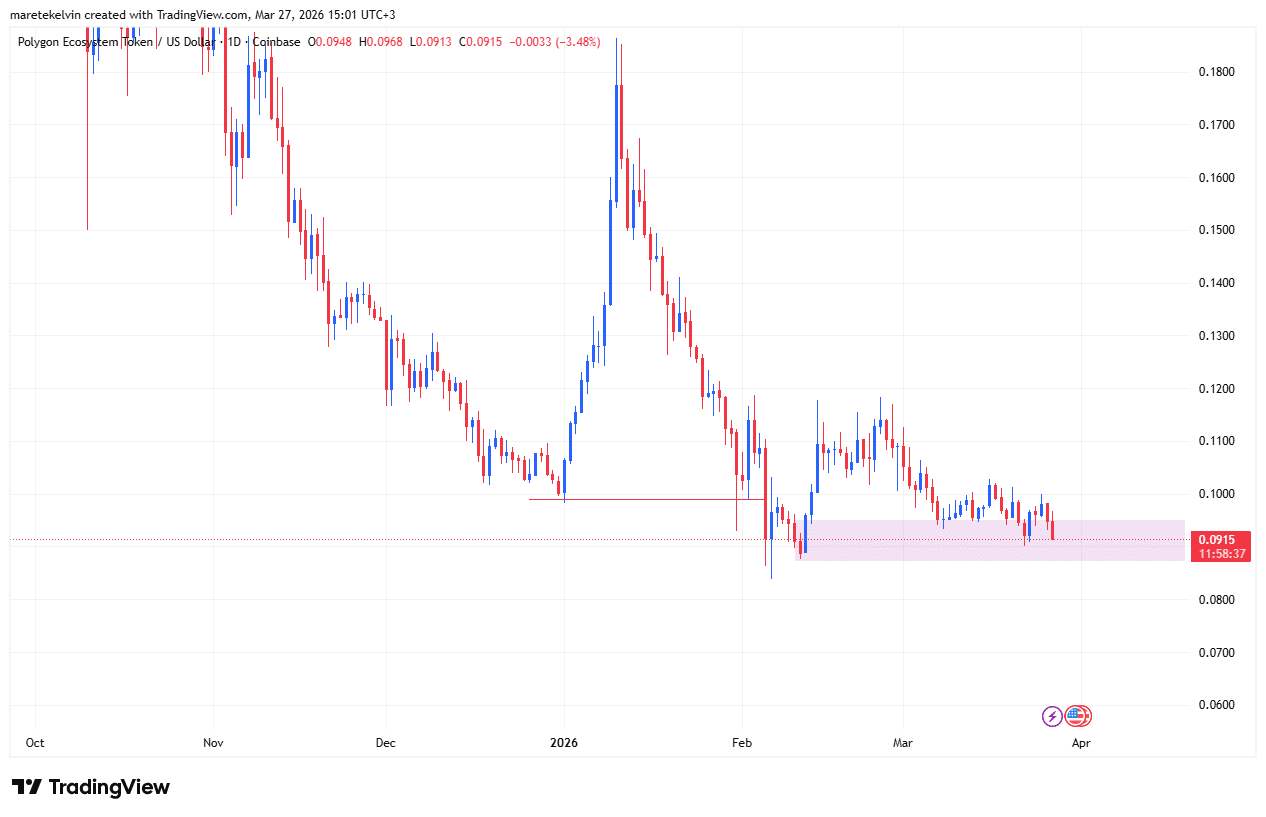
Source: TradingView

Final Summary

  • Blockchain rails like Polygon are proving significantly cheaper and faster than traditional cross-border systems at institutional scale.
  • Revolut’s $1.2B volume signals a structural shift towards stablecoin-powered global payments, rather than a temporary trend.


Preguntas relacionadas

QWhat major milestone did Revolut achieve on the Polygon network?

ARevolut processed over $1.2 billion in stablecoin transfers on the Polygon network, reflecting real user activity.

QHow do transaction costs on Polygon compare to traditional systems like SWIFT?

APolygon transactions cost fractions of a cent, significantly cheaper than traditional systems. For example, Revolut processed $1.2 billion for less than $700 in total fees, while traditional cross-border transfers average around 6.49% in fees.

QWhat are the advantages of using Polygon for cross-border transfers compared to traditional banking networks?

APolygon-based transfers settle in seconds, eliminate intermediaries, offer 1:1 stablecoin conversions with no hidden FX spreads, and are much cheaper than traditional systems like SWIFT, which can take 1-5 business days and involve multiple intermediaries.

QWhat does Revolut's $1.2 billion volume on Polygon indicate about institutional adoption of blockchain?

AIt signals a structural shift towards stablecoin-powered global payments, showing that institutions are no longer just experimenting with blockchain but are deploying it at scale for faster and cheaper transactions.

QHow has Polygon's network token (POL) been performing according to the article?

AAt the time of writing, POL was gaining some traction despite consolidating over the previous weeks. If network adoption continues, the token's price could potentially break out as long as the demand zone around $0.095 holds.

Lecturas Relacionadas

Global Stock Market's Storm Center: South Korea's Stock Market De-leveraging Is Largely Complete

Storm's Eye: South Korean Market De-leveraging Nears Completion The recent sharp correction in South Korean equities, with the KOSPI index dropping 32% from its June high, has been a key trigger for global tech stock volatility. The core driver was not a fundamental shift but a forced de-leveraging process within the market's unique structure, which is now largely complete. Two main leverage channels amplified the sell-off: 1. **Leveraged ETFs:** Their size, proportionally four times larger than in the U.S., peaked near $50 billion. Their mandatory daily rebalancing mechanism created a vicious cycle of "price drop → forced selling → further drop." Approximately 75% of this excess has been unwound, shrinking to $26 billion, with regulatory curbs now blocking new inflows. 2. **Hedge Fund Leverage:** Using swaps to magnify exposure, hedge funds saw their net long positioning fall by over 50% from peak levels. The most intense phase of this institutional de-leveraging is over. In contrast, **retail margin debt** poses minimal systemic risk. At 0.5% of market cap, it is far lower than in the U.S. or China, lacks automatic triggers, and is concentrated in smaller stocks. The conclusion: the high-leverage structures most prone to "chain-reaction selling" have been substantially cleared. The market is transitioning from a liquidity-driven crash to one priced more on fundamentals. The article argues that the AI trend—centered on Korean memory chips—remains intact. This episode represents a painful but necessary clearing of crowded trades, not the end of the AI revolution. For investors, the key question is conviction in the long-term AI direction; if the trend is real, current volatility is a cost of entry, not a terminal risk.

链捕手Hace 1 hora(s)

Global Stock Market's Storm Center: South Korea's Stock Market De-leveraging Is Largely Complete

链捕手Hace 1 hora(s)

Trading

Spot
活动图片




