All about Dogecoin’s ‘muted’ price action and the distribution pressure on it

ambcryptoPublicado a 2026-03-21Actualizado a 2026-03-21

Resumen

Dogecoin's on-chain activity surged with 1.037 billion DOGE transferred, yet the price remained stagnant around $0.094. This divergence suggests the high volume stems from redistribution, exchange movements, or internal transfers rather than genuine buying pressure. Whale activity, including $90 million+ flows into exchanges like Bitget, indicates distribution, increasing sell-side pressure. Although exchange balances dropped 30% since late 2025, intermittent large inflows continue to introduce overhead resistance. With top holders controlling 66% of supply and not accumulating, DOGE remains range-bound, balancing between distribution and absorption forces.

Dogecoin’s [DOGE] on-chain activity has expanded sharply lately. And yet, the price action stayed muted, establishing a clear imbalance between flow and valuation. Transfer volume climbed to 1.037 billion DOGE, roughly $97.8 million, while the price held near $0.094 with gains of only 0.3%.

As this divergence developed, the transaction count increased to 26,627 alongside 32,915 active addresses, reflecting rising network engagement. However, the price failed to respond in tandem, shifting attention towards the composition of these flows.

The high volume is more likely a sign of redistribution, exchange routing, or internal wallet movements than accumulation. As activity intensifies without directional follow-through, the gap between volume and price will only widen.

This pattern also suggested that raw on-chain expansion, when unadjusted for internal transfers, does not quite confirm genuine demand or sustained buying pressure.

Whale flows signal distribution behind Dogecoin’s volume spike

As transaction volume cools down, whale flows can help clarify why the price has been unresponsive. Transfers above $90 million moved into Bitget-linked wallets within 24 hours, signaling distribution into available liquidity.

As these flows hit exchanges, they increased immediate sell pressure, which absorbed incoming demand rather than pushing the price higher.

Meanwhile, top-100 holders still control over 66% of supply, translating to approximately 101.99 billion DOGE, without expanding balances, reinforcing the absence of accumulation. This behavior implied a late-cycle rotation, where large players offload into retail-driven activity. As supply met demand at these levels, the price stabilized near $0.094 instead of breaking out.

However, since holdings have been concentrated, the downside stayed controlled, leaving DOGE range-bound until either accumulation resumes or sell pressure intensifies.

Exchange flows keep Dogecoin range-bound

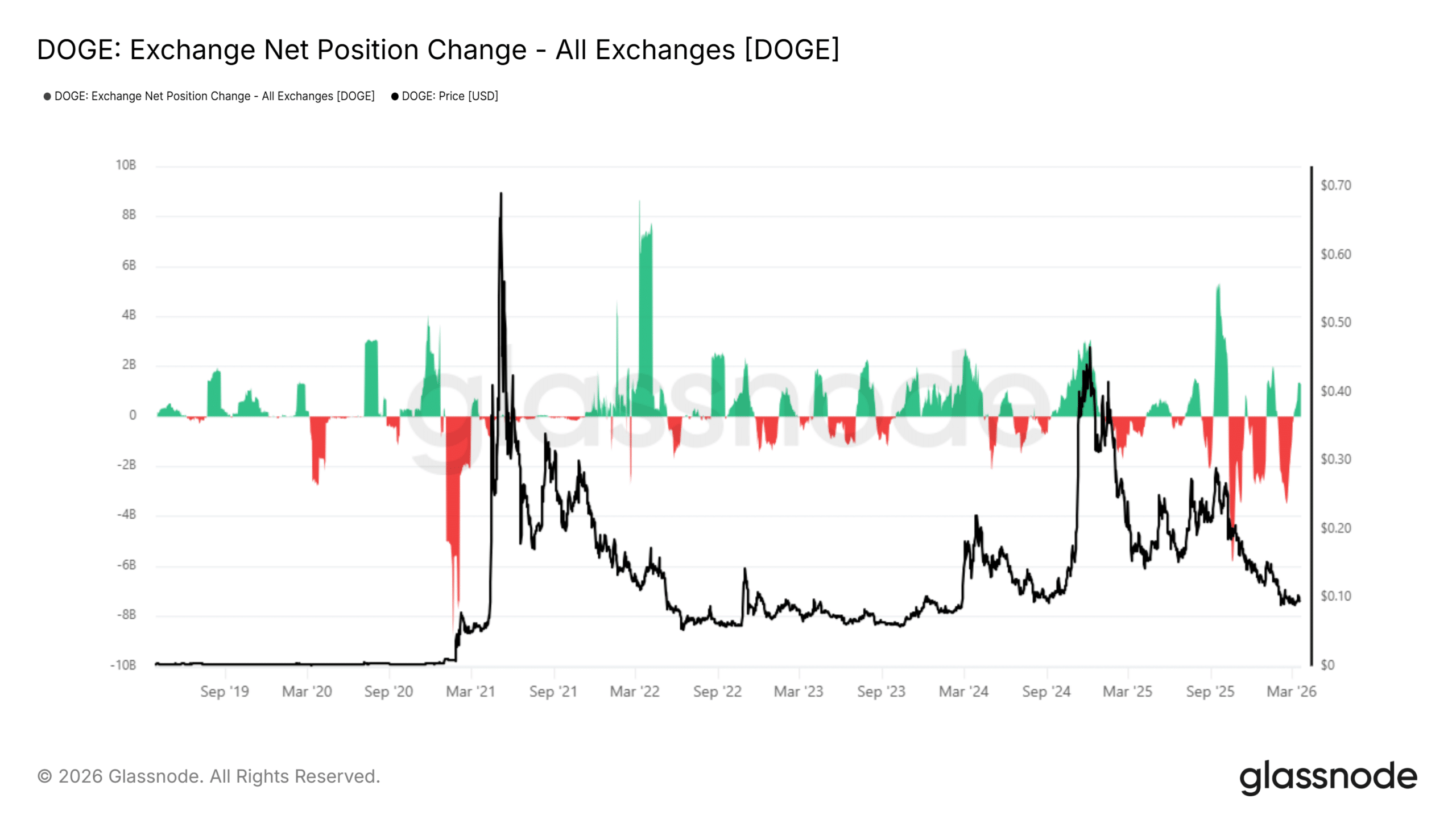
Exchange flows add context to the redistribution narrative. For example – The Net Position change showed repeated spikes above 4 billion DOGE, reflecting strong inflows into exchanges during key periods.
Source: Glassnode

As these inflows rise, the price often stalls or declines, reinforcing sell-side pressure. More recently, persistent negative flows hinted at intermittent outflows – Indicative of periods of absorption or accumulation.

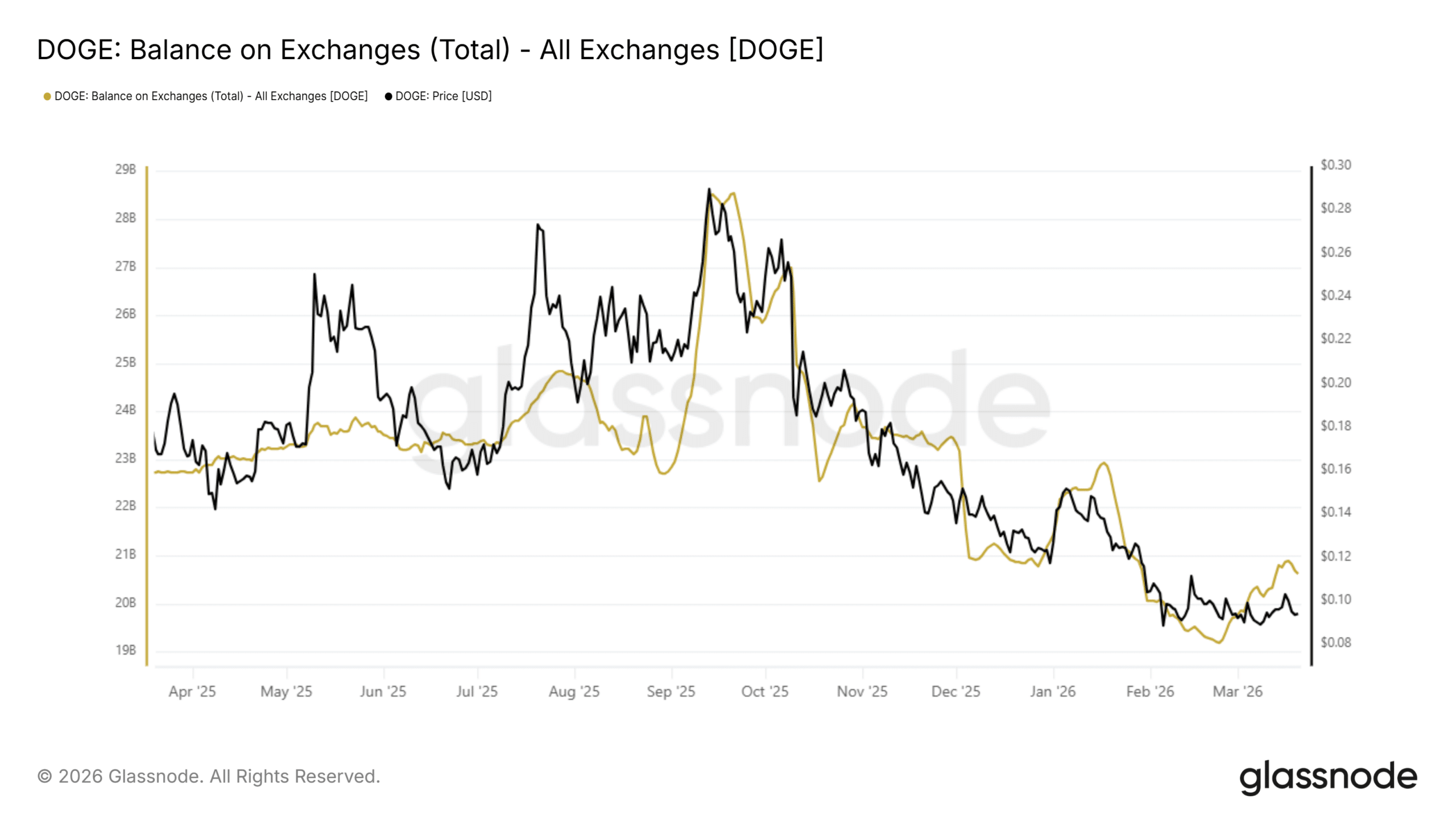
At the same time, total Exchange Balances declined from nearly 29 billion DOGE in late 2025 to around 20 billion DOGE at press time – Marking a roughly 30% drop. This reduction could allude to supply moving off exchanges, which can support price over time.
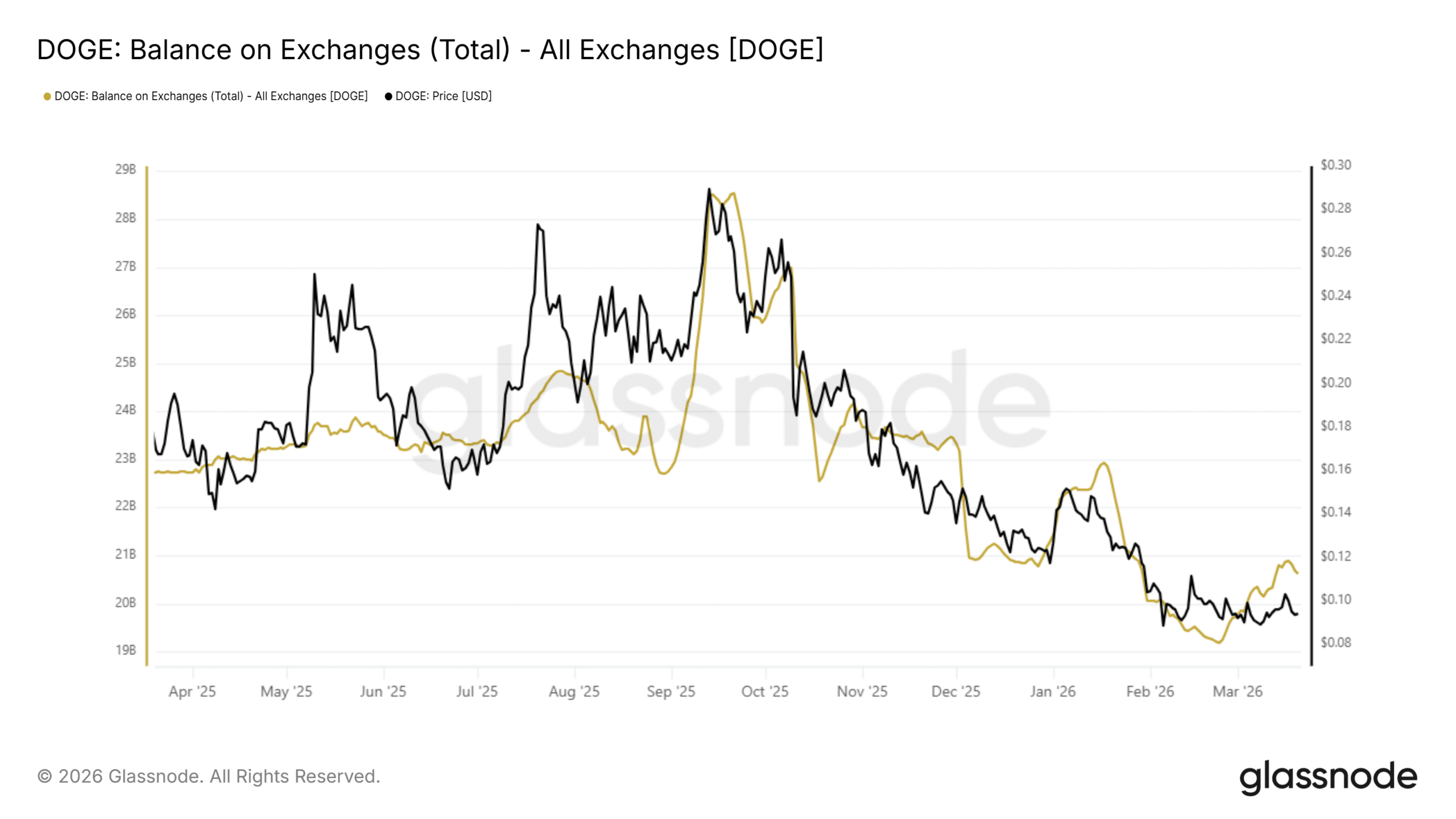
Source: Glassnode

However, intermittent inflow spikes have still introduced some overhead pressure. This is likely to keep DOGE range-bound as opposing forces balance market direction.


Final Summary

  • Dogecoin’s [DOGE] on-chain volume of 1.037 billion DOGE with the price near $0.094 reflected whale-led redistribution into exchanges.
  • Exchange inflows above 4 billion DOGE, alongside a 30% drop in balances, revealed ongoing absorption, despite intermittent sell pressure keeping price compressed.


Preguntas relacionadas

QWhat was the key divergence observed in Dogecoin's on-chain activity and price action?

ADogecoin's on-chain transfer volume climbed sharply to 1.037 billion DOGE, yet the price remained muted, holding near $0.094 with minimal gains of only 0.3%, establishing a clear imbalance between network flow and valuation.

QAccording to the article, what does the high transaction volume more likely signify rather than accumulation?

AThe high volume is more likely a sign of redistribution, exchange routing, or internal wallet movements, rather than genuine demand or sustained buying pressure from accumulation.

QHow did whale flows contribute to the unresponsive price of Dogecoin?

AWhale transfers above $90 million moved into Bitget-linked wallets, signaling distribution into available liquidity. This increased immediate sell pressure on exchanges, which absorbed incoming demand instead of pushing the price higher.

QWhat does the 30% drop in total exchange balances from late 2025 to the time of the article suggest?

AThe decline from nearly 29 billion DOGE to around 20 billion DOGE suggests that supply is moving off exchanges, which can be a supportive factor for the price over time, indicating periods of absorption.

QWhat are the two opposing forces that the article suggests are keeping DOGE's price range-bound?

AThe two opposing forces are intermittent inflow spikes that introduce overhead sell pressure and the reduction of supply on exchanges from absorption, which balance market direction and keep the price compressed.

Lecturas Relacionadas

Fu Peng's First Public Speech in 2026: What Exactly Are Crypto Assets? Why Did I Join the Crypto Asset Industry?

Fu Peng, a renowned macroeconomist and now Chief Economist at New火 Group, delivered his first public speech of 2026 at the Hong Kong Web3 Festival. He explained his perspective on crypto assets and why he joined the industry, framing it within the context of macroeconomic trends and financial evolution. Fu emphasized that crypto assets are transitioning from an early, belief-driven phase to a mature, institutionally integrated asset class. He drew parallels to the 1970s-80s, when technological advances (like computing) revolutionized traditional finance, leading to the rise of FICC (Fixed Income, Currencies, and Commodities). Similarly, current advancements in AI, data, and blockchain are reshaping finance, with crypto assets becoming part of a new "FICC + C" (C for Crypto) framework. He noted that institutional capital, including traditional hedge funds, avoided early crypto due to its speculative nature but are now engaging as regulatory clarity emerges (e.g., stablecoin laws, CFTC classifying crypto as a commodity). Fu predicted that 2025-2026 marks a turning point where crypto becomes a standardized, financially viable asset for diversified portfolios, akin to commodities or derivatives in traditional finance. Fu defined Bitcoin not as "digital gold" in a simplistic sense but as a value-preserving, financially tradable asset. He highlighted that crypto's future lies in regulated, institutional adoption, moving away from retail-dominated trading. His entry into crypto signals this maturation, where traditional finance integrates crypto into mainstream asset management.

marsbitHace 56 min(s)

Fu Peng's First Public Speech in 2026: What Exactly Are Crypto Assets? Why Did I Join the Crypto Asset Industry?

marsbitHace 56 min(s)

Justin Sun Sues Trump Family: What $75 Million Bought Was Only a Blacklist

Justin Sun, founder of Tron, has filed a lawsuit in federal court against World Liberty Financial (WLF), alleging he was made the "primary target of a fraudulent scheme" after investing $75 million. Sun claims the investment secured him an advisor title and WLFI tokens, which were later frozen by WLF, causing "hundreds of millions in losses." The dispute began in late 2024 when Sun's investment helped revive WLF's struggling token sale, which ultimately raised $550 million. Shortly after, the SEC dropped its lawsuit against Sun following Donald Trump's inauguration. However, relations soured when Sun refused WLF's demands for additional funding. In August 2025, WLF added a "blacklist" function to its smart contract, allowing it to unilaterally freeze tokens. Sun's holdings, worth approximately $107 million, were frozen, and he was threatened with token destruction. The lawsuit highlights WLF's structure, which directs 75% of token sale profits to the Trump family, who had earned $1 billion by December 2025. WLF's CEO is Zach Witkoff, son of U.S. Middle East envoy Steve Witkoff. The project faces scrutiny for opaque operations, including a controversial loan arrangement on the Dolomite platform, co-founded by a WLF advisor. Despite Sun's history with the SEC, the case underscores centralization risks within DeFi, as WLF controls governance and holds powers to freeze assets arbitrarily. Sun's tokens remain frozen as legal proceedings begin.

marsbitHace 1 hora(s)

Justin Sun Sues Trump Family: What $75 Million Bought Was Only a Blacklist

marsbitHace 1 hora(s)

$500 to Buy OpenAI Stock: Silicon Valley's Most Respectable Liquidity Invitation

Silicon Valley's largest venture capital platform, AngelList, has launched a new fund called USVC, allowing U.S. retail investors to buy into high-profile AI companies like OpenAI, Anthropic, and xAI with a minimum investment of $500—no accredited investor status required. Promoted by AngelList co-founder Naval Ravikant, the fund is framed as an opportunity for ordinary people to access high-growth private tech investments traditionally reserved for VCs. However, critics argue it functions more like an exit vehicle for early insiders. USVC acquires shares not through primary rounds but largely via secondary transactions—purchasing stakes from early investors, VC funds, and employees looking to cash out at peak valuations. With companies like xAI heavily weighted in the portfolio, the fund effectively channels retail money into providing liquidity for insiders who entered at much lower valuations. The fund’s structure raises concerns: shares are illiquid, with no secondary market, and buybacks are limited and discretionary. The actual annual fee reaches 3.61%, far above the advertised 1% management fee. This model parallels the "low float, high fully diluted valuation" strategy seen in crypto, where early investors profit by selling to latecomers at inflated prices. The timing—alongside similar moves by platforms like Robinhood—suggests that Silicon Valley’s sudden interest in retail inclusion may be less about democratizing access and more about securing exits for insiders.

marsbitHace 1 hora(s)

$500 to Buy OpenAI Stock: Silicon Valley's Most Respectable Liquidity Invitation

marsbitHace 1 hora(s)

Trading

Spot
Futuros
活动图片