AI2 Releases Fully Open-Source Web Agent MolmoWeb: Controlling Web Pages Using Only "Vision"

marsbitPublicado a 2026-03-26Actualizado a 2026-03-26

Resumen

AI2 has released MolmoWeb, a groundbreaking, fully open-source web agent that operates solely by analyzing screenshots, marking a significant leap in vision-driven web navigation. Unlike traditional agents that rely on DOM, MolmoWeb captures and interprets visual data to make decisions—such as clicking, scrolling, or typing—making its process transparent and robust. Despite its compact size (4B and 8B parameters), MolmoWeb performs impressively: it scores 78.2% on the WebVoyager benchmark, nearing OpenAI’s proprietary o3 model (79.3%), and achieves up to 94.7% success with multiple attempts. It even surpasses Anthropic’s Claude3.7 in UI element localization. AI2 also released MolmoWebMix, a massive open dataset with 36K human-browsing tasks, over 2.2M screenshot-QA pairs, and GPT-4o-verified synthetic data. The model and data are fully available on Hugging Face and GitHub under Apache 2.0, promoting transparency and collaboration in AI development. Challenges remain in complex instructions, logins, and legal compliance.

The Allen Institute for Artificial Intelligence (AI2) recently released the groundbreaking fully open-source web agent MolmoWeb . Unlike traditional agents that rely on a webpage's underlying code (DOM), MolmoWeb makes decisions solely by reading screenshots, marking a significant leap forward in "vision-driven" web navigation technology.

Core Technology: "Seeing" Web Pages Like a Human

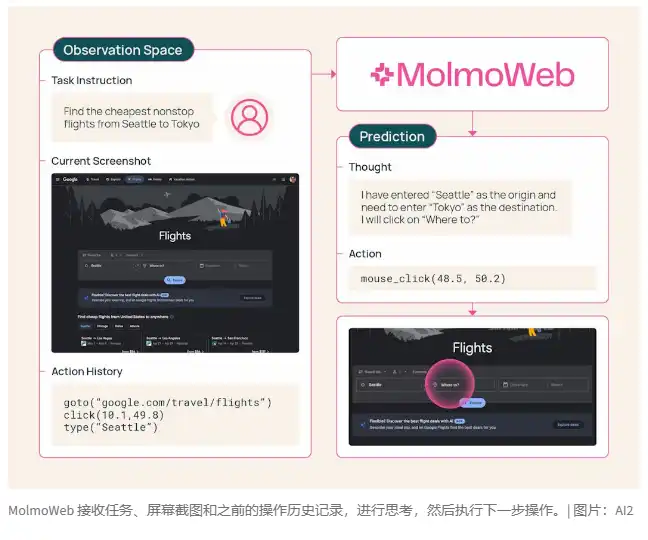
MolmoWeb's operating logic is very intuitive: it captures a screenshot of the current browser window, decides the next action (such as clicking, scrolling, or paging) through visual analysis, then executes it and repeats. This "what you see is what you get" model makes it more robust than traditional agents because the visual layout of a webpage is generally more stable than its underlying code, and its decision-making process is completely transparent and explainable to human users.
Performance Leap: Small Model Outperforms Giants

Despite having parameter sizes of only 4B and 8B, MolmoWeb demonstrates a "small but mighty" performance:

  • Topping the Charts: In the WebVoyager test, the 8B version scored an impressive 78.2%, not only ranking among the top open-source models but also approaching the performance of OpenAI's proprietary model o3 (79.3%).

  • Huge Potential: Research found that by running tasks multiple times and selecting the optimal result, its success rate could further jump to 94.7%.

  • Precise Localization: In UI element localization benchmark tests, it even surpassed Anthropic's Claude3.7.

Data Support: The Largest Open Dataset to Date

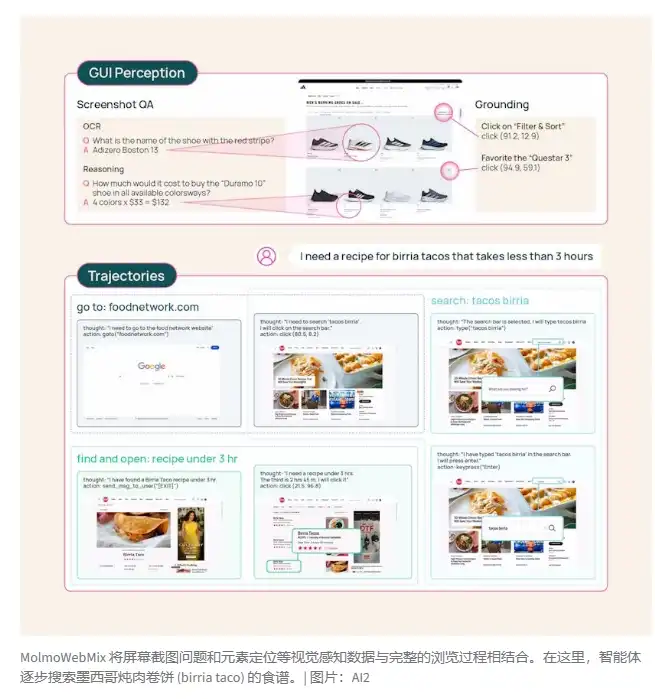
AI2 has not only open-sourced the model weights but also contributed a massive dataset named MolmoWebMix. This dataset contains:

  • 36,000 real browsing tasks completed by human volunteers.

  • Over 2.2 million screenshot-question-answer pairs.

  • Automated synthetic data verified by GPT-4o. Experiments show that synthetic data is even better than human trajectories at guiding the agent to find the "optimal path".
Open-Source Spirit and Future Challenges

Currently, MolmoWeb is fully available under the Apache 2.0 license on Hugging Face and GitHub. Although it still faces challenges in handling complex instructions, login authentication, and legal compliance (such as terms of service), AI2 firmly believes that only through complete transparency and community collaboration can we truly counter the data monopoly of large tech companies.


Preguntas relacionadas

QWhat is the name of the fully open-source web agent released by the Allen Institute for AI (AI2) that navigates using only screenshots?

AThe web agent is called MolmoWeb.

QHow does MolmoWeb's approach to web navigation differ from traditional web agents?

AUnlike traditional agents that rely on a webpage's underlying code (DOM), MolmoWeb makes decisions by reading and analyzing screenshots, making it a 'vision-driven' technology.

QWhat was the performance score of the 8B parameter version of MolmoWeb on the WebVoyager test, and how does it compare to OpenAI's model?

AThe 8B version scored 78.2% on the WebVoyager test, which is very close to the performance of OpenAI's proprietary model o3, which scored 79.3%.

QWhat is the name of the large, open dataset released alongside MolmoWeb, and what does it contain?

AThe dataset is called MolmoWebMix. It contains 36,000 real browsing tasks completed by human volunteers, over 2.2 million screenshot-QA pairs, and automated synthetic data verified by GPT-4o.

QOn which platforms has MolmoWeb been made available, and under what license?

AMolmoWeb has been fully released on Hugging Face and GitHub under the Apache 2.0 license.

Lecturas Relacionadas

SemiAnalysis on the Epic Plunge: It's Not Over Yet

SemiAnalysis Weekly discusses the recent sharp correction in the semiconductor market after a historic first half. Analysts Doug O'Loughlin and Dylan note that despite healthy fundamentals, markets like South Korea's KOSPI have plunged 40%, wiping out leveraged retail investors. A core debate focuses on AI demand versus supply constraints. Dylan cites SemiAnalysis's internal use of AI coding agents, leading to a 100x increase in AI spending, as evidence of powerful demand. Doug agrees demand is strong but questions its exact magnitude, calling it a "trillion-dollar question." His primary concern is physical and financial bottlenecks: a shortage of 100,000 electricians in the US, massive $450B in corporate debt issuance by hyperscalers (funded by a shrinking pension pool), and labor/scale limits in regions like Taiwan, where TSMC constitutes 20% of GDP. The conversation covers market dynamics, including the typical semiconductor cycle where over-ordering leads to crashes, China's growing memory capacity, and the potential for older chips like the H100 to lose value as models scale. Politically, AI is seen as a likely scapegoat in upcoming elections, though not a top-tier voter priority. The analysts conclude that while the long-term potential is significant, the scaling path is narrowing. The challenge is matching exponential compute demands with real-world constraints on capital, labor, and permits, risking scenarios where massive investment outpaces near-term revenue generation.

marsbitHace 48 min(s)

SemiAnalysis on the Epic Plunge: It's Not Over Yet

marsbitHace 48 min(s)

After Robinhood's Aggressive Entry, Why is PUMP Defying the Trend and Rising?

Amid a prolonged crypto bear market that has strained many projects, Pump.fun stands out by maintaining strong profitability. Despite a major token unlock in mid-July that was expected to cause selling pressure, its native token PUMP has risen nearly 48% over the past month. Analysis shows only a small portion of unlocked tokens were sold, with 92% of investor allocations still held. A buyback-and-burn mechanism has also supported the price, though daily回购 funds have declined by 77.5% from their peak, partly due to a change in tokenomics and lower platform revenue. Pump.fun remains a top revenue generator in crypto, with annualized revenue of around $450 million, ranking just behind giants like Tether and Circle. However, its daily revenue is down about 69% from its all-time high, reflecting dependence on meme coin market cycles. The platform also faces a class-action lawsuit alleging market manipulation and securities violations. New competition has emerged with Robinhood Chain's launchpad, which recently saw higher weekly volume and active addresses than Pump.fun. While Pump.fun's metrics haven't declined yet, it has responded with a new token launch mechanism called BOOST to improve liquidity. This has increased platform activity but raised community concerns about potential exploitation for short-term pumps. Ultimately, Pump.fun's success remains tightly linked to meme coin speculation and broader market sentiment.

marsbitHace 49 min(s)

After Robinhood's Aggressive Entry, Why is PUMP Defying the Trend and Rising?

marsbitHace 49 min(s)

Trading

Spot
活动图片