AI Panic Spreads, Pre-market US Storage Chip Stocks Fall Across the Board, SK Hynix Plummets 15.4% for Its Biggest-Ever Drop, Crude Oil Rises, Gold Falls

链捕手Publicado a 2026-07-13Actualizado a 2026-07-13

Resumen

Amid market jitters, SK Hynix shares plunged 15.4%, their largest-ever daily drop, following a below-expectations earnings forecast and profit-taking after its recent U.S. listing. This led a broad selloff in memory chip stocks, dragging South Korea's KOSPI index down sharply and triggering circuit breakers. Concurrently, heightened geopolitical tensions after U.S. strikes on Iran drove oil prices sharply higher, intensifying inflation and further rate hike fears. This pushed U.S. Treasury yields up and strengthened the dollar, while pressuring gold and other precious metals lower. The market now braces for key U.S. inflation data, the start of earnings season, and central bank signals amidst the volatile backdrop.

A "small note" from a South Korean securities firm sent SK Hynix plunging 12%, pressuring the entire memory sector. The US military launched a new round of strikes against Iran, suddenly intensifying tensions in the Middle East and causing turbulence in global markets.

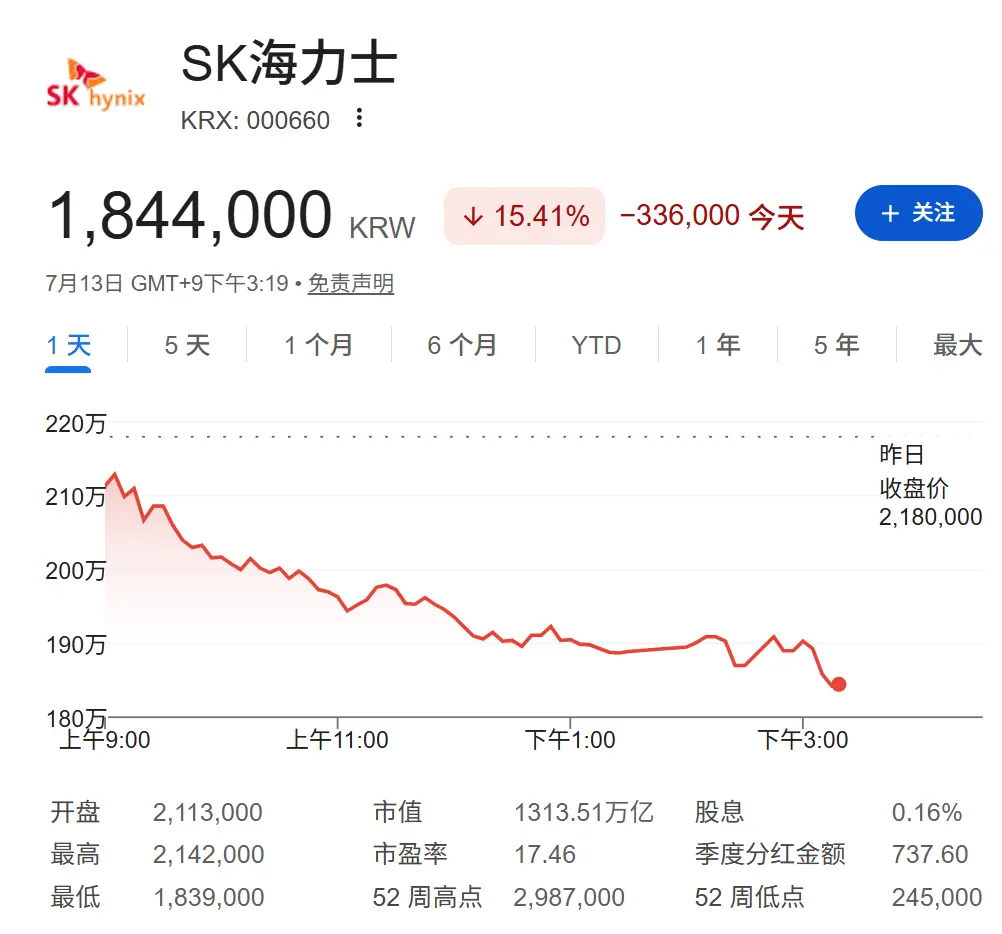
On Monday, before the US market opened, memory chip stocks fell across the board: Micron Technology down about 6%, Seagate Technology down about 4%, Western Digital down about 6%, SanDisk down about 7%. SK Hynix's stock price plunged 15.4%, marking its largest-ever single-day drop, and Samsung fell nearly 11%. The two heavyweight stocks combined to trigger the seventh circuit breaker of the year for South Korea's Kospi index. The immediate trigger was an earnings forecast that was 8% below market expectations, combined with a wave of profit-taking as the "good news" of its $26.5 billion ADR listing was exhausted. Deeper reasons include insufficient pricing elasticity for HBM, and a supply-demand scissors gap between capacity expansion and slowing demand, creating real cracks in the market's valuation logic for memory chips.

Crude oil prices rose sharply, and US Treasury yields climbed. According to CCTV News, US Central Command announced that at 5:00 PM Eastern Time on July 12, the US military began a new round of strikes against Iran, aiming "to continue degrading its ability to attack vessels freely transiting the Strait of Hormuz." In the early hours of July 13 local time, explosions were reported in multiple locations in Iran, including Bandar Abbas and the Sirik region. Meanwhile, precious metals like gold weakened broadly, and the US dollar strengthened.

This round of tensions coincides with a critical juncture for markets—the US earnings season is about to begin, with Goldman Sachs and JPMorgan Chase set to report results on Tuesday. Inflation data is also scheduled for release this week, clearly heightening market concerns that rising energy prices could further push up inflation.

  • Pre-market US memory chip stocks fell across the board: Micron Technology down about 6%, Seagate Technology down about 4%, Western Digital down about 6%, SanDisk down about 7%.
  • Europe's Stoxx 50 index opened down 0.5%, Germany's DAX index down 0.5%, the UK's FTSE 100 up 0.1%, France's CAC 40 index down 0.3%.
  • Japan's Nikkei 225 index closed down 1.9% at 67,242.73 points. Japan's Topix index closed down 0.7% at 4,007.49 points. South Korea's KOSPI index closed down 8.9% at 6,806.93 points. SK Hynix's stock price plunged 15.4%, marking its largest-ever single-day drop.
  • Nasdaq 100 index futures fell 1.3%, and European stock futures also indicated an opening drop of about 1%.
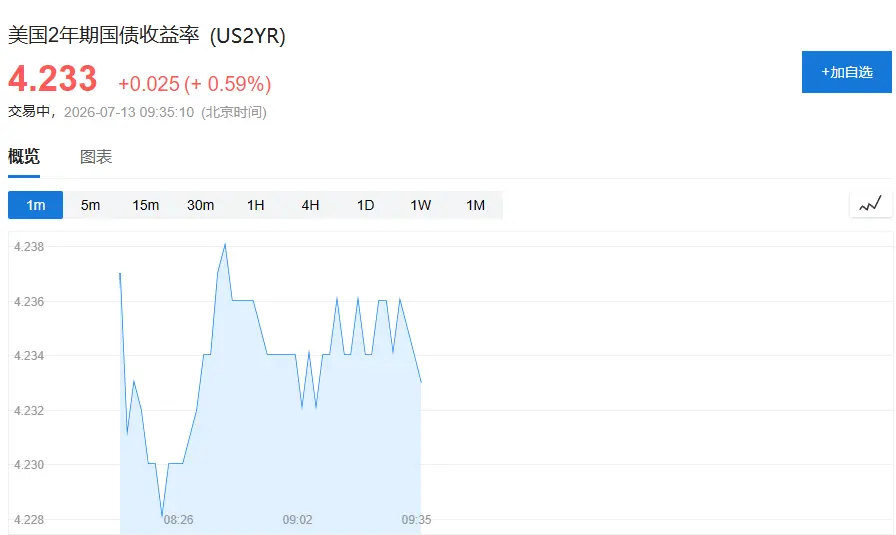
  • US Treasuries were sold off across the board. The yield on the policy-sensitive 2-year Treasury note rose 2 basis points to 4.23%, its highest level since February 2025. Japanese and Australian government bond yields also fell.
  • The US dollar strengthened across the board against G10 currencies. The US dollar index rose 0.2%.
  • Gold fell 1.3% to about $4,065 per ounce; silver fell nearly 3% to about $58.20 per ounce.
  • The cryptocurrency market also weakened, with Bitcoin down over 2% to around $62,700, dragging down the broader crypto market.

Stock Markets Under Pressure Across the Board, South Korea Leads Declines

South Korea's KOSPI index closed down 8.9% at 6,806.93 points. SK Hynix's stock price plunged 15.4%, marking its largest-ever single-day drop. Japan's Nikkei 225 index closed down 1.9% at 67,242.73 points. Japan's Topix index closed down 0.7% at 4,007.49 points.
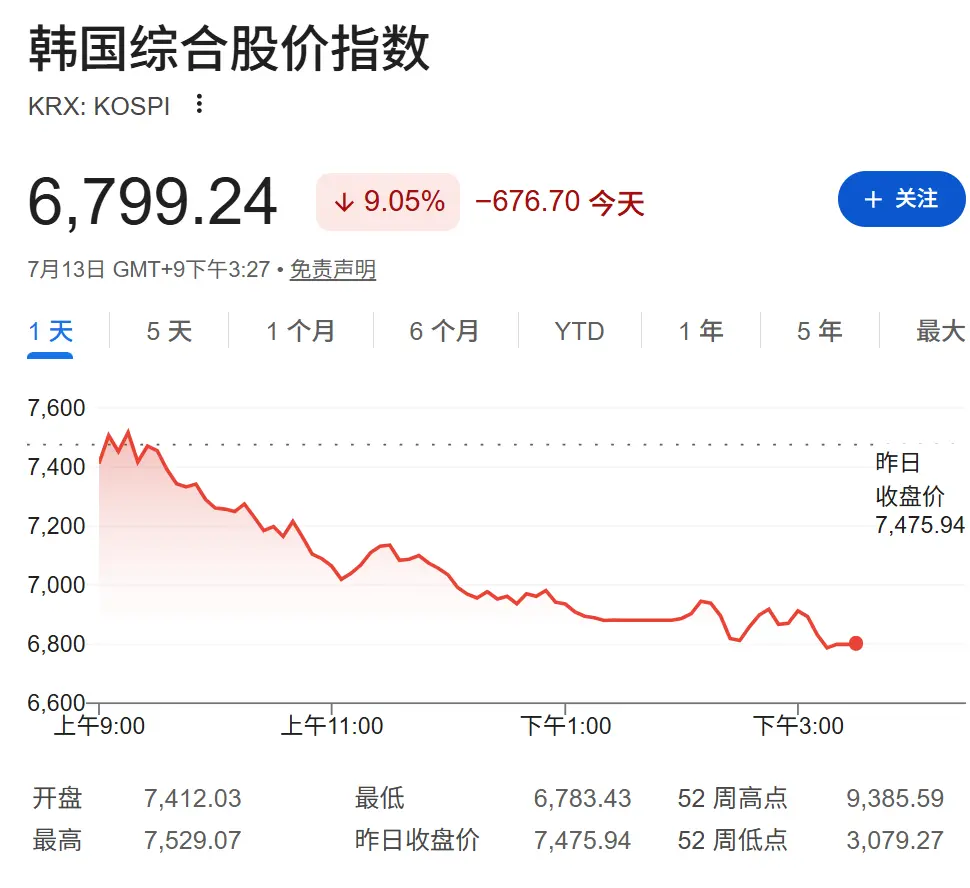
On the news front, South Korean President Lee Jae-myung stated that a "Future Response Fund" will be established to channel surplus tax revenue into productive future investment projects. Government support will be directed to three mega-projects: chips, AI data centers, and physical AI.

Part of SK Hynix's sharp pullback stemmed from profit-taking pressure following its American Depositary Receipts (ADRs) rising 13% on their New York debut last Friday. Korea Investment & Securities predicted that SK Hynix's second-quarter operating profit might be 8% lower than market expectations, citing the company's higher revenue proportion from High Bandwidth Memory (HBM) limiting its average selling price increase potential. The institution believes the upward momentum in the New York market has been fully digested, and the stock may face significant profit-taking and arbitrage unwinding, potentially closing with a long upper shadow.
Japan's Nikkei 225 opened 0.1% lower, with the loss later widening to 1%. Shoji Hirakawa, chief global strategist at Tokai Tokyo Intelligence Lab, said, "Further escalation in attacks between the US and Iran could act as a negative catalyst for the market. During periods of rising geopolitical risk, investors tend to favor sectors with strong profitability, which means semiconductor stocks may remain relatively resilient."

Crude Oil Surges, Market Worried About Inflation and Rate Hike Prospects

Uncertainty surrounding the Strait of Hormuz directly pushed oil prices higher. Brent crude rose over 3% to $78.50 per barrel; WTI crude futures gained up to 4.2% to $74.40 per barrel, one of the largest single-day gains recently.
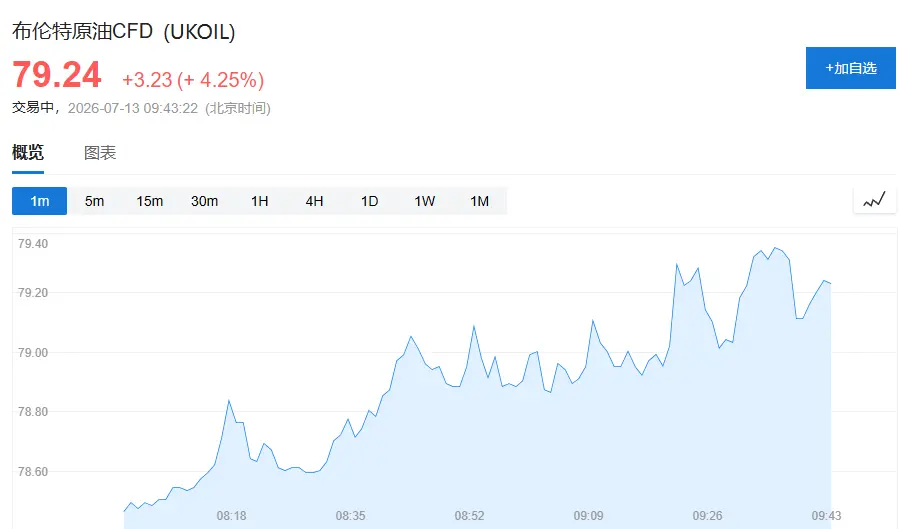
The surge in oil prices has reignited inflation concerns. Oil had already posted its biggest weekly gain since mid-May the previous week. Traders subsequently made large bets on further monetary tightening by the Fed—interest rate swaps are now pricing in nearly 40 basis points of cumulative Fed rate hikes by December, a significant increase from around 15 basis points in early June.

The US Treasury market came under simultaneous pressure. The yield on the rate-sensitive 2-year Treasury note rose 3 basis points to 4.23%, a new high since February 2025; the 10-year yield also climbed 3 basis points to 4.59%. Australian and Japanese government bond yields also moved higher. Bloomberg strategist Mark Cranfield noted that if oil prices remain strong, US Treasuries will face further downward pressure, and the oil-bond-dollar linkage effect will continue to play out in the short term.
Gold Weakens, Dollar Strengthens

In contrast to crude oil, precious metals generally weakened. Spot gold fell 1.1% to $4,073 per ounce; silver dropped 1.8% to $58.82 per ounce; platinum and palladium also weakened.
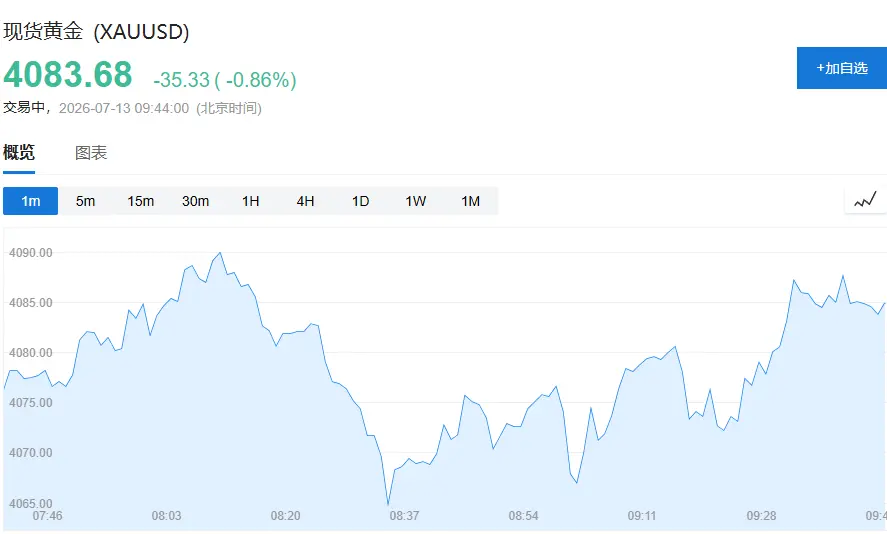
Notably, gold has fallen more than a fifth since the Iran war erupted at the end of February, ending a three-year bull run. A wave of large-scale profit-taking once pushed the gold price below $4,000 for the first time since last November. The core logic behind gold's recent pressure is that rising oil prices boost inflation expectations, thereby strengthening rate hike expectations.

The US dollar, meanwhile, strengthened broadly. The Bloomberg Dollar Spot Index rose 0.2%, the euro fell 0.2% to $1.1397, and the yen fell 0.2% to 162.00 per dollar. Bitcoin, after initially falling, recovered some losses, trading around $64,175.

Focus This Week: Inflation Data, Earnings Season, and Central Bank Moves

Markets face multiple tests this week. US inflation data is due for release, and whether persistently rising energy prices can further push up CPI will be a key focal point. Fed Chairman Kevin Warsh will also make his first appearance before Congress for a hearing, marking his first public remarks since taking office. The market will closely watch his latest stance on the interest rate outlook.

Regarding the earnings season, Goldman Sachs and JPMorgan Chase will be the first to report results on Tuesday, marking the first major test of whether corporate profits can support the market rally driven by AI optimism. Asian markets will focus on China's second-quarter GDP growth data and the Bank of Korea's interest rate decision to assess the extent of economic drag from weak domestic demand.


Criptos en tendencia

Preguntas relacionadas

QWhat triggered the significant drop in SK Hynix's stock price, and what was the magnitude of this decline?

ASK Hynix's stock price was triggered by a lower-than-expected earnings forecast from a Korean brokerage, which predicted Q2 operating profit would be 8% below market expectations. This, combined with profit-taking after its recent ADR listing, led to a decline of 15.4%, marking its largest historical single-day drop.

QWhat were the main factors driving the increase in crude oil prices according to the article?

AThe main factor driving the increase in crude oil prices was heightened geopolitical tensions in the Middle East, specifically new U.S. military strikes against Iran, which raised concerns about potential disruptions to shipping in the critical Strait of Hormuz.

QWhy did gold prices fall despite the rise in geopolitical risk and oil prices?

AGold prices fell because rising oil prices fueled inflation concerns, which in turn strengthened expectations for higher interest rates from central banks like the Fed. Higher interest rates increase the opportunity cost of holding non-yielding assets like gold, leading to selling pressure and price declines.

QWhat key market events are investors focused on in the upcoming week, as mentioned in the article?

AInvestors are focused on several key events: the release of U.S. inflation data, the start of the Q2 earnings season with reports from major banks like Goldman Sachs and JPMorgan, and congressional testimony from the new Federal Reserve Chair, Kevin Warsh, for clues on future monetary policy.

QHow did the broader financial markets react alongside the plunge in SK Hynix and other chip stocks?

AThe broader financial markets experienced significant pressure. Major Asian indices like South Korea's KOSPI and Japan's Nikkei 225 fell sharply. U.S. Treasury yields rose, indicating a bond sell-off. The U.S. dollar strengthened against other major currencies, while cryptocurrencies like Bitcoin also declined.

Lecturas Relacionadas

8,000 BTC Fails to Support Stock Price; Can a Reverse Stock Split Save American Bitcoin?

American Bitcoin, a company closely linked to Eric Trump, faces a paradox: despite significantly increasing its Bitcoin holdings to 8,000 BTC, its stock price continues to decline. The company recently executed a 1-for-15 reverse stock split, effective July 2, aimed at raising its per-share price to meet Nasdaq listing requirements. While this action does not change the company's overall valuation, it carries risks, including potential negative market perception and reduced liquidity. The company's strategy involves using its profitable mining operations, with a cost below market price, to accumulate Bitcoin, unlike competitors who primarily issue new shares to fund purchases. However, its Q1 2026 financials revealed a net loss and significant digital asset impairment losses, highlighting that mere Bitcoin accumulation does not guarantee stock performance. The core challenge is whether the stock offers value beyond direct Bitcoin ownership. Bullish arguments focus on the growing BTC reserves and the sustainable mining model. Bearish concerns center on weak liquidity, the threat of future share dilution from potential fundraising, and the market's reluctance to award a premium simply for holding Bitcoin. The reverse split, necessary to maintain its listing, underscores underlying business weakness. The company's future hinges on stabilizing its stock liquidity, transparently managing its BTC treasury, and proving its model can grow reserves without excessively diluting shareholders. Its performance serves as a critical test for the publicly traded Bitcoin treasury sector.

marsbitHace 17 min(s)

8,000 BTC Fails to Support Stock Price; Can a Reverse Stock Split Save American Bitcoin?

marsbitHace 17 min(s)

Bitcoin Volatility Unchanged Amid Dominant Downtrend; HYPE Faces Repeated Tests at Critical Trendline | Guest Analysis

This weekly market analysis updates the outlook for Bitcoin (BTC) and HYPE based on recent price action, largely confirming prior predictions. **Bitcoin (BTC) Analysis:** The report maintains that BTC is in a downtrend but currently within a corrective rebound phase that began from the July 1st low of $57,820. This rebound has reached a key resistance near $64,700. The daily chart shows a developing "descending central zone," suggesting a shift into a consolidation/range-bound phase. The 4-hour chart indicates the rebound may be completing, with proprietary models showing potential short-term topping signals near the current levels. **BTC Trading Strategy (July 13-19):** * **Key Levels:** Resistance is at $64,700, $65,700-$67,300, and $69,500-$71,000. Support lies at $60,950-$62,000, $57,820, and $55,000. * **Mid-term:** The overall structure is bearish. Hold ~20% short positions. Consider increasing shorts to 50% if price rallies to the $65,700-$67,300 zone and shows weakness. * **Short-term:** Use 30% capital for tactical trades. Three scenarios are outlined: 1. **A (Buying Dip):** Consider buying if price drops to $60,950-$62,000 support and shows signs of stabilization. 2. **B (Selling Rally):** Consider shorting if price rallies to the $65,700-$67,300 resistance zone with confirming signals. 3. **C (Buying Higher Low):** Consider buying if, after a breakout above $65,700, a pullback finds support above $57,820. **HYPE Analysis:** HYPE performed as anticipated last week, facing resistance and correcting from the warned level near $72.97 ("Endpoint 61"), with a maximum drop of 9.39%. The current (61-62) correction leg on the 4-hour chart has broken below a previous low ($68.16), damaging the prior upward structure. **HYPE Trading Strategy:** * **Key Levels:** Resistance is at $68-$69.5, $72.97, and $76.94. Support is at $65.5 and $60.5-$61.5. * **Outlook:** The focus is on where the current correction ends and whether any subsequent rebound can surpass the $72.97 resistance. * **Strategy:** Stay观望 if a rebound breaks above $72.97 (near the all-time high). However, if a rebound fails to reach $72.97, consider establishing short positions (up to 30%仓位) with strict stop-losses. **General Risk Management:** The article emphasizes strict trade execution: set initial stop-loss immediately, move stop-loss to breakeven at +1% profit, and then trail it upwards by 1% for every additional 1% gain to lock in profits dynamically. *Disclaimer: The analysis is based on personal technical models for journaling purposes and is not investment advice. Markets are volatile; trade cautiously.*

Odaily星球日报Hace 27 min(s)

Bitcoin Volatility Unchanged Amid Dominant Downtrend; HYPE Faces Repeated Tests at Critical Trendline | Guest Analysis

Odaily星球日报Hace 27 min(s)

Robinhood Provides the Answer: Why Ethereum Becomes the Optimal Solution After Traditional Businesses Enter

The article argues that as real-world, cash-flow-focused businesses enter the blockchain space, they are increasingly choosing the Ethereum L1 + L2 architecture as the optimal infrastructure solution, in contrast to earlier crypto projects built primarily around token sales. It uses Robinhood as a prime example: after testing its stock tokenization product on Arbitrum One, Robinhood launched its own dedicated blockchain, "Robinhood Chain," which is built as an Ethereum L2 using Arbitrum's technology, relying on Ethereum for data availability (via blobs), using ETH as its native gas token, and employing a standard bridge to Ethereum. The author, Ryan Berckmans, distinguishes between two types of participants with different incentive structures: 1. **The "Old Crypto Economy":** Projects whose primary goal is to create and sell a token, with value derived from utility expectations, speculative "monetary premium," or distant cash-flow promises. Their technology stack choices are often flexible and driven by grants, copycat opportunities, or the need for a new token narrative. 2. **The Emerging "Real-World On-Chain Economy":** Traditional businesses using blockchain to improve existing services or create new cash-flow streams. Their goal is to maximize business profits, not token appreciation. For them, blockchain is infrastructure, and they prioritize low risk, security, user reach, operational control, liquidity, and interoperability. For these real-world enterprises, building a standalone L1 is costly, creating a new "security and liquidity island." Ethereum's L1+L2 model splits their core needs: the L1 provides a highly decentralized, neutral, and liquid global settlement layer, while L2s offer a market of customizable, high-performance, operator-controlled execution environments. An Ethereum L2 grants most benefits of an independent chain (high TPS, control, custom features) while inheriting Ethereum's security, seamless access to its ecosystem and assets, and native, low-trust bridging. The piece concludes that this shift in market participants profoundly benefits Ethereum and ETH. As businesses build on Ethereum (directly on L1, via their own L2 like Robinhood Chain, or on shared L2s like Base), they onboard users, embed ETH into products, and deepen its network effects and monetary premium. The choice is driven not by ideological belief but by rational commercial judgment, making Ethereum L1+L2 the current default optimal solution.

Foresight NewsHace 1 hora(s)

Robinhood Provides the Answer: Why Ethereum Becomes the Optimal Solution After Traditional Businesses Enter

Foresight NewsHace 1 hora(s)

Trading

Spot

Artículos destacados

Cómo comprar CHIP

¡Bienvenido a HTX.com! Hemos hecho que comprar USD.AI (CHIP) sea simple y conveniente. Sigue nuestra guía paso a paso para iniciar tu viaje de criptos.Paso 1: crea tu cuenta HTXUtiliza tu correo electrónico o número de teléfono para registrarte y obtener una cuenta gratuita en HTX. Experimenta un proceso de registro sin complicaciones y desbloquea todas las funciones.Obtener mi cuentaPaso 2: ve a Comprar cripto y elige tu método de pagoTarjeta de crédito/débito: usa tu Visa o Mastercard para comprar USD.AI (CHIP) al instante.Saldo: utiliza fondos del saldo de tu cuenta HTX para tradear sin problemas.Terceros: hemos agregado métodos de pago populares como Google Pay y Apple Pay para mejorar la comodidad.P2P: tradear directamente con otros usuarios en HTX.Over-the-Counter (OTC): ofrecemos servicios personalizados y tipos de cambio competitivos para los traders.Paso 3: guarda tu USD.AI (CHIP)Después de comprar tu USD.AI (CHIP), guárdalo en tu cuenta HTX. Alternativamente, puedes enviarlo a otro lugar mediante transferencia blockchain o utilizarlo para tradear otras criptomonedas.Paso 4: tradear USD.AI (CHIP)Tradear fácilmente con USD.AI (CHIP) en HTX's mercado spot. Simplemente accede a tu cuenta, selecciona tu par de trading, ejecuta tus trades y monitorea en tiempo real. Ofrecemos una experiencia fácil de usar tanto para principiantes como para traders experimentados.

445 Vistas totalesPublicado en 2026.04.21Actualizado en 2026.06.02

Cómo comprar CHIP

Discusiones

Bienvenido a la comunidad de HTX. Aquí puedes mantenerte informado sobre los últimos desarrollos de la plataforma y acceder a análisis profesionales del mercado. A continuación se presentan las opiniones de los usuarios sobre el precio de CHIP (CHIP).

活动图片