AI Isn't Smarter Than Humans, It Can Just Afford to Fail; Fields Medalist Highlights 10 OpenAI Breakthroughs

marsbitPublicado a 2026-08-17Actualizado a 2026-08-17

Resumen

"AI isn't smarter than humans, it just loses more." This is the core idea from Fields Medalist Timothy Gowers, analyzing OpenAI's ten new mathematical breakthroughs. These results, including disproving the 80-year-old Erdős unit distance conjecture and finding the first non-sofic group, caused a "Deep Blue moment" among mathematicians, prompting some to question their future role. Gowers argues the distinction between finding counterexamples and proving theorems is artificial. The real difference lies in the search strategy. AI excels in problems with well-defined, data-rich search paths where it can afford countless failed attempts—it "can lose." Its strengths are breadth of knowledge, speed, and resilience in brute-force exploration. However, AI currently struggles with problems requiring deep "pruning" of a vast decision tree—the intuitive judgment of which paths are fruitless. This is because training data consists of polished final proofs, lacking the crucial "natural friction" of human reasoning that highlights difficult steps. As Terence Tao noted, AI often misallocates emphasis, smoothing over this informative friction. True AI breakthrough, per Gowers, will arrive not when it solves isolated hard problems, but when it produces a method so novel and generative that it immediately redirects the research of an entire human mathematical community—like the cap-set problem solution did in 2016. For now, AI's advantage is stamina, not genius.

AI has solved an 80-year-old mathematical problem: the Erdős plane unit distance conjecture.

One afternoon in May, when Timothy Gowers first heard this news, he thought AI had provided a proof.

If true, "mathematicians might be out of a job soon."

He spent the whole night readjusting his worldview.

The next morning, a clarifying email arrived: AI had not proven the conjecture; it had refuted it.

Gowers actually felt "relieved."

Why did finding a counterexample make Gowers feel more at ease than proving a theorem?

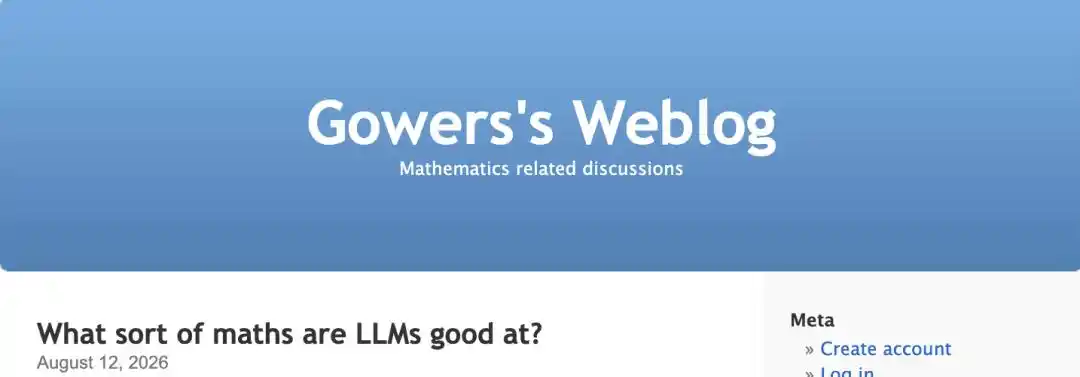
On August 12th, his blog post provided an answer.
It all started on August 1st.

That day, OpenAI dropped ten research achievements in mathematics and theoretical computer science all at once.

In their own words: each one either solves a long-standing open problem or represents a substantial advance on a related problem.

These results came from an unreleased internal version of a model called Astra.

For those few days, social media had only one reaction: this time, it's really different.

As Simon Willison put it, mathematicians online were collectively experiencing a "Deep Blue moment."
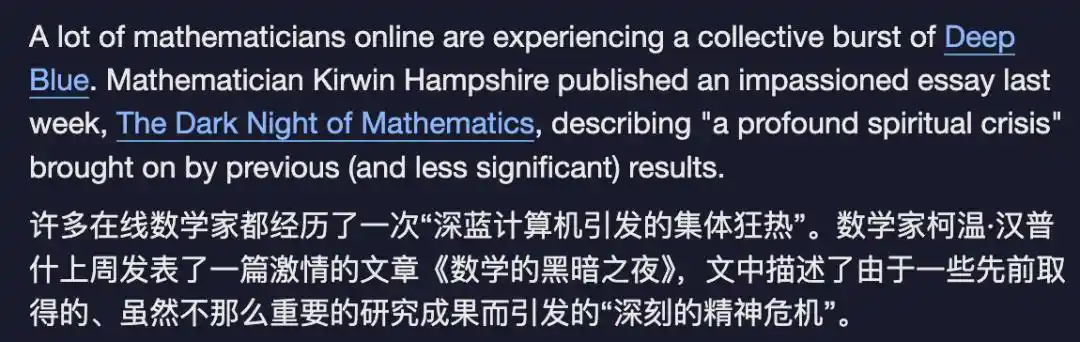
A few days earlier, mathematician Kirwin Hampshire had already written "The Dark Night of Mathematics." What triggered him then were previous, less significant results; he described falling into a profound spiritual crisis.

Gowers first acknowledged that these ten results were extremely impressive, then posed a question:

If large models were already stronger than all humans in all aspects of mathematics, given their speed advantage, results should have flooded out like a deluge.

Why hasn't the deluge arrived?

Two mathematicians immediately wrote papers based on these results

In the 11 days following OpenAI's ten results, two papers appeared on arXiv.

On August 3rd, Cambridge group theorist Francesco Fournier-Facio posted one first.

He took the crucial criterion from OpenAI's proof, bypassed the Leavitt algebra used in the original method, and created from scratch a version that the original method couldn't produce: a torsion-free non-sofic group.

On August 11th, Raphael Steiner modified OpenAI's recursive construction for multicolor Ramsey numbers, generalizing it to all fixed odd cycles.

The fact that people could write follow-up papers based on Astra's research results shows that it provided a method capable of generating new things.

Fournier-Facio also said that from the Kun–Thom result, there are countless possible directions to push forward, many of which simply aren't valid, and many others, even if valid, would be useless.

The specific direction OpenAI chose, most experts familiar with this area could probably prove. The difficulty was thinking, among countless possibilities, to try this particular one.
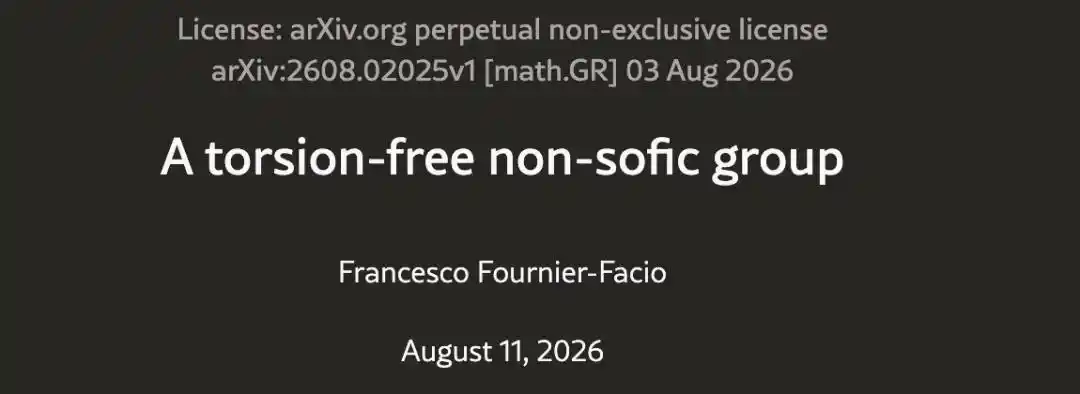
In his paper, Fournier-Facio judged that OpenAI's novelty lay in stating that proposition, not in the proof technique.

He gave a vivid metaphor:

AI is unrestricted by time and resources, so it can keep throwing things at the wall to see what sticks.

Counterexamples and theorems are not two different abilities at all

In a mathematician's intuition, finding a counterexample is a matter of luck.

You just need to cobble together a special case, punch a hole in the conjecture, and the proposition falls. Proving a theorem is hard work; you must guarantee there are no exceptions, and you need those insights that only dawn after much thought.

So it's acceptable if AI is good at finding counterexamples. If AI were good at proving theorems, that would truly signal a changing of the guard.

But what Gowers wants to say is that this line simply doesn't hold. Finding counterexamples and proving theorems are not two different abilities at all.

He first acknowledges that AI's most significant results to date are indeed concentrated on counterexamples.

The unit distance conjecture, the Jacobian conjecture, non-sofic groups, multicolor Ramsey numbers—they all seem to be.

But large models can also prove difficult universal propositions; it's just that those theorems haven't reached the significance of these counterexamples yet.

Then, he presents two results.

Vinogradov proved in 1937: Any sufficiently large integer can be written as the sum of three primes.

Gluskin proved in 1981: In any dimension, there exist two "shapes" of spaces that are extremely far apart.

Translating these two statements into the format mathematicians use for papers, their skeletons are almost identical. Yet no one would say Vinogradov found a counterexample, nor would they say Gluskin proved a theorem.

The difference lies in where the difficult step lands.

Vinogradov's entire effort lies in making three primes add up to exactly the specified number. For Gluskin, constructing two spaces of a specified dimension isn't difficult at all; the difficulty is making them sufficiently far apart.

The same skeleton, different points of difficulty—one becomes a theorem, the other becomes an example.

There's an even subtler layer. The word "counterexample" carries a psychological component. Only when it overturns a proposition that people originally had good reason to believe does it deserve to be called a counterexample.

Non-sofic groups don't count. According to Gowers and Fournier-Facio, the literature already had several construction ideas; few experts really believed all groups were sofic. Therefore, more accurately, OpenAI provided the first explicit instance of a non-sofic group.

Regarding the multicolor Ramsey result, Gowers has more authority. He studied an equivalent form in his youth, and the direction he worked on back then turned out to be the correct one later proven. For him personally, that was an expected example, not a counterexample.

The same result is a counterexample for those who originally believed the conjecture, but just an example for him.

This shows the line follows the person, not the mathematics.

Since counterexamples and theorems are inseparable, AI's strengths and weaknesses in mathematics cannot be drawn along proposition types.

Then, how should they be divided?

Eight methods for finding examples, AI is only good at four

The division is not in proposition type, but in how to search.

Gowers lists eight conventional tactics mathematicians use to find examples:

Go through standard examples on hand and try them one by one.

Assemble from basic examples.

Leave blanks first, then fill in conditions later.

Prove by contradiction that it cannot exist.

Repeatedly revise guesses from the previous version.

Construct step by step according to conditions.

Randomly pick one.

Take a sufficiently generic example.

He judges that large models will be very strong at four of these: trying existing examples, building step by step, random picking, and taking generic examples.

These four share common traits: mature patterns, dense instances in training data, and low cost of failure. As long as the model keeps trying one by one, it will eventually hit upon one.

The other three are different. Leaving blanks and filling later, proving impossibility by contradiction, and repeatedly revising guesses—all three require you to repeatedly judge the same thing mid-process: is the path I'm on now still worth pursuing?

Gowers's explanation is easy to understand.

Large models have two undeniable advantages: First, their knowledge is so broad it almost covers all standard arguments. Second, they are fast, capable of failing countless times before finding a solution.

Together, these create a style completely different from humans: the heavier the luck component of a problem, the more superior it is.

The territory humans can still hold onto is problems with particularly many and deep branches.

Mathematicians call this a search tree.

With each step down, a dozen more branches fork out beneath your feet, widening as you go deeper. You can't travel them all; you must judge midway which ones are根本 worth going down at all and prune them directly.

This action is called pruning. Without pruning, relying on computational power alone, you wouldn't reach the bottom by dawn.

One piece of evidence comes from the collective reaction of experts.

Gowers noticed that everyone's说法 was highly consistent: initially shocked that this problem was solved, but upon closer look, the method wasn't actually that novel; a suitable expert, given a hint, could have found it too.

This isn't belittling AI's discovery; it's giving it a more accurate portrait:

Its advantage lies not in being smarter than humans, but in its ability to "afford to fail."

For the same problem, humans can only try a few paths; it can try hundreds.

Why can't large models develop this sense of smell?

The first reason: the training data simply doesn't include this lesson.

Published proofs are all "clean finished products": which directions the discoverer tried, at which step they thought something was wrong, why they turned back—all erased.

The model sees conclusions, not the process.

Actually, humans aren't formally taught this either. The difference is that mathematicians develop this skill through their own process of getting stuck, going wrong, and turning back. Models can only learn from the curated finished products of others.

The second reason is more counterintuitive: Speed itself is a hindrance.

Humans must prune aggressively because a lifetime is only enough for a few paths.

Large models have speed and breadth of knowledge, able to withstand inefficient searches that humans completely cannot afford. Since they aren't lacking, there's no compelling pressure to prune.

Gowers states plainly: Large models' success today might be using methods humans consider extremely inefficient, but the branches just haven't multiplied enough to overwhelm them yet.

Third, this is hard to experiment on. An idea that seems to come only from deep thought could also just be recalling the deep thought of some human mathematician from the literature.

Gowers's own user experience is also written into the long piece.

Discussing open problems with 5.6 Pro often yields promising-sounding solutions that, upon细想, don't quite work. It also often ends with this line: I couldn't answer your question, but I've reduced it to a narrower, more precise problem.

After five times in a row, no progress is discernible.

Interestingly, another Fields Medalist is saying the same thing.

On July 24th, Terence Tao gave a public lecture at the International Congress of Mathematicians titled "Mathematics in the Age of AI."

He吐槽 that AI-generated mathematics is torturous to read: the emphasis is completely misplaced, capable of spending three pages proving an obvious lemma, then glossing over the truly interesting step in three lines.

Humans don't write proofs like that. Simple parts are passed over briefly; difficult parts pause, carefully organized, minimizing wasted effort. Readers rely on this rhythm to infer where the difficulty lies.

Tao gave it a name: natural friction.
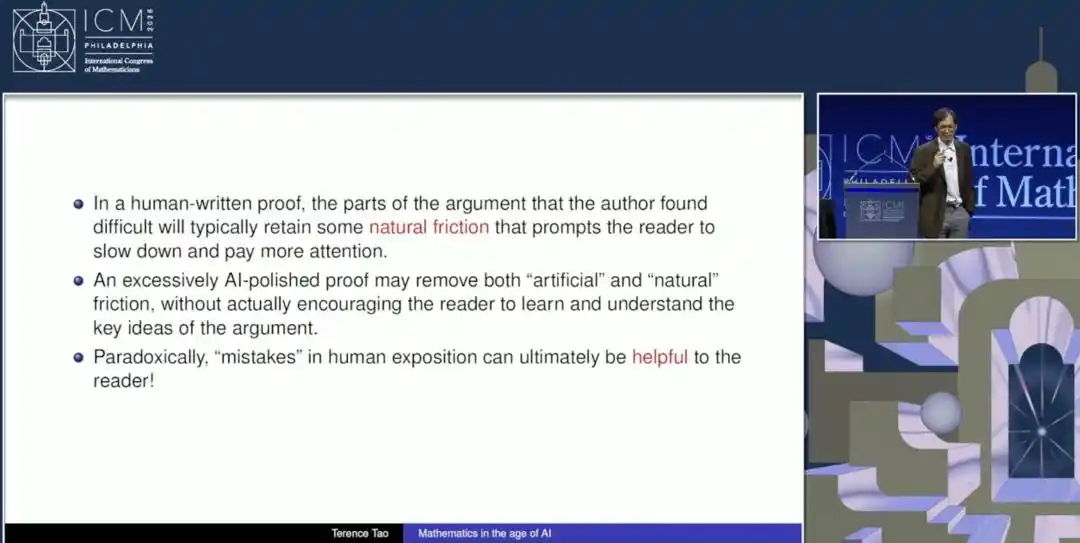
Screenshot from Terence Tao's ICM 2026 lecture: Human-written proofs leave "natural friction" at difficult points, reminding readers to slow down; AI-polished proofs grind it away along with the rest.

AI speeds over both easy and difficult parts uniformly, making everything look the same.

He shared his own example.

As a graduate student grappling with Bourgain's 1991 paper, the margins still bear his annotation from back then: I hate Jean Bourgain.

After struggling through it, he反而 understood the other's way of thinking and later preferred reading his papers.

He said if that proof had been polished by multiple layers of AI, he might not have gotten that training.

The information of "which step is difficult" has never been formally recorded in the tradition of human mathematical writing, so models cannot learn it.

And what AI writes out further grinds away even these remaining traces.

This becomes a vicious cycle: models can't learn judgment, and what they write makes it even harder for the next generation of models to learn it.

Gowers's prescription lands on the model's reward function.

During training, you can't just reward it when it gets the solution; you must also penalize it for two things: exploring too many dead ends, and directly翻ing for ready-made answers in the literature.

Rewarding only results yields only results without process.

This holds true for training, and also for the mathematical community.

What counts as crossing the threshold?

Gowers offers a yardstick that's hardest to fudge.

He cites the cap-set problem from 2016.

This problem asks: In a high-dimensional grid over three elements (ternary), what is the maximum number of points you can select such that no three form an arithmetic progression? For decades, the bounds were only nudged down bit by bit.

That year, a new solution emerged,甩开 the previous best bound by a wide margin, using an approach unlike any he had imagined.

Yet in hindsight, the method clearly should have been done that way; no one had thought of it before.

Immediately, a large group of people rushed in, wanting to understand what else this new technique could do.

A truly good method doesn't just solve the immediate problem; it makes a whole group of people immediately change their current work.

The day a model produces something of equivalent weight on its own, that's when he'll consider the threshold crossed.

This article is from the WeChat public account "新智元" (New Zhiyuan), author: ASI启示录

Criptos en tendencia

Preguntas relacionadas

QAccording to Timothy Gowers, why are AI's recent mathematical achievements concentrated in finding counterexamples rather than proving theorems?

AGowers argues that the distinction between finding counterexamples and proving theorems is artificial. Both are essentially about searching for examples. AI excels at certain search strategies that involve trying many possibilities quickly, which is well-suited for tasks where failure is cheap, such as finding counterexamples. However, its current methods may not be as effective for problems requiring deep strategic pruning of search paths, which is often needed for constructing novel proofs.

QWhat is the 'natural friction' that Terence Tao mentions in his ICM 2026 talk, and why is it important?

ATerence Tao describes 'natural friction' as the natural pacing in human-written proofs where difficult steps are given more emphasis and detail, while easier steps are passed over quickly. This pacing helps readers identify where the key challenges lie. AI-generated proofs often lack this 'friction,' treating all steps with uniform speed and detail, which can make them harder to learn from and can erase a crucial signal about mathematical difficulty.

QWhat are the three key reasons Gowers gives for why large language models struggle with developing a sense of mathematical judgment or 'smell'?

AFirst, their training data consists only of polished, finished proofs, lacking information about the trial-and-error process, dead ends, and strategic decisions. Second, their speed and computational power allow them to perform exhaustive searches inefficiently, reducing the pressure to develop efficient pruning strategies. Third, it is difficult to experimentally verify whether an AI's insight comes from deep reasoning or simply from retrieving a human's prior work.

QHow do the subsequent papers by Francesco Fournier-Facio and Raphael Steiner relate to OpenAI's announced results, and what does this indicate?

AFrancesco Fournier-Facio and Raphael Steiner built upon OpenAI's results, writing papers that generalized or modified the AI's constructions (e.g., creating a torsion-free non-sofic group or extending a multi-color Ramsey number construction). This indicates that the AI's work provided a productive method or framework that human mathematicians could understand, extend, and publish, showing it was a 'fertile' discovery rather than just a one-off answer.

QWhat benchmark does Gowers propose for determining when AI has truly 'crossed a threshold' in mathematical research?

AGowers uses the example of the 2016 breakthrough on the cap-set problem. A true threshold is crossed when an AI independently produces a method of comparable significance—one that not only solves a specific problem but also opens up a new line of research, immediately changing how a community of mathematicians works and leading to a flood of follow-up results based on the new technique.

Lecturas Relacionadas

Tiger Research: How Far Can the On-Chain Foreign Exchange Settlement Layer Go?

"Tiger Research: How Far Can On-Chain FX Settlement Layers Go?" The article examines KiiChain, a startup aiming to create an on-chain foreign exchange settlement layer, focusing on its potential to address inefficiencies in cross-border payments, especially for emerging markets. The core problem is the slow, costly, and fragmented traditional FX infrastructure, where bank hours, regulations, and thin liquidity for local currencies create delays. KiiChain, founded by OTC veterans, proposes aggregating USD and local currency stablecoin liquidity on one chain to enable 24/7 settlement. The platform consists of four components: 1) The KiiChain App uses an Atomic Quote Network (RFQ-style price discovery with on-chain settlement) to tackle settlement delays, but not underlying liquidity scarcity. 2) The RWA Protocol tokenizes collateral using compliant standards (like ERC-3643), shifting trust from bank relationships to coded rules, though regulatory anchors remain. 3) Kii Oracle uses a decentralized validator network to create consensus pricing from fragmented data, improving transparency but not market depth. 4) KiiChain Pay bundles fiat on/off-ramps and swap services; only the DEX swap bypasses banking bottlenecks, while others still rely on licensed operators. The analysis concludes KiiChain doesn't eliminate intermediaries but creates a unified settlement layer where they can interact without geographic or time constraints. It streamlines the process—three of eight traditional steps are removed—by moving infrastructure on-chain, improving speed and accessibility for digital asset swaps. However, fiat entry/exit points remain subject to off-chain service limitations. Current metrics show over $500M in transaction volume. The future depends on ecosystem growth—attracting liquidity partners and users—to evolve beyond settlement into a broader financial hub. Ultimately, the on-chain structure currently solves settlement friction and time, not liquidity depth. Success will be determined by execution in building partnerships and market presence, not by architectural design alone.

marsbitHace 11 min(s)

Tiger Research: How Far Can the On-Chain Foreign Exchange Settlement Layer Go?

marsbitHace 11 min(s)

'The Idea of Catching the Absolute Bottom Is Wrong': Experts on a New Phase of Bitcoin Capitulation

Analysts from CryptoQuant advise investors against trying to pinpoint the exact bottom of Bitcoin's price. Their data shows the percentage of the Bitcoin supply in profit has fallen to 51.4%, a level historically associated with capitulation phases followed by accumulation. This means approximately 48.6% of circulating coins are held at an unrealized loss. The metric, based on UTXO analysis comparing a coin's last moved price to its current market value, last neared this level in early 2023 when Bitcoin traded between $16,000 and $20,000. CryptoQuant states that the idea of catching the "absolute bottom" is flawed. The decline in the average cost basis during a bear market reflects coins transferring from weak hands to stronger, long-term holders. While some investors realize losses, others may use the decline for gradual accumulation. The accumulation window may last longer than many expect, even as fear drives some participants away. Historically, a supply in profit below 55% has been linked to re-accumulation periods. Separately, Swan Bitcoin CEO Cory Klippsten offered a forecast, suggesting Bitcoin could form a bottom in October 2026, followed by a recovery towards approximately $130,000 ahead of the 2028 halving. This aligns with the historical pattern of local lows forming about 12 months after bull market peaks; Bitcoin hit its all-time high above $126,000 in early October 2025. However, Klippsten cautioned against over-relying on past cycles due to limited historical data.

cryptonews.ruHace 53 min(s)

'The Idea of Catching the Absolute Bottom Is Wrong': Experts on a New Phase of Bitcoin Capitulation

cryptonews.ruHace 53 min(s)

How Does FalconX Bring Institutional Lending On-Chain? Deep Dive into the FALX Operational Mechanism

FALX is a structured credit facility that brings institutional prime brokerage loans on-chain as fixed-income assets. It works by having FalconX originate overcollateralized loans to institutional clients (e.g., quant funds, market makers). These loan exposures enter a bankruptcy-remote SPV. The Pareto protocol provides the on-chain credit vault infrastructure, while M11 Credit acts as the credit curator, administrative agent, and collateral agent. Platforms like Plume, Ethereum, and Solana serve as distribution channels for investors. Investors deposit USDC into the vault, receiving an estimated ~7.4% net yield (after a 10% performance fee). This yield represents a premium over low-risk on-chain alternatives (like tokenized Treasuries at ~4%) to compensate for risks including FalconX operational risk, collateral liquidation risk, SPV legal risk, M11's execution risk, a 31-day redemption notice period, and potential contagion from DeFi re-collateralization. The structure incorporates multiple risk mitigations: overcollateralized underlying loans, a first-loss capital contribution from FalconX, and independent oversight by M11. However, challenges remain, such as scaling investor demand (current AUM is ~$148M against a ~$1B potential capacity), managing redemption liquidity, and addressing new risks from the vault token's use as collateral in DeFi lending protocols like Morpho. FALX demonstrates a pragmatic path for on-chain credit by leveraging existing institutional loan origination and combining it with legal structures, external curation, and blockchain-based distribution.

marsbitHace 55 min(s)

How Does FalconX Bring Institutional Lending On-Chain? Deep Dive into the FALX Operational Mechanism

marsbitHace 55 min(s)

Trading

Spot

Artículos destacados

Qué es GROK AI

Grok AI: Revolucionando la Tecnología Conversacional en la Era Web3 Introducción En el paisaje de rápida evolución de la inteligencia artificial, Grok AI se destaca como un proyecto notable que une los dominios de la tecnología avanzada y la interacción del usuario. Desarrollado por xAI, una empresa liderada por el renombrado empresario Elon Musk, Grok AI busca redefinir la forma en que interactuamos con la inteligencia artificial. A medida que el movimiento Web3 continúa floreciendo, Grok AI tiene como objetivo aprovechar el poder de la IA conversacional para responder consultas complejas, proporcionando a los usuarios una experiencia que no solo es informativa, sino también entretenida. ¿Qué es Grok AI? Grok AI es un sofisticado chatbot de IA conversacional diseñado para interactuar dinámicamente con los usuarios. A diferencia de muchos sistemas de IA tradicionales, Grok AI abraza una gama más amplia de consultas, incluyendo aquellas que normalmente se consideran inapropiadas o fuera de las respuestas estándar. Los objetivos centrales del proyecto incluyen: Razonamiento Confiable: Grok AI enfatiza el razonamiento de sentido común para proporcionar respuestas lógicas basadas en la comprensión contextual. Supervisión Escalable: La integración de asistencia de herramientas asegura que las interacciones de los usuarios sean monitoreadas y optimizadas para la calidad. Verificación Formal: La seguridad es primordial; Grok AI incorpora métodos de verificación formal para mejorar la confiabilidad de sus resultados. Comprensión de Largo Contexto: El modelo de IA sobresale en retener y recordar un extenso historial de conversaciones, facilitando discusiones significativas y contextualizadas. Robustez Adversarial: Al enfocarse en mejorar sus defensas contra entradas manipuladas o maliciosas, Grok AI busca mantener la integridad de las interacciones de los usuarios. En esencia, Grok AI no es solo un dispositivo de recuperación de información; es un compañero conversacional inmersivo que fomenta un diálogo dinámico. Creador de Grok AI La mente detrás de Grok AI no es otra que Elon Musk, una persona sinónimo de innovación en varios campos, incluyendo la automoción, los viajes espaciales y la tecnología. Bajo el paraguas de xAI, una empresa enfocada en avanzar la tecnología de IA de maneras beneficiosas, la visión de Musk busca remodelar la comprensión de las interacciones de IA. El liderazgo y la ética fundacional están profundamente influenciados por el compromiso de Musk de empujar los límites tecnológicos. Inversores de Grok AI Si bien los detalles específicos sobre los inversores que respaldan a Grok AI son limitados, se reconoce públicamente que xAI, el incubador del proyecto, está fundado y apoyado principalmente por el propio Elon Musk. Las empresas y participaciones anteriores de Musk proporcionan un respaldo robusto, fortaleciendo aún más la credibilidad y el potencial de crecimiento de Grok AI. Sin embargo, hasta ahora, la información sobre fundaciones de inversión adicionales u organizaciones que apoyan a Grok AI no está fácilmente accesible, marcando un área para una posible exploración futura. ¿Cómo Funciona Grok AI? La mecánica operativa de Grok AI es tan innovadora como su marco conceptual. El proyecto integra varias tecnologías de vanguardia que facilitan sus funcionalidades únicas: Infraestructura Robusta: Grok AI está construido utilizando Kubernetes para la orquestación de contenedores, Rust para rendimiento y seguridad, y JAX para computación numérica de alto rendimiento. Este trío asegura que el chatbot opere de manera eficiente, escale efectivamente y sirva a los usuarios de manera oportuna. Acceso a Conocimiento en Tiempo Real: Una de las características distintivas de Grok AI es su capacidad para acceder a datos en tiempo real a través de la plataforma X—anteriormente conocida como Twitter. Esta capacidad otorga a la IA acceso a la información más reciente, permitiéndole proporcionar respuestas y recomendaciones oportunas que otros modelos de IA podrían pasar por alto. Dos Modos de Interacción: Grok AI ofrece a los usuarios una elección entre “Modo Divertido” y “Modo Regular”. El Modo Divertido permite un estilo de interacción más lúdico y humorístico, mientras que el Modo Regular se centra en ofrecer respuestas precisas y exactas. Esta versatilidad asegura una experiencia personalizada que se adapta a diversas preferencias de los usuarios. En esencia, Grok AI une rendimiento con compromiso, creando una experiencia que es tanto enriquecedora como entretenida. Cronología de Grok AI El viaje de Grok AI está marcado por hitos cruciales que reflejan sus etapas de desarrollo y despliegue: Desarrollo Inicial: La fase fundamental de Grok AI tuvo lugar durante aproximadamente dos meses, durante los cuales se realizó el entrenamiento inicial y el ajuste del modelo. Lanzamiento Beta de Grok-2: En un avance significativo, se anunció la beta de Grok-2. Este lanzamiento introdujo dos versiones del chatbot—Grok-2 y Grok-2 mini—cada una equipada con capacidades para chatear, programar y razonar. Acceso Público: Tras su desarrollo beta, Grok AI se volvió disponible para los usuarios de la plataforma X. Aquellos con cuentas verificadas por un número de teléfono y activas durante al menos siete días pueden acceder a una versión limitada, haciendo que la tecnología esté disponible para un público más amplio. Esta cronología encapsula el crecimiento sistemático de Grok AI desde su inicio hasta el compromiso público, enfatizando su compromiso con la mejora continua y la interacción del usuario. Características Clave de Grok AI Grok AI abarca varias características clave que contribuyen a su identidad innovadora: Integración de Conocimiento en Tiempo Real: El acceso a información actual y relevante diferencia a Grok AI de muchos modelos estáticos, permitiendo una experiencia de usuario atractiva y precisa. Estilos de Interacción Versátiles: Al ofrecer modos de interacción distintos, Grok AI se adapta a diversas preferencias de los usuarios, invitando a la creatividad y la personalización en la conversación con la IA. Avanzada Infraestructura Tecnológica: La utilización de Kubernetes, Rust y JAX proporciona al proyecto un marco sólido para asegurar confiabilidad y rendimiento óptimo. Consideración de Discurso Ético: La inclusión de una función generadora de imágenes muestra el espíritu innovador del proyecto. Sin embargo, también plantea consideraciones éticas en torno a los derechos de autor y la representación respetuosa de figuras reconocibles—una discusión en curso dentro de la comunidad de IA. Conclusión Como una entidad pionera en el ámbito de la IA conversacional, Grok AI encapsula el potencial de experiencias transformadoras para los usuarios en la era digital. Desarrollado por xAI y guiado por el enfoque visionario de Elon Musk, Grok AI integra conocimiento en tiempo real con capacidades avanzadas de interacción. Busca empujar los límites de lo que la inteligencia artificial puede lograr mientras mantiene un enfoque en consideraciones éticas y la seguridad del usuario. Grok AI no solo encarna el avance tecnológico, sino que también representa un nuevo paradigma de conversación en el paisaje Web3, prometiendo involucrar a los usuarios con tanto conocimiento hábil como interacción lúdica. A medida que el proyecto continúa evolucionando, se erige como un testimonio de lo que la intersección de la tecnología, la creatividad y la interacción similar a la humana puede lograr.

568 Vistas totalesPublicado en 2024.12.26Actualizado en 2024.12.26

Qué es GROK AI

Qué es ERC AI

Euruka Tech: Una Visión General de $erc ai y sus Ambiciones en Web3 Introducción En el paisaje en rápida evolución de la tecnología blockchain y las aplicaciones descentralizadas, nuevos proyectos emergen con frecuencia, cada uno con objetivos y metodologías únicas. Uno de estos proyectos es Euruka Tech, que opera en el amplio dominio de las criptomonedas y Web3. El enfoque principal de Euruka Tech, particularmente su token $erc ai, es presentar soluciones innovadoras diseñadas para aprovechar las crecientes capacidades de la tecnología descentralizada. Este artículo tiene como objetivo proporcionar una visión general completa de Euruka Tech, una exploración de sus objetivos, funcionalidad, la identidad de su creador, posibles inversores y su importancia dentro del contexto más amplio de Web3. ¿Qué es Euruka Tech, $erc ai? Euruka Tech se caracteriza como un proyecto que aprovecha las herramientas y funcionalidades ofrecidas por el entorno Web3, centrándose en integrar inteligencia artificial dentro de sus operaciones. Aunque los detalles específicos sobre el marco del proyecto son algo elusivos, está diseñado para mejorar la participación del usuario y automatizar procesos en el espacio cripto. El proyecto tiene como objetivo crear un ecosistema descentralizado que no solo facilite transacciones, sino que también incorpore funcionalidades predictivas a través de inteligencia artificial, de ahí la designación de su token, $erc ai. El objetivo es proporcionar una plataforma intuitiva que facilite interacciones más inteligentes y un procesamiento eficiente de transacciones dentro de la creciente esfera de Web3. ¿Quién es el Creador de Euruka Tech, $erc ai? En la actualidad, la información sobre el creador o el equipo fundador detrás de Euruka Tech permanece no especificada y algo opaca. Esta ausencia de datos genera preocupaciones, ya que el conocimiento del trasfondo del equipo es a menudo esencial para establecer credibilidad dentro del sector blockchain. Por lo tanto, hemos categorizado esta información como desconocida hasta que se disponga de detalles concretos en el dominio público. ¿Quiénes son los Inversores de Euruka Tech, $erc ai? De manera similar, la identificación de inversores u organizaciones de respaldo para el proyecto Euruka Tech no se proporciona fácilmente a través de la investigación disponible. Un aspecto que es crucial para los posibles interesados o usuarios que consideren involucrarse con Euruka Tech es la garantía que proviene de asociaciones financieras establecidas o respaldo de firmas de inversión de renombre. Sin divulgaciones sobre afiliaciones de inversión, es difícil sacar conclusiones completas sobre la seguridad financiera o la longevidad del proyecto. De acuerdo con la información encontrada, esta sección también se encuentra en estado de desconocido. ¿Cómo Funciona Euruka Tech, $erc ai? A pesar de la falta de especificaciones técnicas detalladas para Euruka Tech, es esencial considerar sus ambiciones innovadoras. El proyecto busca aprovechar el poder computacional de la inteligencia artificial para automatizar y mejorar la experiencia del usuario dentro del entorno de las criptomonedas. Al integrar IA con tecnología blockchain, Euruka Tech tiene como objetivo proporcionar características como operaciones automatizadas, evaluaciones de riesgo e interfaces de usuario personalizadas. La esencia innovadora de Euruka Tech radica en su objetivo de crear una conexión fluida entre los usuarios y las vastas posibilidades que presentan las redes descentralizadas. A través de la utilización de algoritmos de aprendizaje automático e IA, busca minimizar los desafíos de los usuarios primerizos y optimizar las experiencias transaccionales dentro del marco de Web3. Esta simbiosis entre IA y blockchain subraya la importancia del token $erc ai, que actúa como un puente entre las interfaces de usuario tradicionales y las capacidades avanzadas de las tecnologías descentralizadas. Cronología de Euruka Tech, $erc ai Desafortunadamente, como resultado de la información limitada disponible sobre Euruka Tech, no podemos presentar una cronología detallada de los principales desarrollos o hitos en el viaje del proyecto. Esta cronología, típicamente invaluable para trazar la evolución de un proyecto y entender su trayectoria de crecimiento, no está actualmente disponible. A medida que la información sobre eventos notables, asociaciones o adiciones funcionales se haga evidente, las actualizaciones seguramente mejorarán la visibilidad de Euruka Tech en la esfera cripto. Aclaración sobre Otros Proyectos “Eureka” Es importante señalar que múltiples proyectos y empresas comparten una nomenclatura similar con “Eureka”. La investigación ha identificado iniciativas como un agente de IA de NVIDIA Research, que se centra en enseñar a los robots tareas complejas utilizando métodos generativos, así como Eureka Labs y Eureka AI, que mejoran la experiencia del usuario en educación y análisis de servicio al cliente, respectivamente. Sin embargo, estos proyectos son distintos de Euruka Tech y no deben confundirse con sus objetivos o funcionalidades. Conclusión Euruka Tech, junto con su token $erc ai, representa un jugador prometedor pero actualmente oscuro dentro del paisaje de Web3. Si bien los detalles sobre su creador e inversores permanecen no revelados, la ambición central de combinar inteligencia artificial con tecnología blockchain se presenta como un punto focal de interés. Los enfoques únicos del proyecto para fomentar la participación del usuario a través de la automatización avanzada podrían destacarlo a medida que el ecosistema Web3 progresa. A medida que el mercado cripto continúa evolucionando, los interesados deben mantener un ojo atento a los avances en torno a Euruka Tech, ya que el desarrollo de innovaciones documentadas, asociaciones o una hoja de ruta definida podría presentar oportunidades significativas en el futuro cercano. Tal como está, esperamos más información sustancial que podría revelar el potencial de Euruka Tech y su posición en el competitivo paisaje cripto.

563 Vistas totalesPublicado en 2025.01.02Actualizado en 2025.01.02

Qué es ERC AI

Qué es DUOLINGO AI

DUOLINGO AI: Integrando el Aprendizaje de Idiomas con Web3 e Innovación en IA En una era donde la tecnología redefine la educación, la integración de la inteligencia artificial (IA) y las redes blockchain anuncia una nueva frontera para el aprendizaje de idiomas. Entra DUOLINGO AI y su criptomoneda asociada, $DUOLINGO AI. Este proyecto aspira a fusionar la capacidad educativa de las principales plataformas de aprendizaje de idiomas con los beneficios de la tecnología descentralizada Web3. Este artículo profundiza en los aspectos clave de DUOLINGO AI, explorando sus objetivos, marco tecnológico, desarrollo histórico y potencial futuro, mientras mantiene claridad entre el recurso educativo original y esta iniciativa independiente de criptomoneda. Visión General de DUOLINGO AI En su esencia, DUOLINGO AI busca establecer un entorno descentralizado donde los aprendices puedan ganar recompensas criptográficas por alcanzar hitos educativos en la competencia lingüística. Al aplicar contratos inteligentes, el proyecto tiene como objetivo automatizar los procesos de verificación de habilidades y asignación de tokens, adhiriéndose a los principios de Web3 que enfatizan la transparencia y la propiedad del usuario. El modelo se aparta de los enfoques tradicionales para la adquisición de idiomas al apoyarse en gran medida en una estructura de gobernanza impulsada por la comunidad, permitiendo a los poseedores de tokens sugerir mejoras al contenido del curso y a las distribuciones de recompensas. Algunos de los objetivos notables de DUOLINGO AI incluyen: Aprendizaje Gamificado: El proyecto integra logros en blockchain y tokens no fungibles (NFTs) para representar niveles de competencia lingüística, fomentando la motivación a través de recompensas digitales atractivas. Creación de Contenido Descentralizada: Abre avenidas para que educadores y entusiastas de los idiomas contribuyan con sus cursos, facilitando un modelo de reparto de ingresos que beneficia a todos los contribuyentes. Personalización Impulsada por IA: Al emplear modelos avanzados de aprendizaje automático, DUOLINGO AI personaliza las lecciones para adaptarse al progreso de aprendizaje individual, similar a las características adaptativas que se encuentran en plataformas establecidas. Creadores del Proyecto y Gobernanza A partir de abril de 2025, el equipo detrás de $DUOLINGO AI permanece seudónimo, una práctica frecuente en el paisaje descentralizado de criptomonedas. Esta anonimidad está destinada a promover el crecimiento colectivo y la participación de los interesados en lugar de centrarse en desarrolladores individuales. El contrato inteligente desplegado en la blockchain de Solana anota la dirección de la billetera del desarrollador, lo que significa el compromiso con la transparencia en las transacciones a pesar de que la identidad de los creadores sea desconocida. Según su hoja de ruta, DUOLINGO AI aspira a evolucionar hacia una Organización Autónoma Descentralizada (DAO). Esta estructura de gobernanza permite a los poseedores de tokens votar sobre cuestiones críticas como implementaciones de características y asignaciones del tesoro. Este modelo se alinea con la ética del empoderamiento comunitario que se encuentra en diversas aplicaciones descentralizadas, enfatizando la importancia de la toma de decisiones colectiva. Inversores y Asociaciones Estratégicas Actualmente, no hay inversores institucionales o capitalistas de riesgo identificables públicamente vinculados a $DUOLINGO AI. En cambio, la liquidez del proyecto proviene principalmente de intercambios descentralizados (DEXs), marcando un contraste marcado con las estrategias de financiamiento de las empresas de tecnología educativa tradicionales. Este modelo de base indica un enfoque impulsado por la comunidad, reflejando el compromiso del proyecto con la descentralización. En su libro blanco, DUOLINGO AI menciona la formación de colaboraciones con “plataformas de educación blockchain” no especificadas, destinadas a enriquecer su oferta de cursos. Si bien aún no se han divulgado asociaciones específicas, estos esfuerzos colaborativos sugieren una estrategia para fusionar la innovación blockchain con iniciativas educativas, ampliando el acceso y la participación de los usuarios a través de diversas avenidas de aprendizaje. Arquitectura Tecnológica Integración de IA DUOLINGO AI incorpora dos componentes principales impulsados por IA para mejorar su oferta educativa: Motor de Aprendizaje Adaptativo: Este sofisticado motor aprende de las interacciones de los usuarios, similar a los modelos propietarios de las principales plataformas educativas. Ajusta dinámicamente la dificultad de las lecciones para abordar desafíos específicos de los aprendices, reforzando áreas débiles a través de ejercicios dirigidos. Agentes Conversacionales: Al emplear chatbots impulsados por GPT-4, DUOLINGO AI proporciona una plataforma para que los usuarios participen en conversaciones simuladas, fomentando una experiencia de aprendizaje de idiomas más interactiva y práctica. Infraestructura Blockchain Construido sobre la blockchain de Solana, $DUOLINGO AI utiliza un marco tecnológico integral que incluye: Contratos Inteligentes de Verificación de Habilidades: Esta característica otorga automáticamente tokens a los usuarios que superan con éxito las pruebas de competencia, reforzando la estructura de incentivos para resultados de aprendizaje genuinos. Insignias NFT: Estos tokens digitales significan varios hitos que los aprendices logran, como completar una sección de su curso o dominar habilidades específicas, permitiéndoles intercambiar o mostrar sus logros digitalmente. Gobernanza DAO: Los miembros de la comunidad con tokens pueden participar en la gobernanza votando sobre propuestas clave, facilitando una cultura participativa que fomenta la innovación en las ofertas de cursos y características de la plataforma. Línea de Tiempo Histórica 2022–2023: Conceptualización Los cimientos de DUOLINGO AI comienzan con la creación de un libro blanco, destacando la sinergia entre los avances en IA en el aprendizaje de idiomas y el potencial descentralizado de la tecnología blockchain. 2024: Lanzamiento Beta Un lanzamiento beta limitado introduce ofertas en idiomas populares, recompensando a los primeros usuarios con incentivos en tokens como parte de la estrategia de participación comunitaria del proyecto. 2025: Transición a DAO En abril, se produce un lanzamiento completo de la red principal con la circulación de tokens, lo que provoca discusiones comunitarias sobre posibles expansiones a idiomas asiáticos y otros desarrollos de cursos. Desafíos y Direcciones Futuras Obstáculos Técnicos A pesar de sus ambiciosos objetivos, DUOLINGO AI enfrenta desafíos significativos. La escalabilidad sigue siendo una preocupación constante, particularmente en equilibrar los costos asociados con el procesamiento de IA y mantener una red descentralizada y receptiva. Además, garantizar la creación y moderación de contenido de calidad en medio de una oferta descentralizada plantea complejidades en el mantenimiento de estándares educativos. Oportunidades Estratégicas Mirando hacia adelante, DUOLINGO AI tiene el potencial de aprovechar asociaciones de micro-certificación con instituciones académicas, proporcionando validaciones verificadas en blockchain de habilidades lingüísticas. Además, la expansión entre cadenas podría permitir que el proyecto acceda a bases de usuarios más amplias y a ecosistemas blockchain adicionales, mejorando su interoperabilidad y alcance. Conclusión DUOLINGO AI representa una fusión innovadora de inteligencia artificial y tecnología blockchain, presentando una alternativa centrada en la comunidad a los sistemas tradicionales de aprendizaje de idiomas. Si bien su desarrollo seudónimo y su modelo económico emergente traen ciertos riesgos, el compromiso del proyecto con el aprendizaje gamificado, la educación personalizada y la gobernanza descentralizada ilumina un camino hacia adelante para la tecnología educativa en el ámbito de Web3. A medida que la IA continúa avanzando y el ecosistema blockchain evoluciona, iniciativas como DUOLINGO AI podrían redefinir cómo los usuarios se involucran con la educación lingüística, empoderando comunidades y recompensando la participación a través de mecanismos de aprendizaje innovadores.

594 Vistas totalesPublicado en 2025.04.11Actualizado en 2025.04.11

Qué es DUOLINGO AI

Discusiones

Bienvenido a la comunidad de HTX. Aquí puedes mantenerte informado sobre los últimos desarrollos de la plataforma y acceder a análisis profesionales del mercado. A continuación se presentan las opiniones de los usuarios sobre el precio de AI (AI).

活动图片