AI Competition's New Battlefield: Long-term Memory Becomes the Pain Point, How Users Can Secure Their Own Context Ownership

marsbitPublicado a 2026-06-02Actualizado a 2026-06-02

Resumen

A new front is emerging in the AI competition: user ownership of long-term memory and context. As AI models like ChatGPT evolve from chat tools into persistent digital assistants that learn user preferences and workflows, a critical question arises: who owns this accumulated "memory"? Currently, this personalized data is siloed within each platform (e.g., OpenAI, Anthropic, Google), creating a fragmented experience when users switch models. The article highlights ZetaChain's strategic pivot from blockchain interoperability to addressing this AI "memory" challenge. Its new focus is on building a "Private Memory Layer" and an "AI Consumer Layer." Through its consumer product Anuma, ZetaChain aims to give users encrypted, portable memory that can be used across different AI models. This system also envisions programmable, auditable permissions for AI agents and a framework where user knowledge can be monetized as shareable assets. Ultimately, ZetaChain's transformation reflects a broader infrastructure shift. The future bottleneck is less about raw model capability and more about continuous context, user-controlled identity, and permission management across multiple collaborating AI agents. The company's ZETA token is being repositioned as an "AI infrastructure token" to facilitate access, payments, and permissions within this proposed ecosystem. The core narrative advocates for returning control of personal context and AI relationships to users, rather than leaving them locke...

Author: Zen, PANews

You spent half a year training ChatGPT to understand your work habits, writing style, and long-term projects. It learned how you like to revise articles, which companies you often follow, and gradually came to understand your preferences for content structure, tone, and information density.

But one day, a newer, more powerful model appears. You open Claude, Gemini, or DeepSeek, and find yourself having to start all over again. The new model doesn't know you, isn't aware of the work context you've accumulated over the past months, and doesn't understand how you think, write, or make decisions.

Over the past two years, the most important competition in the AI industry revolved around "model capabilities." Whose reasoning was stronger, whose context window was longer, whose coding ability was better—these factors almost decided everything. But now, a new issue is emerging: AI is getting to know you better, but who exactly does this "understanding" belong to?

Role Shift: AI Transforms from Chat Tool to Personal Digital Assistant

In November 2022, the AI chatbot ChatGPT debuted, sparking a global chat craze. It reached 100 million monthly active users in just two months, becoming the fastest-growing consumer application in history. At that time, large language models were more like an "advanced search." Users asked AI questions, it generated instant answers, and when the conversation ended, the relationship also ended.

But in recent years, the role of AI has been undergoing a significant shift. As reasoning capabilities, coding abilities, and tool-calling functionalities have continuously improved, AI has begun to deeply integrate into real workflows. More and more people are using it to write code, organize information, analyze data, plan trips, manage schedules, and even for long-term participation in content creation and business decisions.

In many cases, users are no longer just "asking AI questions" but are engaging in long-term collaboration with AI. It starts to understand your working style, expression habits, and long-term goals, begins to consistently participate in the same project, the same workflow, and even gradually takes on some execution tasks. To some extent, AI is evolving from a one-time Q&A tool into a persistently available personal digital assistant.

And as model capabilities have significantly increased, the capabilities of top products have increasingly converged, and with AI being used long-term and extensively, new issues have begun to surface.

Once AI begins long-term collaboration, "memory"—the system storing and recalling past experiences to improve decision-making and overall performance—ceases to be just an inconsequential database. In many application scenarios, the bottleneck is no longer the model's reasoning level, but the capabilities related to long-term memory and context management. Cloudflare has also directly labeled agentic memory as one of the biggest challenges and fastest-developing areas in current AI infrastructure.

Leading AI companies have also realized that long-term memory is becoming part of the product experience. OpenAI has split ChatGPT's memory into saved memories and reference chat history. The former saves information users wish to retain long-term, while the latter allows ChatGPT to extract useful content from past conversations for subsequent personalized responses. Gemini has also begun learning user preferences based on prior conversations. Claude has introduced Memory and supports memory import and export.

Platform Silos Turn AI 'Memory' into a New Industry Battlefield

But the problem is that these memory capabilities are largely still confined to their respective platforms, belonging only to the platform's independent account systems and product environments—they remain isolated islands. Although Anthropic supports memory import/export, it currently functions more like a migration tool for Claude rather than a universal memory standard jointly adopted by various companies.

And this is precisely the gap ZetaChain aims to fill. After fully pivoting to AI, ZetaChain began extending the concept of "ownership," originally from the crypto world, further into AI memory and user context. What it hopes to build is not just a chat product, but a privacy memory layer (Private Memory Layer) independent of model platforms, allowing users to truly own their long-term memories, behavioral preferences, and AI context.
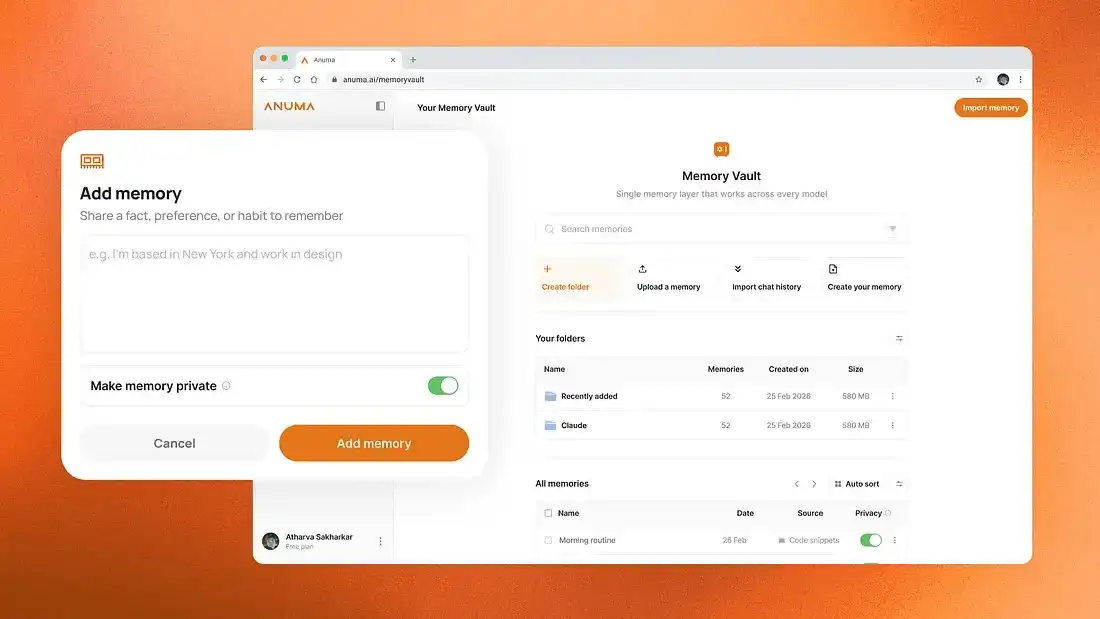
ZetaChain's consumer AI product, Anuma, advocates for users to own a set of encrypted private memory, supporting seamless use across mainstream AI models like ChatGPT, Claude, Gemini, etc. Users don't have to rebuild context, preferences, and work habits every time they switch models. Instead, users control access permissions and bring their historical memory to different models and agents.

As AI gradually accumulates users' usage preferences, writing habits, workflows, and historical conversations, the so-called "memory" will increasingly resemble a layer of "personality mirror." It not only determines whether a model's responses align with user preferences but may also determine whether the model, when making decisions on your behalf in the future, acts according to your habits and values.

Beyond giving users ownership of memory and allowing them to choose models with different strengths for different tasks, Anuma is also building a programmable, auditable, and revocable permission system. It allows AI agents to read records once, with permissions revocable at any time, and all permission changes can be recorded and tracked on-chain.

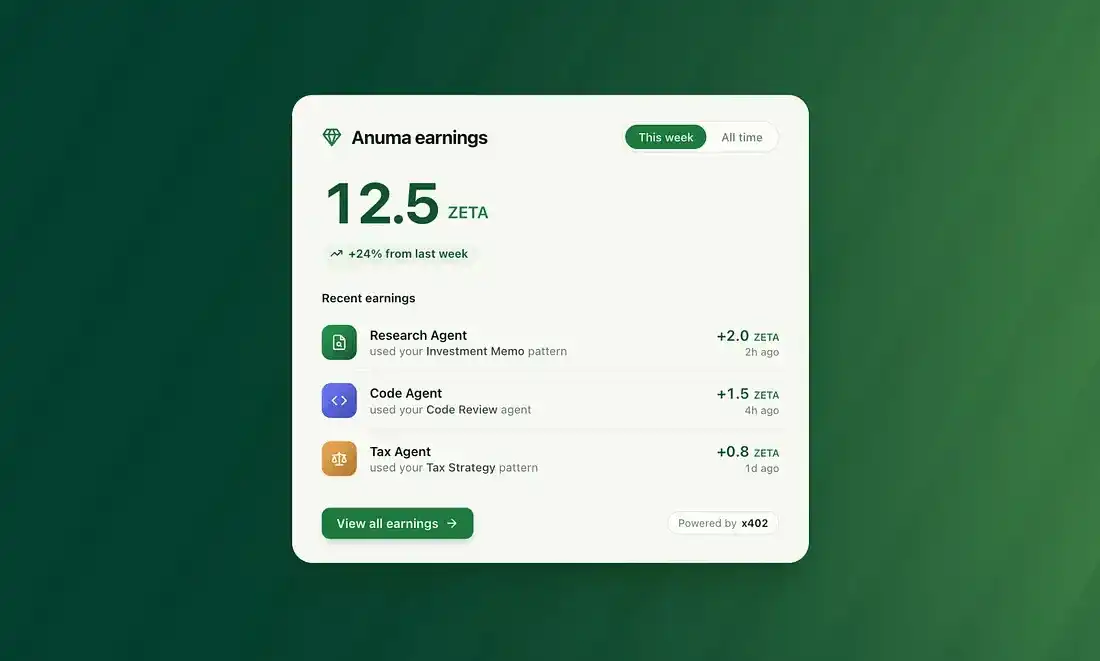
Moreover, users' memory and knowledge graphs can become assets that can be shared, authorized, and monetized without exposing raw data. This enables professional users such as investors, doctors, lawyers, and developers to encapsulate their expertise into agents, publish them to an Agent Marketplace, and earn revenue when others call upon them.

From Cross-Chain to Cross-AI Platform: Why Did ZetaChain Pivot?

What enables Anuma to achieve these functions is the underlying infrastructure, Private Memory Layer, developed by ZetaChain. As an infrastructure for AI-focused private memory, identity, permissions, payments, and agents, it aims to allow applications and agents to collaborate across models while users retain control.

ZetaChain had long focused on cross-chain interoperability infrastructure, with the core goal of solving asset and message transfer issues between different blockchains. Regarding the "unified multi-chain entry point," it built a considerable network and narrative. According to official data, there are 11.9 million unique addresses and 241 million transactions on its blockchain.

But after Anuma publicly launched on April 27th this year and surpassed 50,000 users in its first month, ZetaChain began deciding to fully pivot to AI, gradually phasing out its cross-chain interoperability business. Behind this pivot lies a relatively clear internal logic.
In the past, ZetaChain mainly dealt with the issue of incompatibility between different chains. In today's AI world, similar fragmentation exists. To some extent, digital assets are to blockchain what memory and context are to AI. Different models have their own closed memory systems; once users switch platforms, the long-accumulated context and behavioral preferences are often interrupted.

With developments in recent years, ZetaChain believes the biggest challenge it faces now is no longer cross-chain transfers between blockchains, but continuity between different models and agents, and the issue of user ownership over their own context.

a16z crypto previously mentioned in an analysis article that agents have begun to become economic participants, but they still lack portable identities, programmable payments, verifiable authorization, and the public coordination layer needed for cross-environment collaboration. Therefore, compared to many AI + Crypto projects awkwardly searching for application scenarios, ZetaChain's pivot logic is much smoother.

In business history, successful pivots by infrastructure companies are not uncommon. Such companies often don't simply switch tracks but chase new bottlenecks based on product logic. NVIDIA's most important initial narrative was graphics computing and gaming GPUs. But with the rise of AI, its GPU architecture ultimately became the core infrastructure for the entire AI industry. Infrastructure never revolves around the same constraint point forever, and true winners are often those who earliest identify that the "next constraint point" is emerging.

From Privacy Memory Layer to AI Consumer Layer

With the explosive development of AI, the future form of AI will clearly not be confined to chat windows but will gradually evolve into numerous long-term, collaborative AI assistants. Based on this judgment, after proposing the "Privacy Memory Layer" and attempting to solve how AI can understand users long-term, ZetaChain further proposed the concept of the "AI Consumer Layer," hoping to redefine the relationship between users and AI after AI works on behalf of users long-term.

In ZetaChain's vision, future AI won't just answer questions but will deeply participate in users' workflows and daily decisions. Different AI assistants will be responsible for different tasks—some handling code, others organizing finances, some planning schedules, and others participating long-term in content creation and research analysis. For these AIs to truly collaborate, they need to share the same set of long-term context, identity, and permission systems.

Therefore, the so-called "AI Consumer Layer" essentially attempts to integrate originally scattered capabilities into a unified framework. Among them, Memory handles long-term context, Permissions handles access control, Identity handles the identity system, Payments handles invocation and payments between AIs, and Agents are the AI networks that ultimately execute tasks on behalf of users.

This is why "ownership" has become the core concept ZetaChain repeatedly emphasizes.

Because in this system, whether users still own their context, permissions, and identities becomes paramount. For example, in the future, an AI responsible for code review could be temporarily authorized to read a GitHub repository; an AI handling tax organization could read tax filing materials once; an AI arranging travel could only access travel history and calendar permissions. Permissions would no longer be uniformly controlled by the platform but dynamically allocated by users and revocable at any time.

And this is precisely why blockchain is starting to reconnect with AI.

As more and more AIs simultaneously work on behalf of users, "who can access what," "whether permissions are revocable," and "whether invocations are traceable" will gradually become new infrastructure issues. And on-chain permission systems are naturally suited to handle this kind of multi-party collaboration.

'AI Infrastructure Token' ZETA Brings Utility Growth Alongside Pivot

Alongside ZetaChain's strategy adjustment, the functionality and utility of the ZETA token have also been adjusted. In the past, ZETA was more like a traditional public chain token, primarily serving Gas, validation, and cross-chain network security functions, with not much innovation in its mechanism design. But under the new narrative, ZETA will become an "AI Infrastructure Token," with its utility significantly enhanced.

According to ZetaChain's current description, ZETA will serve several purposes in the future:

Firstly, access permissions for AI models and Agents. Access to certain advanced models, specialized AI tools, or Agent services may require unlocking or payment of invocation fees using ZETA.

Secondly, payment settlement between Agents. ZetaChain mentions that future interactions between different AIs and applications will be completed via on-chain payments through the x402 protocol. Its goal is clear: if AIs in the future will automatically invoke other AIs, then machines also need a native payment system.
Thirdly, on-chain operations for permissions and memory updates. User modifications to permissions, access controls, and memory states may all become on-chain records in the future.

Fourthly, the creator economy. ZetaChain hopes that in the future, professionals like developers, researchers, lawyers, and doctors can encapsulate their knowledge into AI tools or Agents, earn revenue through invocations, with ZETA facilitating the flow of value.

However, it's important to note that this part currently remains largely at the narrative stage. Because the AI Agent economy itself is still far from mature, and truly large-scale "AI invoking AI" and "Agent autonomous payments" have not yet emerged. Concepts like x402, on-chain permissions, and AI identity currently belong more to pre-built infrastructure than to validated, large-scale demand.

But the reason ZetaChain and its product logic are noteworthy is not just because it's building an infrastructure paired with an AI product. More importantly, it attempts to redefine whether users' future memory, identity, context, and AI permissions belong to the platform or to users themselves. What ZetaChain wants to do, in essence, is to ensure these things are no longer controlled by platforms but returned to the hands of users.


Preguntas relacionadas

QWhat is the core issue regarding AI 'memory' that the article identifies as a new competitive battleground?

AThe article identifies that AI 'memory' or long-term context is becoming a new competitive battleground. Currently, AI models like ChatGPT, Claude, and Gemini store user preferences, work habits, and project contexts, but this 'memory' is siloed within each platform. This creates a problem where users lose their accumulated context and personalized AI understanding when switching between different AI models or services.

QWhat problem does the company ZetaChain aim to solve with its 'Private Memory Layer'?

AZetaChain aims to solve the problem of fragmented and platform-owned AI memory. Its Private Memory Layer is designed to be a user-owned, encrypted layer for storing long-term memory, behavior preferences, and AI context. This allows users to take their personalized 'memory' and seamlessly use it across different AI models (like ChatGPT, Claude, Gemini) and agents, maintaining continuity without starting over on each platform.

QWhat major strategic shift did ZetaChain make, and what was the logical connection behind this shift?

AZetaChain made a major strategic shift from being a cross-chain interoperability infrastructure for blockchains to focusing entirely on AI. The logical connection is that the core problem of interoperability and fragmentation exists in both domains. Just as it previously solved the issue of assets and data being siloed on different blockchains, it now addresses the similar issue of user context and memory being siloed within different, closed AI platforms.

QAccording to the article, how does the role of AI assistants evolve in the future vision presented by ZetaChain?

AIn ZetaChain's future vision, AI assistants evolve from simple chat tools into a network of long-term, specialized digital assistants that deeply collaborate. Different AI agents will handle specific tasks (e.g., coding, finance, travel planning, content creation). For them to work together effectively, they will need to share a unified framework for long-term context (memory), user identity, permissions, and a native payment system for inter-agent transactions.

QWhat new utility is the ZETA token expected to gain following ZetaChain's转型 (transformation) to AI?

AFollowing its transformation, the ZETA token is expected to evolve into an 'AI infrastructure token' with significantly expanded utility. Its expected new uses include: 1) Access and payment for premium AI models and agent services. 2) Settlement for payments between different AI agents (via protocols like x402). 3) Facilitating on-chain operations for updating user permissions and memory access controls. 4) Powering a creator economy where professionals monetize their expertise by packaging it into AI agents or tools.

Lecturas Relacionadas

ETH Bull and Bear Views Compilation: Can Ethereum's Value Flow Back to ETH?

Titled "ETH Bull and Bear Views: Can Ethereum's Value Flow Back to ETH?", this article synthesizes the current heated debate around Ethereum's native token, ETH, following Bankless co-founder David Hoffman's decision to sell his entire ETH holdings. The **bullish case**, represented by figures like Tom Lee (BitMine CEO) and Raoul Pal, argues that ETH's core thesis remains intact. They contend Ethereum is the essential, secure, and neutral foundational layer for future finance—encompassing stablecoins, RWA, DeFi, L2s, and Agentic AI. Bulls bet on ETH's long-term revaluation as institutional adoption of on-chain finance grows, with significant buying activity from entities like BitMine and Consensys cited as evidence. Conversely, the **bearish perspective**, led by Hoffman and analysts like Markus Thielen, questions ETH's value capture mechanism. They acknowledge Ethereum's network success but argue that the value created by L2s, DeFi, and applications does not sufficiently accrue to the ETH token itself. Bears point to ETH's prolonged underperformance versus the broader crypto market, lack of traditional cash flows, weakening "ultrasound money" narrative, and apparent institutional retreat (e.g., Harvard Management Company exiting its ETH ETF position) as key concerns. The debate highlights a pivotal shift: ETH is no longer just a community belief asset. The central question is whether ETH can transition from being a "**used infrastructure**" to a "**continuously bought and held core asset**" as more value enters the Ethereum ecosystem. The market is now critically examining the direct link between network growth and ETH's value.

marsbitHace 38 min(s)

ETH Bull and Bear Views Compilation: Can Ethereum's Value Flow Back to ETH?

marsbitHace 38 min(s)

Crypto is dead, Perps are forever

The crypto industry is shifting from a focus on creating native assets (like altcoins and protocol tokens) to becoming a "global asset pipeline." Native cryptocurrencies, except for Bitcoin, are seen as failing in their value storage and utility promises, with demand driven largely by speculation. Attention and liquidity are now moving toward real-world assets (RWAs) like U.S. stocks, bonds, gold, and oil traded on-chain via perpetual contracts (Perps). Stablecoins like USDT and USDC set the precedent, proving blockchain's core strength is efficient global settlement and transfer, not inventing new monetary systems. Meanwhile, assets like Ethereum and many DeFi tokens struggle as their narratives weaken against tangible traditional assets and the rapid real-world progress of AI. Perpetual contracts have emerged as a pivotal innovation. They simplify trading by offering pure price exposure to any asset, bypassing complexities of ownership, custody, and traditional market hours. Projects like Hyperliquid gained traction by combining CEX-like efficiency with on-chain transparency, capitalizing on post-FTX distrust, macroeconomic volatility, and the surge in demand for 24/7 stock trading. In conclusion, while the era of speculative native "crypto assets" may be over, perpetual contracts persist as the industry's most potent financial instrument—transforming all assets into globally accessible, constantly tradable instruments centered on price speculation.

marsbitHace 44 min(s)

Crypto is dead, Perps are forever

marsbitHace 44 min(s)

Tencent, Alibaba, ByteDance in a Battle for the Skill Store

Skill is becoming a key concept in the AI field, essentially serving as a structured "instruction manual" for AI Agents that specifies tool calls, decision logic, and output standards. This allows Agents to execute predefined tasks. As the number of Skills grows, distribution platforms have emerged. Major tech companies are swiftly entering this space. In March, Tencent, Alibaba, and ByteDance launched Skill stores within their respective Agent platforms. Subsequently, players like Zhipu AI, Meituan, and Xiaohongshu joined the fray. This competition for the "Skill store" is fundamentally a battle for the AI-era user entry point; whoever controls distribution controls the users. While ByteDance's Coze has experimented with paid Skills, most platforms offer them for free. The real value lies not in the stores themselves but in using them to attract and retain users within an ecosystem, driving revenue from services like cloud computing, model calls, or advertising. The landscape features three main player types: 1) **Internet giants** (e.g., Alibaba, ByteDance, Tencent, Meituan), leveraging Skills to drive traffic and monetize through their broader ecosystems (cloud services, transactions, ads). 2) **Large model companies** (e.g., Zhipu AI, Moonshot AI), using Skill stores to increase user engagement and monetize model API calls. 3) **Content platforms** (e.g., Xiaohongshu), treating Skills as a new content format to generate traffic and ad revenue. However, transforming Skill stores into a sustainable business faces significant hurdles. Key challenges include: the **difficulty in pricing Skills** due to inconsistent outputs across different models and contexts; **lack of cost transparency** (varying token consumption); **security risks** like Skill poisoning; and the **absence of standardized protocols** for development and evaluation. Unlike standardized mobile apps, Skills are often personalized workflows resistant to uniformity, which hinders the establishment of a reliable review and monetization system akin to the App Store. While there is genuine user demand for paid Skills—particularly in enterprise (e.g., contract review) and certain personal productivity scenarios—current platforms offer developers limited and unpredictable distribution. The future of Skill stores depends on overcoming these standardization, evaluation, and safety challenges to make acquiring a Skill as straightforward as downloading an app. For now, the stores function more as display shelves than robust marketplaces.

marsbitHace 44 min(s)

Tencent, Alibaba, ByteDance in a Battle for the Skill Store

marsbitHace 44 min(s)

The Crypto Scene Is Dead, Perpetual Swaps Are Eternal

The crypto industry is undergoing a fundamental shift. The era defined by minting novel, native digital assets (altcoins) is fading. These assets, lacking real-world cash flows or clear value, are losing relevance as attention and capital flow elsewhere. Two powerful external forces are reshaping the space. First, traditional assets like U.S. stocks, bonds, gold, and oil are being tokenized and traded on-chain. Second, the explosive growth of AI, with its tangible products, has overshadowed crypto's once-dominant "future narrative." This marks a critical pivot: crypto is transitioning from being a "factory for new assets" to becoming a "global conduit for existing assets." Its validated utility is not complex financial reinvention but efficient global settlement, transfer, and trading—the original promise of blockchain. Stablecoins like USDT and USDC exemplify this, offering faster dollar movement rather than replacing it. Consequently, native ecosystems like Ethereum face profound challenges. While still crucial infrastructure, ETH struggles to capture value as users interact with Layer 2s or trade traditional assets without needing to hold it. DeFi's grand narrative of rebuilding finance has narrowed to core needs like cheap transfers and deep liquidity. The true breakout innovation is the perpetual contract (Perp). It brilliantly bypasses the complexities of direct asset ownership (custody, compliance, dividends) by creating pure price exposure. Users can speculate on the price movement of *any* asset—NVIDIA, gold, oil—24/7, globally, and with leverage. This "price casino" model, while risky and ethically fraught, delivers unmatched liquidity and accessibility. Projects like Hyperliquid succeeded not by inventing new mechanics but by perfecting the timing and execution of this model. Key drivers included making on-chain Perps feel like centralized exchanges, post-FTX trust migration towards transparency, and rising demand to trade macro assets and equities round-the-clock. In conclusion, the crypto world's most enduring successes are the dollar (via stablecoins), Bitcoin, and trading. Its new frontier is not creating alternative assets but providing a seamless, perpetual trading layer—a new API—for the world's existing financial system. The age of native altcoins is over; the age of perpetual synthetic exposure has begun.

Odaily星球日报Hace 53 min(s)

The Crypto Scene Is Dead, Perpetual Swaps Are Eternal

Odaily星球日报Hace 53 min(s)

Trading

Spot
Futuros

Artículos destacados

Cómo comprar ZEN

¡Bienvenido a HTX.com! Hemos hecho que comprar Horizen (ZEN) sea simple y conveniente. Sigue nuestra guía paso a paso para iniciar tu viaje de criptos.Paso 1: crea tu cuenta HTXUtiliza tu correo electrónico o número de teléfono para registrarte y obtener una cuenta gratuita en HTX. Experimenta un proceso de registro sin complicaciones y desbloquea todas las funciones.Obtener mi cuentaPaso 2: ve a Comprar cripto y elige tu método de pagoTarjeta de crédito/débito: usa tu Visa o Mastercard para comprar Horizen (ZEN) al instante.Saldo: utiliza fondos del saldo de tu cuenta HTX para tradear sin problemas.Terceros: hemos agregado métodos de pago populares como Google Pay y Apple Pay para mejorar la comodidad.P2P: tradear directamente con otros usuarios en HTX.Over-the-Counter (OTC): ofrecemos servicios personalizados y tipos de cambio competitivos para los traders.Paso 3: guarda tu Horizen (ZEN)Después de comprar tu Horizen (ZEN), guárdalo en tu cuenta HTX. Alternativamente, puedes enviarlo a otro lugar mediante transferencia blockchain o utilizarlo para tradear otras criptomonedas.Paso 4: tradear Horizen (ZEN)Tradear fácilmente con Horizen (ZEN) en HTX's mercado spot. Simplemente accede a tu cuenta, selecciona tu par de trading, ejecuta tus trades y monitorea en tiempo real. Ofrecemos una experiencia fácil de usar tanto para principiantes como para traders experimentados.

221 Vistas totalesPublicado en 2024.12.12Actualizado en 2026.06.02

Cómo comprar ZEN

Discusiones

Bienvenido a la comunidad de HTX. Aquí puedes mantenerte informado sobre los últimos desarrollos de la plataforma y acceder a análisis profesionales del mercado. A continuación se presentan las opiniones de los usuarios sobre el precio de ZEN (ZEN).

活动图片