
AI Competition's New Battlefield: Long-term Memory Becomes the Pain Point, How Users Can Secure Their Own Context Ownership

marsbitPublicado a 2026-06-02Actualizado a 2026-06-02

Resumen

A new front is emerging in the AI competition: user ownership of long-term memory and context. As AI models like ChatGPT evolve from chat tools into persistent digital assistants that learn user preferences and workflows, a critical question arises: who owns this accumulated "memory"? Currently, this personalized data is siloed within each platform (e.g., OpenAI, Anthropic, Google), creating a fragmented experience when users switch models. The article highlights ZetaChain's strategic pivot from blockchain interoperability to addressing this AI "memory" challenge. Its new focus is on building a "Private Memory Layer" and an "AI Consumer Layer." Through its consumer product Anuma, ZetaChain aims to give users encrypted, portable memory that can be used across different AI models. This system also envisions programmable, auditable permissions for AI agents and a framework where user knowledge can be monetized as shareable assets. Ultimately, ZetaChain's transformation reflects a broader infrastructure shift. The future bottleneck is less about raw model capability and more about continuous context, user-controlled identity, and permission management across multiple collaborating AI agents. The company's ZETA token is being repositioned as an "AI infrastructure token" to facilitate access, payments, and permissions within this proposed ecosystem. The core narrative advocates for returning control of personal context and AI relationships to users, rather than leaving them locke...

Author: Zen, PANews

You spent half a year training ChatGPT to understand your work habits, writing style, and long-term projects. It learned how you like to revise articles, which companies you often follow, and gradually came to understand your preferences for content structure, tone, and information density.

But one day, a newer, more powerful model appears. You open Claude, Gemini, or DeepSeek, and find yourself having to start all over again. The new model doesn't know you, isn't aware of the work context you've accumulated over the past months, and doesn't understand how you think, write, or make decisions.

Over the past two years, the most important competition in the AI industry revolved around "model capabilities." Whose reasoning was stronger, whose context window was longer, whose coding ability was better—these factors almost decided everything. But now, a new issue is emerging: AI is getting to know you better, but who exactly does this "understanding" belong to?

Role Shift: AI Transforms from Chat Tool to Personal Digital Assistant

In November 2022, the AI chatbot ChatGPT debuted, sparking a global chat craze. It reached 100 million monthly active users in just two months, becoming the fastest-growing consumer application in history. At that time, large language models were more like an "advanced search." Users asked AI questions, it generated instant answers, and when the conversation ended, the relationship also ended.

But in recent years, the role of AI has been undergoing a significant shift. As reasoning capabilities, coding abilities, and tool-calling functionalities have continuously improved, AI has begun to deeply integrate into real workflows. More and more people are using it to write code, organize information, analyze data, plan trips, manage schedules, and even for long-term participation in content creation and business decisions.

In many cases, users are no longer just "asking AI questions" but are engaging in long-term collaboration with AI. It starts to understand your working style, expression habits, and long-term goals, begins to consistently participate in the same project, the same workflow, and even gradually takes on some execution tasks. To some extent, AI is evolving from a one-time Q&A tool into a persistently available personal digital assistant.

And as model capabilities have significantly increased, the capabilities of top products have increasingly converged, and with AI being used long-term and extensively, new issues have begun to surface.

Once AI begins long-term collaboration, "memory"—the system storing and recalling past experiences to improve decision-making and overall performance—ceases to be just an inconsequential database. In many application scenarios, the bottleneck is no longer the model's reasoning level, but the capabilities related to long-term memory and context management. Cloudflare has also directly labeled agentic memory as one of the biggest challenges and fastest-developing areas in current AI infrastructure.

Leading AI companies have also realized that long-term memory is becoming part of the product experience. OpenAI has split ChatGPT's memory into saved memories and reference chat history. The former saves information users wish to retain long-term, while the latter allows ChatGPT to extract useful content from past conversations for subsequent personalized responses. Gemini has also begun learning user preferences based on prior conversations. Claude has introduced Memory and supports memory import and export.

Platform Silos Turn AI 'Memory' into a New Industry Battlefield

But the problem is that these memory capabilities are largely still confined to their respective platforms, belonging only to the platform's independent account systems and product environments—they remain isolated islands. Although Anthropic supports memory import/export, it currently functions more like a migration tool for Claude rather than a universal memory standard jointly adopted by various companies.

And this is precisely the gap ZetaChain aims to fill. After fully pivoting to AI, ZetaChain began extending the concept of "ownership," originally from the crypto world, further into AI memory and user context. What it hopes to build is not just a chat product, but a privacy memory layer (Private Memory Layer) independent of model platforms, allowing users to truly own their long-term memories, behavioral preferences, and AI context.
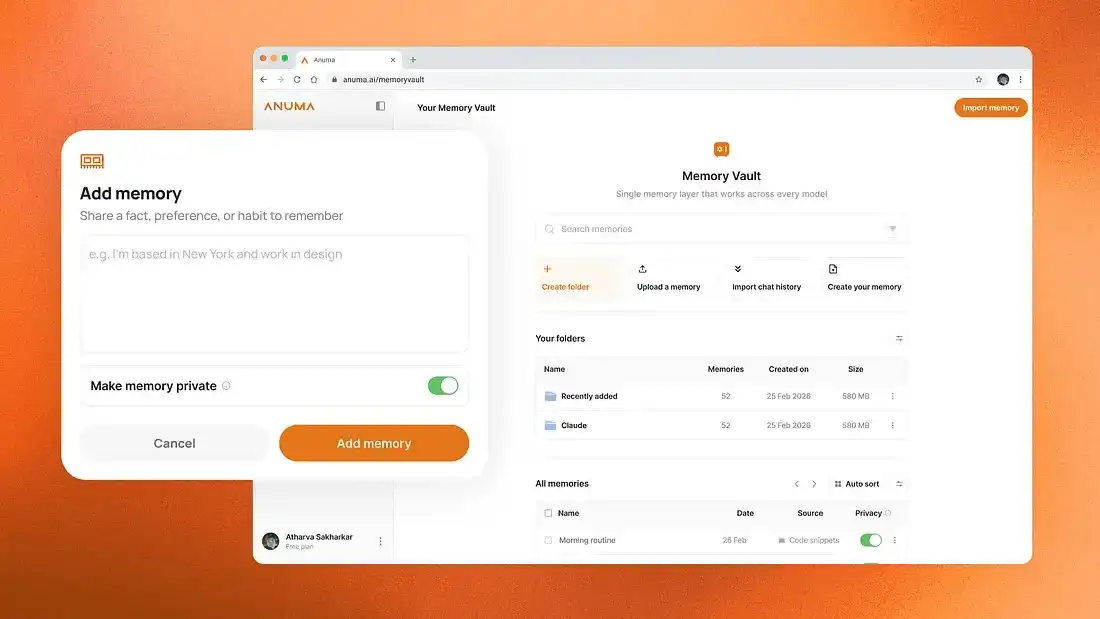
ZetaChain's consumer AI product, Anuma, advocates for users to own a set of encrypted private memory, supporting seamless use across mainstream AI models like ChatGPT, Claude, Gemini, etc. Users don't have to rebuild context, preferences, and work habits every time they switch models. Instead, users control access permissions and bring their historical memory to different models and agents.

As AI gradually accumulates users' usage preferences, writing habits, workflows, and historical conversations, the so-called "memory" will increasingly resemble a layer of "personality mirror." It not only determines whether a model's responses align with user preferences but may also determine whether the model, when making decisions on your behalf in the future, acts according to your habits and values.

Beyond giving users ownership of memory and allowing them to choose models with different strengths for different tasks, Anuma is also building a programmable, auditable, and revocable permission system. It allows AI agents to read records once, with permissions revocable at any time, and all permission changes can be recorded and tracked on-chain.

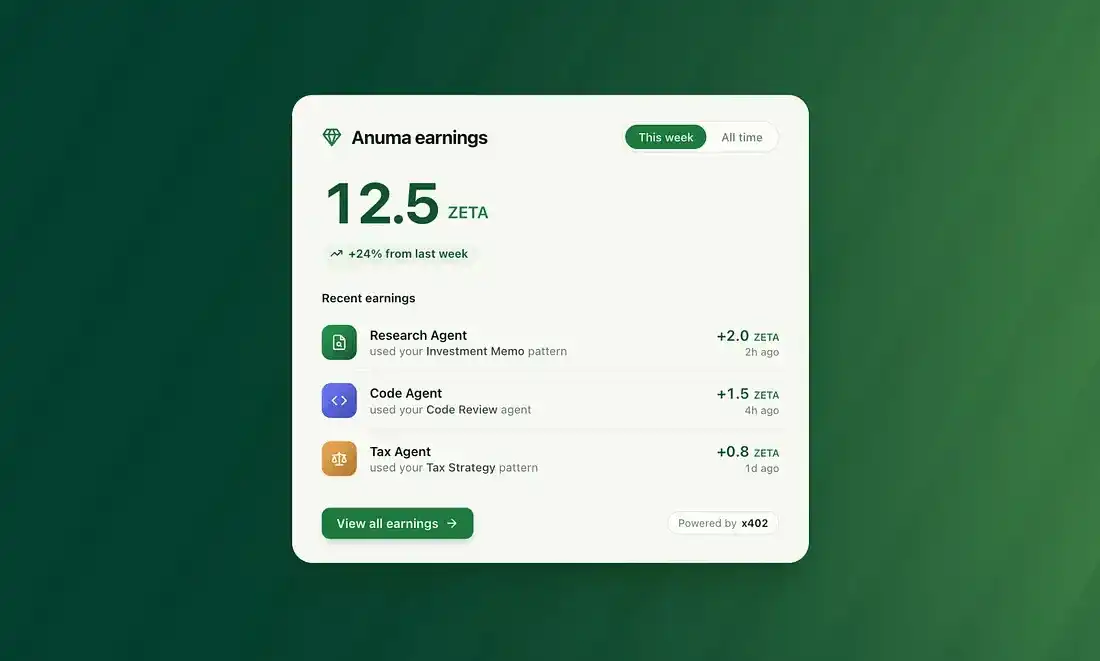
Moreover, users' memory and knowledge graphs can become assets that can be shared, authorized, and monetized without exposing raw data. This enables professional users such as investors, doctors, lawyers, and developers to encapsulate their expertise into agents, publish them to an Agent Marketplace, and earn revenue when others call upon them.

From Cross-Chain to Cross-AI Platform: Why Did ZetaChain Pivot?

What enables Anuma to achieve these functions is the underlying infrastructure, Private Memory Layer, developed by ZetaChain. As an infrastructure for AI-focused private memory, identity, permissions, payments, and agents, it aims to allow applications and agents to collaborate across models while users retain control.

ZetaChain had long focused on cross-chain interoperability infrastructure, with the core goal of solving asset and message transfer issues between different blockchains. Regarding the "unified multi-chain entry point," it built a considerable network and narrative. According to official data, there are 11.9 million unique addresses and 241 million transactions on its blockchain.

But after Anuma publicly launched on April 27th this year and surpassed 50,000 users in its first month, ZetaChain began deciding to fully pivot to AI, gradually phasing out its cross-chain interoperability business. Behind this pivot lies a relatively clear internal logic.
In the past, ZetaChain mainly dealt with the issue of incompatibility between different chains. In today's AI world, similar fragmentation exists. To some extent, digital assets are to blockchain what memory and context are to AI. Different models have their own closed memory systems; once users switch platforms, the long-accumulated context and behavioral preferences are often interrupted.

With developments in recent years, ZetaChain believes the biggest challenge it faces now is no longer cross-chain transfers between blockchains, but continuity between different models and agents, and the issue of user ownership over their own context.

a16z crypto previously mentioned in an analysis article that agents have begun to become economic participants, but they still lack portable identities, programmable payments, verifiable authorization, and the public coordination layer needed for cross-environment collaboration. Therefore, compared to many AI + Crypto projects awkwardly searching for application scenarios, ZetaChain's pivot logic is much smoother.

In business history, successful pivots by infrastructure companies are not uncommon. Such companies often don't simply switch tracks but chase new bottlenecks based on product logic. NVIDIA's most important initial narrative was graphics computing and gaming GPUs. But with the rise of AI, its GPU architecture ultimately became the core infrastructure for the entire AI industry. Infrastructure never revolves around the same constraint point forever, and true winners are often those who earliest identify that the "next constraint point" is emerging.

From Privacy Memory Layer to AI Consumer Layer

With the explosive development of AI, the future form of AI will clearly not be confined to chat windows but will gradually evolve into numerous long-term, collaborative AI assistants. Based on this judgment, after proposing the "Privacy Memory Layer" and attempting to solve how AI can understand users long-term, ZetaChain further proposed the concept of the "AI Consumer Layer," hoping to redefine the relationship between users and AI after AI works on behalf of users long-term.

In ZetaChain's vision, future AI won't just answer questions but will deeply participate in users' workflows and daily decisions. Different AI assistants will be responsible for different tasks—some handling code, others organizing finances, some planning schedules, and others participating long-term in content creation and research analysis. For these AIs to truly collaborate, they need to share the same set of long-term context, identity, and permission systems.

Therefore, the so-called "AI Consumer Layer" essentially attempts to integrate originally scattered capabilities into a unified framework. Among them, Memory handles long-term context, Permissions handles access control, Identity handles the identity system, Payments handles invocation and payments between AIs, and Agents are the AI networks that ultimately execute tasks on behalf of users.

This is why "ownership" has become the core concept ZetaChain repeatedly emphasizes.

Because in this system, whether users still own their context, permissions, and identities becomes paramount. For example, in the future, an AI responsible for code review could be temporarily authorized to read a GitHub repository; an AI handling tax organization could read tax filing materials once; an AI arranging travel could only access travel history and calendar permissions. Permissions would no longer be uniformly controlled by the platform but dynamically allocated by users and revocable at any time.

And this is precisely why blockchain is starting to reconnect with AI.

As more and more AIs simultaneously work on behalf of users, "who can access what," "whether permissions are revocable," and "whether invocations are traceable" will gradually become new infrastructure issues. And on-chain permission systems are naturally suited to handle this kind of multi-party collaboration.

'AI Infrastructure Token' ZETA Brings Utility Growth Alongside Pivot

Alongside ZetaChain's strategy adjustment, the functionality and utility of the ZETA token have also been adjusted. In the past, ZETA was more like a traditional public chain token, primarily serving Gas, validation, and cross-chain network security functions, with not much innovation in its mechanism design. But under the new narrative, ZETA will become an "AI Infrastructure Token," with its utility significantly enhanced.

According to ZetaChain's current description, ZETA will serve several purposes in the future:

Firstly, access permissions for AI models and Agents. Access to certain advanced models, specialized AI tools, or Agent services may require unlocking or payment of invocation fees using ZETA.

Secondly, payment settlement between Agents. ZetaChain mentions that future interactions between different AIs and applications will be completed via on-chain payments through the x402 protocol. Its goal is clear: if AIs in the future will automatically invoke other AIs, then machines also need a native payment system.
Thirdly, on-chain operations for permissions and memory updates. User modifications to permissions, access controls, and memory states may all become on-chain records in the future.

Fourthly, the creator economy. ZetaChain hopes that in the future, professionals like developers, researchers, lawyers, and doctors can encapsulate their knowledge into AI tools or Agents, earn revenue through invocations, with ZETA facilitating the flow of value.

However, it's important to note that this part currently remains largely at the narrative stage. Because the AI Agent economy itself is still far from mature, and truly large-scale "AI invoking AI" and "Agent autonomous payments" have not yet emerged. Concepts like x402, on-chain permissions, and AI identity currently belong more to pre-built infrastructure than to validated, large-scale demand.

But the reason ZetaChain and its product logic are noteworthy is not just because it's building an infrastructure paired with an AI product. More importantly, it attempts to redefine whether users' future memory, identity, context, and AI permissions belong to the platform or to users themselves. What ZetaChain wants to do, in essence, is to ensure these things are no longer controlled by platforms but returned to the hands of users.


Criptos en tendencia

Preguntas relacionadas

QWhat is the core issue regarding AI 'memory' that the article identifies as a new competitive battleground?

AThe article identifies that AI 'memory' or long-term context is becoming a new competitive battleground. Currently, AI models like ChatGPT, Claude, and Gemini store user preferences, work habits, and project contexts, but this 'memory' is siloed within each platform. This creates a problem where users lose their accumulated context and personalized AI understanding when switching between different AI models or services.

QWhat problem does the company ZetaChain aim to solve with its 'Private Memory Layer'?

AZetaChain aims to solve the problem of fragmented and platform-owned AI memory. Its Private Memory Layer is designed to be a user-owned, encrypted layer for storing long-term memory, behavior preferences, and AI context. This allows users to take their personalized 'memory' and seamlessly use it across different AI models (like ChatGPT, Claude, Gemini) and agents, maintaining continuity without starting over on each platform.

QWhat major strategic shift did ZetaChain make, and what was the logical connection behind this shift?

AZetaChain made a major strategic shift from being a cross-chain interoperability infrastructure for blockchains to focusing entirely on AI. The logical connection is that the core problem of interoperability and fragmentation exists in both domains. Just as it previously solved the issue of assets and data being siloed on different blockchains, it now addresses the similar issue of user context and memory being siloed within different, closed AI platforms.

QAccording to the article, how does the role of AI assistants evolve in the future vision presented by ZetaChain?

AIn ZetaChain's future vision, AI assistants evolve from simple chat tools into a network of long-term, specialized digital assistants that deeply collaborate. Different AI agents will handle specific tasks (e.g., coding, finance, travel planning, content creation). For them to work together effectively, they will need to share a unified framework for long-term context (memory), user identity, permissions, and a native payment system for inter-agent transactions.

QWhat new utility is the ZETA token expected to gain following ZetaChain's转型 (transformation) to AI?

AFollowing its transformation, the ZETA token is expected to evolve into an 'AI infrastructure token' with significantly expanded utility. Its expected new uses include: 1) Access and payment for premium AI models and agent services. 2) Settlement for payments between different AI agents (via protocols like x402). 3) Facilitating on-chain operations for updating user permissions and memory access controls. 4) Powering a creator economy where professionals monetize their expertise by packaging it into AI agents or tools.

Lecturas Relacionadas

After Three Consecutive Quarters of Decline, Can the Crypto Market Find a Window for Stabilization in Q3?

The cryptocurrency market has just concluded its worst-performing quarter since 2022, with total capitalization dropping 12.6% to $2.1 trillion. All core metrics indicate capital is leaving the sector, not just rotating within it. Bitcoin fell 14.2% and Ethereum dropped 25.4% in Q2, breaking their previous correlation with US tech stocks. A key driver is the reversal in US spot Bitcoin ETF flows, which saw a net outflow of approximately $4.67 billion in Q2, including a record monthly outflow near $4.5 billion in June. While recent data suggests long-term holders are accumulating again, sustained ETF outflows mean continued selling pressure. Market focus is now singularly on the Federal Reserve. The upcoming July FOMC meeting is seen as the most critical event for Q3. A dovish signal could support Bitcoin reclaiming a $68,000-$84,000 range, while a hawkish stance might establish a new trading band around $50,000-$56,000. Additionally, regulatory uncertainty persists, with the progress of the crucial *CLARITY Act* stalling in the Senate, reducing its perceived 2026 passage probability to 40-45%. Despite the broad downturn, a few sectors showed growth. Prediction markets saw nominal volume surge 48.7% year-over-year to $113.8 billion, and tokenized collectibles transaction volume rose 143% quarterly to $1.4 billion. The Real-World Asset (RWA) tokenization sector also continued steady growth, now representing ~$28.1 billion in on-chain value. The market's foundation for an extreme crash appears limited, with Bitcoin price hovering near its 200-week moving average. However, the trading paradigm has shifted from narrative-driven speculation to decisions based on price action, policy developments, and interest rate expectations, making a broad sentiment-driven rally unlikely in the near term.

marsbitHace 48 min(s)

After Three Consecutive Quarters of Decline, Can the Crypto Market Find a Window for Stabilization in Q3?

marsbitHace 48 min(s)

BIT Trading Moment: BTC Still Suppressed by Weekly 200 EMA, Rejection May Restart Decline; Storage and Semiconductors that Surged Last Night Begin Falling in Evening Trading

**Crypto & Stock Market Wrap: Bitcoin Tests Resistance, Stocks Retreat After AI Surge** Bitcoin consolidates around $66,000, facing key resistance near $68,000—an area seen as a major psychological and technical hurdle where previous rallies have failed. Analysts note the cryptocurrency is caught between its 200-week moving average (~$63,333) and 200-week EMA (~$68,328). A clear break above $68k is needed to signal a stronger bullish trend, while a rejection could lead to a retest of $63k support. Market sentiment remains cautious, with low futures open interest pointing to a low-liquidity rebound rather than a full bull market. Bitcoin spot ETFs saw another $203 million inflow. US stock futures pointed lower after a strong Tuesday session led by a massive rebound in semiconductors and memory stocks. The rally was fueled by renewed optimism about AI-driven hardware demand, with Micron, SanDisk, and SK Hynix surging. However, those gains reversed in pre-market trading. Super Micro Computer (SMCI) soared over 20% after hours on strong guidance and a record backlog. Other standouts included Rocket Lab and nuclear energy plays Oklo and X-Energy. Rising oil prices (Brent above $91) and climbing Treasury yields (10-year near 4.64%), however, are reigniting inflation concerns and acting as a headwind for equities. In Asia, markets were mixed. South Korea's KOSPI pared early gains to close slightly higher as semiconductor stocks like SK Hynix gave back initial surges. Japan's Nikkei edged lower as the yen hit a fresh 38-year low against the dollar, raising fears of potential market intervention. Key events to watch include the Samsung Galaxy launch, AMD's AI event, and a slew of major tech earnings from Alphabet, Tesla, and IBM after the close on Wednesday, followed by the ECB meeting and Intel's earnings on Thursday.

marsbitHace 56 min(s)

BIT Trading Moment: BTC Still Suppressed by Weekly 200 EMA, Rejection May Restart Decline; Storage and Semiconductors that Surged Last Night Begin Falling in Evening Trading

marsbitHace 56 min(s)

Former CFTC Chairman, Circle President Tarbert: Preaching Long-Termism While Cashing Out $30 Million Himself

Former CFTC Chairman and Circle President Heath Tarbert has consistently advocated for a long-term vision in public, urging patience from investors as Circle’s stock price has fallen significantly from its peak. However, it has been revealed that since Circle’s IPO, Tarbert has continuously sold his CRCL shares through pre-arranged trading plans, cashing out approximately $30 million, without making any public market purchases. This contrast between his public messaging and personal actions has drawn criticism. Tarbert joined Circle in July 2023 as Chief Legal Officer, leveraging his regulatory experience to help guide the company through its IPO and expansion. Despite promoting stablecoins as long-term infrastructure, he established a 10b5-1 trading plan just before Circle went public, leading to substantial stock sales over the following year. In March 2026, he initiated another plan to sell more shares. His career trajectory highlights a pattern of moving between high-level regulatory roles and influential positions in the financial sector. After resigning as CFTC Chairman in early 2021, he joined Citadel Securities as Chief Legal Officer just 27 days later, during a period of intense regulatory scrutiny for the firm. He later joined Circle, aiding its efforts to navigate regulatory challenges for its public listing. While Tarbert's expertise in policy and compliance is valuable to companies like Circle, his actions—advocating long-term confidence while personally divesting—raise questions about the alignment between his public statements and his private financial decisions, leaving investors who followed his advice to bear the market risks.

marsbitHace 1 hora(s)

Former CFTC Chairman, Circle President Tarbert: Preaching Long-Termism While Cashing Out $30 Million Himself

marsbitHace 1 hora(s)

Gate Research Institute: The 'Wall Street-ization' Wave of Crypto Financial Products – Competition or Integration?

The article titled "Gate Research Institute: Are Crypto Financial Products Sparking a 'Wall Street' Wave—Competition or Convergence?" explores the evolving relationship between the crypto ecosystem and traditional finance (TradFi). The piece begins by reflecting on Bitcoin's original 2009 vision of decentralization, disintermediation, and moving away from banks. It then contrasts this with the 2024 landscape, where key crypto assets like Bitcoin are increasingly held through Wall Street products like ETFs issued by giants like BlackRock. The article questions whether this signifies that TradFi is systematically taking over the rights to issue, price, custody, and distribute crypto financial assets. The core argument is that this is not a zero-sum takeover but rather a bidirectional convergence where each side addresses the other's weaknesses. Crypto offers 24/7 global markets, programmable settlement, and open access but lacks compliant channels, institutional-grade custody, deep fiat liquidity, and mainstream distribution. TradFi possesses these but is constrained by legacy systems, limited operating hours, and slow settlement. Two primary convergence paths are highlighted: * **Path A (CEX to TradFi):** Exemplified by Gate, which has progressed from offering tokenized stocks and CFDs to providing direct, real stock trading (US, Hong Kong, South Korea) within its platform, using USDT. * **Path B (TradFi to Crypto):** Exemplified by Robinhood, which has integrated crypto trading, acquired exchanges like Bitstamp, and is moving traditional assets like stocks onto the blockchain via tokenization and its own Layer 2. Both paths are ultimately competing to become the next-generation, unified financial account—a "super account" where users can seamlessly trade cryptocurrencies, stocks, ETFs, RWA (Real World Assets), and tokenized treasury products in one interface. The growth of RWA and tokenized treasuries (e.g., BlackRock's BUIDL) is presented as the asset-layer fusion, providing stable, yield-bearing assets on-chain and acting as a bridge between the two worlds. In conclusion, the "Wall Street-ization" of crypto is framed as a mutual transformation. Decentralized ideals persist in the protocol layer, while at the application layer, a more efficient, global, and accessible unified capital market is emerging from this convergence. The future competition lies not between crypto exchanges and stockbrokers, but between platforms vying to offer the most comprehensive asset coverage, liquidity, and user experience within a single account.

marsbitHace 1 hora(s)

Gate Research Institute: The 'Wall Street-ization' Wave of Crypto Financial Products – Competition or Integration?

marsbitHace 1 hora(s)

Trading

Spot

Artículos destacados

Cómo comprar ZEN

¡Bienvenido a HTX.com! Hemos hecho que comprar Horizen (ZEN) sea simple y conveniente. Sigue nuestra guía paso a paso para iniciar tu viaje de criptos.Paso 1: crea tu cuenta HTXUtiliza tu correo electrónico o número de teléfono para registrarte y obtener una cuenta gratuita en HTX. Experimenta un proceso de registro sin complicaciones y desbloquea todas las funciones.Obtener mi cuentaPaso 2: ve a Comprar cripto y elige tu método de pagoTarjeta de crédito/débito: usa tu Visa o Mastercard para comprar Horizen (ZEN) al instante.Saldo: utiliza fondos del saldo de tu cuenta HTX para tradear sin problemas.Terceros: hemos agregado métodos de pago populares como Google Pay y Apple Pay para mejorar la comodidad.P2P: tradear directamente con otros usuarios en HTX.Over-the-Counter (OTC): ofrecemos servicios personalizados y tipos de cambio competitivos para los traders.Paso 3: guarda tu Horizen (ZEN)Después de comprar tu Horizen (ZEN), guárdalo en tu cuenta HTX. Alternativamente, puedes enviarlo a otro lugar mediante transferencia blockchain o utilizarlo para tradear otras criptomonedas.Paso 4: tradear Horizen (ZEN)Tradear fácilmente con Horizen (ZEN) en HTX's mercado spot. Simplemente accede a tu cuenta, selecciona tu par de trading, ejecuta tus trades y monitorea en tiempo real. Ofrecemos una experiencia fácil de usar tanto para principiantes como para traders experimentados.

252 Vistas totalesPublicado en 2024.12.12Actualizado en 2026.06.02

Cómo comprar ZEN

Discusiones

Bienvenido a la comunidad de HTX. Aquí puedes mantenerte informado sobre los últimos desarrollos de la plataforma y acceder a análisis profesionales del mercado. A continuación se presentan las opiniones de los usuarios sobre el precio de ZEN (ZEN).

活动图片












