AI Benefits Senior Staff? 40% of CEOs Plan to Cut Junior Positions, Young People's Jobs Are More at Risk

marsbitPublicado a 2026-05-18Actualizado a 2026-05-18

Resumen

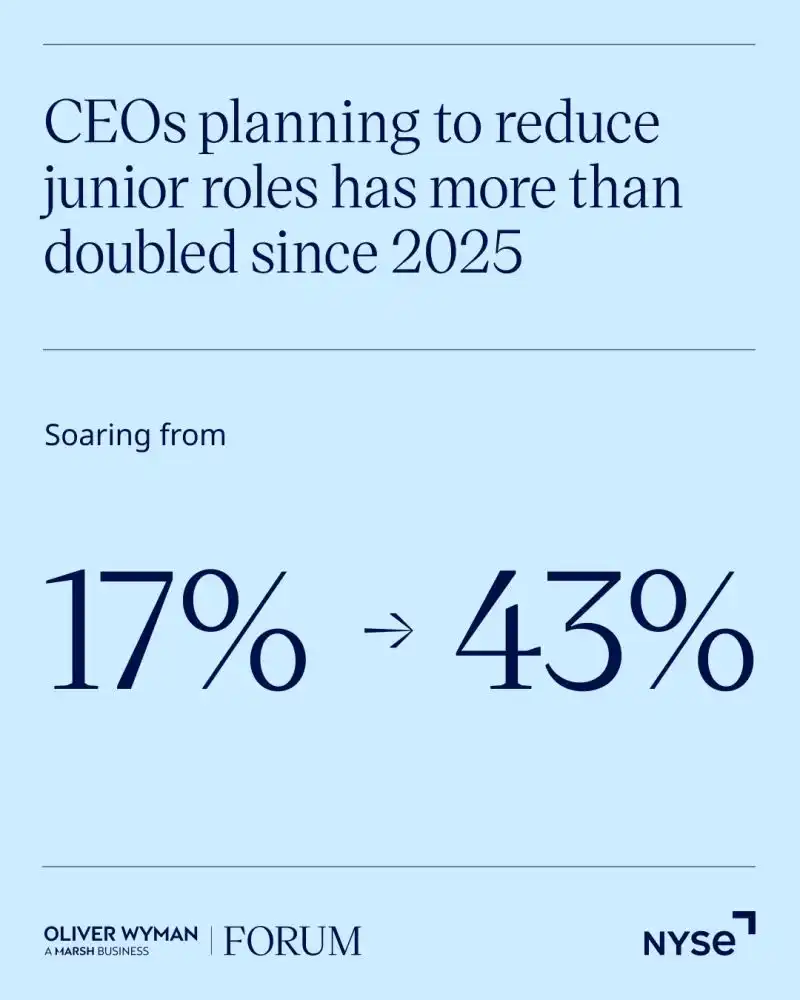
The traditional assumption that senior employees are first in line during layoffs is being inverted in the AI era. A survey of 415 CEOs by Oliver Wyman and the NYSE reveals 43% plan to cut entry-level positions in the next 1-2 years to shift towards a mid-to-senior talent structure, a sharp rise from 17% last year. The logic is that AI excels at automating routine, cognitive tasks typically handled by junior staff (e.g., coding, data review), while the experience and judgment of senior employees remain harder to replicate. Research indicates this shift primarily manifests as a hiring freeze for junior roles rather than mass layoffs. Goldman Sachs estimates AI currently nets a loss of about 16,000 US jobs monthly, disproportionately impacting Generation Z concentrated in highly automatable white-collar roles. This raises long-term concerns about a broken talent pipeline, as companies risk having no future senior managers trained internally. Despite the dominant trend, a minority of successful AI adopters, like IBM and Salesforce, are expanding junior hiring, arguing these employees are adept at using and building AI tools. However, most companies are still in early AI deployment phases, with 67% in planning/pilot stages and many reporting returns below expectations. The overarching reality is a weakening of job security across all levels, as organizations reshape for an AI-augmented, leaner future.

Author: Claude, Shenchao TechFlow

Shenchao's Insight: A recent survey of 415 global CEOs by Oliver Wyman in partnership with the New York Stock Exchange shows that 43% of CEOs plan to reduce junior positions in the next one to two years, shifting their workforce composition towards mid- to senior-level talent. This figure has more than doubled from 17% last year. AI is systematically replacing routine tasks typically handled by junior employees, while experienced employees become more valuable due to their judgment and expertise. Goldman Sachs previously estimated that AI is eliminating a net of approximately 16,000 US jobs per month, with Generation Z being the most affected.

In past waves of layoffs, older, higher-paid employees were often the first targets. But the logic of the AI era is reversing this trend.

According to a Bloomberg report on May 16th, the 2026 CEO Agenda survey released by management consultancy Oliver Wyman and the New York Stock Exchange reveals that over 40% of CEOs plan to reduce junior positions in the next one to two years, tilting their workforce structure towards more mid- to senior-level employees; only 17% of CEOs indicated they would increase the proportion of junior roles. A year ago, these numbers were almost the opposite.

The survey covered 415 CEOs (266 from public companies, 149 from private companies), with the public company sample representing about 10% of global market capitalization, including 65 Fortune 500 CEOs.

John Romeo, Head of the Oliver Wyman Forum, told Bloomberg in an interview, "The difficulty for junior employees to enter the workforce is indeed increasing. CEOs now place greater emphasis on mid- to senior-level employees to drive productivity."
43% of CEOs Plan to Cut Junior Positions, AI's 'Experience Bias' Effect Emerges

The logic behind this shift is not hard to understand: the tasks that AI agents are currently capable of performing are highly concentrated in the typical scope of work for junior employees. Writing code, evaluating sales leads, reviewing documents, compiling data reports—these routine cognitive tasks previously handled by junior staff are being rapidly replaced by AI systems.

However, what AI currently cannot replicate is the judgment formed through years of industry experience. Future of work advisor Ravin Jesuthasan told Bloomberg that the corporate attitude is shifting to "I need someone who has actually done this, because her experience, judgment, and problem-solving ability make her more valuable than the AI."

This phenomenon has data support in academia. A paper by Harvard University researchers Seyed M. Hosseini and Guy Lichtinger analyzed resume and hiring data covering 62 million employees and 285,000 US companies. The results show that since early 2023, among companies actively adopting generative AI, the number of junior employees decreased by 7.7% over six quarters compared to non-adopting firms, while the number of senior employees was largely unaffected. A key finding is that this decline primarily stems from a hiring slowdown, not large-scale layoffs. In other words, they are not firing people, but simply not hiring them.
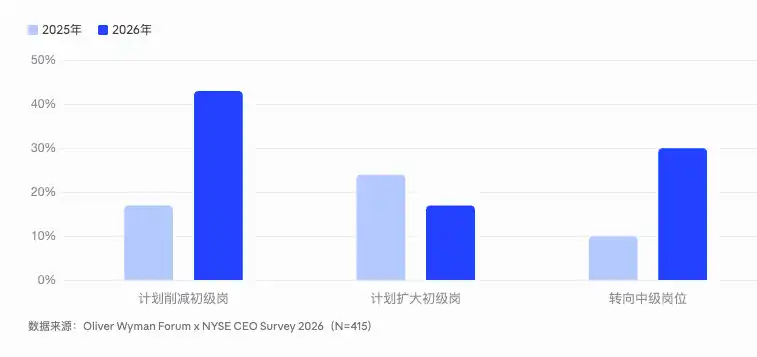
The Oliver Wyman report states the implication of this trend more bluntly: "CEOs with the longest planning horizons are the most likely to plan for headcount reductions. This suggests they anticipate that organizations will become leaner, enhanced by AI, not as a cost-cutting measure, but as an end-state."

Goldman Sachs Estimates: AI Net Eliminates 16,000 US Jobs Monthly, Generation Z Bears the Brunt

Goldman Sachs economist Elsie Peng estimated in an April research report that the AI substitution effect eliminated about 25,000 jobs per month over the past year, while the AI augmentation effect created about 9,000 jobs per month in the same period, resulting in a net elimination of about 16,000 jobs. Frontierbeat

The impact is highly unevenly distributed. In occupations with the highest exposure to AI substitution, the unemployment rate gap between entry-level workers under 30 and experienced workers aged 31 to 50 has widened significantly compared to pre-pandemic levels. The wage gap has also worsened concurrently; Goldman's regression analysis estimates that for every one standard deviation increase in AI substitution exposure, the wage gap between entry-level and experienced workers widens by approximately 3.3 percentage points. Fortune

Generation Z is disproportionately concentrated in routine white-collar roles such as data entry, customer service, legal support, and billing processing—precisely the areas AI is most adept at automating. They lack the experiential buffer that senior employees possess. Fortune

A Stanford University study from last November further confirms this: in fields with the highest AI exposure, young employees are 16% more likely to be unemployed than other groups. Fortune

Long-Term Risks of a Broken Talent Pipeline

While cutting junior positions can lower costs and improve efficiency in the short term, the hidden costs are raising alarms.

Helen Leis, Global Head of Leadership and Change at Oliver Wyman, pointed out to Bloomberg that if companies want to have mid- to senior-level talent to manage AI-driven workflows in the future, "these people need to first learn the job within the company." Not hiring junior employees is akin to cutting off one's own talent pipeline.

Andrew McAfee, co-director of MIT's Initiative on the Digital Economy, previously expressed similar concerns to the Harvard Business Review: "Other than on-the-job learning and apprenticeship training, how are people supposed to learn how to do a job?"

Monster survey data shows that nearly 90% of the class of 2026 are worried that AI or automation will replace entry-level positions, a sharp rise from 64% in 2025. Fortune

These concerns are not unfounded. According to a SignalFire report, from 2023 to 2024, the hiring volume for junior positions at the 15 largest US tech companies fell by 25%. The situation in the UK is more severe, with graduate roles in the tech sector decreasing by 46% in 2024, projected to drop another 53% by 2026. IEEE SpectrumRezi

A Few Companies Go Against the Grain: AI 'Winners' Actually Value Junior Employees More

Interestingly, companies most successful in AI deployment are adopting a different talent strategy.

The Oliver Wyman report points out that "a cohort of contrarian, advanced AI adopters believe this technology is increasing the value of junior talent, not displacing them." Among companies with higher ROI from AI investments, the proportion leaning towards increasing junior positions is higher than among those not yet seeing returns.

IBM announced in February this year its plan to triple its hiring of US junior positions and rewrite job descriptions for the AI era. Salesforce CEO Marc Benioff announced this week the hiring of 1,000 recent graduates and interns to build its AI systems, writing on platform X: "They say AI will kill junior jobs. But these grads & interns are BUILDING AI." Amazon Web Services CEO Matt Garman publicly stated that replacing junior employees with AI is "one of the dumbest decisions a company can make," reasoning that junior employees are often the most proficient users of AI tools.

However, these cases remain the minority in the overall trend. The Oliver Wyman survey shows that 74% of CEOs are freezing or reducing headcount, up from 67% last year. The most aggressive cuts are happening in the technology, media, and telecom industries.

AI's ROI Dilemma: Most Companies Still in the 'Money-Burning Experimentation' Stage

There is a significant gap between CEOs' confidence in AI's ability to change workforce structures and the actual returns AI is delivering.

The Oliver Wyman survey reveals that 67% of corporate AI deployments remain in the planning and pilot stages. 53% of CEOs say it is too early to assess AI investment returns, a figure that has increased from 41% last year. Only 27% of CEOs report that AI investment returns meet or exceed expectations, down from 38% last year. Nearly a quarter say AI has had no impact on revenue whatsoever.

The report describes this as "not a crisis of confidence, but a recognition that redesigning work at scale is slower and more difficult than initial enthusiasm anticipated."

However, the report also notes that companies deploying AI across more than two application areas report cost savings and revenue growth roughly double that of companies with single-scenario deployments. The value curve for AI is non-linear, with real returns concentrated after scaled deployment.

A statement by economist Teresa Ghilarducci of The New School to Bloomberg perhaps sums up the current situation: Even if AI tilts the workplace balance in favor of experienced employees, it does not mean they have gained job security. "Companies are increasingly less committed to their employees."


Preguntas relacionadas

QAccording to the Oliver Wyman survey, what is the key change in CEO hiring plans for junior positions?

AOver 40% of CEOs plan to reduce junior positions over the next one to two years, shifting their workforce structure towards more mid- to senior-level talent. This figure has more than doubled from 17% the previous year, representing a significant reversal in hiring strategy.

QWhat is the 'seniority bias' effect of AI on the workforce mentioned in the article?

AThe 'seniority bias' effect refers to the trend where AI is systematically automating routine, cognitive tasks typically performed by junior employees (e.g., coding, document review, data reporting). Meanwhile, senior employees, whose value lies in experience, judgment, and complex problem-solving abilities that AI cannot yet replicate, are becoming more valuable and less likely to be replaced.

QWhat does the Goldman Sachs research cited in the article say about AI's net impact on US jobs?

AGoldman Sachs economists estimate that AI is currently displacing about 25,000 US jobs per month while simultaneously creating around 9,000 new ones. This results in a net loss of approximately 16,000 jobs per month, with Generation Z workers being disproportionately affected.

QWhat long-term risk does cutting junior positions pose to companies, according to experts in the article?

ACutting junior positions risks severing a company's talent pipeline. Experts warn that future mid- and senior-level leaders, who will need to manage AI-driven workflows, must first learn the business from within the company. By not hiring and training junior employees, companies are undermining their own long-term succession planning and leadership development.

QHow do the most successful AI-adopting companies differ in their approach to hiring junior staff, according to the article?

AA minority of successful, advanced AI adopters are taking a counter-trend approach. Companies like IBM, Salesforce, and Amazon Web Services are expanding hiring for junior roles. They view AI as a tool that enhances the value of junior talent (who often become skilled AI users) rather than simply replacing them, and they are actively recruiting graduates to help build and work with AI systems.

Lecturas Relacionadas

The Age of Decoupling Has Arrived: Bitcoin is No Longer the Sole Compass of Crypto

The era of the cryptocurrency market moving in lockstep with Bitcoin is ending, as the industry splits into two distinct asset categories: endogenous and exogenous. Endogenous assets, like Bitcoin, derive value purely from the crypto market's cycles. Their narratives swing between being "interstellar money" in bull markets and "digital collectibles" in bear markets. Exogenous assets, however, are nominally crypto but operate with independent value drivers. Examples include: * **Venice:** An AI inference service using tokens for payments; its consumer-AI business model is decoupled from crypto price swings. * **Figure:** A fintech lender using blockchain to speed up loan approvals; its core value is in credit, not crypto. * **Stablecoin firms like BVNK:** Acquired by traditional finance giants (Mastercard, Stripe), their growth is tied to payment infrastructure, not market cycles. Hybrid projects like **Hyperliquid** (a decentralized exchange) show a shift, with a growing share of non-crypto trading (e.g., prediction markets). This divergence is fundamental. Endogenous assets remain highly correlated to Bitcoin, similar to gold miners to gold. Exogenous assets are evolving to have their own fundamentals, like the weak correlation between gold and the S&P 500. This changes investment analysis. Evaluating exogenous assets requires traditional fundamental research—assessing user bases, unit economics, and moats—more akin to fintech investing than charting Bitcoin. Promising exogenous sectors include: on-chain exchanges/brokers, AI-crypto fusion, privacy-focused digital banks, lending (institutional/private credit), stablecoins/real-world asset tokenization, payment rails, and non-financial crypto-consumer products. Currently, investing via equity is often safer than via tokens, as token value accrual mechanisms need further regulatory and industry development (e.g., the CLARITY Act). Nonetheless, the core trend is clear: crypto market drivers are diversifying from a single factor (Bitcoin) to multiple fundamentals, ending the era of uniform market moves.

marsbitHace 44 min(s)

The Age of Decoupling Has Arrived: Bitcoin is No Longer the Sole Compass of Crypto

marsbitHace 44 min(s)

Five Cryptos That Could Outperform Bitcoin Over the Next Cycle Due To Higher Growth Velocity

Bitcoin's growth often sets market trends, but analysts believe the next cycle's highest percentage gains may come from assets with greater growth velocity. While Bitcoin provides stability, several cryptocurrencies are positioned for stronger relative upside. This article highlights five such assets, with a particular focus on Ozak AI as the potential high-growth standout of the cycle. Ethereum (ETH) is noted for its ongoing evolution and institutional adoption. Solana (SOL) is recognized for its high throughput and history of sharp rallies. Chainlink (LINK) is highlighted as essential infrastructure for DeFi and AI applications. Avalanche (AVAX) is mentioned for its subnet architecture and enterprise potential. Ozak AI ($OZ) is presented as a distinct early-stage opportunity, currently in presale at $0.014 with a target listing price of $1.00. The project is building a full AI-native blockchain ecosystem, including prediction agents, a data stream network, and structured data vaults. Analysts suggest its early valuation stage and focus on AI infrastructure could allow for exponential growth velocity compared to more mature assets like Bitcoin, which requires massive capital inflows for significant price movement. The final takeaway positions Ozak AI as a high-asymmetry bet for investors seeking exponential upside alongside more stable assets.

TheNewsCryptoHace 1 hora(s)

Five Cryptos That Could Outperform Bitcoin Over the Next Cycle Due To Higher Growth Velocity

TheNewsCryptoHace 1 hora(s)

What's New in Jensen Huang's 'Agent Factory'?

In a keynote at COMPUTEX 2026, NVIDIA CEO Jensen Huang shifted the company's focus from hardware "full-stack" solutions to the era of AI Agents. The centerpiece is the Vera Rubin platform, now in production, which is designed specifically for Agent workloads and offers 10x the efficiency of its predecessor. The platform features the new Vera CPU, built for AI, and incorporates Spectrum-X Ethernet Photonics with CPO technology for improved networking and energy efficiency. NVIDIA introduced DSX, an integrated toolkit for designing, simulating, and operating AI data centers, aiming to streamline "AI factory" deployment and management. For end-user deployment, the company unveiled DGX Station for Windows, a desktop AI supercomputer for running Agents locally, and the RTX Spark SoC for AI PCs. On the software front, NVIDIA launched the 550B-parameter Nemotron 3 Ultra model for enterprise Agents and the Cosmos 3 foundation model for physical AI, unifying visual reasoning and action prediction. In robotics, a partnership with Unitree yielded the H2 Plus, a reference humanoid robot built on the Isaac GR00T platform to lower development barriers. Security was emphasized with enhanced confidential computing for Vera Rubin and new data path security features for the BlueField-4 STX storage platform. The presentation highlighted a strategic pivot: NVIDIA is reorganizing its entire technology stack—from chips and data centers to models, software, and robots—around the emerging ecosystem of autonomous, practical AI Agents.

marsbitHace 1 hora(s)

What's New in Jensen Huang's 'Agent Factory'?

marsbitHace 1 hora(s)

Trading

Spot
Futuros

Artículos destacados

Cómo comprar PEOPLE

¡Bienvenido a HTX.com! Hemos hecho que comprar ConstitutionDAO (PEOPLE) sea simple y conveniente. Sigue nuestra guía paso a paso para iniciar tu viaje de criptos.Paso 1: crea tu cuenta HTXUtiliza tu correo electrónico o número de teléfono para registrarte y obtener una cuenta gratuita en HTX. Experimenta un proceso de registro sin complicaciones y desbloquea todas las funciones.Obtener mi cuentaPaso 2: ve a Comprar cripto y elige tu método de pagoTarjeta de crédito/débito: usa tu Visa o Mastercard para comprar ConstitutionDAO (PEOPLE) al instante.Saldo: utiliza fondos del saldo de tu cuenta HTX para tradear sin problemas.Terceros: hemos agregado métodos de pago populares como Google Pay y Apple Pay para mejorar la comodidad.P2P: tradear directamente con otros usuarios en HTX.Over-the-Counter (OTC): ofrecemos servicios personalizados y tipos de cambio competitivos para los traders.Paso 3: guarda tu ConstitutionDAO (PEOPLE)Después de comprar tu ConstitutionDAO (PEOPLE), guárdalo en tu cuenta HTX. Alternativamente, puedes enviarlo a otro lugar mediante transferencia blockchain o utilizarlo para tradear otras criptomonedas.Paso 4: tradear ConstitutionDAO (PEOPLE)Tradear fácilmente con ConstitutionDAO (PEOPLE) en HTX's mercado spot. Simplemente accede a tu cuenta, selecciona tu par de trading, ejecuta tus trades y monitorea en tiempo real. Ofrecemos una experiencia fácil de usar tanto para principiantes como para traders experimentados.

424 Vistas totalesPublicado en 2024.12.12Actualizado en 2026.06.01

Cómo comprar PEOPLE

Discusiones

Bienvenido a la comunidad de HTX. Aquí puedes mantenerte informado sobre los últimos desarrollos de la plataforma y acceder a análisis profesionales del mercado. A continuación se presentan las opiniones de los usuarios sobre el precio de PEOPLE (PEOPLE).

活动图片












