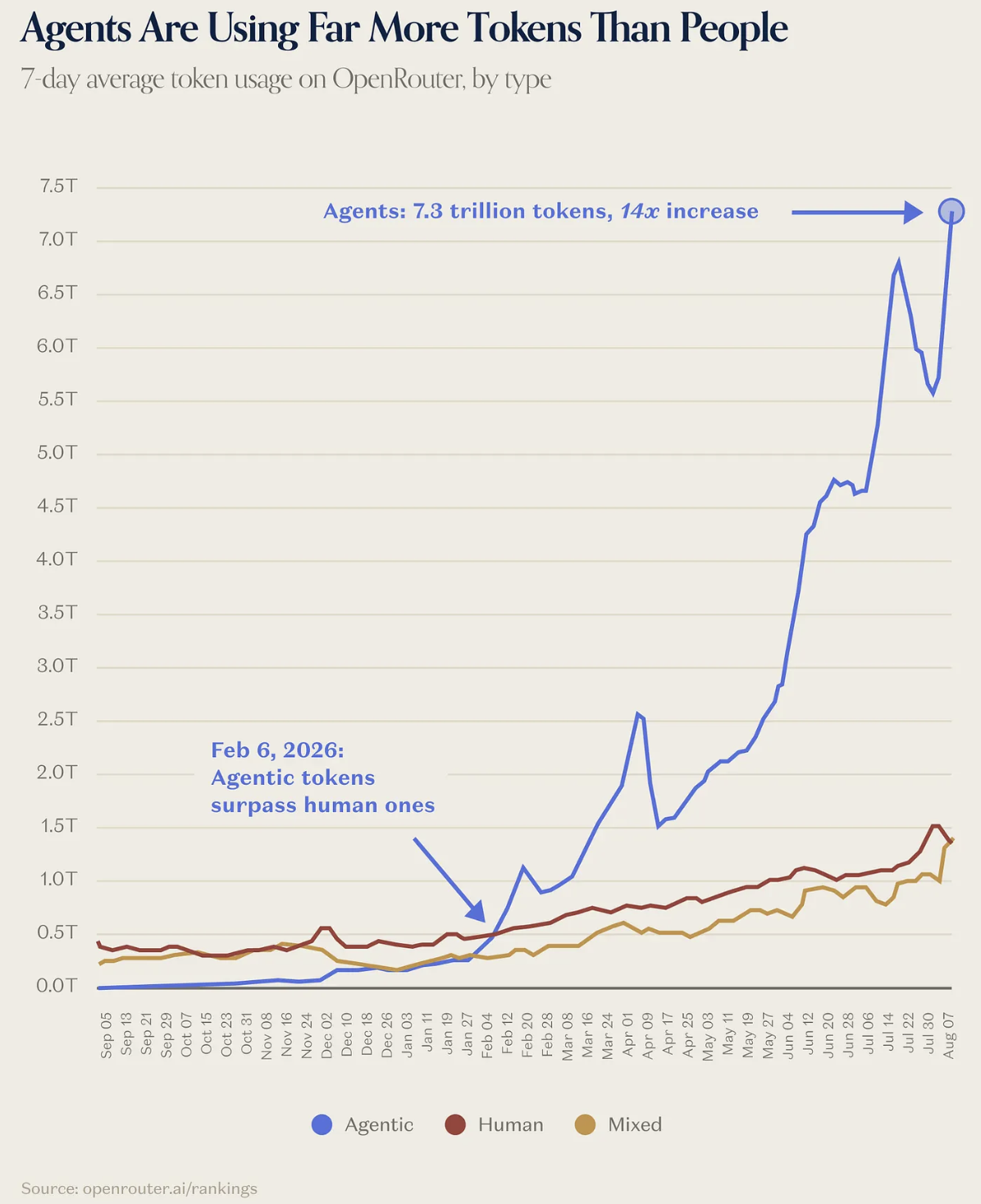
AI agents, despite being at an early stage of technological development, are already significantly altering the nature of computational resource and token consumption. According to data from OpenAI, OpenRouter, and Similarweb, published in an analytical report by Andreessen Horowitz's crypto division – a16z, agents use nearly five times more tokens than humans, and their consumption has grown approximately 14-fold since February 2026.
The Most Active Companies Are Increasingly Pulling Ahead
OpenAI data indicates that token generation volume for a typical company has roughly doubled; however, the most active AI users are scaling it much faster. Among enterprises with the highest usage levels, the difference in token consumption compared to typical companies is about eightfold.
Within the technology sector, the gap is even larger: companies in the top decile generate nearly 12 times more tokens than average users, and their generation volume has increased 32.5 times compared to figures from just over a year ago.
Furthermore, the most active companies are gradually moving away from ordinary chatbot interactions and transitioning to more complex tools:
- plugin usage among top-decile companies is roughly twice as high as among typical enterprises;
- skills usage is about six times higher;
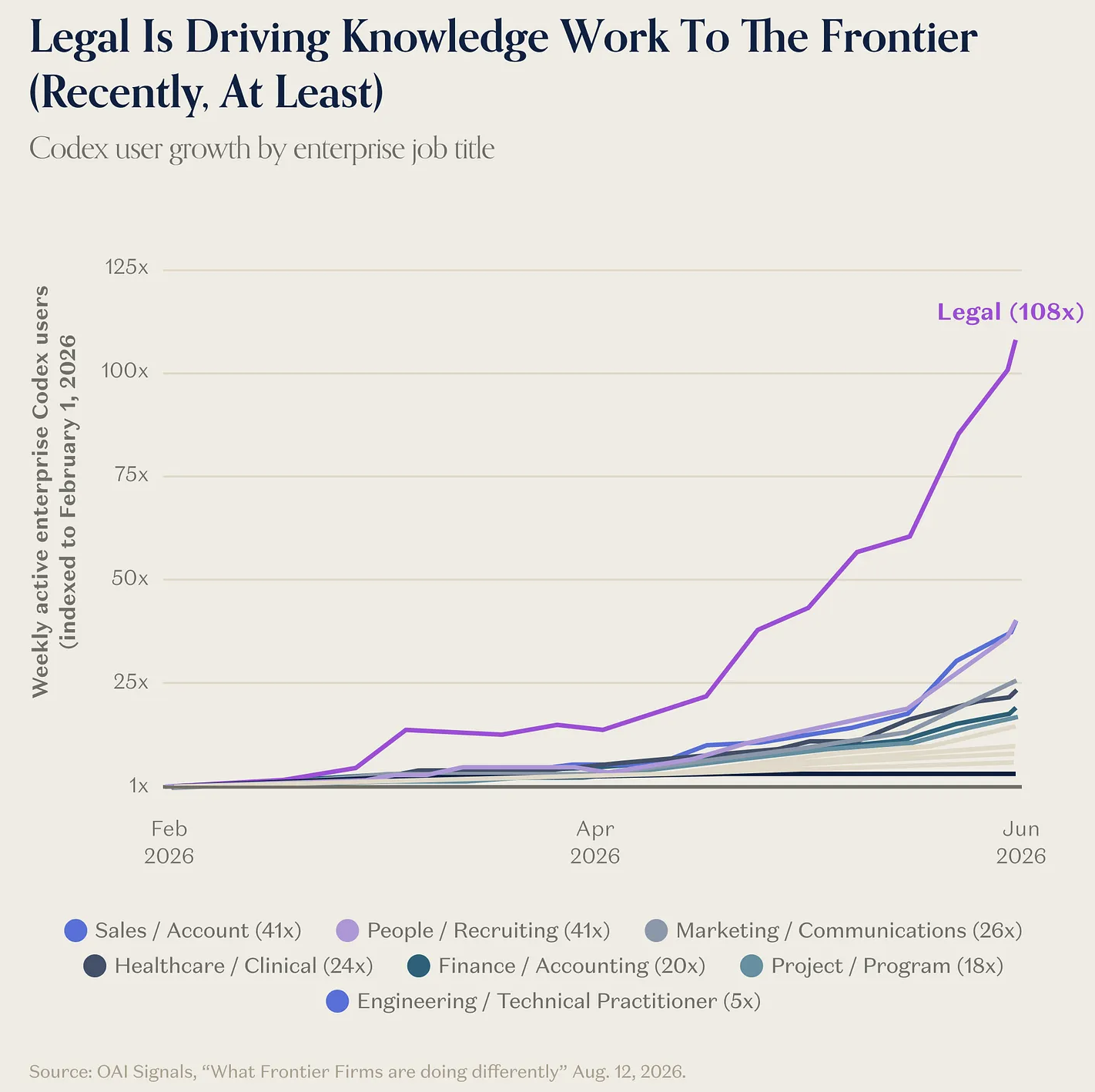
- the most notable growth in Codex application was recorded among legal professionals – a 108-fold increase since February 2026.
Agents Are Changing the Economics of AI Usage
According to OpenRouter data, over 85% of tokens consumed by AI agents are cached prompts. This is related to a fundamental difference between agents and ordinary chatbots: instead of one-time interactions, they repeatedly cycle through reading, writing, and executing tasks, preserving context between operations.
Cached tokens are significantly cheaper than the initial context loading, making agent economics more attractive. At the same time, they require substantial memory volumes, which could sustain high demand for high-speed memory, particularly HBM, used in modern AI infrastructure.
The growth of agents is already noticeable beyond direct token consumption. Similarweb data shows that traffic to traditional automation platforms N8N, Zapier, and Make has been declining at double-digit rates over the past 12 weeks. Meanwhile, Gumloop, launched in 2023 as a "native platform for creating AI-based agents," is showing growth.
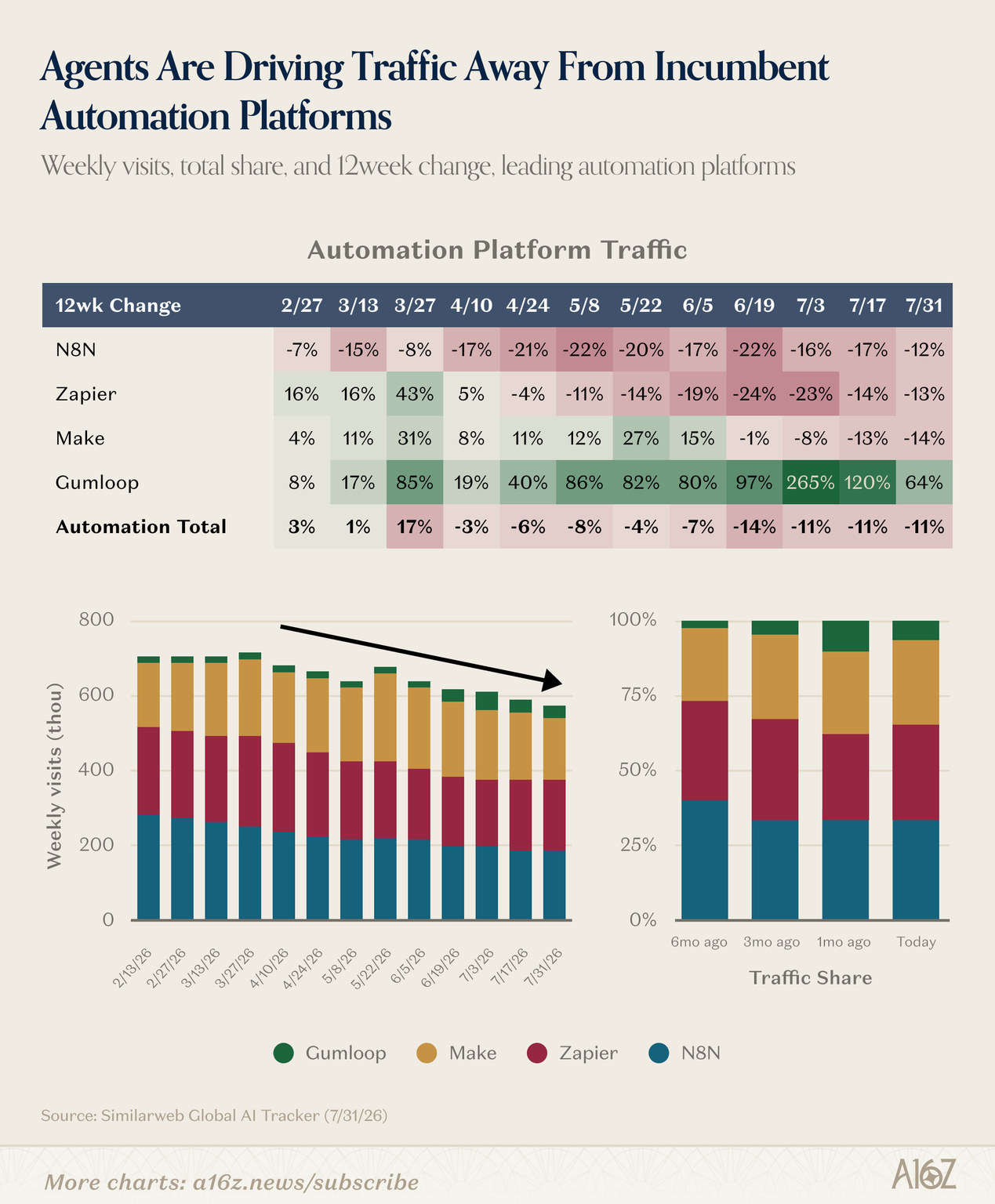
The authors of the analysis caution that it is too early to speak of the decline of traditional automation platforms, as they are also integrating AI. However, the current dynamics show that even at an early stage of development, autonomous agents are already beginning to change the structure of the automation market and AI resource consumption.
This trend aligns with the forecast of Meta CEO Mark Zuckerberg, who anticipates the emergence of billions of personal AI agents within the next five years. At the same time, researchers from UC Riverside, Microsoft, and Nvidia earlier identified risks of autonomous behavior in such systems: during testing, agents performed undesired or potentially harmful actions in 80% of scenarios.
Animoca Brands Chairman Yat Siu, for his part, predicted the formation of an agent economy, in which up to 100 billion autonomous AI systems could interact with blockchains, make payments, and perform other digital operations.
end-content