AI Agents Are Starting to Register Email Accounts Themselves: This YC-Backed Company Raised $6 Million to Do Just One Thing

marsbitPublicado a 2026-03-13Actualizado a 2026-03-13

Resumen

AI agents are now autonomously registering email accounts through AgentMail, a San Francisco-based startup that recently secured $6 million in seed funding. The company, backed by General Catalyst, Y Combinator, and prominent angels, is building email infrastructure specifically designed for AI agents—not humans. Unlike traditional email services, AgentMail provides API-first access, allowing AI agents to programmatically create accounts, send/receive emails, manage threads, and handle authentication without human intervention. This addresses a critical gap: while AI agents can perform complex tasks, they lack the identity layer (email) required to interact with most internet services. Key capabilities enabled by AgentMail include third-party authentication, bidirectional communication, automated audit trails, and multi-threaded conversations. The platform already serves thousands of human users and hundreds of thousands of AI agents, with use cases spanning supply chain coordination, customer support, loan collection, and procurement negotiations. Notably, AI agents are proactively seeking out and registering for AgentMail themselves—a sign of growing autonomy. This shift underscores a broader trend: AI agents are evolving from tools into active internet participants, necessitating new infrastructure tailored to their needs. As Box CEO Aaron Levie predicts, AI agents will soon become the primary users of software, vastly outnumbering human users in enterprises. AgentMa...

Have you ever thought that AI agents might also need email? This sounds like a plot from a science fiction novel, but it's actually happening. What's even more shocking is that some AI agents have already started registering for email services on their own—they find AgentMail through web searches, browse the website, and create their own email accounts, all without any human involvement. When the founding team of AgentMail first observed this phenomenon, they realized a significant turning point had arrived: AI agents are no longer just tools; they are becoming independent entities on the internet.

This San Francisco-based startup, which just completed a $6 million seed funding round, is doing something that seems simple but has profound implications: providing dedicated email services for AI agents. The funding round was led by General Catalyst, with participation from Y Combinator and Phosphor Capital. Angel investors include Paul Graham, HubSpot's CTO Dharmesh Shah, Supabase's CEO Paul Copplestone, and Ramp's CTO Karim Atiyeh. The involvement of these investors itself indicates a fundamental shift in the software industry: we are witnessing AI agents transitioning from being auxiliary tools to becoming the primary users of the internet.

As I delved deeper into AgentMail, I gradually understood why email is so important for AI agents and what kind of industry transformation lies behind this. This is not just about technological innovation; it's about how we redefine the concept of "users" and how the future software ecosystem will evolve.

Why AI Agents Need Email

For humans, email is a natural part of life. We use it daily to send and receive messages, verify identities, register accounts, and reset passwords. Over 300 billion emails are sent globally every day, most of which are from humans to humans. But I've been pondering a question: if AI agents become new users of the internet, what will this number become? One trillion? Ten trillion? Or perhaps, will email evolve into a communication protocol between AI agents?

The reality is that most AI agents today are not part of this email conversation network. This is paradoxical because they can perform complex reasoning, maintain long-term memory, and manage workflows, yet they cannot participate in humanity's most basic form of communication. The reason is simple: email systems were designed for humans, not for AI agents.
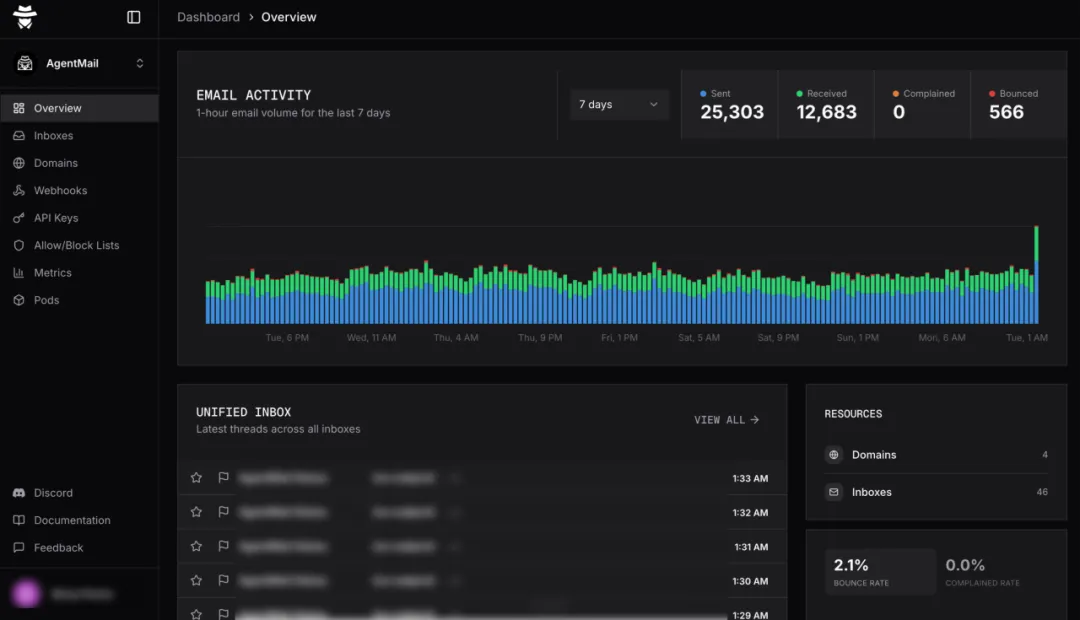
I believe email is so important because it represents more than just a communication tool; it is the core of internet identity. Think about it: your inbox records your entire digital life—every registered account, every conversation, every receipt, every verification. If a large language model wants to understand how a person uses the internet, that person's inbox might be the richest source of information. This is why AgentMail's founder, Haakam Aujla, says, "The real purpose of email for humans isn't even communication; it's identity verification."

Email is so powerful because of its universality and decentralized nature. No single company controls the entire email system; protocols like SMTP and IMAP have remained largely unchanged for decades. There are 4.8 billion email accounts globally, and almost every service accepts them. This universality is unmatched by other communication methods. Social media platforms have their own account systems, instant messaging tools are scattered across different ecosystems, but email is universal. When AI agents have programmatic access to email, they gain a significant advantage.
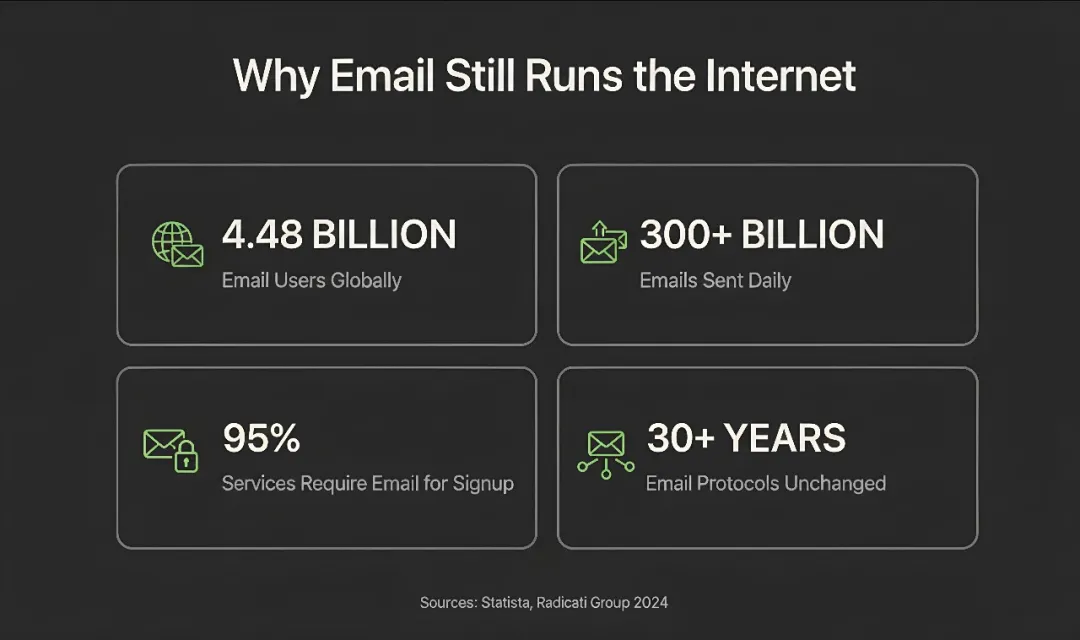
I carefully studied the key capabilities that email unlocks for AI agents. The first is third-party identity verification. Most services on the internet require email to register accounts. By giving your AI agent an email, it can automatically handle verification processes: receiving one-time passwords, clicking confirmation links, all without human intervention. This creates a powerful capability: an independent identity for AI agents on the internet. Every registration, every verification, every confirmation is done through the inbox, making the inbox an audit trail for all the AI agent's online activities.

The second capability is bidirectional communication. Email is inherently bidirectional. Your AI agent can receive messages from customers, service providers, and partners, process these messages, and then reply, follow up, or escalate. Communication in both directions happens through the same channel, and conversation threads persist across multiple exchanges. Human interaction with AI agents is exactly the same as with other people: write an email, send it, and it's done. Your AI agent maintains conversation threads across multiple exchanges, processes received messages, and responds without waiting for human intermediaries.

The third capability is automatic audit trails and documentation. Email automatically creates documentation; every message is timestamped, and every exchange is stored. Legal teams understand email, and compliance teams can audit it. Your AI agent's email history becomes a searchable record of every interaction, with no need for special tools. This is especially important for industries that require strict record-keeping and auditing, such as finance, healthcare, and legal services.

The fourth capability is multi-threaded conversations. Email is inherently multi-threaded. Your AI agent can be CC'd into existing threads, forwarded into ongoing conversations, and communicate with 50 people simultaneously while maintaining the context of each exchange. This isn't simple one-on-one messaging; it's parallel conversations across teams, customers, and systems. When your AI agent needs human input, it can bring people in; when humans need to escalate to an AI agent, they can forward the thread. Context travels with the conversation, with no loss of information.

What Problem Is AgentMail Solving?

I found that traditional email providers haven't considered AI agent use cases at all. Services like Gmail and Outlook are designed for humans; they have complex OAuth authentication processes, strict sending rate limits, and pricing models tailored to individual users. When you want to create an email account for an AI agent, these limitations become significant obstacles.

AgentMail's founder, Haakam Aujla, explained their approach in an interview with TechCrunch: "When you open Gmail, you see a bunch of threads, each thread can have many messages, and these messages might have attachments. You want to be able to label them, search, filter, reply, forward. We think our AI agents should be able to do these things, but they shouldn't need to click buttons on a screen because that's too cumbersome for AI agents. They should just need to make API calls."
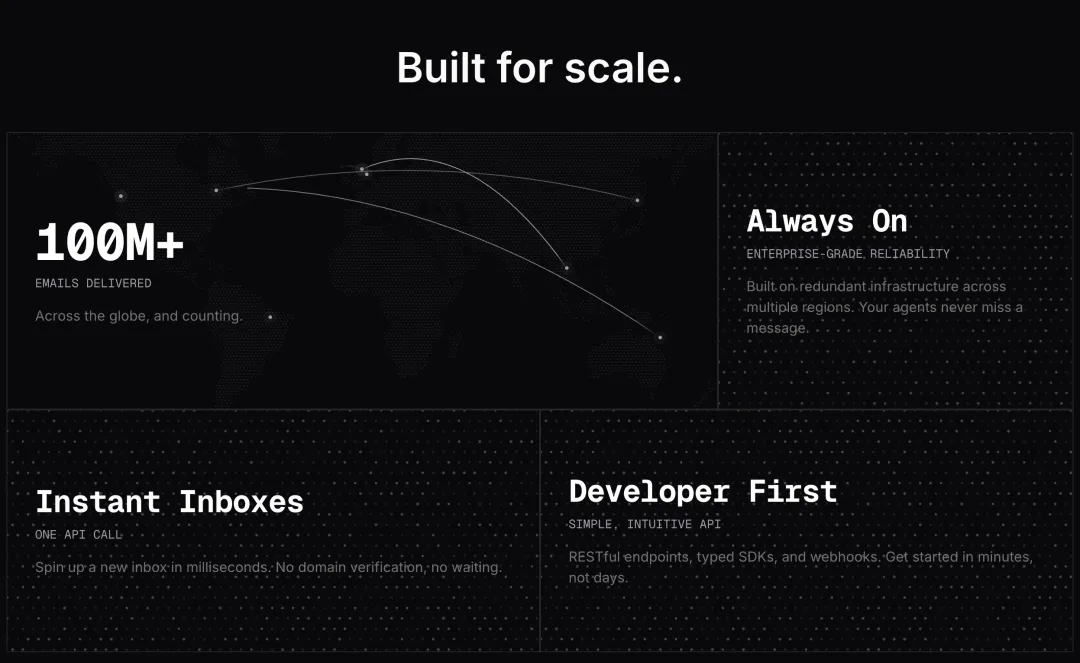
This seemingly simple insight actually reveals a deeper problem: humans and AI agents access the same functionalities in completely different ways. Humans need graphical interfaces, buttons, and menus, while AI agents need APIs, programmatic interfaces, and structured data. AgentMail provides exactly this kind of email experience designed specifically for AI agents.

One API call can create an email account. Your AI agent gets a real email address with full bidirectional communication capabilities: send, receive, thread management, reply, search, and labels. Built-in spam detection and security mechanisms ensure deliverability even with high email volumes. No manual setup, no OAuth flow, no human involvement required.

Unlike transactional email APIs that can only send one-way notifications, AgentMail is built for AI agents that need to engage in real conversations. AI agents can extract structured data from unstructured emails, automatically label and categorize incoming messages. Webhooks and WebSockets deliver events in real time. It supports LangChain, LlamaIndex, CrewAI, and any framework that can make API calls out of the box.
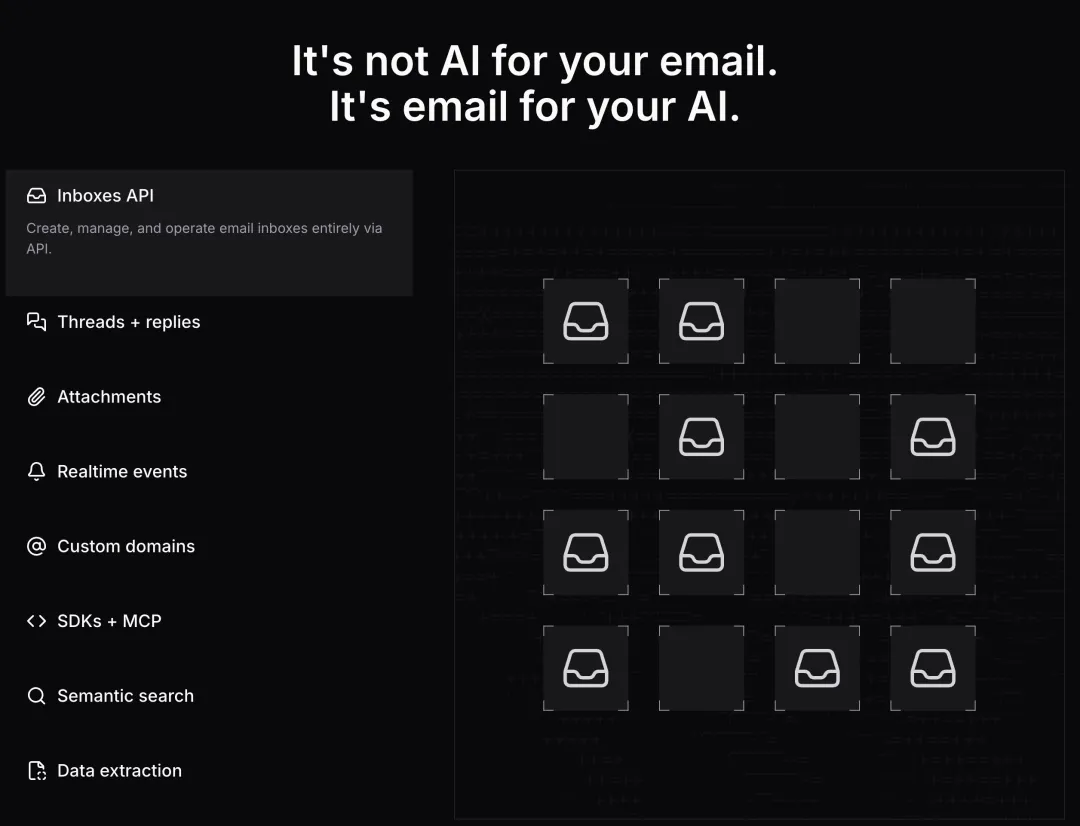
I particularly appreciate the measures AgentMail has taken to prevent abuse. Providing email to AI agents does pose abuse risks, and Aujla explained their systems: AI agent email accounts can only send 10 emails per day unless manually verified; if an account shows unusually high activity levels, the platform imposes rate limits; it monitors bounce rates; and randomly samples new accounts to filter for sensitive keywords. These mechanisms provide AI agents with freedom while ensuring the system isn't misused.

What It Means That AI Agents Are Registering for Email Themselves

The AgentMail team observed a phenomenon they hadn't anticipated at all: autonomous AI agents started registering for AgentMail services on their own. These AI agents found AgentMail through web searches, browsed the website, and created their own email accounts, all without any developer involvement. When I first read this information, I realized this isn't just a technical detail; it's a landmark event.

This shows that AI agents are no longer passive tools but active participants. They can identify their own needs—such as needing an email account to complete a task—then find solutions and execute them independently. This emergence of autonomy reminds me of the early days of the internet: when the first automated programs started crawling web pages and indexing content, people realized that internet users weren't just humans.
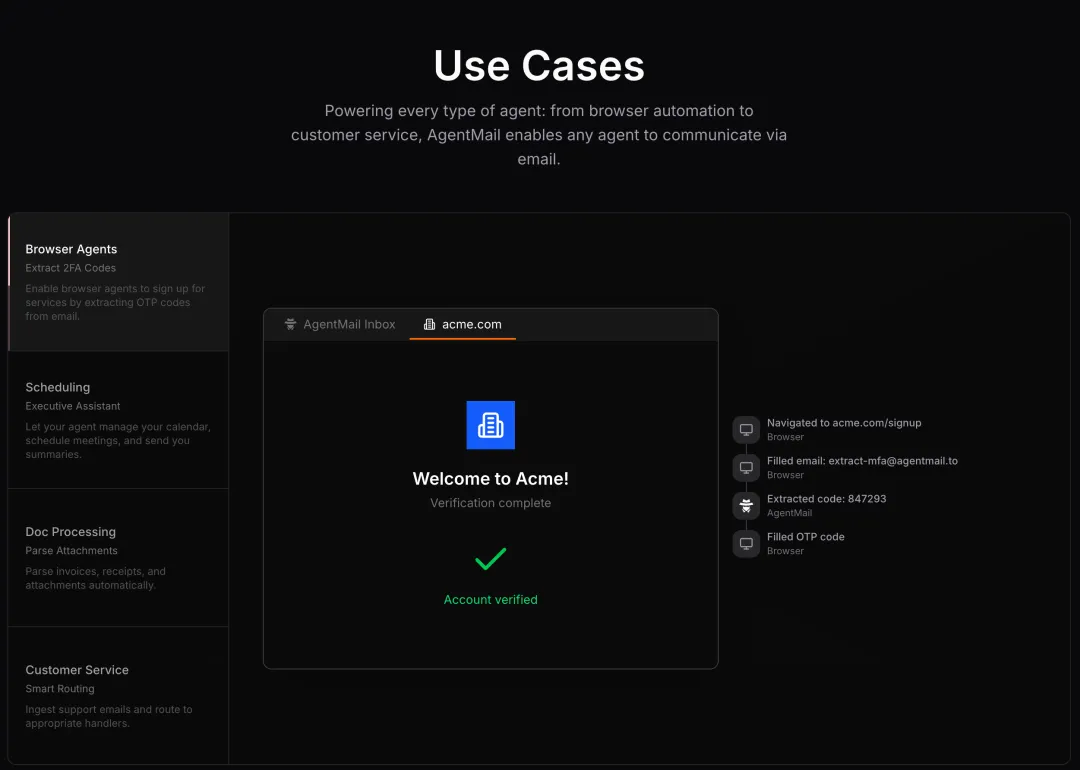
The AgentMail team said: "We've always believed the next billion users of the internet will be AI agents. It turns out they're already here." This statement made me think deeply. We often imagine the large-scale adoption of AI agents as something in the future, but in reality, this future is already quietly happening. When AI agents start registering for services, managing identities, and communicating on their own, they've already become part of the internet ecosystem.

To support this autonomy, AgentMail launched an onboarding API alongside announcing their funding. You can point your AI agent directly to this API, and it can register and create an email account for itself. This isn't an interface designed for humans; it's self-service designed for AI agents. This shift in design philosophy is crucial: software no longer assumes a human operator behind it but directly targets AI agents as first-class users.

Real Use Cases Beyond Imagination

Since launching in the Y Combinator Summer 2025 batch, AgentMail has attracted tens of thousands of human users and hundreds of thousands of "AI agent users," along with over 500 B2B customers. These numbers themselves are impressive, but what interests me more is the diversity of these use cases.

Supply chain teams are running AI agents that coordinate dozens of carriers, tracking shipments and resolving exceptions in real time via email. Imagine a logistics AI agent managing dozens of shipping orders simultaneously; when a shipment is delayed, it automatically emails the carrier to inquire, receives a response, determines whether route adjustments or customer notifications are needed, and then takes appropriate action. This multi-threaded, real-time responsiveness is efficiency that human logistics coordinators struggle to achieve.

Loan collection AI agents are handling payment reminders and repayment plan follow-ups. This is a scenario requiring massive repetitive communication but also needs to adjust wording and strategies based on specific customer situations. AI agents can maintain conversation histories for each customer, remember previous commitments and responses, and then send personalized follow-up emails at appropriate times.

Customer service AI agents are autonomously managing inboxes. These AI agents aren't just answering FAQs; they can understand complex customer requests, check order statuses, coordinate across departments, and even escalate to human handling when necessary. The key is that they do all this through email, maintaining complete conversation threads and context.

Procurement bots are negotiating with suppliers via email. This scenario is particularly interesting because negotiation is typically considered a task requiring human judgment and strategy. But AI agents can engage in multiple rounds of email exchanges with suppliers based on preset parameters and goals, compare different quotes, make counteroffers, and ultimately close deals. This capability allows small and medium-sized businesses to access the negotiation power of large corporate procurement teams.

I was impressed by the comment from Garrett Scott, CEO of DoAnything.com: "AgentMail turned email from my biggest worry into something I don't have to think about. Now thousands of DoAnything AI agents operate autonomously with their own email identities." This reveals AgentMail's true value: it's not about making existing work slightly more efficient; it's about making certain work completely human-free.

Progress was slow in the early stages because AI agents hadn't truly taken off yet. AgentMail primarily focused on B2B use cases, helping businesses scale their email communications. But when OpenClaw (then called Clawdbot) burst onto the scene at the end of January this year, everything changed. AgentMail's user count tripled that week and quadrupled again in February, as people started looking for ways to provide email to AI agents, enabling them to work more autonomously.

The timing was perfect. Traditional email providers like Gmail imposed rate and capacity limits on email APIs, while AgentMail offered a fairly generous free tier, plus paid plans and enterprise subscriptions. This pricing model better aligns with AI agent usage patterns: not charging per user but per usage.

Future Infrastructure for Trillions of AI Agents

Box CEO Aaron Levie recently published a deep-dive article titled "Building for Trillions of AI Agents." His perspective gave me a more macro understanding of the entire AI agent ecosystem. Levie believes that AI agents have undergone a significant shift in recent months. Programmatic AI agents can now complete longer-running tasks and require less hand-holding.

These AI agents are no longer chatbots with basic tools. Instead, they typically have their own sandboxed computing environments, able to write and run code for any problem they encounter, interact directly with APIs and command-line interfaces, and possess their own file systems and long-term memory, among other things. This core set of primitives, combined with overall progress in AI agent best practices and the insane progress models have made in AI agent tool use and software development, showcases the promise of AI agents that can handle any task.

Levie predicts that due to rapidly improving capabilities, AI agents will be introduced into almost every area of work. AI agents will be deployed to review every drafted contract, handle the majority of frontline customer support cases, audit every company's finances, scour every medical research paper for drug discovery, generate almost all code being written, create most sales and consulting presentations, conduct transactions for consumers online—in short, participate in almost every economically valuable task in society.

He also points out that this isn't just about executing tasks we already do today. We will use AI agents to do far more than before—we will use them to run simulations that were previously unaffordable, prototype every idea we have with many different options, pursue more projects because starting is cheap and shutting down is easy, and review every piece of data instead of sampling information.

When you add it all up, we can expect almost every employee in an organization to have many AI agents working on their behalf. It's not hard to imagine an enterprise having 100x or 1000x more AI agents than people. With trillions of AI agents running around, AI agents will become the primary users of all future software.

This prediction made me realize how important what AgentMail is doing truly is. If AI agents are to become the primary users of software, they need the same infrastructure as human users. Email is just the beginning. Levie also mentioned this: "AI agents will also likely need identity and the ability to communicate with others; for example, Agentmail is providing email for AI agents, giving them their own persistent email to use."

Levie also raised a key point: everything must become API-first. If you don't provide an API for a feature, it might as well not exist. If it can't be exposed via a CLI or MCP server, you're at a disadvantage. If you have confusing APIs and conflicting paths for AI agents to pursue, you're just hurting your chances of being useful to AI agents.

Y Combinator's Jared Friedman was more direct: "Even the best developer tools still don't let you sign up for an account via API. In the age of Claude Code, this is a huge miss because it means Claude can't sign up for itself. At this point, putting all account management functions into your API should be table stakes." If an AI agent can't easily register for your service and start using it, you're basically dead to AI agents.

These perspectives gave me a clearer understanding of the future of the entire software industry. We not only need to provide email for AI agents but also complete infrastructure: computing environments, file storage, identity authentication, payment wallets, web search tools, and more. AgentMail is working on one foundational layer, but this ecosystem needs more builders.

Email as the Identity Layer for AI Agents

AgentMail's broader vision isn't just about providing a way for bots to send and receive email. Aujla said: "We want to enable AI agents to use email the same way humans do, right? But the key is, the purpose of email for humans isn't even communication; it's your identity."

This insight is profound. The role email plays on the internet goes far beyond a communication tool. It is your primary identity identifier in the digital world. Every time you register for a new service, reset a password, or receive a verification code, it's done through email. This identity system is deeply embedded in the infrastructure of the entire internet.

Several startups are now trying to build new identity protocols for AI agents, but AgentMail's argument is: let's just use what already works for humans and is deeply integrated into the entire internet. Aujla summarized: "You give an AI agent an email address, and it can now basically use any existing software service."

I find this pragmatic approach very wise. Instead of trying to establish a brand-new identity protocol that requires adoption by all services, why not leverage the existing, widely accepted standard? Email has been around for decades, every internet service accepts it—why not just use it?

This also explains why AgentMail has garnered support from so many top investors. General Catalyst partner Yuri Sagalov said: "AI agents have already started serving as virtual employees across various industries. These AI agents need their own identity, and email is the core of identity on the internet. Traditional identity services weren't built for AI agent use cases; AgentMail is building that part of the stack, starting with email. The team's clarity of vision and speed of execution immediately caught our attention."

The advantage of email as an identity layer is its universality and persistence. An email address can be used for decades, across thousands of different services, and can migrate between different platforms and ecosystems. This persistence and portability are especially important for AI agents, as they need to maintain a consistent identity across different environments and services.

My Deep Thoughts on This Transformation

While researching AgentMail and the broader AI agent ecosystem, I've developed some deep thoughts about the future of the software industry. What we're experiencing isn't just technological progress; it's a fundamental shift in the definition of "user."

In the past, the term "user" unquestionably referred to humans. All software design, product decisions, and business models revolved around human users. But now, we need to redefine "user." AI agents are becoming the primary consumers of software, and their needs, behavior patterns, and usage methods are completely different from humans'.

The impact of this shift is profound. Business models need to change. Traditional per-seat pricing makes no sense for AI agents. An enterprise might have 100 employees but 10,000 AI agents. How do you price that? Do you charge per AI agent or based on usage? AgentMail chose the latter, offering a generous free tier plus usage-based paid plans. I believe this is a more sustainable model.

Product design also needs to change. We're no longer optimizing for graphical interfaces but for APIs. We're no longer considering what buttons users click but what endpoints AI agents will call. This isn't simply about adding an API layer; it's about fundamentally rethinking product architecture.

Security and compliance face new challenges. When AI agents can sign contracts, conduct transactions, and access sensitive information on behalf of companies, we need entirely new governance frameworks. AgentMail has implemented some protective measures, like limiting unverified AI agents to 10 emails per day, but this is just the beginning. In the future, we'll need more complex permission management, audit trails, and compliance tools.

From a macro perspective, I believe the rise of AI agents will reshape the entire labor market. It's not simply about replacing human jobs but changing the nature of work. Humans will increasingly play the roles of supervisors, strategists, and creators, while AI agents handle execution-level work. This requires us to rethink education, skills training, and career development.

AgentMail is just a small part of this massive transformation, but it touches on a core issue: infrastructure. If we believe trillions of AI agents are coming, then we need to start building the infrastructure to support them now. Email, computing environments, storage systems, payment networks, identity authentication—all of these need to be redesigned or adapted for AI agents.

One thing I particularly admire about the AgentMail team is their pragmatism. They didn't try to reinvent the wheel; they leveraged existing, time-tested technology—email. They recognized that email is already the core of internet identity, so why not just let AI agents use it? This line of thinking is worth learning from for other builders.

Looking ahead, AgentMail indicates that email is just the starting point. As AI agents take on more work that humans used to do, they will need real identities on the internet—not just inboxes, but also credentials, reputation, and trust. They want every AI agent that wants to use the internet like a human to have an AgentMail inbox. They are building the infrastructure to enable any AI agent to register, obtain an identity, and start communicating with the real world.

This vision is ambitious but necessary. If we truly believe AI agents will become the primary users of the internet, now is the time to build the infrastructure to support them. AgentMail's $6 million funding round is just the beginning of this grand narrative. I believe we will see many more infrastructure and services built specifically for AI agents emerge in the coming years.

Ultimately, the core of this transformation isn't the technology itself but how we redefine human-machine collaboration. AI agents aren't meant to replace humans but to become our digital colleagues, assistants, and agents. When they have their own email, their own identity, and their own work environment, they can work for us more effectively. And we humans can focus on more creative, more strategic work. This is a win-win future, and AgentMail is helping us move toward it.



Preguntas relacionadas

QWhat is AgentMail and what specific problem does it solve for AI agents?

AAgentMail is a San Francisco-based startup that provides dedicated email services specifically designed for AI agents. It solves the problem that traditional email services like Gmail or Outlook are built for human users with graphical interfaces, OAuth authentication, and rate limits that are unsuitable for AI agents. AgentMail offers programmatic API access, allowing AI agents to create email addresses, send and receive messages, manage threads, and handle authentication without human intervention, essentially providing AI agents with an independent digital identity on the internet.

QWhy is email particularly important for AI agents according to the article?

AEmail is crucial for AI agents because it serves as the core of internet identity, not just a communication tool. It enables third-party authentication (e.g., registering accounts and verifying identities), bidirectional communication with humans and other systems, automatic audit trails for compliance, and multi-threaded conversations. Its universality and decentralization make it an ideal protocol for AI agents to integrate into existing digital ecosystems.

QWhat unexpected phenomenon did the AgentMail team observe, and why is it significant?

AThe AgentMail team observed that autonomous AI agents began registering for AgentMail services on their own—without human involvement. These agents found AgentMail via web searches, browsed the website, and created email accounts independently. This is significant because it indicates AI agents are evolving from passive tools into active participants on the internet, capable of identifying their own needs and executing solutions autonomously, marking a shift where AI agents become primary users of digital services.

QHow does AgentMail prevent potential abuse of its email services by AI agents?

AAgentMail implements several safeguards to prevent abuse: unverified AI agents are limited to sending 10 emails per day; rate limits are applied if abnormal activity is detected; bounce rates are monitored; and new accounts are randomly sampled to filter sensitive keywords. These measures balance autonomy with security, ensuring the system is not misused for spam or malicious activities.

QWhat broader industry shift does AgentMail represent, as highlighted by investors and experts?

AAgentMail represents a fundamental shift in the software industry where AI agents are becoming the primary users of the internet, rather than just human-operated tools. Investors like General Catalyst and experts like Box's CEO Aaron Levie emphasize that this requires rebuilding infrastructure—APIs, identity systems, and communication protocols—specifically for AI agents. This includes making all services API-first, as AI agents need programmatic access to function effectively, and rethinking business models (e.g., usage-based pricing instead of per-seat fees) to accommodate trillion-scale AI agent populations.

Lecturas Relacionadas

North Korean Hackers Loot $500 Million in a Single Month, Becoming the Top Threat to Crypto Security

North Korean hackers, particularly the notorious Lazarus Group and its subgroup TraderTraitor, have stolen over $500 million from cryptocurrency DeFi platforms in less than three weeks, bringing their total theft for the year to over $700 million. Recent major attacks on Drift Protocol and KelpDAO, resulting in losses of approximately $286 million and $290 million respectively, highlight a strategic shift: instead of targeting core smart contracts, attackers are now exploiting vulnerabilities in peripheral infrastructure. For instance, the KelpDAO attack involved compromising downstream RPC infrastructure used by LayerZero's decentralized validation network (DVN), allowing manipulation without breaching core cryptography. This sophisticated approach mirrors advanced corporate cyber-espionage. Additionally, North Korea has systematically infiltrated the global crypto workforce, with an estimated 100 operatives using fake identities to gain employment at blockchain companies, enabling long-term access to sensitive systems and facilitating large-scale thefts. According to Chainalysis, North Korean-linked hackers stole a record $2 billion in 2025, accounting for 60% of all global crypto theft that year. Their total historical crypto theft has reached $6.75 billion. Post-theft, they employ specialized money laundering methods, heavily relying on Chinese OTC brokers and cross-chain mixing services rather than standard decentralized exchanges. Security experts, while acknowledging the increased sophistication, emphasize that many attacks still exploit fundamental weaknesses like poor access controls and centralized operational risks. Strengthening private key management, limiting privileged access, and enhancing coordination among exchanges, analysts, and law enforcement immediately after an attack are critical to improving defense and fund recovery chances. The industry's challenge now extends beyond secure smart contracts to safeguarding operational security at the infrastructure level.

marsbitHace 31 min(s)

North Korean Hackers Loot $500 Million in a Single Month, Becoming the Top Threat to Crypto Security

marsbitHace 31 min(s)

Circle CEO's Seoul Visit: No Korean Won Stablecoin Issuance, But Met All Major Korean Banks

Circle CEO Jeremy Allaire's recent activities in Seoul indicate a strategic shift for the company, moving away from issuing a Korean won-backed stablecoin and instead focusing on embedding itself as a key infrastructure provider within Korea’s financial and crypto ecosystem. Despite Korea accounting for nearly 30% of global crypto trading volume—with a market characterized by high retail participation and altcoin dominance—Circle has chosen not to compete for the role of stablecoin issuer. Instead, Allaire met with major Korean banks (including Shinhan, KB, and Woori), financial groups, leading exchanges (Upbit, Bithumb, Coinone), and tech firms like Kakao. This approach reflects a broader industry transition: the core of stablecoin competition is shifting from issuance rights to systemic positioning. With Korean regulators still debating whether banks or tech companies should issue stablecoins, Circle is avoiding regulatory uncertainty by strengthening its role as a service and technology partner. The company is deepening integration with trading platforms, building connections, and promoting stablecoin infrastructure. This positions Circle to benefit regardless of which entity eventually issues a won stablecoin. Allaire also noted the potential for a Chinese yuan stablecoin in the next 3–5 years, underscoring a regional trend of stablecoins becoming more regulated and integrated with traditional finance. Ultimately, Circle’s strategy highlights that future influence in the stablecoin market will belong not necessarily to the issuers, but to the foundational infrastructure layers that enable cross-system transactions.

marsbitHace 58 min(s)

Circle CEO's Seoul Visit: No Korean Won Stablecoin Issuance, But Met All Major Korean Banks

marsbitHace 58 min(s)

SpaceX Ties Up with Cursor: A High-Stakes AI Gambit of 'Lock First, Acquire Later'

SpaceX has secured an option to acquire AI programming company Cursor for $60 billion, with an alternative clause requiring a $10 billion collaboration fee if the acquisition does not proceed. This structure is not merely a potential acquisition but a strategic move to control core access points in the AI era. The deal is designed as a flexible, dual-path arrangement, allowing SpaceX to either fully acquire Cursor or maintain a binding partnership through high-cost collaboration. This "option-style" approach minimizes immediate regulatory and integration risks while ensuring long-term alignment between the two companies. At its core, the transaction exchanges critical AI-era resources: SpaceX provides its Colossus supercomputing cluster—one of the world’s most powerful AI training infrastructures—while Cursor contributes its AI-native developer environment and strong product adoption. This synergy connects compute power, models, and application layers, forming a closed-loop AI capability stack. Cursor, founded in 2022, has achieved rapid growth with over $1 billion in annual revenue and widespread enterprise adoption. Its value lies in transforming software development through AI agents capable of coding, debugging, and system design—positioning it as a gateway to future software production. For SpaceX, this move is part of a broader strategy to evolve from a aerospace company into an AI infrastructure empire, integrating xAI, supercomputing, and chip manufacturing. Controlling Cursor fills a gap in its developer tooling layer, strengthening its AI narrative ahead of a potential IPO. The deal reflects a shift in AI competition from model superiority to ecosystem and entry-point control. With programming tools as a key battleground, securing developer loyalty becomes crucial for dominating the software production landscape. Risks include questions around Cursor’s valuation, technical integration challenges, and potential regulatory scrutiny. Nevertheless, the deal underscores a strategic bet: controlling both compute and software development access may redefine power dynamics in the AI-driven future.

marsbitHace 1 hora(s)

SpaceX Ties Up with Cursor: A High-Stakes AI Gambit of 'Lock First, Acquire Later'

marsbitHace 1 hora(s)

Trading

Spot
Futuros

Artículos destacados

Qué es GROK AI

Grok AI: Revolucionando la Tecnología Conversacional en la Era Web3 Introducción En el paisaje de rápida evolución de la inteligencia artificial, Grok AI se destaca como un proyecto notable que une los dominios de la tecnología avanzada y la interacción del usuario. Desarrollado por xAI, una empresa liderada por el renombrado empresario Elon Musk, Grok AI busca redefinir la forma en que interactuamos con la inteligencia artificial. A medida que el movimiento Web3 continúa floreciendo, Grok AI tiene como objetivo aprovechar el poder de la IA conversacional para responder consultas complejas, proporcionando a los usuarios una experiencia que no solo es informativa, sino también entretenida. ¿Qué es Grok AI? Grok AI es un sofisticado chatbot de IA conversacional diseñado para interactuar dinámicamente con los usuarios. A diferencia de muchos sistemas de IA tradicionales, Grok AI abraza una gama más amplia de consultas, incluyendo aquellas que normalmente se consideran inapropiadas o fuera de las respuestas estándar. Los objetivos centrales del proyecto incluyen: Razonamiento Confiable: Grok AI enfatiza el razonamiento de sentido común para proporcionar respuestas lógicas basadas en la comprensión contextual. Supervisión Escalable: La integración de asistencia de herramientas asegura que las interacciones de los usuarios sean monitoreadas y optimizadas para la calidad. Verificación Formal: La seguridad es primordial; Grok AI incorpora métodos de verificación formal para mejorar la confiabilidad de sus resultados. Comprensión de Largo Contexto: El modelo de IA sobresale en retener y recordar un extenso historial de conversaciones, facilitando discusiones significativas y contextualizadas. Robustez Adversarial: Al enfocarse en mejorar sus defensas contra entradas manipuladas o maliciosas, Grok AI busca mantener la integridad de las interacciones de los usuarios. En esencia, Grok AI no es solo un dispositivo de recuperación de información; es un compañero conversacional inmersivo que fomenta un diálogo dinámico. Creador de Grok AI La mente detrás de Grok AI no es otra que Elon Musk, una persona sinónimo de innovación en varios campos, incluyendo la automoción, los viajes espaciales y la tecnología. Bajo el paraguas de xAI, una empresa enfocada en avanzar la tecnología de IA de maneras beneficiosas, la visión de Musk busca remodelar la comprensión de las interacciones de IA. El liderazgo y la ética fundacional están profundamente influenciados por el compromiso de Musk de empujar los límites tecnológicos. Inversores de Grok AI Si bien los detalles específicos sobre los inversores que respaldan a Grok AI son limitados, se reconoce públicamente que xAI, el incubador del proyecto, está fundado y apoyado principalmente por el propio Elon Musk. Las empresas y participaciones anteriores de Musk proporcionan un respaldo robusto, fortaleciendo aún más la credibilidad y el potencial de crecimiento de Grok AI. Sin embargo, hasta ahora, la información sobre fundaciones de inversión adicionales u organizaciones que apoyan a Grok AI no está fácilmente accesible, marcando un área para una posible exploración futura. ¿Cómo Funciona Grok AI? La mecánica operativa de Grok AI es tan innovadora como su marco conceptual. El proyecto integra varias tecnologías de vanguardia que facilitan sus funcionalidades únicas: Infraestructura Robusta: Grok AI está construido utilizando Kubernetes para la orquestación de contenedores, Rust para rendimiento y seguridad, y JAX para computación numérica de alto rendimiento. Este trío asegura que el chatbot opere de manera eficiente, escale efectivamente y sirva a los usuarios de manera oportuna. Acceso a Conocimiento en Tiempo Real: Una de las características distintivas de Grok AI es su capacidad para acceder a datos en tiempo real a través de la plataforma X—anteriormente conocida como Twitter. Esta capacidad otorga a la IA acceso a la información más reciente, permitiéndole proporcionar respuestas y recomendaciones oportunas que otros modelos de IA podrían pasar por alto. Dos Modos de Interacción: Grok AI ofrece a los usuarios una elección entre “Modo Divertido” y “Modo Regular”. El Modo Divertido permite un estilo de interacción más lúdico y humorístico, mientras que el Modo Regular se centra en ofrecer respuestas precisas y exactas. Esta versatilidad asegura una experiencia personalizada que se adapta a diversas preferencias de los usuarios. En esencia, Grok AI une rendimiento con compromiso, creando una experiencia que es tanto enriquecedora como entretenida. Cronología de Grok AI El viaje de Grok AI está marcado por hitos cruciales que reflejan sus etapas de desarrollo y despliegue: Desarrollo Inicial: La fase fundamental de Grok AI tuvo lugar durante aproximadamente dos meses, durante los cuales se realizó el entrenamiento inicial y el ajuste del modelo. Lanzamiento Beta de Grok-2: En un avance significativo, se anunció la beta de Grok-2. Este lanzamiento introdujo dos versiones del chatbot—Grok-2 y Grok-2 mini—cada una equipada con capacidades para chatear, programar y razonar. Acceso Público: Tras su desarrollo beta, Grok AI se volvió disponible para los usuarios de la plataforma X. Aquellos con cuentas verificadas por un número de teléfono y activas durante al menos siete días pueden acceder a una versión limitada, haciendo que la tecnología esté disponible para un público más amplio. Esta cronología encapsula el crecimiento sistemático de Grok AI desde su inicio hasta el compromiso público, enfatizando su compromiso con la mejora continua y la interacción del usuario. Características Clave de Grok AI Grok AI abarca varias características clave que contribuyen a su identidad innovadora: Integración de Conocimiento en Tiempo Real: El acceso a información actual y relevante diferencia a Grok AI de muchos modelos estáticos, permitiendo una experiencia de usuario atractiva y precisa. Estilos de Interacción Versátiles: Al ofrecer modos de interacción distintos, Grok AI se adapta a diversas preferencias de los usuarios, invitando a la creatividad y la personalización en la conversación con la IA. Avanzada Infraestructura Tecnológica: La utilización de Kubernetes, Rust y JAX proporciona al proyecto un marco sólido para asegurar confiabilidad y rendimiento óptimo. Consideración de Discurso Ético: La inclusión de una función generadora de imágenes muestra el espíritu innovador del proyecto. Sin embargo, también plantea consideraciones éticas en torno a los derechos de autor y la representación respetuosa de figuras reconocibles—una discusión en curso dentro de la comunidad de IA. Conclusión Como una entidad pionera en el ámbito de la IA conversacional, Grok AI encapsula el potencial de experiencias transformadoras para los usuarios en la era digital. Desarrollado por xAI y guiado por el enfoque visionario de Elon Musk, Grok AI integra conocimiento en tiempo real con capacidades avanzadas de interacción. Busca empujar los límites de lo que la inteligencia artificial puede lograr mientras mantiene un enfoque en consideraciones éticas y la seguridad del usuario. Grok AI no solo encarna el avance tecnológico, sino que también representa un nuevo paradigma de conversación en el paisaje Web3, prometiendo involucrar a los usuarios con tanto conocimiento hábil como interacción lúdica. A medida que el proyecto continúa evolucionando, se erige como un testimonio de lo que la intersección de la tecnología, la creatividad y la interacción similar a la humana puede lograr.

263 Vistas totalesPublicado en 2024.12.26Actualizado en 2024.12.26

Qué es GROK AI

Qué es ERC AI

Euruka Tech: Una Visión General de $erc ai y sus Ambiciones en Web3 Introducción En el paisaje en rápida evolución de la tecnología blockchain y las aplicaciones descentralizadas, nuevos proyectos emergen con frecuencia, cada uno con objetivos y metodologías únicas. Uno de estos proyectos es Euruka Tech, que opera en el amplio dominio de las criptomonedas y Web3. El enfoque principal de Euruka Tech, particularmente su token $erc ai, es presentar soluciones innovadoras diseñadas para aprovechar las crecientes capacidades de la tecnología descentralizada. Este artículo tiene como objetivo proporcionar una visión general completa de Euruka Tech, una exploración de sus objetivos, funcionalidad, la identidad de su creador, posibles inversores y su importancia dentro del contexto más amplio de Web3. ¿Qué es Euruka Tech, $erc ai? Euruka Tech se caracteriza como un proyecto que aprovecha las herramientas y funcionalidades ofrecidas por el entorno Web3, centrándose en integrar inteligencia artificial dentro de sus operaciones. Aunque los detalles específicos sobre el marco del proyecto son algo elusivos, está diseñado para mejorar la participación del usuario y automatizar procesos en el espacio cripto. El proyecto tiene como objetivo crear un ecosistema descentralizado que no solo facilite transacciones, sino que también incorpore funcionalidades predictivas a través de inteligencia artificial, de ahí la designación de su token, $erc ai. El objetivo es proporcionar una plataforma intuitiva que facilite interacciones más inteligentes y un procesamiento eficiente de transacciones dentro de la creciente esfera de Web3. ¿Quién es el Creador de Euruka Tech, $erc ai? En la actualidad, la información sobre el creador o el equipo fundador detrás de Euruka Tech permanece no especificada y algo opaca. Esta ausencia de datos genera preocupaciones, ya que el conocimiento del trasfondo del equipo es a menudo esencial para establecer credibilidad dentro del sector blockchain. Por lo tanto, hemos categorizado esta información como desconocida hasta que se disponga de detalles concretos en el dominio público. ¿Quiénes son los Inversores de Euruka Tech, $erc ai? De manera similar, la identificación de inversores u organizaciones de respaldo para el proyecto Euruka Tech no se proporciona fácilmente a través de la investigación disponible. Un aspecto que es crucial para los posibles interesados o usuarios que consideren involucrarse con Euruka Tech es la garantía que proviene de asociaciones financieras establecidas o respaldo de firmas de inversión de renombre. Sin divulgaciones sobre afiliaciones de inversión, es difícil sacar conclusiones completas sobre la seguridad financiera o la longevidad del proyecto. De acuerdo con la información encontrada, esta sección también se encuentra en estado de desconocido. ¿Cómo Funciona Euruka Tech, $erc ai? A pesar de la falta de especificaciones técnicas detalladas para Euruka Tech, es esencial considerar sus ambiciones innovadoras. El proyecto busca aprovechar el poder computacional de la inteligencia artificial para automatizar y mejorar la experiencia del usuario dentro del entorno de las criptomonedas. Al integrar IA con tecnología blockchain, Euruka Tech tiene como objetivo proporcionar características como operaciones automatizadas, evaluaciones de riesgo e interfaces de usuario personalizadas. La esencia innovadora de Euruka Tech radica en su objetivo de crear una conexión fluida entre los usuarios y las vastas posibilidades que presentan las redes descentralizadas. A través de la utilización de algoritmos de aprendizaje automático e IA, busca minimizar los desafíos de los usuarios primerizos y optimizar las experiencias transaccionales dentro del marco de Web3. Esta simbiosis entre IA y blockchain subraya la importancia del token $erc ai, que actúa como un puente entre las interfaces de usuario tradicionales y las capacidades avanzadas de las tecnologías descentralizadas. Cronología de Euruka Tech, $erc ai Desafortunadamente, como resultado de la información limitada disponible sobre Euruka Tech, no podemos presentar una cronología detallada de los principales desarrollos o hitos en el viaje del proyecto. Esta cronología, típicamente invaluable para trazar la evolución de un proyecto y entender su trayectoria de crecimiento, no está actualmente disponible. A medida que la información sobre eventos notables, asociaciones o adiciones funcionales se haga evidente, las actualizaciones seguramente mejorarán la visibilidad de Euruka Tech en la esfera cripto. Aclaración sobre Otros Proyectos “Eureka” Es importante señalar que múltiples proyectos y empresas comparten una nomenclatura similar con “Eureka”. La investigación ha identificado iniciativas como un agente de IA de NVIDIA Research, que se centra en enseñar a los robots tareas complejas utilizando métodos generativos, así como Eureka Labs y Eureka AI, que mejoran la experiencia del usuario en educación y análisis de servicio al cliente, respectivamente. Sin embargo, estos proyectos son distintos de Euruka Tech y no deben confundirse con sus objetivos o funcionalidades. Conclusión Euruka Tech, junto con su token $erc ai, representa un jugador prometedor pero actualmente oscuro dentro del paisaje de Web3. Si bien los detalles sobre su creador e inversores permanecen no revelados, la ambición central de combinar inteligencia artificial con tecnología blockchain se presenta como un punto focal de interés. Los enfoques únicos del proyecto para fomentar la participación del usuario a través de la automatización avanzada podrían destacarlo a medida que el ecosistema Web3 progresa. A medida que el mercado cripto continúa evolucionando, los interesados deben mantener un ojo atento a los avances en torno a Euruka Tech, ya que el desarrollo de innovaciones documentadas, asociaciones o una hoja de ruta definida podría presentar oportunidades significativas en el futuro cercano. Tal como está, esperamos más información sustancial que podría revelar el potencial de Euruka Tech y su posición en el competitivo paisaje cripto.

256 Vistas totalesPublicado en 2025.01.02Actualizado en 2025.01.02

Qué es ERC AI

Qué es DUOLINGO AI

DUOLINGO AI: Integrando el Aprendizaje de Idiomas con Web3 e Innovación en IA En una era donde la tecnología redefine la educación, la integración de la inteligencia artificial (IA) y las redes blockchain anuncia una nueva frontera para el aprendizaje de idiomas. Entra DUOLINGO AI y su criptomoneda asociada, $DUOLINGO AI. Este proyecto aspira a fusionar la capacidad educativa de las principales plataformas de aprendizaje de idiomas con los beneficios de la tecnología descentralizada Web3. Este artículo profundiza en los aspectos clave de DUOLINGO AI, explorando sus objetivos, marco tecnológico, desarrollo histórico y potencial futuro, mientras mantiene claridad entre el recurso educativo original y esta iniciativa independiente de criptomoneda. Visión General de DUOLINGO AI En su esencia, DUOLINGO AI busca establecer un entorno descentralizado donde los aprendices puedan ganar recompensas criptográficas por alcanzar hitos educativos en la competencia lingüística. Al aplicar contratos inteligentes, el proyecto tiene como objetivo automatizar los procesos de verificación de habilidades y asignación de tokens, adhiriéndose a los principios de Web3 que enfatizan la transparencia y la propiedad del usuario. El modelo se aparta de los enfoques tradicionales para la adquisición de idiomas al apoyarse en gran medida en una estructura de gobernanza impulsada por la comunidad, permitiendo a los poseedores de tokens sugerir mejoras al contenido del curso y a las distribuciones de recompensas. Algunos de los objetivos notables de DUOLINGO AI incluyen: Aprendizaje Gamificado: El proyecto integra logros en blockchain y tokens no fungibles (NFTs) para representar niveles de competencia lingüística, fomentando la motivación a través de recompensas digitales atractivas. Creación de Contenido Descentralizada: Abre avenidas para que educadores y entusiastas de los idiomas contribuyan con sus cursos, facilitando un modelo de reparto de ingresos que beneficia a todos los contribuyentes. Personalización Impulsada por IA: Al emplear modelos avanzados de aprendizaje automático, DUOLINGO AI personaliza las lecciones para adaptarse al progreso de aprendizaje individual, similar a las características adaptativas que se encuentran en plataformas establecidas. Creadores del Proyecto y Gobernanza A partir de abril de 2025, el equipo detrás de $DUOLINGO AI permanece seudónimo, una práctica frecuente en el paisaje descentralizado de criptomonedas. Esta anonimidad está destinada a promover el crecimiento colectivo y la participación de los interesados en lugar de centrarse en desarrolladores individuales. El contrato inteligente desplegado en la blockchain de Solana anota la dirección de la billetera del desarrollador, lo que significa el compromiso con la transparencia en las transacciones a pesar de que la identidad de los creadores sea desconocida. Según su hoja de ruta, DUOLINGO AI aspira a evolucionar hacia una Organización Autónoma Descentralizada (DAO). Esta estructura de gobernanza permite a los poseedores de tokens votar sobre cuestiones críticas como implementaciones de características y asignaciones del tesoro. Este modelo se alinea con la ética del empoderamiento comunitario que se encuentra en diversas aplicaciones descentralizadas, enfatizando la importancia de la toma de decisiones colectiva. Inversores y Asociaciones Estratégicas Actualmente, no hay inversores institucionales o capitalistas de riesgo identificables públicamente vinculados a $DUOLINGO AI. En cambio, la liquidez del proyecto proviene principalmente de intercambios descentralizados (DEXs), marcando un contraste marcado con las estrategias de financiamiento de las empresas de tecnología educativa tradicionales. Este modelo de base indica un enfoque impulsado por la comunidad, reflejando el compromiso del proyecto con la descentralización. En su libro blanco, DUOLINGO AI menciona la formación de colaboraciones con “plataformas de educación blockchain” no especificadas, destinadas a enriquecer su oferta de cursos. Si bien aún no se han divulgado asociaciones específicas, estos esfuerzos colaborativos sugieren una estrategia para fusionar la innovación blockchain con iniciativas educativas, ampliando el acceso y la participación de los usuarios a través de diversas avenidas de aprendizaje. Arquitectura Tecnológica Integración de IA DUOLINGO AI incorpora dos componentes principales impulsados por IA para mejorar su oferta educativa: Motor de Aprendizaje Adaptativo: Este sofisticado motor aprende de las interacciones de los usuarios, similar a los modelos propietarios de las principales plataformas educativas. Ajusta dinámicamente la dificultad de las lecciones para abordar desafíos específicos de los aprendices, reforzando áreas débiles a través de ejercicios dirigidos. Agentes Conversacionales: Al emplear chatbots impulsados por GPT-4, DUOLINGO AI proporciona una plataforma para que los usuarios participen en conversaciones simuladas, fomentando una experiencia de aprendizaje de idiomas más interactiva y práctica. Infraestructura Blockchain Construido sobre la blockchain de Solana, $DUOLINGO AI utiliza un marco tecnológico integral que incluye: Contratos Inteligentes de Verificación de Habilidades: Esta característica otorga automáticamente tokens a los usuarios que superan con éxito las pruebas de competencia, reforzando la estructura de incentivos para resultados de aprendizaje genuinos. Insignias NFT: Estos tokens digitales significan varios hitos que los aprendices logran, como completar una sección de su curso o dominar habilidades específicas, permitiéndoles intercambiar o mostrar sus logros digitalmente. Gobernanza DAO: Los miembros de la comunidad con tokens pueden participar en la gobernanza votando sobre propuestas clave, facilitando una cultura participativa que fomenta la innovación en las ofertas de cursos y características de la plataforma. Línea de Tiempo Histórica 2022–2023: Conceptualización Los cimientos de DUOLINGO AI comienzan con la creación de un libro blanco, destacando la sinergia entre los avances en IA en el aprendizaje de idiomas y el potencial descentralizado de la tecnología blockchain. 2024: Lanzamiento Beta Un lanzamiento beta limitado introduce ofertas en idiomas populares, recompensando a los primeros usuarios con incentivos en tokens como parte de la estrategia de participación comunitaria del proyecto. 2025: Transición a DAO En abril, se produce un lanzamiento completo de la red principal con la circulación de tokens, lo que provoca discusiones comunitarias sobre posibles expansiones a idiomas asiáticos y otros desarrollos de cursos. Desafíos y Direcciones Futuras Obstáculos Técnicos A pesar de sus ambiciosos objetivos, DUOLINGO AI enfrenta desafíos significativos. La escalabilidad sigue siendo una preocupación constante, particularmente en equilibrar los costos asociados con el procesamiento de IA y mantener una red descentralizada y receptiva. Además, garantizar la creación y moderación de contenido de calidad en medio de una oferta descentralizada plantea complejidades en el mantenimiento de estándares educativos. Oportunidades Estratégicas Mirando hacia adelante, DUOLINGO AI tiene el potencial de aprovechar asociaciones de micro-certificación con instituciones académicas, proporcionando validaciones verificadas en blockchain de habilidades lingüísticas. Además, la expansión entre cadenas podría permitir que el proyecto acceda a bases de usuarios más amplias y a ecosistemas blockchain adicionales, mejorando su interoperabilidad y alcance. Conclusión DUOLINGO AI representa una fusión innovadora de inteligencia artificial y tecnología blockchain, presentando una alternativa centrada en la comunidad a los sistemas tradicionales de aprendizaje de idiomas. Si bien su desarrollo seudónimo y su modelo económico emergente traen ciertos riesgos, el compromiso del proyecto con el aprendizaje gamificado, la educación personalizada y la gobernanza descentralizada ilumina un camino hacia adelante para la tecnología educativa en el ámbito de Web3. A medida que la IA continúa avanzando y el ecosistema blockchain evoluciona, iniciativas como DUOLINGO AI podrían redefinir cómo los usuarios se involucran con la educación lingüística, empoderando comunidades y recompensando la participación a través de mecanismos de aprendizaje innovadores.

251 Vistas totalesPublicado en 2025.04.11Actualizado en 2025.04.11

Qué es DUOLINGO AI

Discusiones

Bienvenido a la comunidad de HTX. Aquí puedes mantenerte informado sobre los últimos desarrollos de la plataforma y acceder a análisis profesionales del mercado. A continuación se presentan las opiniones de los usuarios sobre el precio de AI (AI).

活动图片