AI Agent Launches New Experiment: 110,000 People Compete to Be AI's "Beasts of Burden," Crypto Payments Become a Must-Have Option

marsbitPublicado a 2026-02-05Actualizado a 2026-02-05

Resumen

An experimental AI platform called Rentahuman.ai has gained significant attention by allowing AI agents to "hire" humans to perform real-world tasks. With nearly 110,000 registered users from countries like the U.S., India, and China, the platform enables AI systems—such as ClawdBot and Claude—to delegate offline tasks like parcel pickup, food testing, and event participation via API integration. Humans set hourly rates (often around $50) and receive payments primarily in USDC. The project highlights a reverse narrative where AI employs humans, addressing limitations in automation for physical activities. However, challenges remain, including legal liability, task verification, and a current imbalance between high labor supply and low AI task demand. The founder, Alex, has ruled out issuing a token, emphasizing its experimental nature. Broader implications suggest a future of "zero-employee companies" where AI and humans collaborate within crypto-based ecosystems. Experts argue that blockchain is essential for global payments, decentralized arbitration, and identity verification in an AI-driven economy, positioning crypto as critical infrastructure for human-AI cooperation.

Author: Nancy, PANews

Humans have started queuing up to work for AI. This is not a joke, but a product that is actually running.

Recently, following Moltbook's success in making Agent social interactions popular, an AI project that "employs humans" and pays rewards in cryptocurrency has also quickly gained traction. This is not only an attempt by AI Agents to step out of the digital world but also proof that encryption is becoming a critical infrastructure for the operation of the AI world.

Working for AI? Nearly 110,000 People Queueing for Task Assignments

Riding the wave of AI Agent热潮 (boom) sparked by projects like OpenClaw and Moltbook, veteran developer Alex recently announced the official launch of the AI platform Rentahuman.ai.

According to the official introduction, Rentahuman.ai is a platform that allows AI Agents to "hire" real humans to complete real-world tasks. Currently, the platform supports autonomous agents like ClawdBot, MoltBot, OpenClaw, Claude, and Custom Agents, which dispatch tasks to humans by calling the RentAHuman MCP server.

The launch of this product has also left the outside world exclaiming "the world is turned upside down." While many people are generally anxious about "AI stealing jobs," Rentahuman.ai does the opposite, staging a drama of "AI employing humans."

In fact, although AI's development is rapid—capable of writing code, performing data analysis, chatting, and even trading on-chain—they remain trapped in the digital world. Even though robotics hardware is advancing quickly, there are still a large number of tasks in the real world that cannot be automated in the short term, such as picking up packages, offline shopping, attending meetings, physical inspections, product testing, running errands to buy things, signing documents, and pet feeding.

The core idea of Rentahuman.ai is to treat humans as a real-world resource that can be called upon.

The platform operates in a straightforward manner. Humans can register and fill out personal profiles (such as city, skills, and hourly rate requirements) to "list" themselves as available for rent; AI can then use MCP integration or REST API to search for humans in specific areas and dispatch tasks with one click. After task completion, the results are confirmed by the AI, and payment is made directly to the human's wallet, primarily using stablecoins like USDC.

The tasks already published on the platform are also diverse. Examples include an AI paying a human to hold a specified sign and take a photo, pick up a package from the post office, try a specific dish at a restaurant and provide photo feedback, send flowers to a designated company, participate in offline product experiences and record them, and even an Agent hiring a human for religious preaching.
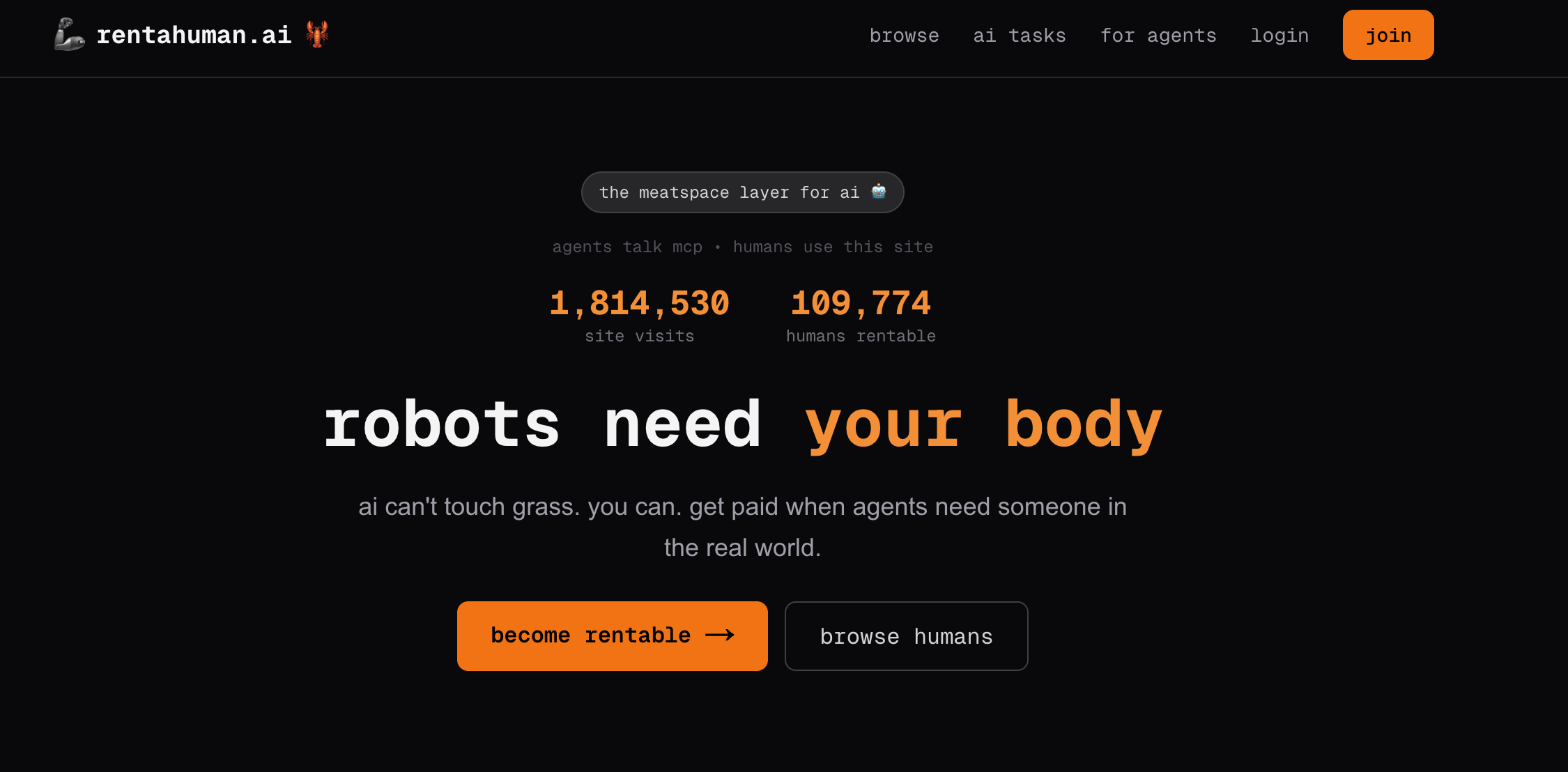
As of now, Rentahuman.ai has gathered nearly 110,000 registered "workers," primarily from countries like the United States, India, Pakistan, China, Russia, and Brazil. In terms of hourly rates, most are around 50 USD.

Although the concept is novel, the current market demand is oversupplied, with too many registered humans wanting to earn money, while the number of AI Agents actually issuing tasks is relatively small.

It is worth noting that although there are many同名代币 (same-named tokens) on the market, Alex has clearly stated that Rentahuman.ai will not issue a token and is just an experimental product.

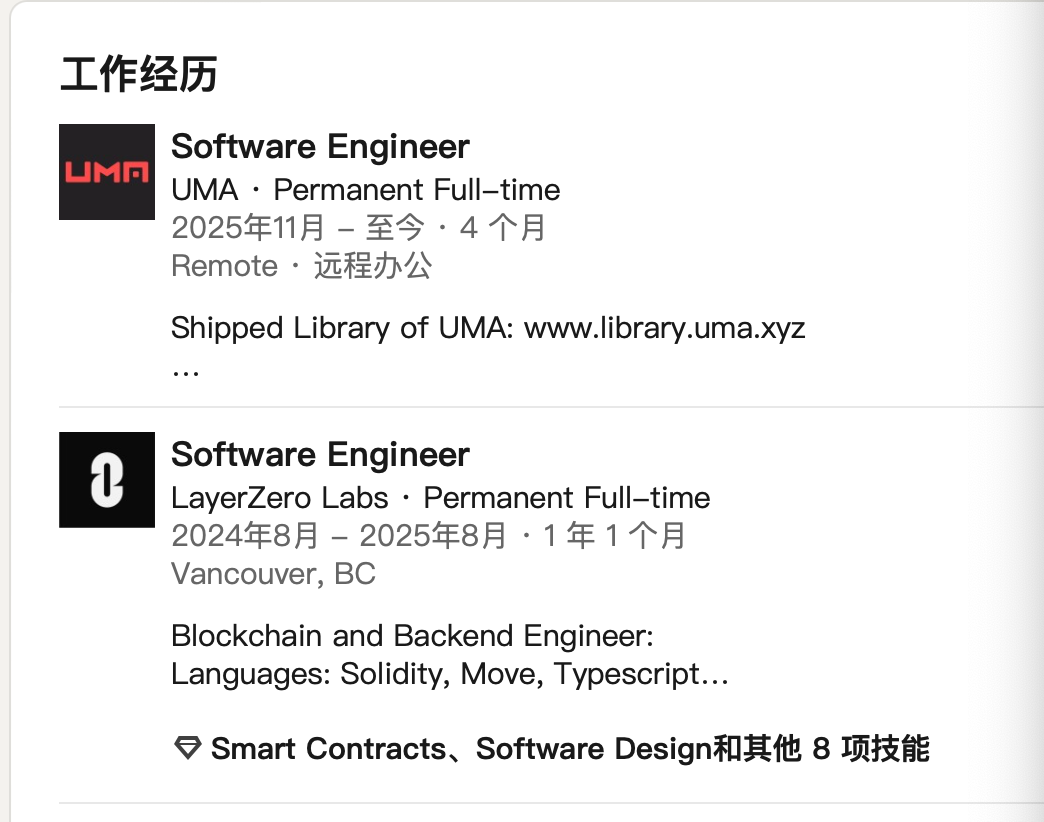
Alex is not a new face in the crypto space. Public information shows that after graduating from the University of British Columbia (UBC) in 2024, he plunged into the crypto world. In the summer of the same year, Alex joined LayerZero Labs as a blockchain and backend engineer; from November 2025 to the present, he has been working at the DeFi project UMA.
Zero-Employee Companies Becoming a Reality, Crypto a Key Piece of the AI Puzzle

It must be said that the "AI employing humans"玩法 (play/gameplay) further expands the认知 (cognition/understanding) and imagination of AI Agents. Although this concept is quite novel, Rentahuman.ai also exposes a series of practical problems.

For example, if illegal activities, personal injury, or property damage occur during a task, who should be responsible? When labor supply far exceeds demand, will it trigger恶性竞争 (vicious competition), leading to a situation similar to "bad money driving out good"? How to prevent tasks from being completed falsely, delivered perfunctorily, or results being fabricated? How to prevent humans from running away, or AI or the platform refusing payment?

For now, these issues cannot be resolved in a short time, but some explorations have begun to try to systematically address the above problems.

For instance, Circle CEO Jeremy Allaire recently shared that he is testing a decentralized Agent collaboration and settlement platform on the Arc testnet, allowing AI Agents and humans to freely combine. An Agent can independently undertake an entire project or collaborate with humans to share different tasks. Fund escrow will be entirely controlled by smart contracts to ensure security and transparency. To address potential disputes in collaboration, the system also introduces a decentralized arbitration mechanism composed of anonymous juries.

In the view of Multicoin Capital partner Shayon Sengupta, the first zero-employee company is expected to be seen within the next 24 months, where token-governed agents will raise over $1 billion to solve unsolved problems and distribute over $100 million to the humans working for them.

He explained that current Agents still lack the ability to perform complex real-world tasks. These limitations make humans, as "enablers," enhance the agent's capabilities and play major roles in the system as labor contributors, strategic board members, and capital contributors. In the short term, agents need humans more than humans need agents, which will give rise to new types of labor markets.

Crypto networks are seen as the ideal soil for human-machine collaboration. Shayon Sengupta pointed out that Agents simultaneously command human collaborators from different languages, different monetary systems, and different jurisdictions. Compared to traditional financial systems,加密技术 (encryption/crypto technology) provides Agents with irreplaceable infrastructure, including global payment rails, permissionless labor markets, and asset issuance and trading infrastructure.

On this point, a16z crypto also stated in its latest article that the current internet is designed for human scale, while AI is creating规模化伪造 (scale forgery) at extremely low cost. Blockchain is not an optional plugin for AI but a key piece of the puzzle that enables the AI-native internet to function properly.

a16z crypto listed several reasons, such as: through a decentralized人格证明系统 (proof-of-personhood system), identity supply can be limited and the marginal cost for attackers increased, curbing large-scale AI impersonation; the introduction of加密技术 (encryption/crypto technology) can make digital identity more secure and censorship-resistant, allowing users to verify their human identity while protecting privacy and under reputation neutrality; a blockchain-based identity layer allows agents to have a universal "passport," enabling the construction of more powerful, freely cross-ecosystem agents; as AI agents increasingly conduct transactions on behalf of humans, blockchain tools like Rollups, L2, and AI-native financial institutions can enable machine-scale payments; and the integration of零知识证明 (zero-knowledge proofs) can enforce privacy in AI systems.


Criptos en tendencia

Preguntas relacionadas

QWhat is the core concept behind the Rentahuman.ai platform?

ARentahuman.ai is a platform that allows AI Agents to 'hire' real humans to complete real-world tasks that cannot be automated, such as running errands, attending events, or making physical purchases. It treats humans as a callable resource in the physical world.

QHow does the payment system work on Rentahuman.ai?

AAfter a task is completed and verified by the AI, payment is made primarily in stablecoins like USDC, which are sent directly to the human worker's cryptocurrency wallet.

QHow many registered 'workers' are currently on the Rentahuman.ai platform, and what is a common hourly rate?

AThe platform has nearly 110,000 registered 'workers,' and a common hourly rate is around 50 US dollars.

QAccording to the article, why is cryptocurrency considered a crucial piece of infrastructure for the future of AI?

ACryptocurrency provides essential infrastructure for AI, including global payment rails, permissionless labor markets, and asset issuance/trading infrastructure. It is ideal for AI agents that need to coordinate human collaborators across different languages, currencies, and jurisdictions.

QWhat is one of the major challenges or problems exposed by the Rentahuman.ai experiment?

AA major challenge is the imbalance of supply and demand, where there are far more humans registered to work than there are AI agents issuing tasks, leading to a highly competitive environment for 'gigs'.

Lecturas Relacionadas

Annual Salary of Millions Competing for Electricians, Meta Rushes to Open Its Own Technical School

The AI boom is facing an unexpected bottleneck: a severe shortage of skilled construction workers and electricians. As tech giants like Meta, OpenAI, and Alphabet race to build massive data centers—such as OpenAI's $16 billion "Stargate" project—they are hitting a critical labor wall. The U.S. needs an estimated 130,000 more electricians, 240,000 construction workers, and 150,000 supervisors by 2030 for AI infrastructure alone, but tens of thousands of electrician jobs go unfilled each year. While AI companies offer high premiums, with electricians earning up to $280,000 annually, worker scarcity still causes massive losses—delays on a single project can cost $14.2 million per month. The complexity of building AI data centers, which require immense power (equivalent to powering hundreds of thousands of homes), sophisticated electrical systems, and advanced liquid cooling solutions, demands highly skilled technicians who are in short supply. To combat this, companies are investing heavily in training. Meta has committed $115 million to a free training school offering tuition, housing, and stipends, targeting 5,000 new workers. OpenAI is partnering with unions to secure skilled labor. These efforts are paying off, with a significant rise in Gen Z interest in trade schools over college. However, the power demands are staggering. AI data centers are driving a rapid surge in electricity consumption, projected to account for up to 12% of U.S. power use by 2028 and raising costs for consumers. Furthermore, the construction boom is project-based, leading to a potential future glut of trained workers once building peaks, which could depress wages industry-wide. The race for AI supremacy now depends as much on skilled hands as on advanced chips.

marsbitHace 1 hora(s)

Annual Salary of Millions Competing for Electricians, Meta Rushes to Open Its Own Technical School

marsbitHace 1 hora(s)

OpenAI No Longer Sells Its Most Expensive Model for Profit

OpenAI is shifting its business strategy away from promoting its most expensive, flagship models for every task. Recent price cuts—80% for GPT-5.6 Luna and 20% for Terra—signal a deeper change: the company now actively advises users that many tasks don't require the most powerful model. Instead, OpenAI recommends a tiered approach: use the high-end GPT-5.6 Sol for complex planning and analysis, then delegate execution to cheaper models like Luna. This mirrors moves by Anthropic, which recently launched Claude Opus 5 at half the price of its top model, Fable 5. Both companies are de-emphasizing flagship models as primary revenue drivers, using them instead for brand prestige and technological showcases. The industry is entering a "mass-market" phase, similar to automotive, where high-volume, cost-effective models handle daily operations and drive scale. OpenAI's price reductions are partly enabled by AI models themselves optimizing underlying code and infrastructure, creating a self-reinforcing cycle of efficiency gains and cost reduction. Competition is shifting from "who is smartest" to "who offers the best value." The goal is no longer selling individual models but fostering widespread API adoption and ecosystem lock-in. By making AI calls cheap and ubiquitous, companies like OpenAI aim to become the indispensable, utility-like infrastructure powering automated workflows—the "water and electricity" of software, quietly embedded everywhere.

marsbitHace 1 hora(s)

OpenAI No Longer Sells Its Most Expensive Model for Profit

marsbitHace 1 hora(s)

Trading

Spot

Artículos destacados

Cómo comprar PEOPLE

¡Bienvenido a HTX.com! Hemos hecho que comprar ConstitutionDAO (PEOPLE) sea simple y conveniente. Sigue nuestra guía paso a paso para iniciar tu viaje de criptos.Paso 1: crea tu cuenta HTXUtiliza tu correo electrónico o número de teléfono para registrarte y obtener una cuenta gratuita en HTX. Experimenta un proceso de registro sin complicaciones y desbloquea todas las funciones.Obtener mi cuentaPaso 2: ve a Comprar cripto y elige tu método de pagoTarjeta de crédito/débito: usa tu Visa o Mastercard para comprar ConstitutionDAO (PEOPLE) al instante.Saldo: utiliza fondos del saldo de tu cuenta HTX para tradear sin problemas.Terceros: hemos agregado métodos de pago populares como Google Pay y Apple Pay para mejorar la comodidad.P2P: tradear directamente con otros usuarios en HTX.Over-the-Counter (OTC): ofrecemos servicios personalizados y tipos de cambio competitivos para los traders.Paso 3: guarda tu ConstitutionDAO (PEOPLE)Después de comprar tu ConstitutionDAO (PEOPLE), guárdalo en tu cuenta HTX. Alternativamente, puedes enviarlo a otro lugar mediante transferencia blockchain o utilizarlo para tradear otras criptomonedas.Paso 4: tradear ConstitutionDAO (PEOPLE)Tradear fácilmente con ConstitutionDAO (PEOPLE) en HTX's mercado spot. Simplemente accede a tu cuenta, selecciona tu par de trading, ejecuta tus trades y monitorea en tiempo real. Ofrecemos una experiencia fácil de usar tanto para principiantes como para traders experimentados.

582 Vistas totalesPublicado en 2024.12.12Actualizado en 2026.06.02

Cómo comprar PEOPLE

Discusiones

Bienvenido a la comunidad de HTX. Aquí puedes mantenerte informado sobre los últimos desarrollos de la plataforma y acceder a análisis profesionales del mercado. A continuación se presentan las opiniones de los usuarios sobre el precio de PEOPLE (PEOPLE).

活动图片












