After Tokenized U.S. Treasury Bonds, Tokenized Stocks Are Becoming the New Battleground for RWA

marsbitPublicado a 2026-08-14Actualizado a 2026-08-14

Resumen

**Tokenized Stocks Emerge as the New RWA Battleground** Following the initial surge of tokenized U.S. Treasuries, the tokenized stock market is rapidly expanding in both scale and quality. Unlike the currently stagnating treasury tokenization market, tokenized stock offerings are seeing significant growth and attracting major players from traditional finance, fintech, crypto exchanges, and native Web3 platforms. The U.S. SEC has outlined a framework for tokenized securities, which applies to stocks: **Issuer-Sponsored Tokenized Securities** (direct tokenization by the issuer, inheriting all shareholder rights but with strict compliance, e.g., Securitize); **Custodial Tokenized Securities** (tokenization of custodied interests, e.g., DTCC, Ondo's recent IVV/MU tokens); **Linked Securities** (tokenized debt notes backed by the stock, offering price exposure and greater on-chain utility, e.g., Ondo, xStocks, Robinhood's new Stock Tokens); and **Security-Based Swaps** (tokenized derivatives contracts, e.g., Robinhood's earlier Classic Stock Tokens). Key platforms are pursuing different strategies: * **Securitize** leads with an issuer-sponsored model, ensuring full rights but limiting on-chain interactions via its compliance-enforcing DS Protocol. * **Ondo** and **xStocks** use the linked security structure for broad accessibility on CEXs and DeFi, though this fragments liquidity and excludes U.S. users. * **Robinhood** recently launched linked security-based Stock Token...

Authored by: 100y_eth

Compiled by: AididiaoJP

Key Takeaways

Unlike the recently stagnant tokenized U.S. Treasury bond market, the tokenized stock market is experiencing rapid expansion in both scale and quality.

From traditional stock infrastructure providers and fintech companies to crypto exchanges and Web3 native platforms, all see tokenized stocks as the next significant opportunity in the RWA industry. In fact, there are multiple pathways for stock tokenization, and understanding their respective advantages, disadvantages, and positioning is crucial.

This article will analyze the strategies of various players from different backgrounds, such as Securitize, Ondo, xStocks, Robinhood, DTCC, the New York Stock Exchange, Nasdaq, and Coinbase.

Everyone is Watching Tokenized Stocks
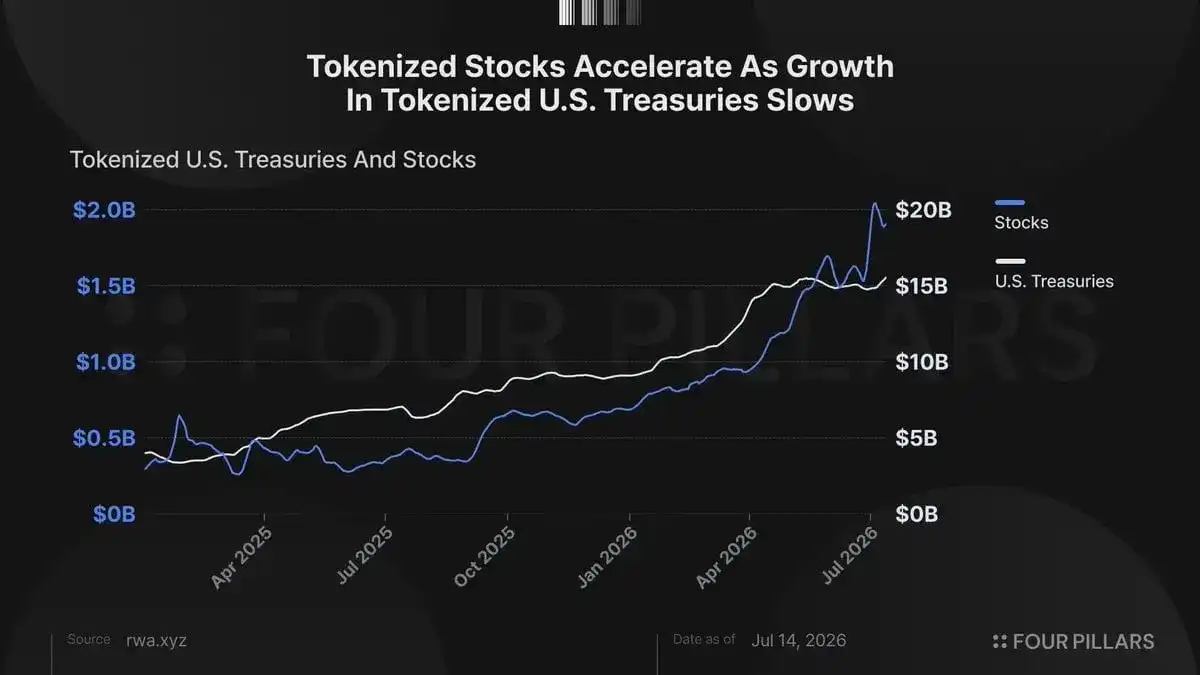
Today, regulators, banks, institutions, fintech companies, and almost all major market participants are showing strong interest in tokenization. But it's only recently that the term 'tokenization' has truly become a focal point. In the early stages, the main driver of growth in the tokenized market was undoubtedly U.S. Treasury bonds. Its rapid take-off relied on three factors: the safety of U.S. government debt, the relatively simple tokenization structure, and the relatively high yields at the time.

The tokenized U.S. Treasury market grew from $701 million on January 1, 2024, to surpassing $15 billion for the first time on April 17, 2026, representing a staggering compound annual growth rate of approximately 3.81x. However, after breaching $15 billion, the market has hovered around this level, showing a clear slowdown in growth. Considering that a significant portion of the demand for tokenized U.S. Treasuries came from DeFi protocols or exchange margin scenarios, the recent unfavorable market environment making demand stagnate is not surprising.

Just as the momentum for tokenized U.S. Treasuries weakened, another tokenization track is rapidly rising in both quantity and quality—tokenized stocks. The market size grew approximately 6.5x from $291 million on January 1, 2025, to around $1.9 billion currently within a year and a half. At the industry level, whether it's Web3 native players like Securitize and Ondo Global Markets, financial companies like Robinhood and Coinbase, or financial infrastructure providers like DTCC, the NYSE, and Nasdaq, either have already launched tokenized stocks or are actively preparing to do so.

What advantages do tokenized stocks have over traditional stock markets that make almost all major U.S. players see them as the next significant opportunity? At first glance, tokenizing stocks might seem simple, but in practice, depending on the regulatory framework adopted, various tokenization structures emerge, each with its own set of advantages. To understand these differences, one must first grasp the SEC's classification framework for tokenized securities.

SEC's Classification Framework for Tokenized Securities
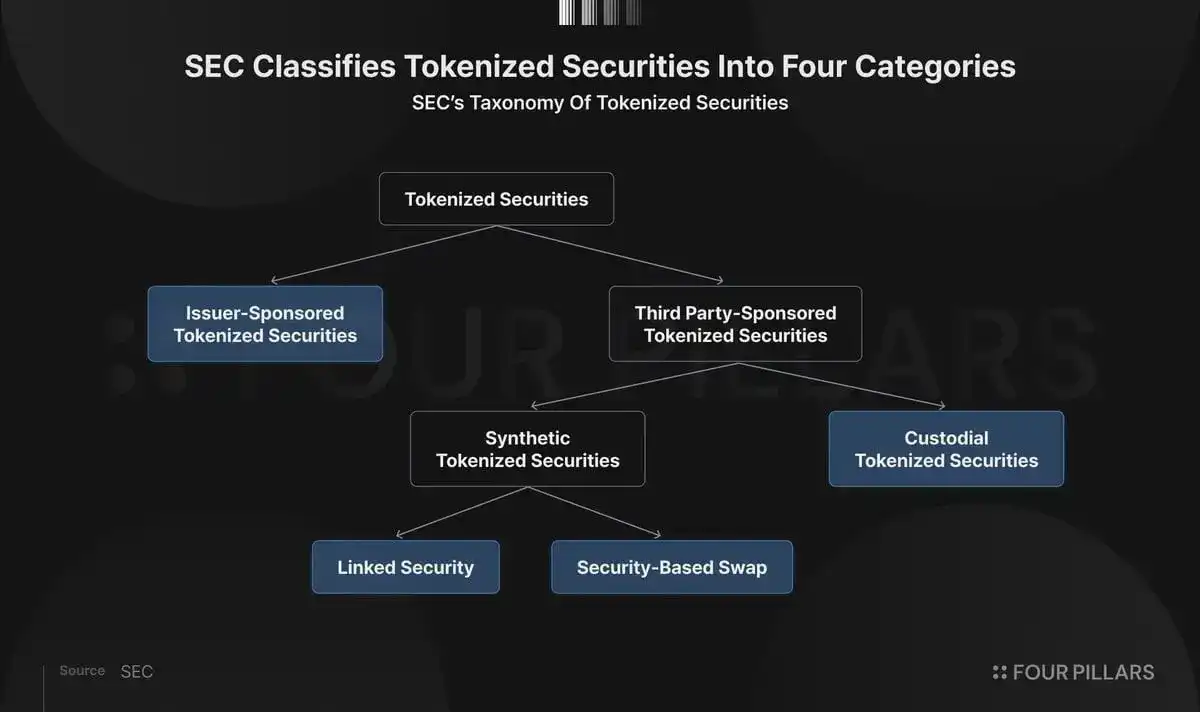
In January of this year, the SEC issued a statement proposing a classification framework for tokenized securities.

First, based on whether the tokenization is conducted by the security issuer itself or a third party, they are categorized as 'Issuer-Sponsored Tokenized Securities' or 'Third Party-Sponsored Tokenized Securities.'

Third Party-Sponsored Tokenized Securities are further subdivided: if the rights associated with the underlying security itself are tokenized, they are 'Custodial Tokenized Securities'; if a separate tokenized product is issued that is merely linked to the price, yield, events, or other characteristics of the underlying security, they are 'Synthetic Tokenized Securities.'

Synthetic types are further classified by product type: if a third party issues an independent security (such as a debt security), it's a 'Linked Security'; if it involves entering into a derivative contract, it's a 'Security-Based Swap.'

Ultimately, under this framework, tokenized securities can be classified into the following four categories, which also apply to tokenized stocks:

  • Issuer-Sponsored Tokenized Securities: The stock issuer itself, or its designated agent (like a transfer agent), directly tokenizes and operates the security. The issuer (or its agent) connects a blockchain or other DLT system to the official shareholder register for maintaining shareholder records. This method does not fundamentally alter the existing legal framework and directly complies with current securities laws. The biggest advantage is that the token inherits all shareholder rights, including ownership. However, strict compliance requirements limit usability to some extent. Main representatives: Securitize, Superstate, Figure.
  • Custodial Tokenized Securities: A third party tokenizes the rights (indirect rights) to securities held by a depository (like DTCC) or broker. This also inherits all related rights but is highly dependent on existing stock market infrastructure, ownership remains indirect, and improvements to the traditional system are relatively limited. Main representatives: DTCC; Ondo also recently used this method to tokenize IVV and MU.
  • Linked Security: A third party issues and tokenizes an independent security (e.g., a debt security) that provides synthetic exposure to the underlying stock. Token holders only obtain price performance exposure and do not inherit other shareholder rights. The biggest advantage is high flexibility for on-chain use. Main representatives: Ondo, xStocks, Robinhood Stock Tokens.
  • Security-Based Swap: A third party issues a derivative contract providing synthetic exposure to the underlying stock and tokenizes the contract. Like Linked Securities, it only provides price-related exposure and does not inherit other rights. Currently, Robinhood Classic Stock Tokens is almost the sole major example.

Analysis of Major Tokenized Stock Platforms

Securitize: Taking the Most Direct Route

Securitize is currently the largest tokenization platform by market share, with tokenized RWA valued at $5.1 billion. Its flagship product is BlackRock's money market fund BUIDL. Securitize holds SEC-registered broker-dealer, transfer agent, and ATS licenses and leverages these regulatory advantages to adopt a 'Direct Tokenized Security' model. According to the SEC classification, this falls under 'Issuer-Sponsored Tokenized Securities.'

Recently, Securitize has extended the same model to tokenized stocks. When it went public via a SPAC with its own stock SECZ, it used its own service to tokenize and issue $180 million worth of SECZ on-chain.

The advantages of this model are clear: existing stocks can be tokenized as-is while fully complying with current securities laws. Investors first directly register ownership of their shares, previously held via DTCC or brokers, through DRS. Then, Securitize, acting as the transfer agent, tokenizes these shares. The result is that the stock token shares the same CUSIP as the existing stock, inheriting not only economic rights but also all related rights like voting rights and claims on remaining assets in bankruptcy.

However, precisely because the tokenized stock is essentially another form of the same stock, it comes with corresponding drawbacks. Most importantly, the compliance requirements are strict, and on-chain use is relatively restricted. Unlike Ondo's or xStocks' tokenized stocks, Securitize's stock tokens can only be transferred between KYC/AML-approved whitelisted wallets, and on-chain interactions are only possible with a limited set of smart contracts pre-approved by the team.
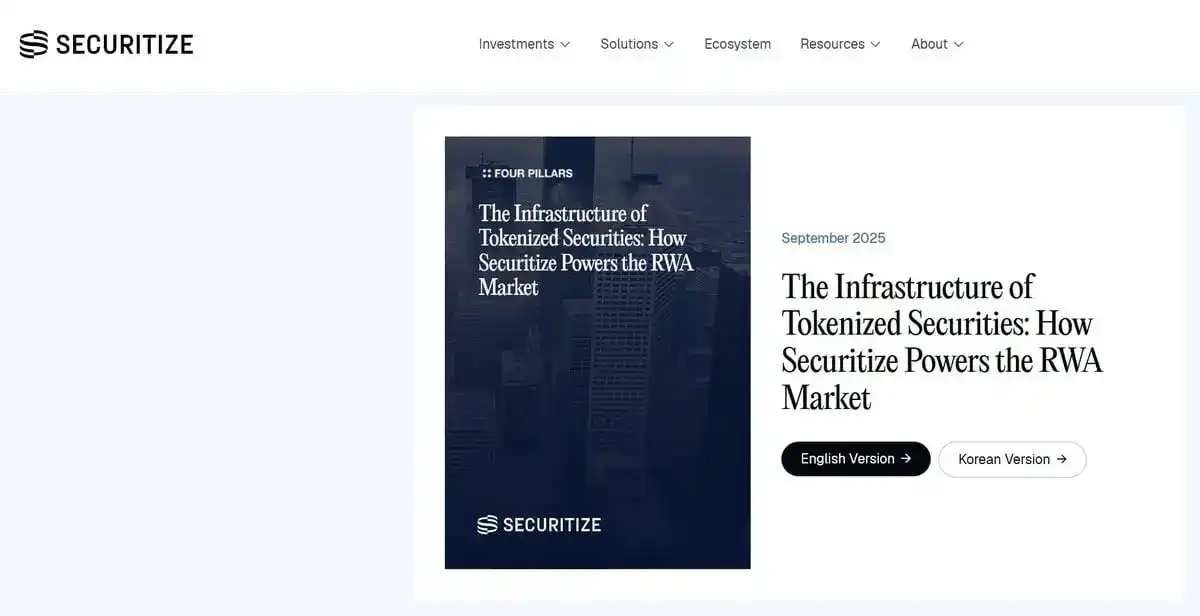
How does Securitize enforce compliance requirements like KYC/AML on-chain? The answer is the DS Protocol. This is a suite of smart contracts developed by Securitize that uses code to enforce compliance throughout the lifecycle of a tokenized security (issuance, transfer, use, voting, dividends). Four Pillars previously produced an in-depth research report on the DS Protocol, which is also archived on Securitize's website. Readers interested in understanding how tokenized securities operate at the smart contract level can refer to that report.

Platforms adopting similar methods for tokenizing stocks include Superstate and Figure. They all act as transfer agents for tokenization, with the main difference being the type of stock tokenized: Securitize and Superstate tokenize shares identical to existing stocks via the DRS system, while Figure issues a separate blockchain-native class of shares and tokenizes that portion.

Ondo & xStocks: Expanding the Ecosystem with Broad Accessibility

Ondo and xStocks adopt a structure where, when a user orders a stock token, an offshore SPV acquires the underlying stock and then issues a tokenized debt security backed by that stock.

Take xStocks as an example. It has a Jersey-regulated SPV—Backed Assets (JE) Limited. When a user requests a stock token issuance via the platform, this SPV purchases the underlying stock through U.S.-based Alpaca Securities and holds it in a segregated account with a regulated custodian. The SPV then issues an independent debt security backed by these stocks, tokenizes it, and delivers it to the user.

This structure falls under the SEC's 'Linked Security' classification.
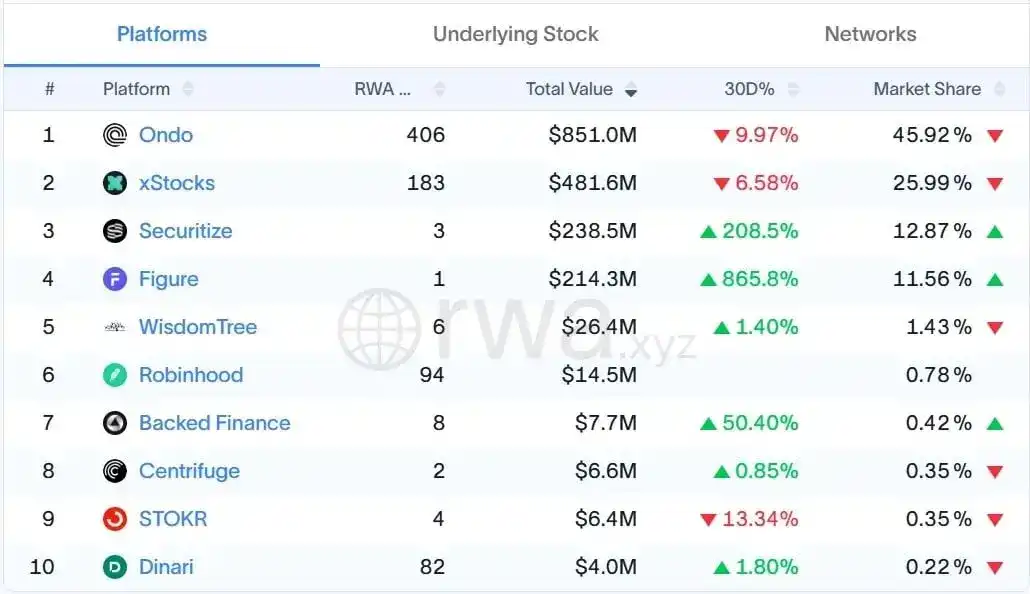
Currently, Ondo has tokenized 406 different stocks, with a total value of approximately $851 million; xStocks has tokenized 183 stocks, worth about $482 million. Their respective market shares in the tokenized stock space are 45.9% and 26.0%, firmly occupying the top two positions.

The key to their rapid growth lies in the broad accessibility enabled by their tokenization structure. Strictly speaking, they are not tokenizing the stock itself but rather tokenizing a debt security issued by a third party and backed by the stock. Therefore, compared to the issuer-sponsored model that directly tokenizes existing stocks, this structure has more relaxed compliance requirements for distribution and secondary trading. Users can more freely trade and use Ondo and xStocks issued tokenized stocks on CEXs and on-chain DeFi protocols. For example, with xStocks, anyone can trade via Jupiter DEX using a Web3 wallet or deposit them into lending protocols like Kamino as collateral to borrow stablecoins.

However, this indirect tokenization also brings issues: even if the underlying asset is the same, tokens issued by different platforms are not interoperable, leading to liquidity fragmentation. For example, for Nvidia stock backing, Ondo issues NVDAon, and xStocks issues NVDAx, and the two are not interchangeable. Additionally, due to reliance on Regulation S, U.S. investors and U.S. persons cannot use them.

To address these limitations, Ondo recently acquired Oasis Pro, obtaining broker-dealer, ATS, and transfer agent licenses, moving towards a more compliance-friendly tokenization model. In fact, Ondo has already used these licenses to tokenize IVV ETF shares and MU stock held in a brokerage account via the 'Custodial Tokenized Securities' model, demonstrating the possibility of parallel multi-structure operations.

Robinhood: Can the Latecomer Make a Strong Push?

Another important new player has joined the tokenized stock ecosystem—Robinhood. It had already offered tokenized stock services to European investors through Classic Stock Tokens. However, according to the SEC classification, that structure was a 'Security-Based Swap': Robinhood enters into a derivative contract with the user based on the stock and tokenizes the contract into a receipt token. The entire structure was highly closed, usable only within the Robinhood App.

On July 1, 2026, Robinhood launched a new Stock Tokens service. Its tokenization structure adopts the 'Linked Security' model, almost identical to the ones used by Ondo and xStocks mentioned earlier, with similar advantages and disadvantages.

While the structure is the same, the potential Robinhood brings is clear: its product DNA and massive existing user base. Concurrently with launching Stock Tokens, Robinhood also launched the Robinhood Chain mainnet, centered around Stock Tokens. U.S. users can also deposit stablecoins into Morpho on Robinhood Chain via the Robinhood App to earn 7% interest. Despite entering later than Ondo and xStocks, with its product iteration capabilities and ecosystem expansion potential, Robinhood still has the opportunity to scale quickly.

DTCC, NYSE, Nasdaq: Signals of Financial Infrastructure Reshaping

It's not just platforms and companies considering stock tokenization. Key traditional stock market settlement and trading infrastructure providers—DTCC, the New York Stock Exchange (NYSE), and Nasdaq—are also moving towards tokenization.

The DTC, under DTCC, has received an SEC no-action letter allowing the tokenization of some securities held by DTC on pre-approved blockchains. DTC expects this to enhance collateral liquidity, extend trading hours, improve operational and settlement efficiency, and enable programmability and real-time auditing. On July 15, DTCC conducted limited tokenization of securities like QQQ and SPY in a live securities infrastructure environment and successfully completed transactions and collateral transfers.

In April 2026, the NYSE submitted a rule change proposal to the SEC supporting DTC's tokenization pilot, allowing stocks to be settled in tokenized form. Additionally, the NYSE is developing a new regulated exchange—the Digital Trading Platform—aiming to use blockchain infrastructure to enable 7x24 trading of U.S. stocks and ETFs and support stablecoin funding. In March 2026, the NYSE also signed a memorandum of understanding with Securitize, designating Securitize as the first potential digital transfer agent for this new platform.

Nasdaq received SEC rule change approval in March 2026, allowing stocks in DTC's tokenization pilot to be traded and settled in tokenized form. Nasdaq is also collaborating with Payward, the parent company of Kraken, to design gateway services enabling issuers and investors to transfer stocks between the regulated Nasdaq market and the permissionless blockchain environment.

Coinbase: Which Path Will It Take?

The last player worth watching is Coinbase. It hasn't launched tokenized stock services yet, but since last year, it has stated its intention to do so multiple times. In February of this year, Coinbase launched 5x24 trading for traditional stocks in the U.S.; at an event in June, it announced that it would offer tokenized stocks soon.
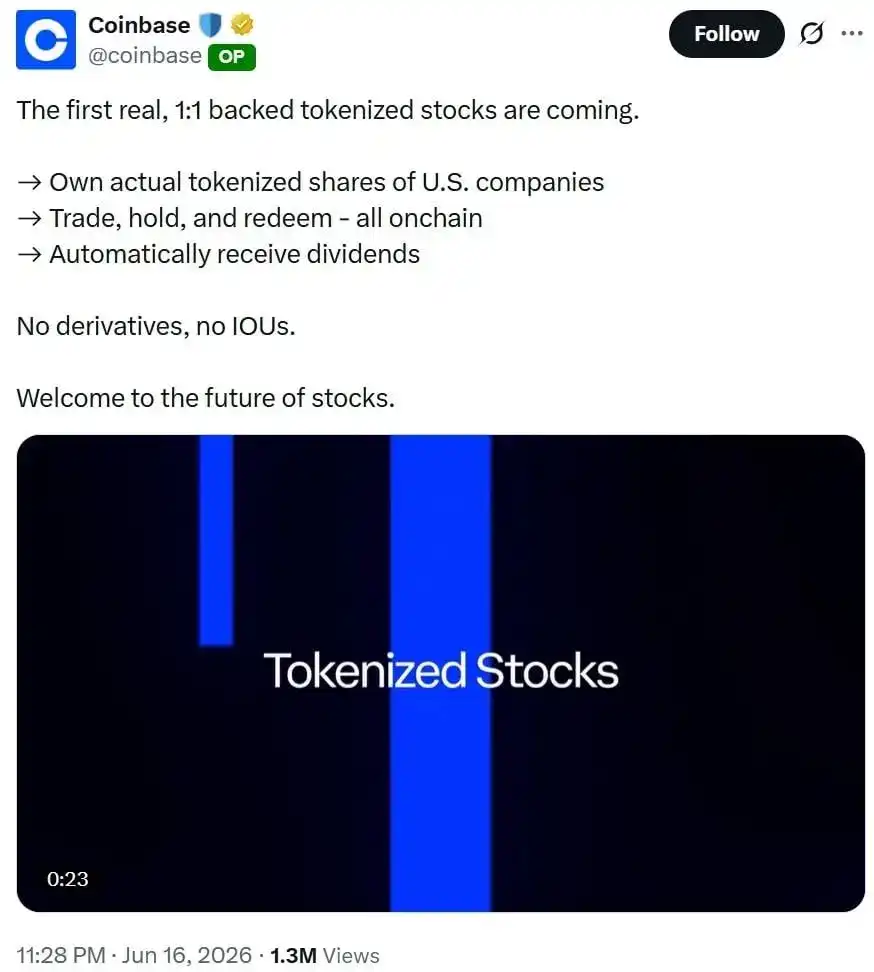
The industry is highly focused on what structure Coinbase will use to tokenize stocks. Coinbase has stated that its service will not only ensure tokens are 1:1 backed by real stocks but will also provide shareholder rights, though the specific structure hasn't been detailed. More importantly, it explicitly stated these stock tokens will be usable on-chain while not being available to U.S. customers.

If an issuer-sponsored structure is adopted, tokens typically inherit all shareholder rights and are available to U.S. customers, but on-chain usability is relatively restricted. The combination of 'broad on-chain availability + exclusion of U.S. customers' seems more aligned with a third-party structure (like Linked Securities). Which structure Coinbase ultimately uses to tokenize stocks and how it leverages its own exchange infrastructure to expand the tokenized stock ecosystem warrant continued observation.

Competing on the Same Battlefield

The goal of financial services is clear: to enable anyone, anywhere, anytime, to trade all types of assets through a single backend and frontend. Today's financial services may seem close to this goal, but in reality, integration mostly happens at the frontend, while the backend remains fragmented.

Stocks, as one of many asset classes, are no exception. From Robinhood, which started with stock trading, Coinbase, which started with crypto trading, traditional stock infrastructure providers DTCC/NYSE/Nasdaq, to Web3 native players like Securitize, Ondo, and xStocks, tokenization structures and strategic directions vary, yet all are moving towards the same North Star—tokenized stocks.

The key points to watch next are how the U.S. and other jurisdictions view tokenized stocks, how regulatory frameworks are implemented, and how these changes will reshape the competitive landscape among the various players; also, whether tokenized stocks can become the next important catalyst driving the expansion of the entire RWA track, following tokenized U.S. Treasuries.

The Korean market is also worth watching: despite high retail trading activity, RWA industry development is relatively slow. How discussions around tokenized stocks unfold in Korea deserves ongoing tracking.

Criptos en tendencia

Preguntas relacionadas

QAccording to the article, what are the four main categories of tokenized securities as classified by the SEC's framework?

AThe four main categories are: 1) Issuer-Sponsored Tokenized Securities, 2) Custodial Tokenized Securities, 3) Linked Securities (a type of Synthetic Tokenized Security), and 4) Security-Based Swaps (another type of Synthetic Tokenized Security).

QWhat are the key differences between Securitize's approach to tokenizing stocks and the approach used by platforms like Ondo and xStocks?

ASecuritize uses an 'Issuer-Sponsored' model, directly tokenizing the underlying stock itself, which inherits all shareholder rights but has stricter compliance limiting on-chain usability (e.g., whitelisted wallets only). Ondo and xStocks use a 'Linked Security' model, issuing tokenized debt securities backed by the stock, which offers greater on-chain flexibility and accessibility but does not grant full shareholder rights and fragments liquidity.

QWhy has the growth of the tokenized U.S. Treasury market stalled recently, as mentioned in the article?

AThe growth of the tokenized U.S. Treasury market has stalled because a significant portion of its demand came from DeFi protocols or exchange margin scenarios, and the recent unfavorable market environment has led to a stagnation in that demand.

QWhat significant advantage does the Robinhood Stock Tokens service launched in July 2026 have over its earlier Classic Stock Tokens?

AThe new Robinhood Stock Tokens service uses a 'Linked Security' structure similar to Ondo and xStocks, which is more open and potentially integrates with broader on-chain ecosystems. In contrast, the older Classic Stock Tokens were structured as 'Security-Based Swaps,' which were highly封闭 and could only be used within the Robinhood app itself.

QHow are traditional financial market infrastructure providers like DTCC, NYSE, and Nasdaq getting involved in tokenized stocks?

ADTCC has received regulatory approval to tokenize some securities it holds for a pilot program aimed at improving efficiency. The NYSE has proposed rule changes to support this pilot and is developing a new Digital Trading Platform for 24/7 trading using blockchain. Nasdaq has also received approval for rules allowing the trading and settlement of tokenized stocks from the pilot and is designing gateway services to connect regulated markets with permissionless blockchains.

Lecturas Relacionadas

Tether Finally Gets Audited by a Big Four Firm, But USDT's Transparency Issues Are Far From Over

Tether announced that KPMG U.S. has completed its first independent audit of Tether International's financial statements as of December 31, 2025, issuing an unqualified opinion—the highest level of assurance. The audit confirms Tether's assets exceeded liabilities by $6.814 billion at that date, with physical verification of gold bars and examination of underlying records. This represents a significant step beyond the quarterly reserve attestations Tether previously received, moving to a full financial statement audit that examines internal controls, transaction sampling, and accounting policies. However, the article highlights several ongoing transparency questions. The full KPMG audit report has not been publicly released, preventing independent verification of details like asset classification or related-party transactions. The audit covers a specific entity, "Tether International, S.A. de C.V.," leaving the scope concerning Tether's complex corporate structure unclear. Furthermore, the $6.8 billion excess reserves confirmed for end-2025 had shrunk to approximately $4.1 billion by Q2 2026. Risks within the reserve composition, particularly concerning secured loans, persist even with an audit. The audit's data is also already 8 months old, while USDT's circulation has grown rapidly. Strategically, the audit is seen as a move to bolster Tether's position amid U.S. regulatory developments like the GENIUS Act, which mandates audits for stablecoin issuers but leaves a path for foreign entities like Tether. While the KPMG opinion is a strong credibility signal, the article concludes that full transparency and regulatory compliance require further steps, starting with the publication of the complete audit report.

marsbitHace 16 min(s)

Tether Finally Gets Audited by a Big Four Firm, But USDT's Transparency Issues Are Far From Over

marsbitHace 16 min(s)

Nvidia Faces Collective Selling by Funds: What Are Private Equity Firms Sniffing Out?

Several prominent Chinese private equity funds, including Gaoyi Asset and Dantoo's Orient Harbor, made significant portfolio adjustments in Q2 2024, as revealed in their latest SEC 13F filings. The most notable move was a collective retreat from AI chip leader NVIDIA, with Gaoyi reducing its stake by over 70%, Jilin Asset selling out completely, and Orient Harbor trimming its holdings. This shift does not signal a loss of faith in the AI trend, but rather a change in investment focus from "expectation-driven" to "realization-driven" valuation. Capital is flowing from crowded, high-valuation names towards segments with clearer profitability visibility and better risk-reward profiles. The funds' new major conviction is Taiwan Semiconductor Manufacturing Company (TSMC), which Gaoyi built into its top holding. The thesis centers on TSMC's role as a critical bottleneck in the AI supply chain due to its dominance in advanced semiconductor manufacturing and, crucially, advanced CoWoS packaging capacity. As demand for AI chips explodes, TSMC's "must-pass" foundry services grant it significant pricing power, suggesting a potential migration of profits from chip designers to manufacturers. Simultaneously, both Gaoyi and Orient Harbor substantially increased positions in memory chip companies like Micron and SanDisk. The investment logic here is twofold: a cyclical recovery in the memory market combined with a new, structural growth driver from AI. High Bandwidth Memory (HBM), essential for AI processor performance, is supply-constrained and its production diverts capacity from standard DRAM and NAND, creating a broad-based pricing tailwind for the memory sector. The collective reduction in NVIDIA reflects a view that its massive prior gains have compressed its future upside potential ("lowered赔率"). The market now demands flawless execution and faces new risks like rising costs from TSMC and HBM suppliers, as well as competition from cloud companies' custom chips. The funds' reallocation highlights a broader thematic: as the AI boom matures, investment opportunities and excess profits are shifting along the supply chain—from design to the physical constraints of manufacturing and memory. The next phase of AI investing may be defined by pricing power derived from tangible bottlenecks like advanced packaging and HBM capacity.

marsbitHace 1 hora(s)

Nvidia Faces Collective Selling by Funds: What Are Private Equity Firms Sniffing Out?

marsbitHace 1 hora(s)

Reverse Turing Test: This 'Pure Handcrafted Large Model' Is Driving Netizens Crazy

An art project called ChatTJB, humorously billed as a "next-generation, single-operator Large Language Experience" (LLE), gained viral attention in San Francisco. Promoted via a billboard, its website mimicked a genuine AI service with a chat interface, documentation, and even a "Pro" subscription. The twist? It was entirely manual. A single person, named Tucker, personally read, thought about, and typed replies to thousands of user queries using his thumbs, even hand-drawing images. He coined terms like "human-powered reasoning layer" to describe this process, highlighting its inherent human limitations: speed depended on his alertness, capacity was strictly one conversation at a time, and errors were traceable to a specific individual. The project's popularity overwhelmed Tucker, forcing a pause on new users and leading to plans for a community version with volunteer "AIs" (Average Individuals). While initially a source of amusement, Tucker noted that some users began sharing genuine personal concerns, valuing the knowledge that a real person was attentively listening and responding. The project satirizes AI hype while underscoring the irreplaceable value of human connection and attention in an age of automated, scalable interactions. A similar platform, "Your AI Slop Bores Me," was mentioned, where users either submit requests or role-play as the "AI" to fulfill others' text or drawing prompts, further emphasizing the human element behind the interface. The core message: sometimes, knowing there's a real person on the other end is what truly matters.

marsbitHace 1 hora(s)

Reverse Turing Test: This 'Pure Handcrafted Large Model' Is Driving Netizens Crazy

marsbitHace 1 hora(s)

Overnight, GPT-5.6 Sol Was Accelerated 14x by OpenAI

OpenAI, in collaboration with chipmaker Cerebras, has unveiled a limited preview of an "Ultrafast Mode" for its flagship GPT-5.6 Sol model. This new service tier reportedly achieves output speeds of up to 750 tokens per second—a 14x increase over the standard mode's baseline of ~53 tokens/s—without any loss in quality. Key to this acceleration is Cerebras's wafer-scale architecture (WSE-3), which houses model parameters entirely in on-chip SRAM to eliminate the memory bandwidth bottlenecks typical of traditional GPU clusters. In benchmark testing on the challenging "Humanity's Last Exam" (HLE), GPT-5.6 Sol in Ultrafast Mode answered all 2500 questions in 11 hours and 11 minutes, compared to over 78 hours for a competitor model, while maintaining similar accuracy. The speed boost also translated to a 5.6x faster end-to-end performance on the GDP-Val benchmark for economically valuable knowledge work. OpenAI highlights several potential applications for such rapid inference, including real-time event response and reliability analysis, dynamic financial research and security, complex customer support, interactive shopping assistance, and accelerated research and experimentation workflows that enable multiple iterative cycles within a single workday. This advancement may allow users to deploy the highest-tier models for tasks previously requiring slower secondary models, significantly compressing multi-step agent workflows from hours to minutes.

marsbitHace 1 hora(s)

Overnight, GPT-5.6 Sol Was Accelerated 14x by OpenAI

marsbitHace 1 hora(s)

Trading

Spot

Artículos destacados

Qué es ETH 2.0

ETH 2.0: Una Nueva Era para Ethereum Introducción ETH 2.0, conocido ampliamente como Ethereum 2.0, marca una actualización monumental para la blockchain de Ethereum. Esta transición no es solo una mejora superficial; busca mejorar fundamentalmente la escalabilidad, seguridad y sostenibilidad de la red. Con un cambio del mecanismo de consenso intensivo en energía Prueba de Trabajo (PoW) a una Prueba de Participación (PoS) más eficiente, ETH 2.0 promete un enfoque transformador para el ecosistema blockchain. ¿Qué es ETH 2.0? ETH 2.0 es un conjunto de actualizaciones interconectadas y distintivas centradas en optimizar las capacidades y el rendimiento de Ethereum. La reestructuración está diseñada para abordar desafíos críticos que el mecanismo actual de Ethereum ha enfrentado, particularmente en lo que respecta a la velocidad de transacción y la congestión de la red. Objetivos de ETH 2.0 Los objetivos principales de ETH 2.0 giran en torno a mejorar tres aspectos clave: Escalabilidad: Con el objetivo de aumentar significativamente el número de transacciones que la red puede manejar por segundo, ETH 2.0 busca superar la limitación actual de aproximadamente 15 transacciones por segundo, potencialmente alcanzando miles. Seguridad: Las medidas de seguridad mejoradas son fundamentales para ETH 2.0, particularmente a través de una mejor resistencia contra ciberataques y la preservación del ethos descentralizado de Ethereum. Sostenibilidad: El nuevo mecanismo PoS está diseñado no solo para mejorar la eficiencia, sino también para reducir drásticamente el consumo de energía, alineando el marco operativo de Ethereum con consideraciones ambientales. ¿Quién es el Creador de ETH 2.0? La creación de ETH 2.0 se puede atribuir a la Fundación Ethereum. Esta organización sin fines de lucro, que desempeña un papel crucial en el apoyo al desarrollo de Ethereum, es liderada por el notable cofundador Vitalik Buterin. Su visión de un Ethereum más escalable y sostenible ha sido la fuerza motriz detrás de esta actualización, involucrando contribuciones de una comunidad global de desarrolladores y entusiastas dedicados a mejorar el protocolo. ¿Quiénes son los Inversores de ETH 2.0? Si bien los detalles sobre los inversores de ETH 2.0 no se han hecho públicos, se sabe que la Fundación Ethereum recibe apoyo de varias organizaciones e individuos en el ámbito de blockchain y tecnología. Estos socios incluyen firmas de capital de riesgo, compañías tecnológicas y organizaciones filantrópicas que comparten un interés mutuo en apoyar el desarrollo de tecnologías descentralizadas e infraestructura blockchain. ¿Cómo Funciona ETH 2.0? ETH 2.0 se distingue por introducir una serie de características clave que lo diferencian de su predecesor. Prueba de Participación (PoS) La transición a un mecanismo de consenso PoS es uno de los cambios más destacados de ETH 2.0. A diferencia de PoW, que se basa en la minería intensiva en energía para la verificación de transacciones, PoS permite a los usuarios validar transacciones y crear nuevos bloques de acuerdo con la cantidad de ETH que apuestan en la red. Esto conduce a una mayor eficiencia energética, reduciendo el consumo en aproximadamente un 99.95%, convirtiendo a Ethereum 2.0 en una alternativa considerablemente más verde. Cadenas Shard Las cadenas shard son otra innovación crítica de ETH 2.0. Estas cadenas más pequeñas operan en paralelo con la cadena principal de Ethereum, lo que permite que múltiples transacciones sean procesadas simultáneamente. Este enfoque mejora la capacidad general de la red, abordando las preocupaciones de escalabilidad que han afectado a Ethereum. Cadena Beacon En el núcleo de ETH 2.0 se encuentra la Cadena Beacon, que coordina la red y gestiona el protocolo PoS. Funciona como un organizador de cierta manera: supervisa a los validadores, asegura que los shards permanezcan conectados a la red y monitorea la salud general del ecosistema blockchain. Cronología de ETH 2.0 El viaje de ETH 2.0 ha estado marcado por varios hitos clave que trazan la evolución de esta importante actualización: Diciembre 2020: El lanzamiento de la Cadena Beacon marcó la introducción de PoS, preparándose para la migración hacia ETH 2.0. Septiembre 2022: La finalización de “La Fusión” representa un momento crucial en el que la red Ethereum se trasladó exitosamente de un marco PoW a uno PoS, anunciando una nueva era para Ethereum. 2023: El lanzamiento esperado de cadenas shard tiene como objetivo mejorar aún más la escalabilidad de la red Ethereum, consolidando a ETH 2.0 como una plataforma robusta para aplicaciones y servicios descentralizados. Características Clave y Beneficios Escalabilidad Mejorada Una de las ventajas más significativas de ETH 2.0 es su escalabilidad mejorada. La combinación de PoS y cadenas shard permite que la red expanda su capacidad, permitiendo acomodar un volumen mucho mayor de transacciones en comparación con el sistema heredado. Eficiencia Energética La implementación de PoS representa un gran paso hacia la eficiencia energética en la tecnología blockchain. Al reducir drásticamente el consumo de energía, ETH 2.0 no solo disminuye los costos operativos, sino que también se alinea más estrechamente con los objetivos de sostenibilidad global. Seguridad Mejorada Los mecanismos actualizados de ETH 2.0 contribuyen a mejorar la seguridad en toda la red. El despliegue de PoS, junto con las medidas de control innovadoras establecidas a través de cadenas shard y la Cadena Beacon, asegura un mayor grado de protección contra posibles amenazas. Costos Más Bajos para los Usuarios A medida que la escalabilidad mejora, los efectos sobre los costos de transacción también serán evidentes. Se espera que una mayor capacidad y una menor congestión se traduzcan en tarifas más bajas para los usuarios, haciendo que Ethereum sea más accesible para transacciones cotidianas. Conclusión ETH 2.0 marca una evolución significativa en el ecosistema blockchain de Ethereum. A medida que aborda problemas fundamentales como la escalabilidad, el consumo de energía, la eficiencia en las transacciones y la seguridad general, la importancia de esta actualización no puede ser subestimada. La transición a la Prueba de Participación, la introducción de cadenas shard y el trabajo fundamental de la Cadena Beacon son indicativos de un futuro donde Ethereum puede satisfacer las crecientes demandas del mercado descentralizado. En una industria impulsada por la innovación y el progreso, ETH 2.0 se erige como un testimonio de las capacidades de la tecnología blockchain para allanar el camino hacia una economía digital más sostenible y eficiente.

322 Vistas totalesPublicado en 2024.04.04Actualizado en 2024.12.03

Qué es ETH 2.0

Qué es ETH 3.0

ETH3.0 y $eth 3.0: Un Examen Profundo del Futuro de Ethereum Introducción En el paisaje en rápida evolución de las criptomonedas y la tecnología blockchain, ETH3.0, a menudo denotado como $eth 3.0, ha surgido como un tema de considerable interés y especulación. El término abarca dos conceptos principales que merecen aclaración: Ethereum 3.0: Esto representa una posible actualización futura destinada a aumentar las capacidades de la blockchain existente de Ethereum, enfocándose particularmente en mejorar la escalabilidad y el rendimiento. ETH3.0 Meme Token: Este proyecto de criptomoneda distinto busca aprovechar la blockchain de Ethereum para crear un ecosistema centrado en memes, promoviendo la participación dentro de la comunidad de criptomonedas. Comprender estos aspectos de ETH3.0 es esencial no solo para los entusiastas de las criptomonedas, sino también para aquellos que observan tendencias tecnológicas más amplias en el espacio digital. ¿Qué es ETH3.0? Ethereum 3.0 Ethereum 3.0 se presenta como una actualización propuesta para la red de Ethereum ya establecida, que ha sido la columna vertebral de muchas aplicaciones descentralizadas (dApps) y contratos inteligentes desde su inicio. Las mejoras previstas se concentran principalmente en la escalabilidad, integrando tecnologías avanzadas como sharding y pruebas de conocimiento cero (zk-proofs). Estas innovaciones tecnológicas tienen como objetivo facilitar un número sin precedentes de transacciones por segundo (TPS), potencialmente alcanzando millones, abordando así una de las limitaciones más significativas que enfrenta la tecnología blockchain actual. La mejora no es meramente técnica, sino también estratégica; está destinada a preparar la red de Ethereum para su adopción generalizada y utilidad en un futuro marcado por una mayor demanda de soluciones descentralizadas. ETH3.0 Meme Token En contraste con Ethereum 3.0, el ETH3.0 Meme Token se aventura en un ámbito más ligero y juguetón al combinar la cultura de memes de internet con la dinámica de las criptomonedas. Este proyecto permite a los usuarios comprar, vender e intercambiar memes en la blockchain de Ethereum, proporcionando una plataforma que fomenta la participación comunitaria a través de la creatividad y los intereses compartidos. El ETH3.0 Meme Token tiene como objetivo demostrar cómo la tecnología blockchain puede intersectarse con la cultura digital, creando casos de uso que son tanto entretenidos como financieramente viables. ¿Quién es el Creador de ETH3.0? Ethereum 3.0 La iniciativa hacia Ethereum 3.0 es impulsada principalmente por un consorcio de desarrolladores e investigadores dentro de la comunidad de Ethereum, incluyendo notablemente a Justin Drake. Conocido por sus ideas y contribuciones a la evolución de Ethereum, Drake ha sido una figura prominente en las discusiones sobre la transición de Ethereum a una nueva capa de consenso, denominada “Beam Chain.” Este enfoque colaborativo para el desarrollo significa que Ethereum 3.0 no es el producto de un creador singular, sino más bien una manifestación de ingenio colectivo centrado en avanzar la tecnología blockchain. ETH3.0 Meme Token Los detalles sobre el creador del ETH3.0 Meme Token son actualmente inidentificables. La naturaleza de los tokens de memes a menudo conduce a una estructura más descentralizada y dirigida por la comunidad, lo que podría explicar la falta de atribución específica. Esto se alinea con la ética de la comunidad cripto más amplia, donde la innovación a menudo surge de esfuerzos colaborativos en lugar de individuales. ¿Quiénes son los Inversores de ETH3.0? Ethereum 3.0 El apoyo a Ethereum 3.0 proviene principalmente de la Fundación Ethereum junto con una entusiasta comunidad de desarrolladores e inversores. Esta asociación fundamental proporciona un grado significativo de legitimidad y mejora la perspectiva de una implementación exitosa, ya que aprovecha la confianza y credibilidad construidas a lo largo de años de operaciones en la red. En el clima cambiando rápidamente de las criptomonedas, el apoyo de la comunidad juega un papel crucial en impulsar el desarrollo y la adopción, posicionando a Ethereum 3.0 como un contendiente serio para futuros avances en blockchain. ETH3.0 Meme Token Si bien las fuentes actualmente disponibles no proporcionan información explícita sobre las fundaciones o organizaciones de inversión que respaldan el ETH3.0 Meme Token, es indicativo del modelo de financiamiento típico para tokens de memes, que a menudo depende del apoyo de base y la participación comunitaria. Los inversores en tales proyectos suelen consistir en individuos motivados por el potencial de innovación impulsada por la comunidad y el espíritu de cooperación que se encuentra dentro de la comunidad cripto. ¿Cómo Funciona ETH3.0? Ethereum 3.0 Las características distintivas de Ethereum 3.0 radican en su implementación propuesta de sharding y tecnología zk-proof. Sharding es un método de particionamiento de la blockchain en piezas más pequeñas y manejables o “shards,” que pueden procesar transacciones de manera concurrente en lugar de secuencial. Esta descentralización del procesamiento ayuda a prevenir la congestión y asegura que la red permanezca receptiva incluso bajo una carga pesada. La tecnología de prueba de conocimiento cero (zk-proof) contribuye con otra capa de sofisticación al permitir la validación de transacciones sin revelar los datos subyacentes involucrados. Este aspecto no solo mejora la privacidad, sino que también aumenta la eficiencia general de la red. También se habla de incorporar una Máquina Virtual de Ethereum de conocimiento cero (zkEVM) en esta actualización, amplificando aún más las capacidades y utilidad de la red. ETH3.0 Meme Token El ETH3.0 Meme Token se distingue al capitalizar la popularidad de la cultura de memes. Establece un mercado para que los usuarios participen en el comercio de memes, no solo por entretenimiento sino también por el posible beneficio económico. Al integrar características como staking, provisión de liquidez y mecanismos de gobernanza, el proyecto fomenta un entorno que incentiva la interacción y participación de la comunidad. Al ofrecer una mezcla única de entretenimiento y oportunidad económica, el ETH3.0 Meme Token tiene como objetivo atraer a una audiencia diversa, que abarca desde entusiastas de las criptomonedas hasta conocedores casuales de memes. Línea de Tiempo de ETH3.0 Ethereum 3.0 11 de noviembre de 2024: Justin Drake insinúa la próxima actualización de ETH 3.0, centrada en mejoras de escalabilidad. Este anuncio significa el comienzo de las discusiones formales sobre la futura arquitectura de Ethereum. 12 de noviembre de 2024: Se espera que la propuesta anticipada para Ethereum 3.0 se desvele en Devcon en Bangkok, preparando el escenario para una mayor retroalimentación de la comunidad y posibles próximos pasos en el desarrollo. ETH3.0 Meme Token 21 de marzo de 2024: El ETH3.0 Meme Token se lista oficialmente en CoinMarketCap, marcando su incursión en el dominio público de las criptomonedas y mejorando la visibilidad de su ecosistema basado en memes. Puntos Clave En conclusión, Ethereum 3.0 representa una evolución significativa dentro de la red de Ethereum, enfocándose en superar las limitaciones en términos de escalabilidad y rendimiento a través de tecnologías avanzadas. Sus actualizaciones propuestas reflejan un enfoque proactivo hacia las demandas y la usabilidad futura. Por otro lado, el ETH3.0 Meme Token encapsula la esencia de la cultura impulsada por la comunidad en el espacio de las criptomonedas, aprovechando la cultura de memes para crear plataformas atractivas que fomentan la creatividad y participación del usuario. Comprender los distintos propósitos y funcionalidades de ETH3.0 y $eth 3.0 es fundamental para cualquiera interesado en los desarrollos en curso dentro del espacio cripto. Con ambas iniciativas abriendo caminos únicos, subrayan colectivamente la naturaleza dinámica y multifacética de la innovación en blockchain.

338 Vistas totalesPublicado en 2024.04.04Actualizado en 2024.12.03

Qué es ETH 3.0

Cómo comprar ETH

¡Bienvenido a HTX.com! Hemos hecho que comprar Ethereum (ETH) sea simple y conveniente. Sigue nuestra guía paso a paso para iniciar tu viaje de criptos.Paso 1: crea tu cuenta HTXUtiliza tu correo electrónico o número de teléfono para registrarte y obtener una cuenta gratuita en HTX. Experimenta un proceso de registro sin complicaciones y desbloquea todas las funciones.Obtener mi cuentaPaso 2: ve a Comprar cripto y elige tu método de pagoTarjeta de crédito/débito: usa tu Visa o Mastercard para comprar Ethereum (ETH) al instante.Saldo: utiliza fondos del saldo de tu cuenta HTX para tradear sin problemas.Terceros: hemos agregado métodos de pago populares como Google Pay y Apple Pay para mejorar la comodidad.P2P: tradear directamente con otros usuarios en HTX.Over-the-Counter (OTC): ofrecemos servicios personalizados y tipos de cambio competitivos para los traders.Paso 3: guarda tu Ethereum (ETH)Después de comprar tu Ethereum (ETH), guárdalo en tu cuenta HTX. Alternativamente, puedes enviarlo a otro lugar mediante transferencia blockchain o utilizarlo para tradear otras criptomonedas.Paso 4: tradear Ethereum (ETH)Tradear fácilmente con Ethereum (ETH) en HTX's mercado spot. Simplemente accede a tu cuenta, selecciona tu par de trading, ejecuta tus trades y monitorea en tiempo real. Ofrecemos una experiencia fácil de usar tanto para principiantes como para traders experimentados.

4.6k Vistas totalesPublicado en 2024.12.10Actualizado en 2026.06.02

Cómo comprar ETH

Discusiones

Bienvenido a la comunidad de HTX. Aquí puedes mantenerte informado sobre los últimos desarrollos de la plataforma y acceder a análisis profesionales del mercado. A continuación se presentan las opiniones de los usuarios sobre el precio de ETH (ETH).

活动图片