After the 'Golden Finger' Points to IBM, the Stock God Trump's Next Target Emerges

marsbitPublicado a 2026-06-02Actualizado a 2026-06-02

Resumen

The White House occupant is being called a "stock god." Financial disclosures show former President Trump executed 3,642 stock trades in Q1 2026, averaging 58 per trading day. More significantly, a pattern has emerged where companies he publicly praises often see their stock prices rise and frequently overlap with his personal portfolio holdings, government industrial policy, and federal funding. Since a high-profile Tesla event in March 2025, Trump has publicly endorsed at least nine companies, including Intel, Dell, Micron, Palantir, IBM, Apple, Thermo Fisher, Nvidia, and AMD. These "Trump concept stocks" share key traits: they are tied to AI, semiconductors, quantum computing, or "Made in America" narratives; they often receive government contracts, subsidies (like CHIPS Act funding), or regulatory favors; and their CEOs typically have strong personal or political ties to Trump. Timing raises questions. In several instances, such as with Palantir and Dell, Trump's personal account established or increased positions weeks before his public endorsements, which were followed by significant stock price jumps. While his assets are reportedly held in a blind trust managed by his children, the correlation is notable. Based on this pattern, analysis suggests the next companies likely to be endorsed are those where the US government has already taken a strategic equity stake but which haven't yet received a high-profile "call-out." Prime candidates include MP Materials (rare ear...

This White House is home to a stock god.

According to the latest disclosed financial documents, Trump completed 3,642 U.S. stock trades in the first quarter of this year, averaging about 58 trades per trading day. This frequency far exceeds that of most professional fund managers.

If it were only about high trading frequency, this matter wouldn't be enough to attract market attention.

What has truly started making Wall Street talk is another set of increasingly difficult-to-ignore data: over the past year, publicly listed companies that Trump has publicly praised by name are showing increasingly obvious overlap with his holdings, government industrial policies, and the flow of federal funds.

Perhaps the most impressive was last year when Trump turned the White House South Lawn into a Tesla product launch event. In front of media cameras, he sat in a Model S, calling Tesla a "great product" and the Cybertruck having the "coolest design."

This was followed by a series of companies including Dell, Intel, Micron, NVIDIA, IBM, Apple, Thermo Fisher, and others entering his public praise list one after another.

The stock prices of some companies showed noticeable abnormal movements after being named; for others, Trump's account had already established positions before the praise; and some companies simultaneously received government contracts, subsidies, export licenses, or other policy support.

When these events occur individually, they might just be coincidences. But when more and more coincidences start pointing to the same group of companies, we can't help but ask a question: Is Trump supporting U.S. manufacturing and the tech industry, or is he shaping his own list of "presidential concept stocks"?

And if this pattern truly exists, then the question the market cares most about is: Who will be the next to be named by the White House?

Common Traits of the Promoted Companies

Counting from the March 2025 performance that turned the White House South Lawn into a Tesla showroom to May 2026, there have been nine publicly listed companies that Trump has publicly named or posted strong support for on Truth Social, with the density sharply rising in 2026. The most typical examples are Dell and Intel.

On February 10th of this year, the Trump account established a position of $1 million to $5 million. On May 8th, he publicly called out from the White House, "Go buy a Dell, they're great." Dell's stock price surged about 14% intraday. Before this, the Dell family had already committed $6.25 billion to "Trump accounts."

Intel represents another typical case. In August 2025, the Trump administration converted the $8.9 billion subsidy owed to Intel under the CHIPS and Science Act into equity, acquiring approximately 9.9% at $20.47 per share, making the U.S. government Intel's largest shareholder. The online community simply calls it a "U.S. state-owned enterprise." Six months later, in early March 2026, his personal account also appeared in Intel's holdings. Subsidy conversion to equity, government backing, personal holdings, and public promotion have all become bullish factors for Intel.

Another landmark moment was Palantir (PLTR). On April 10th, he endorsed it on Truth Social by its company name and stock ticker, calling it "proven to have powerful combat capabilities and equipment," becoming the first sitting president to do so.
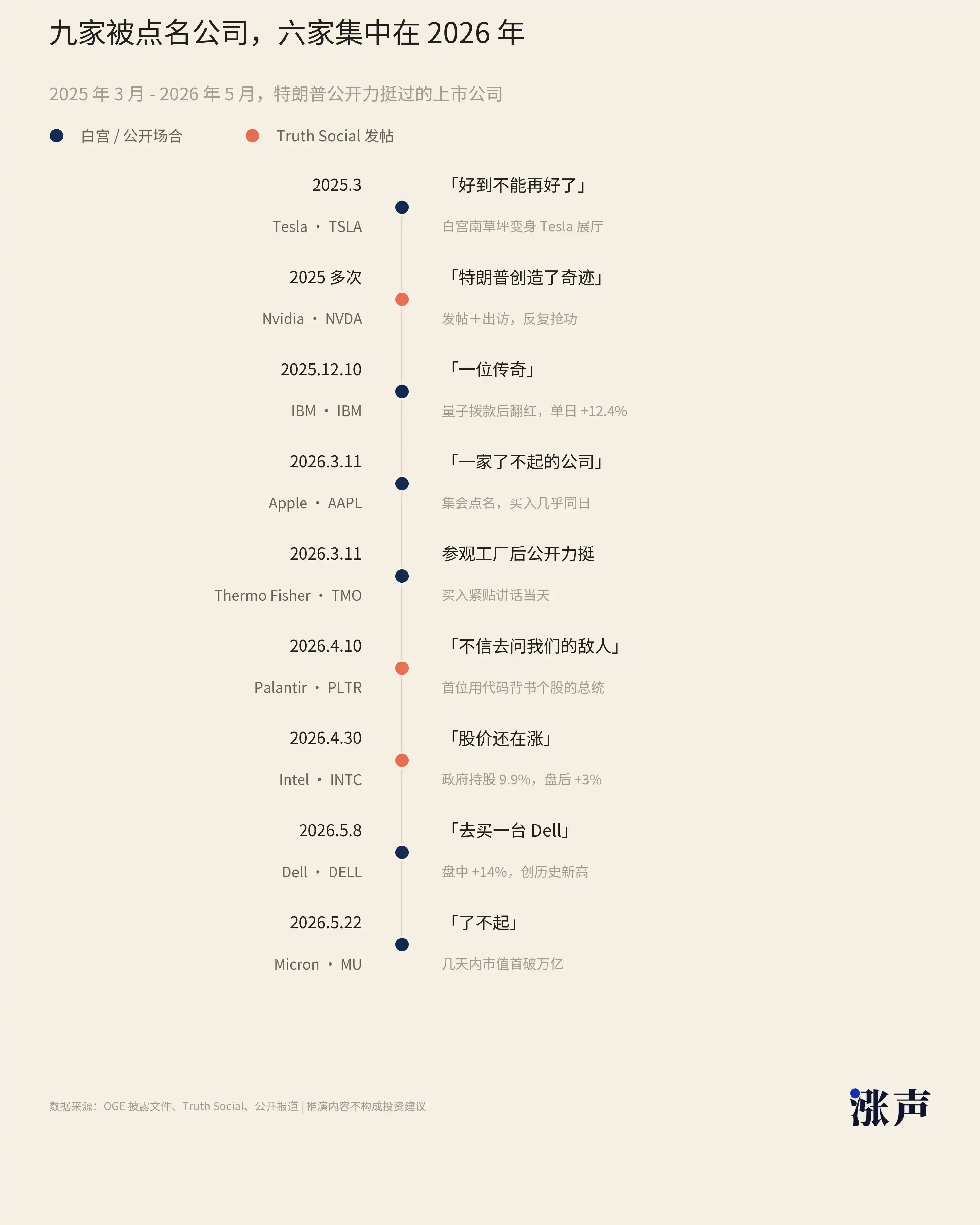
If we expand the scope from Trump's personal holdings to publicly listed companies he has publicly praised by name, the number far exceeds the few familiar tech giants. Based on statistics from public speeches, White House events, and Truth Social posts, Trump has explicitly praised at least 9 publicly listed companies over the past year or so, causing short-term stock price increases, including Intel, Dell, Micron, Palantir, IBM, Apple, Thermo Fisher Scientific, Tesla, and NVIDIA.

We've summarized some of their commonalities:

First and most obviously, they almost all fit the narratives of "AI/new tech," "U.S. leading manufacturing," and "reshoring of production capacity."

Industrially, they are highly concentrated in the AI computing power and semiconductor chain. Intel, Micron, NVIDIA, AMD are chips; Dell is computing hardware; IBM is quantum; Palantir is AI software.

Secondly, each named company has a direct interest lever that the government can pull. For example, Intel has 9.9% government ownership; Palantir is a major federal contractor; IBM and Intel received CHIPS Act grants; NVIDIA and AMD benefit from loosened export controls to China; Dell received a $9.7 billion Pentagon contract on May 27th, shortly after being praised. Apple was praised because it promised investment in the U.S. and iPhone glass production at its Kentucky factory; Intel and Micron are domestic fabs; Dell assembles AI servers in the U.S.; IBM has its quantum foundry in Albany; Tesla, on the day it was promoted, saw Musk promise on the spot to double U.S. production. Trump rarely praises purely overseas production; he praises the act of "moving production lines back to the U.S." itself.

To some extent, the narratives of these companies have been packaged and elevated into matters of "national security" and "competition with China." Chips are a bottleneck; quantum is cybersecurity. Of course, a prerequisite for being named is often the CEO first submitting a pledge of allegiance.
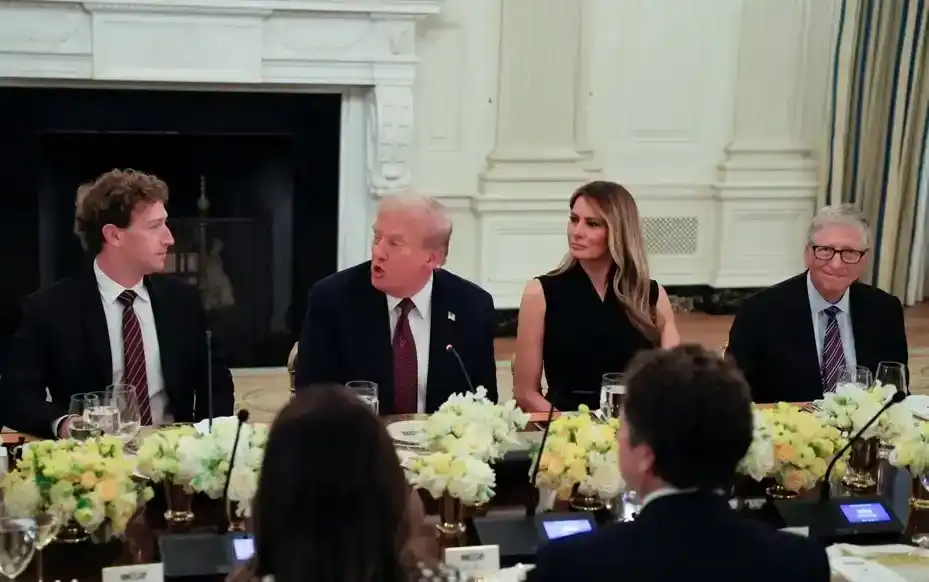
Trump hosting a dinner for tech giants after taking office last year, asking each about their investment amounts in the U.S.

All the positive factors are, first and foremost, "having the right connections." These CEOs generally publicly expressed support for Trump or have personal relationships with him.

Jensen Huang accompanied him on visits and publicly thanked him; the Dell family donated $6.25 billion to "Trump accounts"; Oracle's Larry Ellison is a long-time supporter, deeply involved in the Stargate and TikTok deals; Musk was an ally during the promotion period; Arvind Krishna was named in the room during a face-to-face meeting.

Although the White House's unified explanation is that the President's assets are held in a trust managed by his children, with independent third-party discretionary accounts, and Trump himself does not participate in specific trades, we can indeed observe that the timing of Trump's promotions overlaps with his personal holdings and trades.

For example, Palantir was intensively bought in March, and Trump named it on Truth Social a few weeks later; Dell was bought on February 10th ($1-5 million per month), and publicly promoted in May; Apple and Thermo Fisher were bought and publicly praised almost on the same day.

If these patterns are correct, then predicting Trump's next promotion isn't difficult.

Who Might Be the Next to Be Promoted

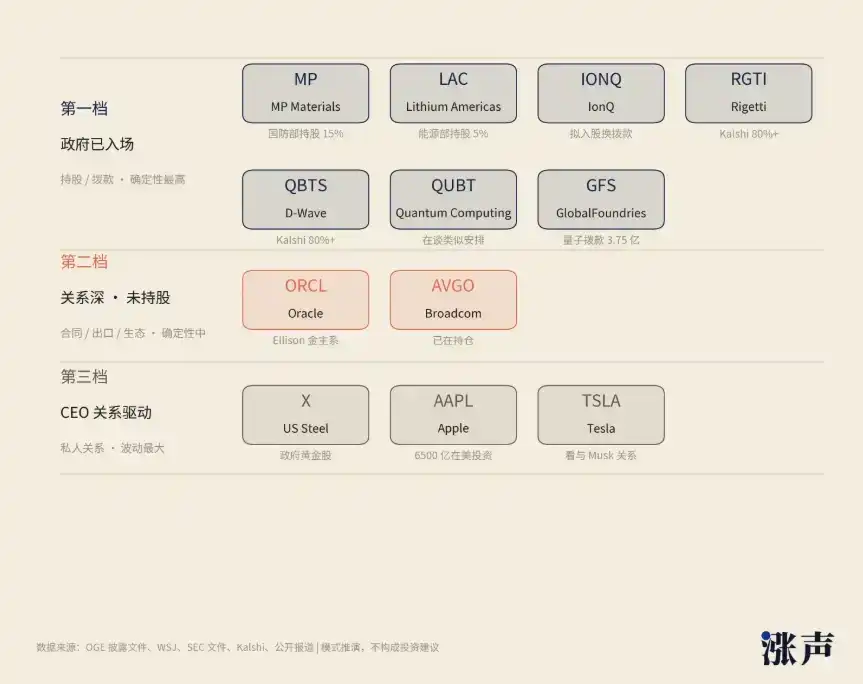
First and most likely are companies where the government has already taken a position: MP Materials (MP), Lithium Americas (LAC), IonQ (IONQ), Rigetti (RGTI), D-Wave (QBTS), etc.

MP Materials is currently one of the U.S.'s core rare earth magnet suppliers. Its main business is rare earth mining and separation processing, ultimately used to manufacture permanent magnets, which go directly into fighter jets, electric vehicles, and missile systems.

In other words, it's not just a "resource company" but a link in the defense supply chain.

In July 2025, the U.S. Department of Defense acquired approximately 15% equity and related arrangements, transforming it from an ordinary publicly listed company into a kind of "quasi-strategic asset." More crucially, this move occurred before the government's investment in Intel.

But an interesting point in the market is: compared to Intel being frequently discussed, MP is relatively low-key, and hasn't even been centrally named in political narratives. This state of being "already invested in but not yet narrated" itself constitutes a lag in pricing.

Lithium Americas is a typical lithium resource development company. Its core asset is the Thacker Pass lithium project in Nevada, USA, one of the largest known lithium resources in North America. The strategic significance of lithium needs no explanation: electric vehicles, battery storage, military energy systems all depend on it.

The U.S. Department of Energy indirectly holds approximately 5% equity through warrants and project structures and obtains about a 5% economic interest in the Thacker Pass project. Simultaneously, the project is tied to General Motors (GM), forming a tripartite structure of "government + industry + listed company."
More critically, the U.S. Department of Energy explicitly defined Thacker Pass as a "national security-level strategic lithium asset" in documents.

Furthermore, according to The Wall Street Journal, several companies including IonQ (IONQ), Rigetti (RGTI), and D-Wave (QBTS) are discussing obtaining at least $10 million-level grant support through "government equity stakes or quasi-equity arrangements." Quantum Computing (QUBT) and Atom Computing are also being considered under similar frameworks.

These quantum computing players are currently still in very early stages, but their peculiarity lies in the fact that they almost naturally belong to the intersection of national security and basic scientific research.

If we extend the timeline, the U.S. government previously initiated a roughly $20 billion quantum technology support program, with IBM receiving about $10 billion, GlobalFoundries (GFS) about $3.75 billion, and the remaining funds allocated to various labs and companies.

IBM has already been fully traded by the market for a round, and the next step will naturally go to more "pure" quantum plays. Notably, the market has already priced this ahead of him. On Kalshi, in the market betting on "which companies the government will invest in this year," the probability for Rigetti and D-Wave has already been bet to over 80%.

GlobalFoundries (GFS) deserves special mention. It both received that $3.75 billion quantum grant and is itself a U.S. domestic fab, fitting both the chip and domestic manufacturing narratives, making it the most suitable company to be incidentally named at a "Made in America Chips" event.

Apart from companies where the government has already taken a position, there are also some that perfectly fit structurally and have deep enough government ties but haven't yet received explicit equity that are worth mentioning.

However, this category is more likely to be named through contracts, exports, or ecosystem support, potentially less direct than previous promotions.

Oracle (ORCL) might be the best positioned among them. Ellison's personal relationship, Stargate, the TikTok deal, and existing holdings in his personal account—all the soft conditions are in place, just waiting for a formal verbal endorsement. Broadcom (AVGO) is similar, a core supplier of custom AI chips and data center construction, already in the holdings.

Besides these, there are companies driven by CEO personal relationships. The U.S. Steel (X) line is worth separate attention. In the Nippon Steel acquisition case, the government obtained a "golden share" stronger than ordinary equity, and the "protect American steel" narrative can be reused at any time. Apple, although already promoted, has a $650 billion U.S. investment promise that is material that can be reused repeatedly, so the probability of being promoted again is not low. Tesla depends on the degree of repair in his relationship with Musk, making it the most volatile item on this list.

It should be noted that the above is a pattern extrapolation based on publicly disclosed industrial policies and equity stake clues, not a deterministic prediction, and certainly does not constitute any investment advice. These targets themselves carry high political premiums, and political premiums are always double-edged. They can push stock prices up after a post, but can also compress valuations when the wind changes direction.

After all, relying solely on the "White House Stock God" to promote stocks makes price increases very fragile.


Preguntas relacionadas

QAccording to the article, what is the average number of stock trades President Trump executed per trading day in Q1 of the reported year, and why did it attract Wall Street's attention?

AAccording to the article, President Trump executed an average of approximately 58 stock trades per trading day in Q1, totaling 3,642 trades. This frequency itself surpassed that of most professional fund managers. However, what truly drew Wall Street's focus was the increasing overlap between the companies he publicly praised, his personal stock holdings, government industrial policies, and the flow of federal funds, suggesting a potential pattern beyond mere coincidence.

QWhat are the three main common characteristics shared by the companies publicly praised by Trump, as summarized in the article?

AThe article summarizes three main common characteristics of the companies Trump praised: 1) Their narratives align with 'AI & New Tech,' 'U.S. Leading Manufacturing,' and 'Production Reshoring.' 2) Each company has a direct interface where government interests can be applied, such as receiving CHIPS Act grants, government contracts, export license approvals, or commitments to U.S. investment. 3) Their CEOs generally have demonstrated public support or personal connections with Trump, having offered what the article terms 'pledges of allegiance' or investments.

QUsing the pattern identified in the article, which category of companies is most likely to be Trump's next 'stock tip' target, and name two specific examples mentioned.

ABased on the pattern identified, companies where the U.S. government has already taken an equity stake or similar financial interest are the most likely category to be Trump's next 'stock tip' target. Two specific examples mentioned are MP Materials (MP), a rare earths supplier where the Defense Department acquired ~15% interest, and Lithium Americas (LAC), a lithium developer where the Department of Energy holds an indirect ~5% stake and economic interest.

QBesides companies with direct government stakes, what other type of company might be named by Trump, and which company is cited as the best candidate due to its 'soft conditions'?

ABesides companies with direct government stakes, companies that perfectly fit the strategic narrative and have deep government ties, even without an explicit equity stake, might also be named. The article cites Oracle (ORCL) as the best candidate in this category due to its 'soft conditions' being fully in place: CEO Larry Ellison's personal relationship with Trump, involvement in projects like Stargate and the TikTok deal, and Trump's existing personal holdings in the company.

QWhat cautionary note does the article provide regarding investments based on the 'presidential stock tip' phenomenon?

AThe article cautions that investments based on this phenomenon carry high 'political premium,' which is a double-edged sword. This premium can push stock prices up following a public endorsement but can also compress valuations just as quickly if the political winds change. It concludes that stock gains relying solely on 'White House stock god' tips are inherently fragile.

Lecturas Relacionadas

ETH Bull and Bear Views Compilation: Can Ethereum's Value Flow Back to ETH?

Titled "ETH Bull and Bear Views: Can Ethereum's Value Flow Back to ETH?", this article synthesizes the current heated debate around Ethereum's native token, ETH, following Bankless co-founder David Hoffman's decision to sell his entire ETH holdings. The **bullish case**, represented by figures like Tom Lee (BitMine CEO) and Raoul Pal, argues that ETH's core thesis remains intact. They contend Ethereum is the essential, secure, and neutral foundational layer for future finance—encompassing stablecoins, RWA, DeFi, L2s, and Agentic AI. Bulls bet on ETH's long-term revaluation as institutional adoption of on-chain finance grows, with significant buying activity from entities like BitMine and Consensys cited as evidence. Conversely, the **bearish perspective**, led by Hoffman and analysts like Markus Thielen, questions ETH's value capture mechanism. They acknowledge Ethereum's network success but argue that the value created by L2s, DeFi, and applications does not sufficiently accrue to the ETH token itself. Bears point to ETH's prolonged underperformance versus the broader crypto market, lack of traditional cash flows, weakening "ultrasound money" narrative, and apparent institutional retreat (e.g., Harvard Management Company exiting its ETH ETF position) as key concerns. The debate highlights a pivotal shift: ETH is no longer just a community belief asset. The central question is whether ETH can transition from being a "**used infrastructure**" to a "**continuously bought and held core asset**" as more value enters the Ethereum ecosystem. The market is now critically examining the direct link between network growth and ETH's value.

marsbitHace 42 min(s)

ETH Bull and Bear Views Compilation: Can Ethereum's Value Flow Back to ETH?

marsbitHace 42 min(s)

Crypto is dead, Perps are forever

The crypto industry is shifting from a focus on creating native assets (like altcoins and protocol tokens) to becoming a "global asset pipeline." Native cryptocurrencies, except for Bitcoin, are seen as failing in their value storage and utility promises, with demand driven largely by speculation. Attention and liquidity are now moving toward real-world assets (RWAs) like U.S. stocks, bonds, gold, and oil traded on-chain via perpetual contracts (Perps). Stablecoins like USDT and USDC set the precedent, proving blockchain's core strength is efficient global settlement and transfer, not inventing new monetary systems. Meanwhile, assets like Ethereum and many DeFi tokens struggle as their narratives weaken against tangible traditional assets and the rapid real-world progress of AI. Perpetual contracts have emerged as a pivotal innovation. They simplify trading by offering pure price exposure to any asset, bypassing complexities of ownership, custody, and traditional market hours. Projects like Hyperliquid gained traction by combining CEX-like efficiency with on-chain transparency, capitalizing on post-FTX distrust, macroeconomic volatility, and the surge in demand for 24/7 stock trading. In conclusion, while the era of speculative native "crypto assets" may be over, perpetual contracts persist as the industry's most potent financial instrument—transforming all assets into globally accessible, constantly tradable instruments centered on price speculation.

marsbitHace 48 min(s)

Crypto is dead, Perps are forever

marsbitHace 48 min(s)

Tencent, Alibaba, ByteDance in a Battle for the Skill Store

Skill is becoming a key concept in the AI field, essentially serving as a structured "instruction manual" for AI Agents that specifies tool calls, decision logic, and output standards. This allows Agents to execute predefined tasks. As the number of Skills grows, distribution platforms have emerged. Major tech companies are swiftly entering this space. In March, Tencent, Alibaba, and ByteDance launched Skill stores within their respective Agent platforms. Subsequently, players like Zhipu AI, Meituan, and Xiaohongshu joined the fray. This competition for the "Skill store" is fundamentally a battle for the AI-era user entry point; whoever controls distribution controls the users. While ByteDance's Coze has experimented with paid Skills, most platforms offer them for free. The real value lies not in the stores themselves but in using them to attract and retain users within an ecosystem, driving revenue from services like cloud computing, model calls, or advertising. The landscape features three main player types: 1) **Internet giants** (e.g., Alibaba, ByteDance, Tencent, Meituan), leveraging Skills to drive traffic and monetize through their broader ecosystems (cloud services, transactions, ads). 2) **Large model companies** (e.g., Zhipu AI, Moonshot AI), using Skill stores to increase user engagement and monetize model API calls. 3) **Content platforms** (e.g., Xiaohongshu), treating Skills as a new content format to generate traffic and ad revenue. However, transforming Skill stores into a sustainable business faces significant hurdles. Key challenges include: the **difficulty in pricing Skills** due to inconsistent outputs across different models and contexts; **lack of cost transparency** (varying token consumption); **security risks** like Skill poisoning; and the **absence of standardized protocols** for development and evaluation. Unlike standardized mobile apps, Skills are often personalized workflows resistant to uniformity, which hinders the establishment of a reliable review and monetization system akin to the App Store. While there is genuine user demand for paid Skills—particularly in enterprise (e.g., contract review) and certain personal productivity scenarios—current platforms offer developers limited and unpredictable distribution. The future of Skill stores depends on overcoming these standardization, evaluation, and safety challenges to make acquiring a Skill as straightforward as downloading an app. For now, the stores function more as display shelves than robust marketplaces.

marsbitHace 48 min(s)

Tencent, Alibaba, ByteDance in a Battle for the Skill Store

marsbitHace 48 min(s)

The Crypto Scene Is Dead, Perpetual Swaps Are Eternal

The crypto industry is undergoing a fundamental shift. The era defined by minting novel, native digital assets (altcoins) is fading. These assets, lacking real-world cash flows or clear value, are losing relevance as attention and capital flow elsewhere. Two powerful external forces are reshaping the space. First, traditional assets like U.S. stocks, bonds, gold, and oil are being tokenized and traded on-chain. Second, the explosive growth of AI, with its tangible products, has overshadowed crypto's once-dominant "future narrative." This marks a critical pivot: crypto is transitioning from being a "factory for new assets" to becoming a "global conduit for existing assets." Its validated utility is not complex financial reinvention but efficient global settlement, transfer, and trading—the original promise of blockchain. Stablecoins like USDT and USDC exemplify this, offering faster dollar movement rather than replacing it. Consequently, native ecosystems like Ethereum face profound challenges. While still crucial infrastructure, ETH struggles to capture value as users interact with Layer 2s or trade traditional assets without needing to hold it. DeFi's grand narrative of rebuilding finance has narrowed to core needs like cheap transfers and deep liquidity. The true breakout innovation is the perpetual contract (Perp). It brilliantly bypasses the complexities of direct asset ownership (custody, compliance, dividends) by creating pure price exposure. Users can speculate on the price movement of *any* asset—NVIDIA, gold, oil—24/7, globally, and with leverage. This "price casino" model, while risky and ethically fraught, delivers unmatched liquidity and accessibility. Projects like Hyperliquid succeeded not by inventing new mechanics but by perfecting the timing and execution of this model. Key drivers included making on-chain Perps feel like centralized exchanges, post-FTX trust migration towards transparency, and rising demand to trade macro assets and equities round-the-clock. In conclusion, the crypto world's most enduring successes are the dollar (via stablecoins), Bitcoin, and trading. Its new frontier is not creating alternative assets but providing a seamless, perpetual trading layer—a new API—for the world's existing financial system. The age of native altcoins is over; the age of perpetual synthetic exposure has begun.

Odaily星球日报Hace 57 min(s)

The Crypto Scene Is Dead, Perpetual Swaps Are Eternal

Odaily星球日报Hace 57 min(s)

Trading

Spot
Futuros
活动图片